by Sarah Whitfield
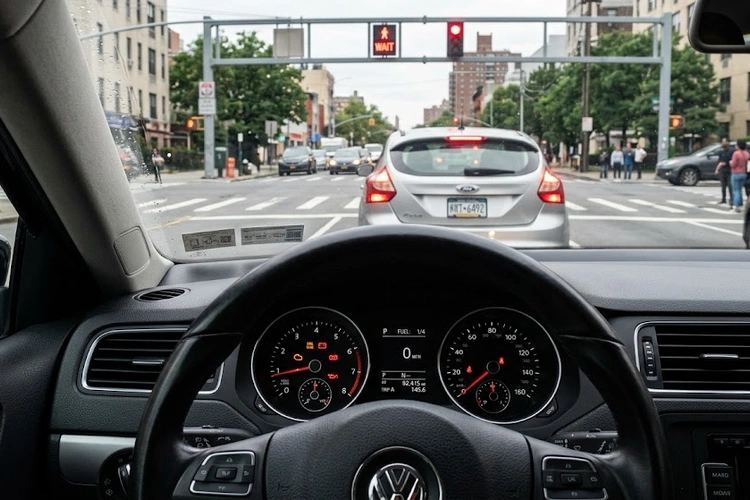
Nearly one in five unexpected roadside breakdowns involve stalling — and a disproportionate number happen right at a red light, where the engine drops to idle and suddenly has to survive on its own. When a car stalls at a traffic light, it's almost never random. Something specific in the idle system, fuel delivery, or sensor network is failing, and the red light is simply where it shows up first. This guide covers the 7 most common causes, how to diagnose each one, and what the fix actually involves — from a $10 cleaning job to a transmission specialist. For a broader look at engine and driveability problems, the troubleshooting section covers it all. Drivers also dealing with acceleration issues should check out engine stalls when accelerating — it shares several of the same root causes.
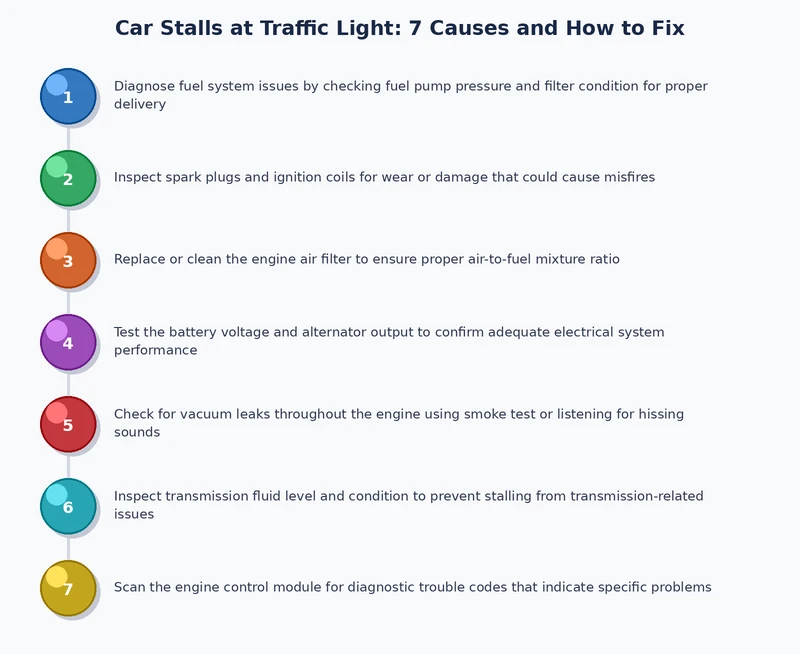
Contents
When a car is moving, engine RPM stays elevated — anywhere from 1,500 to 3,000 RPM depending on speed and load. At a red light, the engine drops to idle, typically between 600 and 900 RPM for most gas-powered vehicles. At that low RPM, there's almost no margin for error. A slightly lean fuel mixture, a minor vacuum leak, or a sticky idle control valve that would go completely unnoticed at highway speed can be enough to kill the engine entirely.
That's why stalling is such a specific symptom. The car runs fine on the highway, fine in a parking lot — but the moment it hits a red light and the throttle closes all the way, it dies. The problem was always there; the red light just exposed it.
The experience of stalling differs by transmission type:
This guide focuses on mechanical causes. On manual cars, rule out driver error first, then work through the diagnostic checklist below.
| Cause | Typical Symptoms | DIY-Friendly? | Estimated Cost |
|---|---|---|---|
| Faulty IAC Valve | Rough idle, RPM hunting up and down | Yes | $10–$100 |
| Dirty or Failing MAF Sensor | Poor fuel economy, check engine light | Yes | $10–$150 |
| Vacuum Leak | High or erratic idle, hissing noise | Partial | $5–$200 |
| Low Fuel Pressure / Dirty Injectors | Hard start, stalling after idling | Partial | $15–$500 |
| Bad Throttle Position Sensor (TPS) | Jerky acceleration, check engine light | Yes | $30–$100 |
| Torque Converter Lockup (auto only) | Stalls when slowing to a stop, shuddering | No | $150–$800 |
| Faulty EGR Valve | Rough idle, surging RPM, codes P0400–P0408 | Partial | $100–$300 |
Three of the seven causes are genuinely home-garage fixes with basic tools: cleaning the IAC valve, cleaning or replacing the MAF sensor, and swapping a bad TPS. The other four range from "doable with some experience" to "definitely needs a specialist." The dividing line is usually whether a smoke machine, fuel pressure gauge, or transmission expertise is required.
The IAC valve (idle air control valve) regulates how much air bypasses the throttle plate at idle. When it sticks or fails, the engine can't hold a stable RPM at low speeds — and it stalls when the throttle closes fully at a red light.
Symptoms:
Fix:
The mass airflow (MAF) sensor measures incoming air volume so the ECU (engine control unit, the car's main computer) can calculate the correct fuel amount. A dirty or failing MAF sends inaccurate readings, producing a rich or lean fuel mixture that makes the engine stumble and stall at idle.
Symptoms:
Fix:
A lean fuel mixture is one of the most common outcomes of a failing MAF. The full guide to the P0171 lean fuel code breaks down exactly what that means and how to trace it step by step.
The engine's intake manifold runs at lower pressure than surrounding air — this is called engine vacuum. Cracks in hoses, loose connections, or failed intake gaskets let unmetered air into the engine, throwing off the air-fuel ratio and destabilizing the idle.
Symptoms:
Fix:
Vacuum leaks can also reduce brake booster effectiveness since both share vacuum supply. If the brake pedal feels unusually stiff alongside the stalling, check for brake booster failure symptoms — the two problems sometimes share a common vacuum hose.
The engine needs consistent, pressurized fuel delivery to idle properly. A weak fuel pump, clogged fuel filter, or dirty injectors can starve the engine at low RPM — when fuel demand is low but consistency is critical.
Symptoms:
Fix:
The TPS tells the ECU exactly where the throttle plate sits. When a driver releases the gas at a red light, the ECU uses that data to adjust fuel trim and maintain idle speed. A faulty TPS sends inaccurate signals — and the ECU can miscalculate badly enough to stall the engine entirely.
Symptoms:
Fix:
Any time stalling comes with a check engine light, the codes should be the first stop. Understanding what triggers a check engine light and how to read the codes can save a lot of guesswork.
In automatic transmissions, the torque converter acts as the clutch — allowing the engine to idle in gear without stalling. At highway speed, the torque converter clutch (TCC) locks up to improve fuel efficiency. It's designed to disengage completely before the car slows below about 25 MPH. When the TCC solenoid fails, it can keep the converter locked all the way to a full stop — which kills the engine exactly like pressing the brakes while in gear with a manual.
Symptoms:
Fix:
Shaking that accompanies the stalling is a common companion symptom. Read about why a car shakes when put in drive — the torque converter is frequently behind both.
The exhaust gas recirculation (EGR) valve routes a small portion of exhaust back into the intake manifold to reduce combustion temperatures and lower emissions. When the EGR valve sticks open at idle, exhaust gas floods the intake at exactly the wrong moment — diluting the air-fuel mixture and causing rough idle or outright stalling.
Symptoms:
Fix:
Warning: Never treat a car that stalls regularly at red lights as a minor inconvenience — stalling means an immediate loss of power steering and brake boost, which makes emergency maneuvers significantly harder in traffic.
These repairs require only basic tools and carry low risk of making things worse:
Some jobs require tools or expertise that most home garages simply don't have:
The clearest signal to go straight to a shop: the car won't hold idle at all, or it stalls with no warning in the middle of traffic. Intermittent stalling that's becoming more frequent is also a shop-now situation — it won't resolve on its own.
Most idle problems are preventable. These are the maintenance items most directly tied to stable idle performance:
Don't wait for a complete stall. These symptoms appear earlier in the problem's development:
Bad fuel is rarely the actual culprit. While heavily contaminated fuel can cause stalling, it's uncommon at reputable stations. Blaming the gas is a common instinct when a fill-up happened recently — but the real cause is almost always a mechanical or sensor issue that was already developing before the stop. Don't let this assumption delay a proper diagnosis.
A single stalling event at a red light isn't a fluke — it's a symptom. Intermittent problems are harder to diagnose as they progress, and they always progress. The right response to one stall is a diagnostic scan and an inspection, not wishful thinking that it won't happen again.
This surprises a lot of drivers. Automatic transmissions include a torque converter that normally handles the clutch function — but when the torque converter clutch solenoid fails, the car absolutely can and will stall at a stop. That's why torque converter lockup makes this list. It's a real and common failure mode in automatic vehicles.
A stalling engine isn't a dying engine. In the vast majority of cases, stalling traces back to a sensor, valve, or maintenance issue that costs a few hundred dollars or less to fix. There's no reason to assume a full engine rebuild or replacement — just a methodical diagnosis starting with the most accessible causes first.
At highway speed, the engine runs at 2,000 RPM or higher, which gives plenty of margin to mask idle system problems. At a red light, RPM drops to 600–900, where even a minor vacuum leak, sticky IAC valve, or lean fuel mixture becomes severe enough to kill the engine. The highway hides the problem; the red light exposes it.
Yes. Carbon buildup around the throttle plate restricts airflow at idle, which can drop RPM low enough to stall the engine. Throttle body cleaning is one of the most effective and least expensive fixes for stalling — and one of the most commonly overlooked maintenance items.
Occasional stalling warrants immediate diagnosis but may not require stopping all driving. Frequent or unpredictable stalling in traffic is a genuine safety hazard — when the engine dies, power steering assist and brake boost are lost simultaneously, making emergency maneuvers much harder. Get it diagnosed before driving in heavy or high-speed traffic.
It depends heavily on the cause. Cleaning the IAC valve or MAF sensor costs $10–$30 in supplies. Replacing a TPS runs $30–$100 for the part. Fuel pump replacement ranges from $150–$500. Torque converter solenoid work is the most expensive at $300–$800 including labor. Most stalling problems land in the $50–$300 total range.
Not always. IAC valve problems and vacuum leaks frequently stall the engine without setting a diagnostic code. Sensor failures — MAF, TPS, EGR — are more likely to trigger a code. Running a scan is always the right first step, but a clean result doesn't rule out a mechanical problem.
Severely depleted oil can cause internal engine damage that affects idle stability, but being one or two quarts low on oil doesn't directly cause stalling. If oil pressure drops dangerously, the ECU may trigger a protective shutdown — but stalling due to oil level is rare compared to the idle system and sensor causes covered in this guide.
The clearest indicator is RPM instability at idle — the tachometer needle hunts up and down rather than holding steady. Stalling specifically when coming to a stop (not during acceleration or cruising) is another strong sign. Since cleaning the IAC valve is low-cost and low-risk, it's a logical first step even without a definitive test result.
A car that stalls at a traffic light isn't broken beyond repair — it's asking for the specific attention that idle systems need to keep running reliably for another hundred thousand miles.
 |
 |
 |
 |

About Sarah Whitfield
Sarah Whitfield is a diagnostics and troubleshooting specialist who spent ten years as an ASE-certified technician before joining the editorial team. She specializes in OBD-II analysis, electrical gremlins, and the kind of intermittent problems that make most owners give up.
Get some FREE car parts & gear.. Or check out the latest free automotive manuals and build guides here.
Disable your ad blocker to unlock all the hidden deals. Hit the button below 🚗
| | | |
