Car Stalls in Cold Weather: Causes & How to Fix

by Sarah Whitfield

Cold weather is responsible for more than 7 million vehicle breakdowns in North America every year, and engine stalling ranks among the most disruptive failures a driver can experience. A car stalls in cold weather for a predictable set of reasons — most of which are diagnosable and correctable without a trip to the dealership. The primary culprits include weakened batteries, restricted fuel delivery, fouled idle control components, and failed temperature sensors. Understanding these causes protects drivers from being stranded in dangerous conditions and from paying for repairs that never address the actual problem.

Cold-induced stalling frequently presents alongside engine misfire symptoms, making accurate diagnosis essential before purchasing replacement parts. Rough idle, hesitation, and sudden engine cutout can all trace back to five distinct root causes, each requiring a different repair approach. This guide examines every major cause, outlines the diagnostic tools required, details preventive maintenance steps, and provides a full repair cost breakdown so drivers can make informed decisions.
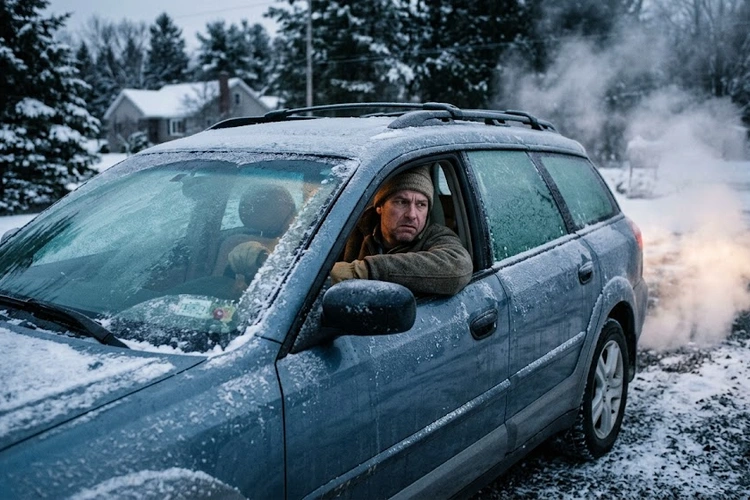
Car stalls in cold weather due to a weak battery and restricted fuel delivery
Figure 1 — Cold temperatures weaken batteries, thicken engine oil, and disrupt fuel atomization — creating ideal conditions for stalling.
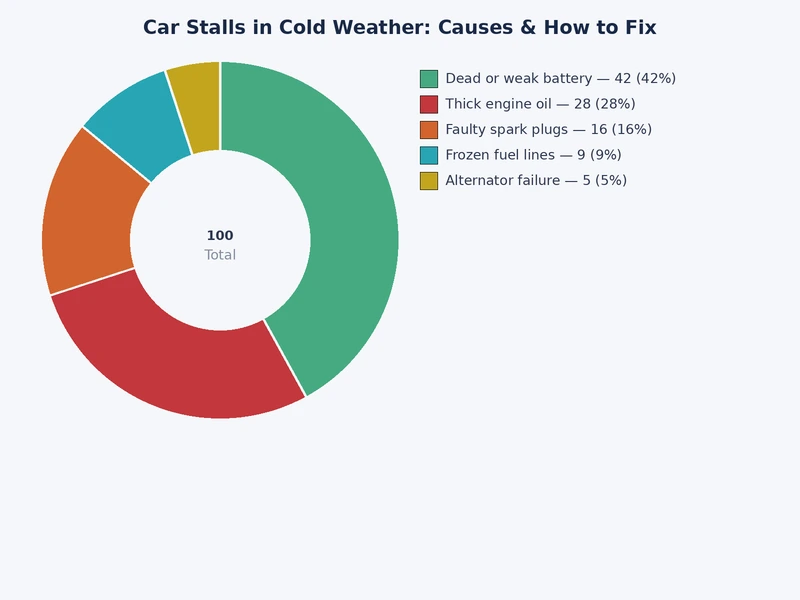
Bar chart showing frequency of cold-weather car stall causes by component
Figure 2 — Relative frequency of cold-weather stall causes, from most common (battery and idle control) to least common (fuel pump failure).

Why a Car Stalls in Cold Weather

Cold temperatures affect virtually every system in a modern vehicle simultaneously. Engine oil thickens, increasing mechanical resistance on the crankshaft. Battery chemistry slows, reducing the current available to fuel injectors and ignition coils. Metal components contract, tightening tolerances the engine depends on during the first minutes of operation. When multiple systems are degraded at the same time — which cold weather reliably causes — the margin between a successful cold start and a stall narrows to near zero.

Fuel System Failures

The fuel system is the most frequent culprit when a car stalls in cold weather. Three failure modes account for the majority of fuel-related cold stalls:

  • Fuel injector deposits — Cold temperatures cause fuel to atomize (break into fine droplets for efficient combustion) less effectively. Deposits on dirty injectors worsen this effect, producing a lean fuel mixture (too much air, not enough fuel) that cannot sustain combustion at low idle speeds.
  • Moisture in the fuel line — Water vapor enters the fuel tank during temperature fluctuations and can freeze inside fuel lines, blocking delivery entirely. This failure is most common in vehicles driven consistently with a low fuel level, as condensation has more surface area to accumulate.
  • Failed cold-start enrichment — Modern fuel-injected engines use sensor data to add extra fuel during cold starts — a process called cold-start enrichment. A faulty coolant temperature sensor (CTS) or mass airflow sensor (MAF) can prevent this enrichment cycle from activating, causing the engine to stall within seconds of startup before the oil pressure has fully stabilized.

Vehicles that run roughly in cold or damp conditions often share overlapping causes with moisture-related ignition problems. The engine runs rough after rain guide covers the moisture and ignition angle in detail, as spark plug fouling and vacuum leaks produce nearly identical stalling symptoms under both wet and cold conditions.

Battery and Electrical Faults

A weak battery is the single most predictable cause of cold-weather vehicle failure. The electrochemical reaction inside a lead-acid battery slows dramatically in low temperatures, reducing the battery's ability to deliver high current on demand.

  • At 0°F (−18°C), a lead-acid battery can lose as much as 60% of its rated cranking power, as documented in the automotive battery reference maintained by Wikipedia.
  • A battery that delivers insufficient voltage during cranking may successfully start the engine but then fail to maintain the voltage required by fuel injectors and engine sensors, causing an immediate post-start stall.
  • Corroded battery terminals add electrical resistance to an already-stressed circuit. Even a small voltage drop across a corroded terminal compounds the effects of cold-induced power loss.
  • An aging alternator that undercharges the battery overnight leaves the vehicle in a weakened state at every cold start — and the problem compounds each morning.

Idle Air Control Valve and Throttle Body Problems

The idle air control valve (IACV) regulates engine idle speed by metering airflow around the throttle plate. In cold weather, the engine demands a significantly higher idle speed — typically 1,000 to 1,500 RPM rather than the warm idle of 600 to 800 RPM — to compensate for thickened oil and the increased electrical load of the heater, rear defroster, and headlights.

A dirty IACV cannot supply the extra airflow the cold engine requires. Carbon deposits accumulate on the valve seat and pintle over time, reducing its range of motion. When the engine demands maximum airflow on a cold start, a fouled valve delivers insufficient air, the mixture goes momentarily rich, and the engine stalls before the idle stabilizes. This failure mode is especially common on vehicles with 50,000 or more miles that have never had the throttle body serviced.

A carbon-coated throttle body — the component governing the main airflow path into the engine — produces a similar restriction. Deposits accumulate along the throttle plate edges and form a partial seal that prevents the engine from establishing stable idle. Cleaning both components together at the same service interval is the most cost-effective approach.

Diagnosing Cold-Weather Stalls

Accurate diagnosis prevents unnecessary parts replacement. Most cold-weather stall causes leave fault codes in the engine control unit (ECU) or produce measurable symptoms with basic equipment. The critical rule: perform diagnostics while the engine is cold. Many codes and symptoms disappear once the engine reaches operating temperature, eliminating the diagnostic trail entirely.

Essential Diagnostic Tools

The following tools are necessary to properly diagnose a car that stalls in cold weather:

  • OBD-II scanner — Reads fault codes stored by the ECU. Many auto parts retailers offer free code reading, though a personal scanner allows for immediate capture right after a cold-start stall, before codes clear on warmup.
  • Digital multimeter — Tests battery resting voltage (12.6V fully charged), alternator output (13.5 to 14.5V at idle), and coolant temperature sensor resistance values to confirm sensor accuracy.
  • Fuel pressure gauge — Connects to the Schrader valve on the fuel rail and confirms fuel delivery pressure at cold start. Most port-injected systems require 35 to 65 PSI; direct-injected systems require significantly higher pressures.
  • Battery load tester — Applies a controlled electrical load and measures voltage drop under real-world stress. This test reveals hidden battery weakness that a simple resting-voltage check will miss entirely.
  • Throttle body cleaner spray — Functions as a diagnostic tool as well as a cleaning product. Spraying it into the intake while the engine idles reveals whether a restriction in airflow is causing the instability.

Reading OBD-II Fault Codes

Specific fault codes appear consistently in cold-weather stall cases and point directly to the responsible component. Retrieve codes while the engine is still cold for the most accurate picture:

  • P0171 / P0174 — Fuel system running lean. Caused by a failing MAF sensor, vacuum leaks that expand in cold air, or restricted fuel delivery pressure.
  • P0128 — Coolant temperature below thermostat regulating temperature. Indicates a thermostat stuck in the open position, which prevents the engine from reaching operating temperature and disrupts cold-start fuel enrichment.
  • P0300 — Random misfire detected. Cold-induced misfires are a frequent companion to stalling events. The complete diagnostic approach for this code is covered in the P0300 random misfire code guide, which includes cold-specific misfire patterns.
  • P0505 — Idle control system malfunction. This code identifies the IACV as the direct cause of idle instability and confirms that airflow management is the stall trigger.

Always scan for fault codes immediately after a cold-start stall, while the engine is still cold. Certain codes are cold-condition-specific and will clear automatically once the engine reaches operating temperature, erasing the only diagnostic record of what caused the failure.

Preventive Maintenance That Stops Cold-Weather Stalls

The large majority of cold-weather stalling is preventable with a consistent maintenance schedule. The components most vulnerable to cold-weather failure — the battery, spark plugs, throttle body, and fuel system — are also among the most accessible and least expensive to service.

Pre-Winter Preparation Checklist

Complete the following inspections before temperatures drop:

  1. Load-test the battery — Any battery over three years old requires a load test, not just a voltage measurement. Replace any battery testing below 70% of its rated cold cranking amps (CCA). A battery at 65% CCA functions adequately in summer and fails completely at 20°F.
  2. Inspect and replace spark plugs — Worn plugs require significantly higher voltage to fire in cold, dense air. Replace at the manufacturer's specified interval, or earlier if electrode gap measurement exceeds specification by more than 0.005 inches.
  3. Clean the throttle body and IACV — Use throttle body cleaner and a lint-free cloth. This 20-minute service eliminates the carbon deposits responsible for a significant percentage of cold-idle stall cases, and costs under $15 in supplies.
  4. Test the coolant temperature sensor — Measure resistance at a known coolant temperature and compare to the manufacturer's specification chart. A failed CTS prevents cold-start enrichment and is one of the least expensive sensor replacements on most platforms ($15 to $50 for the part).
  5. Add a quality fuel system cleaner — One bottle per 3,000 to 5,000 miles removes injector deposits that impair fuel atomization in cold air. This is a preventive measure, not a cure for severe deposit buildup.
  6. Replace the fuel filter if overdue — A clogged filter restricts fuel flow under the elevated demand of a cold start. Most manufacturers recommend replacement every 30,000 miles, though the interval varies significantly by vehicle.

Year-Round Habits

Preventive maintenance is not exclusively a seasonal concern. The following practices reduce cold-weather vulnerability throughout the year:

  • Allow the engine to idle for 30 to 60 seconds before applying load in extreme cold. This allows oil pressure to build and fuel delivery to stabilize before the drivetrain is engaged.
  • Avoid driving with a fuel level below one-quarter tank during winter. Low fuel levels increase moisture contamination risk and reduce fuel pump cooling, shortening pump life.
  • Keep battery terminals clean and free of corrosion. A paste of baking soda and water neutralizes terminal buildup in minutes and meaningfully reduces circuit resistance.
  • Address stumbling or hesitation symptoms before they worsen. A vehicle that hesitates at highway speeds is already signaling early fuel or ignition system problems — the same problems that become stall-inducing failures in cold weather.

What Cold-Weather Repairs Actually Cost

Repair costs for a car that stalls in cold weather range from under $15 for a DIY throttle body cleaning to over $650 for a professional fuel pump replacement. The spectrum is wide, which makes accurate diagnosis the highest-value first investment in the repair process. Spending $60 on an OBD-II scanner that confirms a $30 IACV replacement is the correct fix — rather than replacing a battery, MAF sensor, and fuel filter through trial and error — represents a significant net saving.

Cost Breakdown by Component

Component / Repair DIY Part Cost Professional Total Difficulty
Throttle body / IACV cleaning $8–$15 $80–$150 Easy
Battery replacement $80–$200 $150–$300 Easy
Spark plug replacement $20–$80 $100–$300 Easy–Moderate
Thermostat replacement $15–$50 $100–$250 Easy–Moderate
Fuel filter replacement $15–$50 $80–$175 Easy–Moderate
Coolant temperature sensor $15–$50 $100–$200 Moderate
Idle air control valve replacement $30–$100 $150–$400 Moderate
MAF sensor replacement $50–$150 $150–$350 Moderate
Fuel pump replacement $100–$300 $350–$650 Difficult

DIY vs. Professional Repair

Several of these repairs fall comfortably within the skill range of a competent home mechanic:

  • Recommended for DIY: Throttle body and IACV cleaning, battery replacement, spark plug replacement, external fuel filter replacement, thermostat replacement on most inline four-cylinder engines, coolant temperature sensor replacement.
  • Best left to professionals: Fuel pump replacement (requires dropping the fuel tank on the majority of vehicles), IACV replacement on engines where the component is deeply recessed, MAF sensor replacement on turbocharged systems where inlet plumbing must be disassembled and re-torqued to specification.

Professional diagnostic fees — typically $100 to $150 per hour — are warranted when multiple cold-start codes appear simultaneously, as the interaction between a failing sensor and a weak battery can produce misleading symptom patterns. A shop with an oscilloscope and live-data capabilities can isolate complex sensor failures in minutes that a consumer scanner will misidentify.

Step-by-Step: How to Fix a Car That Stalls in Cold Weather

A systematic approach resolves cold-weather stalling faster and at lower cost than random parts replacement. The sequence below is ordered from lowest-cost to highest-cost intervention, ensuring that the most accessible fixes are confirmed or ruled out before advancing to more expensive repairs.

Immediate Steps After a Stall

  1. Move the vehicle off active traffic lanes to a safe location before attempting any diagnosis.
  2. Turn off all electrical accessories — heater blower, rear defroster, headlights — to reduce load on a potentially weakened battery before the next restart attempt.
  3. Wait 5 to 10 minutes. This allows fuel pressure to rebuild in the fuel rail and the starter motor to cool if it was cranked repeatedly.
  4. Attempt a restart with a single, steady crank. Do not pump the accelerator pedal on a fuel-injected engine — doing so signals the ECU to reduce fuel delivery and worsens a lean-start condition.
  5. Connect an OBD-II scanner immediately upon restarting and record all stored and pending fault codes before the engine reaches operating temperature.
  6. Check resting battery voltage with a multimeter. A reading below 12.4V on a battery that has been sitting for 30 minutes indicates the battery is either undercharged or failing under normal conditions.

Systematic Diagnosis and Repair

Work through the following sequence in order. Each step eliminates the most common, lowest-cost causes before advancing to more expensive interventions:

  1. Confirm the battery and charging system first. A weak battery masks every other electrical and sensor-related problem by introducing erratic voltage that causes false sensor readings. Confirm the battery passes a load test and the alternator produces 13.5 to 14.5V at idle before moving to any other diagnosis.
  2. Clean the throttle body and IACV. This single step resolves a significant percentage of cold-weather stall cases. Total cost is under $15 in supplies, requires no special tools beyond a flathead screwdriver and throttle body cleaner, and takes approximately 20 minutes on most vehicles.
  3. Inspect and replace spark plugs. Pull one plug from each cylinder bank and examine the electrode condition. Black, sooty deposits indicate a persistent rich mixture; chalky white deposits indicate lean running. Either condition destabilizes cold-start combustion and worsens stalling risk.
  4. Test fuel pressure at cold start. Connect a gauge to the fuel rail Schrader valve before cranking. Pressure that drops significantly below the manufacturer's specification — or that bleeds down rapidly after shutdown — points to a failing fuel pump or pressure regulator, not a sensor issue.
  5. Test and replace the coolant temperature sensor. If lean codes (P0171/P0174) or code P0128 accompany the cold-weather stalls, measure CTS resistance at a known temperature and compare to the factory chart. A failed CTS is one of the most cost-effective repairs in the entire cold-stall diagnostic tree and is frequently overlooked in favor of more expensive components.
  6. Replace the fuel filter, then the fuel pump if pressure remains low. After confirming that the battery, ignition system, and sensors are all functioning correctly, persistent low fuel pressure with no related sensor codes points firmly to a mechanical fuel delivery failure that requires component replacement.

Frequently Asked Questions

Why does a car stall in cold weather but run fine once the engine warms up?

Cold-start enrichment, idle speed control, and battery performance all normalize as the engine approaches operating temperature. Components such as a dirty idle air control valve or a failing coolant temperature sensor only expose their weakness during the brief window — typically the first 2 to 5 minutes — when the engine demands elevated airflow and additional fuel. Once the engine warms, those elevated demands decrease, the component's deficiency becomes invisible, and the problem resets to repeat at the next cold start.

How long should a vehicle warm up before driving in cold weather?

Modern fuel-injected engines require only 30 to 60 seconds of idle time before gentle driving in most cold conditions. Extended idling beyond two minutes wastes fuel and does not significantly accelerate engine warm-up — the engine actually reaches operating temperature faster under light driving load than it does sitting at idle. The one exception is temperatures below 0°F (−18°C), where allowing at least 60 seconds for oil to circulate before applying throttle reduces wear on cold bearing surfaces.

Can a bad thermostat cause a car to stall in cold weather?

A thermostat stuck in the open position prevents the engine from ever reaching normal operating temperature. The engine control unit interprets the persistent low coolant temperature as an extended cold-start condition and continues cold-start fuel enrichment far beyond its intended duration. This produces an increasingly rich mixture that fouls spark plugs, destabilizes idle, and in severe cases causes a stall. Fault code P0128 confirms this failure mode directly, and thermostat replacement is one of the lowest-cost repairs in the cold-weather stall diagnostic process.

Key Takeaways

  • A car stalls in cold weather due to five primary causes: fuel system restrictions, weakened batteries, dirty idle air control valves and throttle bodies, failed temperature sensors, and worn spark plugs — each requiring a different repair approach.
  • Pre-winter maintenance — specifically battery load testing, throttle body cleaning, spark plug inspection, and coolant temperature sensor verification — prevents the majority of cold-start stall events before they occur.
  • Repair costs range from under $15 for a DIY throttle body cleaning to over $650 for a professional fuel pump replacement, making an OBD-II scanner the highest-value first purchase in the diagnostic process.
  • Systematic diagnosis following the battery-first sequence eliminates the most accessible causes before advancing to expensive component replacements, consistently producing faster and cheaper resolutions than random parts substitution.

About Sarah Whitfield

Sarah Whitfield is a diagnostics and troubleshooting specialist who spent ten years as an ASE-certified technician before joining the editorial team. She specializes in OBD-II analysis, electrical gremlins, and the kind of intermittent problems that make most owners give up.

Get some FREE car parts & gear.. Or check out the latest free automotive manuals and build guides here.

Disable your ad blocker to unlock all the hidden deals. Hit the button below 🚗