by Sarah Whitfield
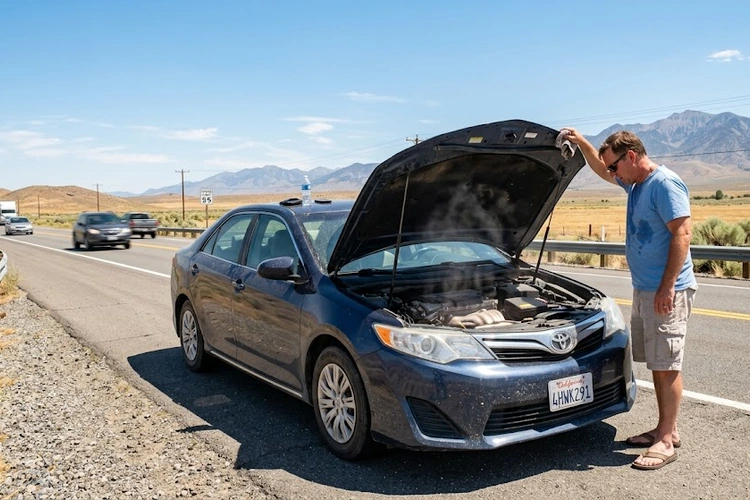
Car stalls in hot weather because heat pushes weak components — fuel pumps, sensors, and ignition coils — past their operating limits. The car frequently restarts once things cool down, which fools most drivers into thinking the problem resolved itself. It has not.
Hot-weather stalling follows predictable patterns, and each cause leaves behind specific clues that narrow the diagnosis quickly. Drivers who already suspect something in the fuel system are usually on the right track — heat amplifies every underlying fuel delivery weakness, and fuel-related causes account for at least half of all hot-weather stall events. This guide covers all seven causes with clear diagnostic steps and repair guidance.
Contents
Most hot-weather stalls fit into three distinct real-world scenarios, and recognizing which one applies cuts diagnostic time significantly.
Underhood temperatures in summer can exceed 200°F even when outside air sits at a relatively modest 90°F, because the engine generates its own heat and the closed hood traps it. Fuel in uninsulated lines near the exhaust can approach boiling temperature, coolant runs near its design limit, and electronic sensors that function fine in winter start to drift outside their calibrated range. All of these stressors hit simultaneously — and whichever component is weakest fails first.
Vapor lock occurs when fuel inside the lines vaporizes before reaching the injectors or carburetor, starving the engine of liquid fuel. The condition is most common in older vehicles with return-less fuel systems and in any vehicle where heat-damaged line insulation allows fuel to absorb excessive heat from adjacent exhaust components.
When coolant temperature climbs into the danger zone, the ECU (engine control unit) may cut fuel or spark to prevent catastrophic engine damage — which presents as a sudden, clean stall rather than a gradual power loss. A leaking or collapsed coolant hose is one of the fastest ways to lose cooling capacity in summer, and the failure often goes unnoticed until the engine is already struggling.
Heat is the primary cause of electric fuel pump failure. The motor inside the pump weakens over time, and running consistently on a low fuel level accelerates the process — the fuel itself cools and lubricates the pump motor, and an empty tank removes that protection entirely. The symptoms of deteriorating fuel delivery closely mirror those described in low fuel pressure diagnostics: hesitation, surging, and sudden cutout under load.
The crankshaft position sensor (CKP) provides the ECU with real-time data on engine rotation — without it, the ECU cannot determine ignition timing or fuel injection timing, and the engine dies immediately. Some CKP sensors develop heat-related intermittent failures, working perfectly when cold and failing completely when hot, which makes them especially difficult to catch on a cold diagnostic scan.
A contaminated MAF (mass airflow) sensor sends inaccurate air mass readings to the ECU, causing it to miscalculate the fuel mixture. Running lean — too little fuel for the amount of air — in high ambient heat creates rough idle, hesitation, and eventual stall. A stored P0174 lean code alongside a hot-weather stall is a strong indicator that the MAF sensor is the culprit.
Carbon and varnish deposits accumulate inside injectors over time, and heat causes those deposits to swell and harden, further restricting the spray pattern. The engine runs progressively leaner, misfires under load, and eventually stalls — particularly in hot, slow traffic where the engine has time to heat soak without the cooling effect of highway airflow.
Ignition coil insulation breaks down through repeated heat cycling, and once it does, the coil can no longer produce a consistent high-voltage spark — causing misfires and stall, most often on the hottest days. The failure is typically intermittent at first, which leads many drivers to dismiss early symptoms as minor before the coil fails completely.
Most hot-weather stall causes can be narrowed down at home with basic tools, though some repairs require professional equipment to complete properly.
| Cause | DIY Difficulty | Minimum Tool Needed | Typical Repair Cost |
|---|---|---|---|
| Vapor lock | Moderate | None to diagnose | $50–$200 |
| Overheating | Easy | Coolant test strip | $20–$500+ |
| Fuel pump | Moderate | Fuel pressure gauge | $200–$600 |
| CKP sensor | Easy–Moderate | OBD-II scanner | $50–$250 |
| MAF sensor | Easy | MAF cleaner spray | $10–$150 |
| Fuel injectors | Hard | Professional equipment | $100–$500 |
| Ignition coil | Easy | OBD-II scanner | $30–$150 |
MAF sensor cleaning, CKP sensor swaps, and ignition coil replacements are straightforward jobs that any home mechanic with basic hand tools and a code reader can handle. These three causes account for a large share of intermittent hot-weather stalls and cost very little to diagnose and repair independently.
Fuel injector cleaning and in-tank fuel pump replacement benefit from professional equipment and lift access. Overheating diagnosis — particularly if it involves a head gasket — should not be attempted without proper pressure testing tools and experience reading the results.
If the temperature gauge is climbing into the red zone, pull over immediately and shut the engine off. Driving an overheating engine even a short distance can warp the cylinder head and turn a minor repair into a major rebuild.
In these cases, restarting and driving slowly to a nearby safe location is acceptable — but the underlying cause still needs diagnosis, and the stall will return under similar conditions.
A hot-weather stall that allows a cold restart is not a self-correcting problem — it is a component that has reached its thermal failure threshold and recovered temporarily. The threshold will be reached again under identical conditions, and the failure will eventually become permanent rather than intermittent.
Fuel grade has no meaningful effect on vapor lock. Vapor lock is caused by heat reaching the fuel lines, not by the fuel's octane rating. The fix is thermal insulation and proper fuel line routing — not a more expensive fuel grade.
Turning off the AC reduces load on the engine slightly, but if a fuel pump is failing or a CKP sensor is at its thermal limit, removing the AC load will not prevent the stall. It may delay it by a few minutes. Address the root cause rather than compensating for it by driving without climate control.
This is the classic signature of a heat-sensitive component failure — most commonly a failing fuel pump, a faulty crankshaft position sensor, or vapor lock in the fuel lines. The component reaches its thermal failure threshold when hot and recovers enough function when cool to allow a restart. The problem will worsen over time until the component fails permanently.
Yes. A thermostat stuck in the closed position prevents coolant from flowing through the radiator, causing the engine to overheat rapidly. When coolant temperature climbs dangerously high, the ECU cuts power to protect the engine, which causes an immediate stall. A stuck thermostat is one of the faster-developing overheating failures.
Vapor lock primarily affects older carbureted or early fuel-injected vehicles with return-less fuel systems and uninsulated lines routed near heat sources. Modern returnless direct-injection systems are far less susceptible because fuel circulates constantly and line routing is better managed from the factory. However, any vehicle with damaged or missing fuel line insulation near exhaust components can experience vapor lock.
The clearest indicator is a whining or buzzing noise from the fuel tank area that appears or worsens when the engine is hot. Stalls specifically under heavy acceleration or going uphill — when the pump is working hardest — also point toward a heat-related pump failure. A fuel pressure gauge test performed immediately after a hot stall (before it cools) can confirm low pressure.
A contaminated MAF sensor will not destroy an engine immediately, but running lean consistently accelerates wear on valves, pistons, and catalytic converter substrate. The bigger concern is that a lean-running engine under hot conditions increases the risk of detonation (engine knock), which does cause direct mechanical damage over time. Cleaning or replacing the MAF sensor is inexpensive insurance.
Indirectly, yes. The AC compressor adds roughly 5–10 horsepower of load on the engine, which increases heat output and fuel demand. If a weak fuel pump or failing ignition coil is already near its limit, the additional AC load can push it into failure. The AC is not the root cause — it is the factor that exposes an already-marginal component.
A minimum of 15 to 20 minutes is the practical baseline, with longer waits producing better results for severe vapor lock. For fuel pump failures, waiting longer does not help much — the pump needs replacement, not cooling time. If the car does not restart after 30 minutes, further cranking is unlikely to succeed and professional assistance is appropriate.
It depends on the cause and the vehicle's warranty status. Fuel pump failure, crankshaft position sensor failure, and ignition coil failure are all powertrain components typically covered under a factory powertrain warranty while it is active. Vapor lock caused by aftermarket fuel line damage or deferred maintenance would generally not be covered. Owners should document the stall conditions and have the vehicle inspected by a dealer while the fault is active.
Hot-weather stalling is a solvable problem — the key is diagnosing the specific cause rather than waiting for the car to fail completely. Start with the simplest checks: scan for codes, test fuel pressure while the engine is hot, and inspect the coolant system before the next summer heat wave arrives. A qualified mechanic can confirm a heat-sensitive CKP sensor or fuel pump failure in a single diagnostic session, and repairing those components now costs a fraction of what a broken-down tow and emergency repair will run later.
 |
 |
 |
 |

About Sarah Whitfield
Sarah Whitfield is a diagnostics and troubleshooting specialist who spent ten years as an ASE-certified technician before joining the editorial team. She specializes in OBD-II analysis, electrical gremlins, and the kind of intermittent problems that make most owners give up.
Get some FREE car parts & gear.. Or check out the latest free automotive manuals and build guides here.
Disable your ad blocker to unlock all the hidden deals. Hit the button below 🚗
| | | |
