by Sarah Whitfield
A car that stalls when turning is almost always dealing with an engine that cannot sustain idle under added load — and turning is one of the few everyday inputs that applies exactly that kind of pressure. The power steering system draws extra demand, fuel sloshes away from the pump pickup, and the idle control circuit must compensate in milliseconds. When any of these systems are already degraded, the engine cannot recover and shuts down.
This guide covers the six most documented causes behind a car stalls when turning scenario, how to test each one systematically, realistic repair costs, and which fixes fall within DIY range. For overlapping failure modes where the engine quits without warning, the Car Starts Then Dies guide covers the broader stalling picture in detail.
Contents
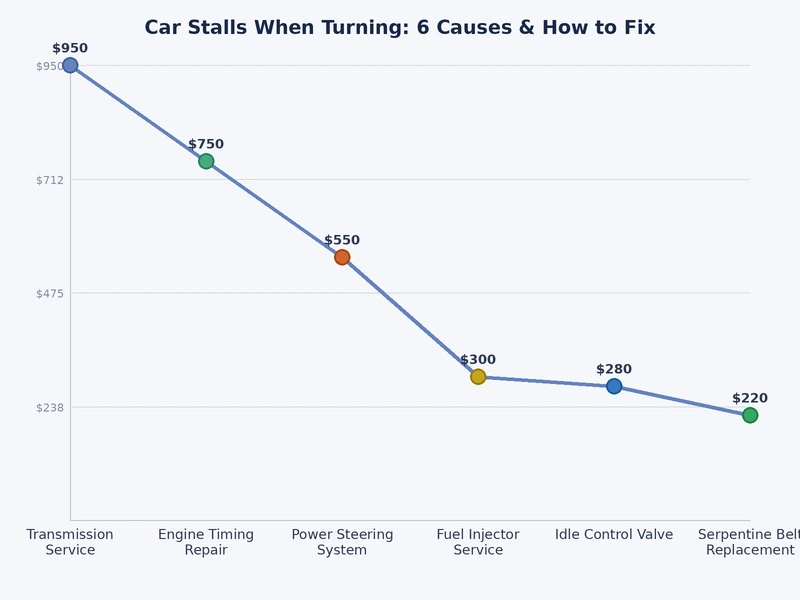
Each of the six causes below exploits the same vulnerability: an engine running at minimum output with no margin to absorb added demand. Turning amplifies that demand through mechanical load, fuel delivery interruption, or sensor signal disruption. The cause determines the fix — and confusing them leads to expensive parts replacements that solve nothing.
The idle air control (IAC) valve meters the air bypassing the throttle plate at idle. When it sticks, clogs with carbon, or fails electronically, idle RPM drops below the margin needed to absorb additional load. Engaging the power steering, turning on the AC, or cranking the wheel hard at low speed can push RPM below the stall threshold.
A rough or inconsistent idle that worsens when accessories activate is the clearest indicator. The Idle Speed Too High guide covers the same circuit from the opposite failure direction — a useful reference for understanding how idle compensation is supposed to behave under load.
A weakened fuel pump or failing fuel pressure regulator cannot maintain steady pressure during the transient load of a turning maneuver. Fuel slosh inside the tank — particularly when the tank is below one-quarter full — can momentarily starve the pump inlet. The engine leans out, misfires, then stalls. A clogged fuel filter produces the same outcome by restricting flow before it even reaches the pump.
Testing fuel pressure with a rail-mounted gauge is the most direct diagnostic step. According to Wikipedia's overview of fuel injection systems, port-injected engines typically operate between 40 and 60 psi at idle. A pressure drop exceeding 5 psi under simulated load confirms a delivery fault. The Fuel Pressure Regulator Symptoms guide provides a complete testing procedure.
Hydraulic power steering pumps are belt-driven accessories. As internal seals and vanes wear, the pump's resistance increases. At idle — when the engine is producing minimum torque — a struggling pump can steal enough rotational energy to drag RPM below the stall point. The effect is most pronounced when the wheel is held at or near full lock, which maximizes hydraulic demand.
The intake vacuum system on a modern engine controls the brake booster, IAC bypass, MAP sensor signal, EGR valve, and multiple emissions components. A cracked hose or failed intake manifold gasket introduces unmetered air that leans out the fuel mixture. At idle, the ECU partially compensates through fuel trim adjustments — but during a turn, the additional load overwhelms that compensation and the engine stalls.
Automatic transmissions use a torque converter clutch (TCC) to mechanically couple the engine to the transmission output shaft at cruise speeds, improving fuel efficiency. If the TCC solenoid fails to disengage when the vehicle decelerates into a turn, the engine remains mechanically locked to a slowing drivetrain. The result is an abrupt stall — indistinguishable from engine failure to most drivers.
The crankshaft position sensor (CKP) provides the ECU with real-time data on engine rotation speed and cylinder position. Without it, the ECU cannot time fuel injection or ignition. A failing sensor produces intermittent signal dropouts — often triggered by vibration or heat — and when the dropout occurs mid-turn, the engine shuts down instantly with no warning or sputtering.
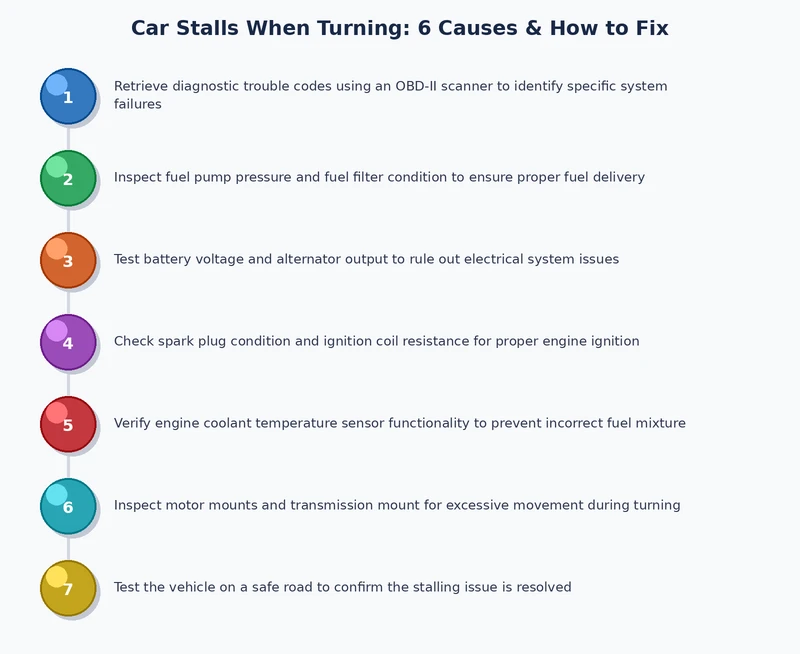
Systematic diagnosis saves money. Replacing parts by guess — starting with the most expensive and working down — is the costliest approach. The sequence below moves from free observations to tool-assisted testing, narrowing the field at each step.
Pro tip: Holding the wheel at full lock while stationary is the single fastest isolation test for power steering pump load — if RPM drops sharply only during that maneuver, start with the pump fluid level and IAC cleaning before ordering any parts.
The table below summarizes distinguishing characteristics, primary diagnostic method, and DIY accessibility for each cause. Use it to match the observed symptom pattern to the most probable cause before committing to any repair.
| Cause | Stall Type | Key Symptom | Primary Diagnostic | DIY Accessible? |
|---|---|---|---|---|
| IAC Valve / Low Idle | Gradual RPM drop | RPM sags when wheel turns or AC activates | Observe idle RPM under accessory load | Yes — cleaning is straightforward |
| Fuel Pump / Regulator | Gradual or sudden | Worsens with low fuel tank; hard acceleration | Fuel pressure gauge on rail | Moderate — filter easy; pump requires tank drop |
| Power Steering Pump | Gradual RPM drop | Whine at full lock; stall during parking | Full-lock RPM test; fluid check | Fluid check yes; pump replacement no |
| Vacuum Leak | Gradual or hunting | Erratic idle; hissing sound | Carb cleaner spray or smoke machine | Hoses yes; manifold gasket moderate |
| Torque Converter TCC | Sudden shutdown | Stall when decelerating into turns | OBD-II scan; P0740–P0744 codes | No — requires transmission tooling |
| Crankshaft Position Sensor | Instant complete shutdown | No warning; may restart after cooling | OBD-II scan; oscilloscope waveform | Yes — single sensor, one connector |
Every cause listed above develops gradually. Consistent maintenance intercepts the degradation before it becomes a roadside failure. These are not optional suggestions — they are the specific intervals and checks that address the root conditions of each cause.
Costs below reflect typical independent shop pricing in the United States. Dealership rates run 20–40% higher. Geographic variation and vehicle make can shift these ranges significantly — European and luxury vehicles typically cost more for both parts and labor.
The correct choice is not purely about skill level. Some repairs require specialized equipment that no amount of experience can substitute. Others are genuinely straightforward for anyone with basic tools and a willingness to follow a procedure.
Experience level should dictate the starting point, not the ending point. Beginners who attempt oscilloscope waveform analysis before checking the power steering fluid level waste time and risk misidentifying symptoms. Experienced mechanics who skip live data monitoring miss intermittent faults that never set a code.
Vehicles that shake or vibrate through the steering wheel during the turn preceding a stall may have a compounding suspension issue. The Car Shakes When Turning guide covers how steering geometry and component wear interact with engine response during cornering.
Low-speed turns place the maximum demand on the power steering pump and require the idle control system to compensate for the additional load. At higher speeds, engine RPM is already elevated enough that the extra demand does not push it below the stall threshold. If stalling only occurs at slow speeds or while parking, the IAC valve, power steering pump, or a marginally low idle is the most likely cause.
Yes. Hydraulic power steering pumps are belt-driven and draw torque directly from the engine. A worn pump with increased internal resistance can draw enough power at idle to cause a stall, particularly when the wheel is held at full lock. Vehicles with electric power steering cannot stall for this reason.
Immediate restart after a stall usually indicates a momentary signal dropout or brief fuel pressure collapse rather than a complete component failure. Crankshaft position sensor dropouts and TCC solenoid sticking are common causes of instant-restart stalls. A stall that requires cool-down time before restarting suggests a heat-sensitive sensor failure.
Yes, in vehicles with automatic transmissions. A failing torque converter clutch solenoid can prevent the TCC from disengaging when the car decelerates into a turn. The engine remains mechanically coupled to the slowing drivetrain and stalls. This is one of the most commonly misdiagnosed causes because it feels identical to an engine problem rather than a transmission fault.
A vacuum leak causes the engine to run lean and reduces its ability to compensate for additional load. At idle, the ECU adjusts fuel trim to partially mask the lean condition. When the steering input adds load, the margin disappears and the engine stalls. Fixing the vacuum leak — not compensating with richer fueling — is the correct repair.
Cost depends entirely on the root cause. A throttle body and IAC cleaning costs $80–$200 at a shop and frequently resolves the issue. A fuel pump replacement runs $400–$900. Torque converter clutch repair is the most expensive at $500 or more depending on the extent of transmission work required. Starting with a proper diagnosis avoids paying for repairs that do not address the actual failure.
No. A stall during a turn disables power steering assist and may disable power braking simultaneously, requiring significantly more physical effort to steer and stop. At any speed above parking pace, an unexpected stall during a turn creates a genuine collision risk. The vehicle should be diagnosed and repaired before regular use.
 |
 |
 |
 |

About Sarah Whitfield
Sarah Whitfield is a diagnostics and troubleshooting specialist who spent ten years as an ASE-certified technician before joining the editorial team. She specializes in OBD-II analysis, electrical gremlins, and the kind of intermittent problems that make most owners give up.
Get some FREE car parts & gear.. Or check out the latest free automotive manuals and build guides here.
Disable your ad blocker to unlock all the hidden deals. Hit the button below 🚗
| | | |
