by Sarah Whitfield
Does your engine make a ticking noise on cold mornings — then go quiet once it warms up? That question alone tells you something important. When a car ticks when cold start conditions hit — below 40°F, after sitting overnight, or following a long cool-down — the cause ranges from harmless thermal physics to a failing component that demands immediate attention.
Seven documented causes account for nearly all cold start engine ticks. The engine category covers the full spectrum of related symptoms. This guide breaks down each cause, maps the noise to a diagnosis, and tells you exactly what to inspect first.

Contents
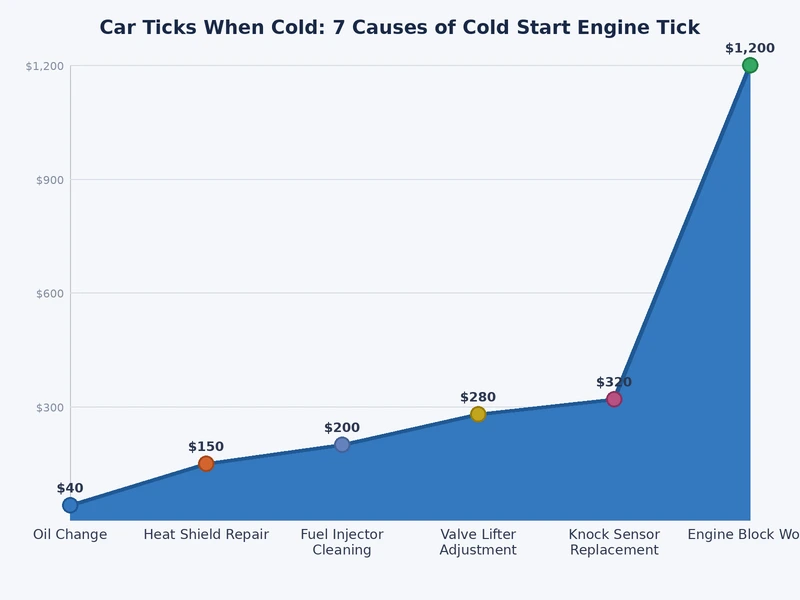
According to Wikipedia's overview of engine knocking, mechanical noise sources inside an engine often share acoustic signatures, making precise localization critical to an accurate diagnosis. Here are the seven causes behind the majority of cold start ticks.
Cold oil is thick. At low temperatures, motor oil takes several seconds to circulate from the oil pan to upper engine components — including valve lifters and camshaft bearings. During that window, metal runs with minimal lubrication and produces a light, rapid tick.
If the tick lasts longer than a minute, check your oil level immediately. A slow leak can quietly drop your oil to unsafe levels — a situation covered in detail in our guide on oil leaks after an oil change.
Hydraulic valve lifters (HVLs) are oil-filled cylinders that control valve timing. When they wear or accumulate sludge, they don't fill with oil fast enough after a cold start. The result is a hollow, rhythmic ticking from the top of the engine.
Using oil that's too thick for your climate makes lifter tick significantly worse. Always match viscosity to your manufacturer's specification for the lowest expected temperature in your region.
A stretched timing chain or a failing hydraulic tensioner produces a rattle at cold start. The tensioner relies on oil pressure to maintain chain tension — and those first seconds of low pressure let the chain slap the guide.
A cracked exhaust manifold or a failed gasket ticks sharply at cold start, then often goes quiet as the engine reaches operating temperature. Heat causes the metal to expand and the crack to temporarily seal — a classic disappearing-noise pattern.
Worn piston rings allow combustion pressure to escape past the ring seal, producing a low hollow knock or tick on cold start. Carbon deposits on piston tops can also tap against cylinder walls until the engine reaches full operating temperature. Our detailed breakdown of bad piston ring symptoms covers the full range of warning signs, including oil consumption and blue smoke.
A loose, fouled, or cracked spark plug can produce a ticking sound because combustion gases escape around the plug threads or through a damaged insulator. The sound comes from the cylinder head and often intensifies under acceleration. Spark plug fouling is a closely related issue that can accompany or accelerate plug seating failure.
Not every cold start tick signals a problem. Metal components contract in cold temperatures and expand as they heat. This thermal cycling produces light ticking or tapping during the first minute of operation — particularly noticeable in aluminum engines, which are standard on most modern vehicles.
The most useful diagnostic variable isn't the sound itself — it's how the tick behaves as your engine warms. Duration and change in intensity are your primary clues.
| Symptom Pattern | Most Likely Cause | Action Required |
|---|---|---|
| Tick fades in under 60 seconds | Thermal expansion, brief oil pressure lag | Monitor — no immediate action needed |
| Tick lasts 1–5 minutes | Hydraulic lifter delay, incorrect oil viscosity | Check oil level and spec; consider oil change |
| Tick never goes away | Timing chain, piston rings, exhaust manifold | Diagnose now — don't delay |
| Tick worsens under load or acceleration | Piston ring or bearing wear | Urgent — limit driving, inspect immediately |
| Tick + blue smoke on startup | Worn piston rings or valve seals | Urgent — schedule full engine inspection |
| Tick + check engine light | Multiple possible causes | Scan OBD-II codes before driving further |
If you notice milky oil on your dipstick alongside a persistent cold start tick, treat it as a multi-system emergency. Coolant contaminating the oil points to a head gasket failure, which dramatically accelerates internal wear. A tick combined with an engine that also vibrates in neutral points to a broader mechanical condition requiring a full professional inspection.
You don't need a full shop to identify a cold start tick. A few targeted tools get you 90% of the way there before spending any money on parts or labor.
Basic tools (own or borrow these first):
Optional but useful:
Never rev a cold engine to speed up warm-up time. High RPMs under low oil pressure accelerate wear on the exact components most likely to cause cold start ticking in the first place.
A mechanic's stethoscope costs under $20 at most auto parts stores. Pressing the probe against the valve cover, timing cover, and exhaust manifold separately while the engine ticks locates the noise source before any disassembly — a significant time and money saver.
Work through this sequence before replacing parts or booking a shop appointment.
Some cold start tick causes are weekend-level fixes. Others require specialized tools and partial engine teardown. Knowing which category you're in prevents wasted effort.
Reasonable DIY repairs:
Professional service recommended:
| Repair | Avg. DIY Cost | Avg. Shop Cost |
|---|---|---|
| Oil change (viscosity correction) | $30–$60 | $60–$120 |
| Spark plug replacement | $20–$40 | $80–$150 |
| Exhaust manifold gasket | $25–$70 | $200–$600 |
| Hydraulic lifter replacement | Advanced DIY only | $500–$2,000+ |
| Timing chain kit | $100–$300 (parts) | $800–$2,500+ |
| Piston ring replacement | Not recommended | $1,500–$4,000+ |
If the tick is accompanied by performance loss, increased oil consumption, or abnormal smoke, the job belongs in a professional shop regardless of your skill level.
Misinformation about cold start engine ticks is widespread — and acting on it leads to either unnecessary repairs or ignored problems that worsen over time.
False. Thermal expansion ticking during the first 30–60 seconds is considered normal by most OEM engineers. The behavior as the engine warms — not the sound itself — is what separates harmless from harmful.
Partially true — but frequently counterproductive. A slightly higher viscosity can reduce noise on high-mileage engines, but deviating from your manufacturer's specification (for example, switching from 5W-30 to 10W-30) worsens cold start ticking in cold climates because thicker oil takes longer to reach upper engine components during those critical first seconds.
Not necessarily. A timing chain that rattles for 10 seconds every cold start is still a stretched timing chain progressing toward failure. An exhaust manifold crack that seals when hot is still cracked. Disappearing symptoms often mark progressive failures in their early — and cheapest to fix — stage.
This depends entirely on the cause. Thermal expansion ticking — yes, drive normally. A timing chain rattle or confirmed piston knock — no. Identifying your specific cause before making that call is the only responsible approach.
 |
 |
 |
 |

About Sarah Whitfield
Sarah Whitfield is a diagnostics and troubleshooting specialist who spent ten years as an ASE-certified technician before joining the editorial team. She specializes in OBD-II analysis, electrical gremlins, and the kind of intermittent problems that make most owners give up.
Get some FREE car parts & gear.. Or check out the latest free automotive manuals and build guides here.
Disable your ad blocker to unlock all the hidden deals. Hit the button below 🚗
| | | |
