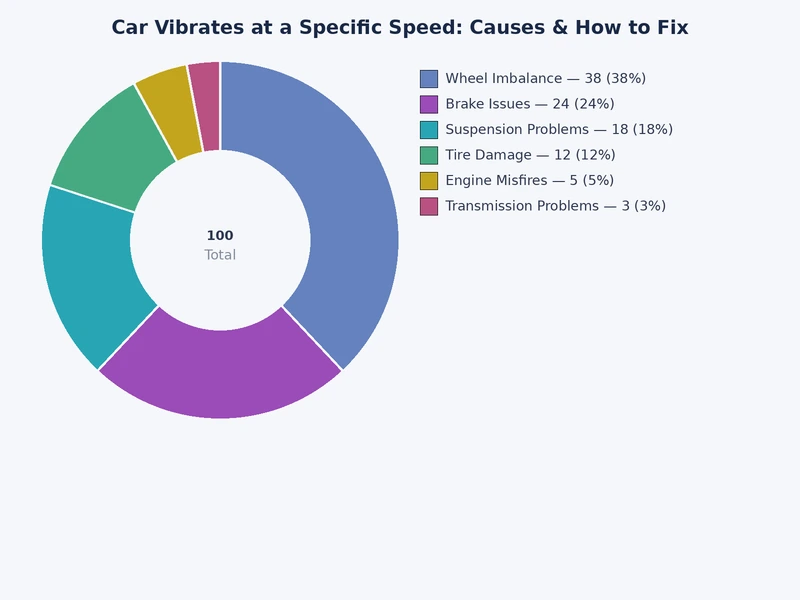
Car Vibrates at a Specific Speed: Causes & How to Fix

by Sarah Whitfield

Does your car ride smooth at every speed except one — and at that one speed it shakes hard enough to rattle your teeth? That's not a mystery; it's a diagnostic gift. When your car vibrates at a specific speed, the problem is almost always tied to a resonance point where an imbalance or worn component amplifies into something you can't ignore. The good news is that speed-specific vibration is one of the most diagnosable issues you'll face as a car owner, and the most common fixes are affordable and fast. This guide walks you through every major cause, a methodical step-by-step diagnosis, and the maintenance habits that keep the shaking from ever coming back.

Car steering wheel shaking due to vibration at a specific speed on the highway
Figure 1 — Speed-specific vibration originates at a resonance point where an imbalance or worn component amplifies at a precise wheel-rotation frequency.
Chart mapping common car vibration causes to specific speed ranges from 20 MPH to highway speeds
Figure 2 — Common causes of speed-specific vibration mapped by MPH range, location felt, and repair urgency.

Speed-Specific Vibration Patterns and What They Reveal

The speed at which your car shakes gives you the most useful clue you have. Different speed ranges correspond to different resonance frequencies, and each one implicates a different set of components. Before you spend money on anything, use this information to narrow your suspects.

Speed Range Most Likely Cause Where You Feel It Urgency
20–35 MPH Bent rim, severe tire flat spot Steering wheel, floorboard High — inspect immediately
40–55 MPH Tire imbalance, failing CV axle Steering wheel or seat Medium — fix within a week
55–75 MPH Wheel imbalance, driveshaft imbalance Whole cabin, seat, pedals Medium — address soon
Any speed under braking Warped rotors, uneven pad deposits Brake pedal, steering wheel High — safety-critical
Above 75 MPH Wheel alignment, driveshaft imbalance Whole car, pulls to one side Medium — check alignment soon

Vibration Between 20 and 45 MPH

Vibration that starts at low speed and fades as you push through it usually points to a bent rim or a severe flat spot in a tire — problems that manifest at lower resonance frequencies before the road smooths them out at higher speeds. You'll typically feel this vibration more in the steering wheel than in the seat, which suggests the front axle is the primary culprit. A CV axle that's beginning to fail can also produce a rhythmic shudder in this range, especially during light acceleration or gentle turns.

  • Bent rim: Look for a visible wobble when the wheel spins freely on a jack stand — even a small deformation creates significant vibration.
  • Flat-spotted tire: Common after hard braking events or extended periods of sitting stationary under load; the flat spot creates a rhythmic thump that lessens as the tire warms up.
  • Failing CV axle: Usually paired with a clicking or popping noise during turns; grease flung inside the wheel well is a reliable sign the CV boot has torn.

Vibration Between 55 and 75 MPH

This is the most common speed band where drivers notice that their car vibrates at a specific speed, and wheel imbalance is the number-one cause by a wide margin. When a wheel loses a balance weight — which happens regularly on rough roads and over potholes — the uneven mass creates a wobble that resonates most intensely at highway speeds. If the shaking peaks around 65 MPH and then settles as you push past 70, that resonance pattern is a textbook sign of an out-of-balance wheel. Driveshaft imbalance produces a similar feeling but pulses through the seat and floor rather than the steering wheel, and it's more pronounced in rear-wheel-drive and four-wheel-drive vehicles.

  • Wheel imbalance: Shaking concentrated in the steering wheel that changes in intensity as speed increases or decreases.
  • Driveshaft imbalance: Vibration felt through the seat and floorboards, often with a low frequency hum; U-joint wear is a common companion symptom.
  • Worn wheel bearings: Produces a humming or growling noise alongside the vibration that grows louder when you change lanes and load one side of the axle.

Vibration That Appears Only Under Braking

If your car shakes exclusively when you press the brake pedal — regardless of the speed you're traveling — warped brake rotors are almost certainly the cause. Rotors develop uneven thickness over time through repeated heat cycling and uneven pad material deposits, so when you apply the brakes, the pads grab those thicker spots and create a pulsing sensation you feel in both the pedal and the steering wheel. Understanding how to break in new brake pads properly after your next brake job prevents the uneven deposits that lead to this problem recurring on fresh rotors.

Pro tip: If your brake pedal pulses under your foot but your steering wheel stays completely steady, the warped rotor is almost certainly in the rear — front rotor problems almost always transfer vibration forward through the steering column.

How to Diagnose Why Your Car Vibrates at a Specific Speed

Diagnosing speed-specific vibration is methodical work, and the method matters because it saves you money. You start with the cheapest and most common causes, confirm whether they're resolved, and work toward the more expensive ones only when the basics check out clean.
What You'll Need

  • A floor jack and a set of jack stands rated for your vehicle's weight
  • A torque wrench capable of reaching 80–100 ft-lbs for lug nut confirmation
  • A tire pressure gauge and a flashlight for visual inspections
  • Access to a tire shop for spin balancing — this step can't be done at home with standard tools
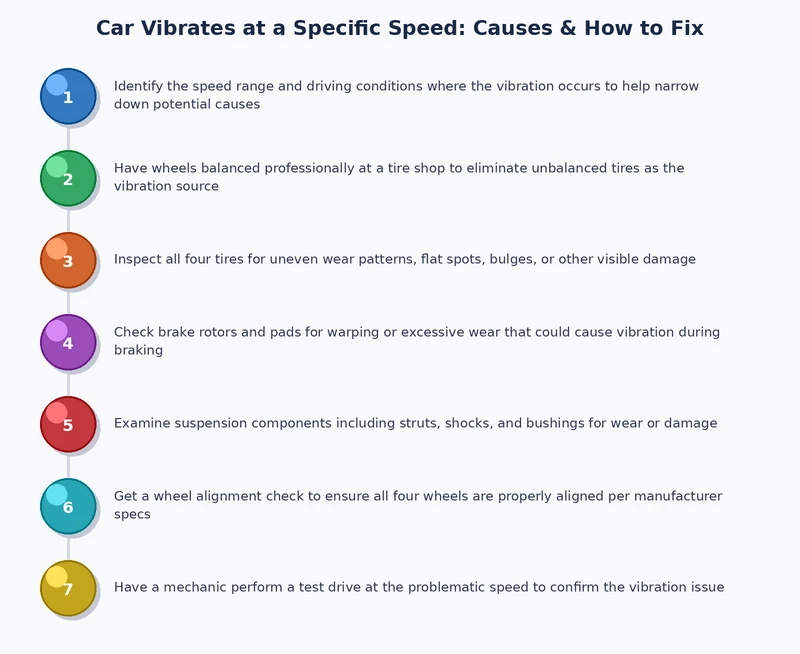
Step-by-step diagnostic process for finding the cause of car vibration at a specific speed
Figure 3 — A systematic diagnostic process works from tires and wheels through suspension and drivetrain components, ruling out the cheapest causes first.

Step-by-Step Diagnostic Process

  1. Document the vibration precisely. Note the exact speed at which it starts and peaks, whether it's present during acceleration, coasting, or both, and whether steering input changes the intensity — these details dramatically narrow your suspect list.
  2. Inspect all four tires visually. Look for bulges, cracking sidewalls, uneven tread wear, or visible flat spots across the contact patch; any of these conditions creates speed-dependent vibration without any other components being involved.
  3. Check tire pressure cold. Under-inflated and over-inflated tires both create irregular road contact; check all four tires before your first drive of the day and compare against the door placard specification.
  4. Verify lug nut torque with a wrench. A loose wheel is both dangerous and a direct vibration source; use a torque wrench in a star pattern and confirm every lug nut sits at your vehicle's specified torque — typically 80–100 ft-lbs for most passenger cars.
  5. Have all four wheels spin-balanced. Take your car to a tire shop and request a four-wheel balance; this is the single most effective fix for highway-speed vibration and costs roughly $60–$100 for all four wheels at most shops.
  6. Check wheel alignment. Learn how to check wheel alignment at home to spot obvious camber or toe problems before booking a professional alignment — a car that pulls to one side alongside the vibration almost always needs alignment work.
  7. Inspect CV axles and U-joints on a jack stand. Spin each front wheel by hand and feel for roughness or binding in the CV joint; examine the CV boot for tears and look for grease spatter inside the wheel well, which confirms a compromised joint.
  8. Check wheel bearings for play. Grip each tire at 9 and 3 o'clock and push-pull firmly — then repeat at 12 and 6 o'clock; any detectable looseness means the bearing is worn and requires replacement before the situation worsens.

Routine Maintenance That Prevents Speed-Related Vibration

Most cases where a car vibrates at a specific speed trace back to deferred maintenance — components that wore out or fell out of specification because nobody caught them early enough. A consistent maintenance routine is your most powerful tool for keeping speed-related vibration from ever developing in the first place.

Tire Maintenance Essentials

Your tires are the first line of defense against vibration, and keeping them in good condition requires active attention, not just an occasional visual check from the driveway.

  • Rotate every 5,000–7,500 miles: Rotation equalizes wear across all four tires, preventing the uneven tread patterns that cause vibration, pulling, and handling degradation over time.
  • Balance when you rotate: Most reputable shops include balancing with rotation; if yours doesn't, ask for it specifically, because catching an imbalance early prevents the weight loss that causes highway shaking.
  • Check pressure monthly: Under-inflation causes excessive sidewall flex and irregular contact-patch wear; over-inflation causes center-wear and reduced grip; both conditions create speed-dependent vibration as the tire deteriorates.
  • Replace in pairs or sets: Mixing tires with significantly different wear levels creates an axle-level imbalance that individual wheel balancing can't fully correct.

According to NHTSA tire safety guidelines, tires worn to 2/32 inch of remaining tread depth must be replaced immediately, and tires older than six years require annual professional inspection regardless of how much tread remains.

Suspension and Drivetrain Checks

Worn suspension components translate directly into speed-related vibration because they allow your wheels to move in ways the suspension geometry wasn't designed to permit. Make these checks part of every tire rotation visit:

  • Ball joints: Any detectable play or looseness during a push-pull test means replacement is overdue — worn ball joints allow the wheel to move unpredictably and create vibration that worsens under load.
  • Tie rod ends: Have a helper watch the tie rod end while you push and pull the tire from side to side; visible movement at the joint means the tie rod end is loose and needs replacement.
  • Struts and shock absorbers: Weak shocks allow tires to bounce across the road surface at speed and create a vibration that mimics wheel imbalance closely enough to fool you into chasing the wrong fix.
  • Control arm bushings: Cracked or collapsed bushings change suspension geometry unpredictably and create vibration under both acceleration and braking, especially on older vehicles with higher mileage.

Drivetrain issues also contribute significantly to speed-related vibration, and issues like differential fluid leaks can starve your differential of lubrication and create irregular gear engagement that you feel as a speed-specific shudder from the rear of the vehicle.

Quick Fixes That Stop the Shake Fast

Before you tear into suspension components or start ordering parts, run through these quick wins first — they resolve the majority of speed-specific vibration cases without any significant disassembly or specialized tools.

Balancing and Alignment

  • Standard wheel balance ($15–$25 per wheel): A tire shop spins each wheel on a computerized balancing machine and adds small clip-on weights to correct mass imbalances; the entire process takes about 30 minutes and resolves the majority of highway-speed vibration cases on the first visit.
  • Road force balancing ($25–$40 per wheel): A more advanced technique that simulates the weight of the vehicle pressing down on the tire; it catches stiff spots and radial force variation inside the tire that standard spin balancing completely misses, and it's worth the premium when standard balancing doesn't solve the problem.
  • Four-wheel alignment ($75–$150): Corrects the toe, camber, and caster angles of your wheels so they track parallel to each other and perpendicular to the road; misalignment causes uneven tire wear that creates speed-dependent vibration even on newly balanced wheels.

Warning: Never skip balancing after mounting a new tire — driving even 50 miles on an unbalanced new tire creates flat spots and uneven tread wear that shortens the tire's usable life and introduces the exact vibration problem you're trying to prevent.

Lug Nut Torque Check

A wheel that isn't fully seated and properly torqued will vibrate at almost any speed, and the shaking worsens progressively as the lug nuts back off further — which becomes a genuinely dangerous situation quickly. After any tire rotation, wheel removal, or roadside tire change, always retorque your lug nuts after the first 25–50 miles of driving to account for the initial seating and settling of the wheel against the hub.

  • Use a calibrated torque wrench rather than an impact gun for final torque — impact guns frequently over-torque, distorting the rotor hat and causing the exact brake vibration described above.
  • Tighten in a star pattern, not a circular sequence, to ensure the wheel seats evenly and squarely against the hub face.
  • Consult your owner's manual for the exact torque specification — most passenger vehicles fall between 80 and 100 ft-lbs, but trucks and performance vehicles often require more.

Mistakes to Avoid When Diagnosing Speed-Related Vibration

These are the errors that send people back to the shop twice, spending more money and more time than the original problem ever warranted.

Skipping the Simple Stuff First

  • Jumping directly to expensive repairs: Replacing CV axles, wheel bearings, or a driveshaft without first eliminating wheel imbalance wastes hundreds of dollars on parts that weren't causing the problem; balance the wheels first and test-drive before assuming anything else is at fault.
  • Ignoring tire pressure before diagnosing: Low or uneven tire pressure changes how each tire deforms at speed, creating a vibration signature that mimics wheel imbalance closely enough to send you chasing the wrong fix; always check pressure cold before drawing conclusions.
  • Overlooking a recently reinstalled spare: If you used your spare tire and reinstalled the original afterward, a newly unbalanced or slightly bent spare is a frequently overlooked source of vibration that gets mistaken for a developing suspension problem.

Misidentifying the Vibration Source

  • Assuming steering-wheel vibration always means front wheels: A failing rear wheel bearing can transmit vibration forward through the chassis and into the steering column convincingly enough to make you focus on the wrong axle entirely and miss the real problem.
  • Confusing engine and drivetrain vibration with wheel vibration: Engine misfires and transmission shudder can feel nearly identical to wheel imbalance at certain RPM bands; pay close attention to whether the vibration tracks your speed in MPH or changes when you upshift or downshift at the same MPH — if gear selection changes the vibration, the drivetrain is the source.
  • Stacking multiple repairs without testing between them: Fix one component at a time and take a test drive after each repair; stacking fixes makes it impossible to know what actually solved the problem, and you'll repeat the same expensive guesswork the next time the issue appears.

Frequently Asked Questions

Why does my car only vibrate at 65 MPH but ride smoothly at every other speed?

Vibration that appears only at a specific highway speed like 65 MPH is almost always caused by an out-of-balance wheel. Every rotating mass has a natural resonance frequency, and a wheel that's lost a balance weight shakes most intensely at the speed where that frequency matches its rotation rate. Have all four wheels spin-balanced at a tire shop — this single repair resolves the majority of highway-speed vibration cases and typically costs under $100 for a full set.

Can bad wheel alignment cause a car to vibrate at a specific speed?

Misalignment itself rarely causes vibration directly, but it creates uneven tire wear over time that absolutely does. If your tires have developed irregular wear patterns due to uncorrected alignment, you'll experience speed-dependent vibration because parts of the tire have thinner rubber and create an uneven contact patch with the road. Correct the alignment first, then balance the tires, and assess whether replacement is needed based on how much uneven wear has already occurred.

Is it safe to keep driving when my car vibrates at a specific speed?

It depends on the cause. Mild wheel imbalance carries relatively low risk for short distances to a shop, but vibration from a failing wheel bearing, a loose wheel, or a damaged CV axle is a genuine safety hazard with the potential for sudden loss of vehicle control. If the vibration is severe, appeared suddenly, or is accompanied by unusual noises, pull over safely and have the car inspected before driving further — don't push it to an appointment days away.

Next Steps

  1. Pay close attention during your next drive and note the exact speed at which the vibration starts, peaks, and fades — write it down along with where you feel it (steering wheel, seat, or pedals), because this information is the foundation of an accurate diagnosis.
  2. Check all four tire pressures cold before your first drive tomorrow and inspect each tire visually for bulges, cracking, or uneven wear that might be causing the problem without any other components being involved.
  3. Book a four-wheel balance and rotation at a tire shop this week — this one service resolves the majority of speed-specific vibration cases and costs less than any other repair on the diagnostic list.
  4. If balancing doesn't resolve the vibration after a test drive, have a mechanic inspect your wheel bearings, CV axles, and brake rotors during the same follow-up visit so you're not paying for multiple appointments to chase one problem.
  5. Schedule a four-wheel alignment check if you haven't had one in the past 12,000 miles, particularly if you've noticed any pulling to one side or abnormal tire wear alongside the vibration — alignment problems always get worse over time, never better on their own.

About Sarah Whitfield

Sarah Whitfield is a diagnostics and troubleshooting specialist who spent ten years as an ASE-certified technician before joining the editorial team. She specializes in OBD-II analysis, electrical gremlins, and the kind of intermittent problems that make most owners give up.

Get some FREE car parts & gear.. Or check out the latest free automotive manuals and build guides here.

Disable your ad blocker to unlock all the hidden deals. Hit the button below 🚗