by Sarah Whitfield
A client at my local shop described it perfectly last fall: she pulled up to a stoplight, shifted into neutral, and felt the whole car shaking like it had something to say. The highway drive over had been fine. It was only when everything slowed down that the problem revealed itself.
If your car vibrates in neutral but settles down at speed, the cause is almost certainly engine-side — not tires, not wheels, not the road. The vibration is telling you something specific, and once you understand what to look for, the diagnosis becomes surprisingly straightforward. For a broader look at related idle shaking problems, start with our guide on car shakes when idle.
This post covers every major cause of neutral vibration, a clear step-by-step diagnosis process, practical repair options, and honest guidance on what you can fix yourself versus what belongs at a shop.

Contents
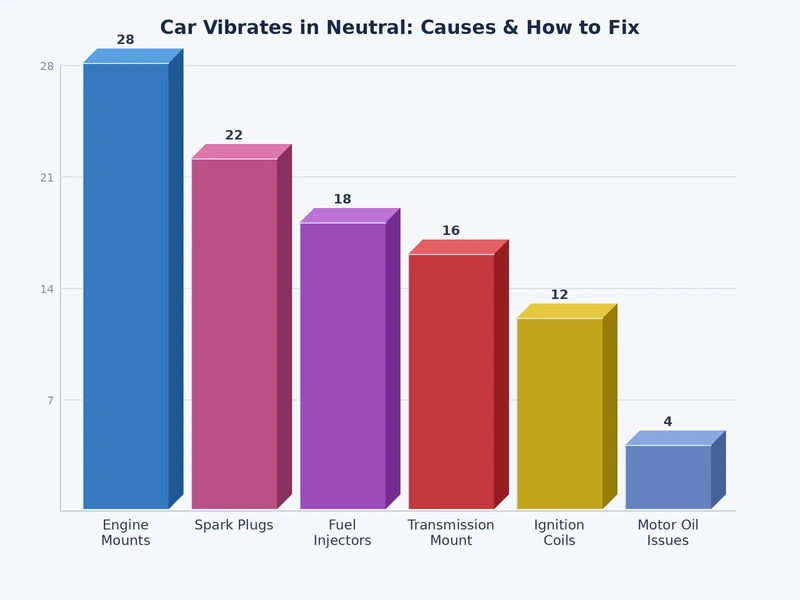
When your car is in neutral, the drivetrain is disconnected. The wheels and road surface are out of the equation entirely. That means any vibration you feel is coming directly from the engine, its mounting system, or the components immediately attached to it. Narrowing the source to that zone cuts the diagnostic work in half.
These are the most common culprits, ranked by how frequently they show up:
| Cause | Key Symptom | DIY Difficulty | Estimated Repair Cost |
|---|---|---|---|
| Worn engine mounts | Thud when shifting, constant idle vibration | Moderate | $150–$600 |
| Spark plug misfire | Rough idle, stumble, vibration | Easy | $50–$200 |
| Vacuum leak | Erratic idle, hissing sound | Easy–Moderate | $50–$250 |
| Dirty fuel injectors | Rough idle, occasional stumble at low RPM | Easy | $80–$350 |
| Transmission mount failure | Vibration plus clunk on engagement | Moderate | $100–$400 |
| Torque converter shudder | Low-speed shudder, rough idle in Drive | Difficult | $400–$1,200 |
| Loose belt or worn pulley | Squealing plus rhythmic idle vibration | Easy–Moderate | $50–$300 |
Engine mounts are rubber-and-steel brackets that bolt the engine to the vehicle's subframe or chassis. Their job is to absorb vibration so the combustion pulses do not travel directly into the cabin. When the rubber degrades, cracks, or — in the case of hydraulic mounts — loses its internal fluid, the dampening disappears. The engine begins rocking on every power stroke, and you feel it through the floor, the shifter, and the steering column.
According to the Wikipedia overview of engine mounts, hydraulic fluid-filled mounts provide superior vibration isolation across a wider frequency range than solid rubber units — but they also fail more suddenly when the fluid leaks out. The classic tell is a heavy thud every time you shift into or out of gear, followed by persistent vibration at idle.
If the vibration climbs up into the steering column, that specific symptom has its own diagnostic path. Our post on steering wheel vibrates at idle covers the overlap between mount failure and other causes that transmit through the wheel.
A misfiring cylinder fires irregularly or skips entirely. When one cylinder in a four-cylinder engine is not contributing, the engine runs on three uneven power strokes — it rocks and stumbles instead of spinning smoothly. You will feel this as a rhythmic vibration that often comes with a rough, uneven idle sound.
Spark plugs are the first component to check. Worn electrodes, carbon deposits, or oil fouling all cause misfires. For a detailed breakdown of what causes plug fouling and how to identify it by the deposits you see, read our post on spark plug fouling causes. If new plugs do not solve the misfire, the ignition coils are the next step — they fail individually and produce exactly the same symptoms.
Your engine's idle quality depends on a precise air-to-fuel ratio. A vacuum leak introduces unmetered air into the intake manifold, leaning out the mixture beyond what the ECU can fully compensate for. The result is an erratic, hunting idle — the RPM bounces up and down, and you feel the engine stumbling underneath you.
You will often hear a faint hissing from the engine bay when a vacuum line has cracked or a gasket has failed. A lean condition fault code (P0171 or P0174) frequently follows. Our breakdown of P0171 code causes walks through how to trace the leak and fix it systematically.
Transmission mounts serve the same function as engine mounts — they prevent the gearbox from shifting against the chassis. A collapsed transmission mount allows direct metal contact between the transmission housing and the subframe, which produces a grinding vibration you can feel through the floor on the passenger side.
In automatic transmissions, a worn torque converter can produce a shudder at low RPM that is noticeable in both Neutral and Drive. This is most common in older automatics or vehicles that have been running on degraded transmission fluid for extended periods. If the problem is paired with hesitation under load, also check our post on engine revs but car won't move, which covers drivetrain disconnects that follow similar patterns.
A systematic approach saves you from replacing parts that do not need replacing. Work through this sequence and you will have a clear answer in under an hour — without guessing.
You do not need a professional scan tool or a lift. Gather these before you begin:
Always pull fault codes first. A misfire code in the P0300–P0308 range immediately narrows the diagnosis to ignition. No codes does not rule out a mechanical problem — vacuum leaks and mount failures rarely trigger a code on their own.
Once you know the cause, the repair path is direct. Start with the least expensive and most accessible fix, then work outward. Most neutral vibration problems resolve with one of the repairs below.
Engine mount replacement is a moderate home repair on most front-wheel-drive vehicles. The general procedure involves supporting the engine safely from below with a floor jack and a wooden block, unbolting the failed mount, and installing the replacement. Allow two to four hours if you are doing this for the first time. Working from a factory service manual for your specific vehicle is essential — mount locations and access vary considerably.
Use OEM-specification mounts or a reputable aftermarket equivalent rated for the same durometer. Avoid mounts marketed as "performance" or "race spec" — they are intentionally stiff to reduce engine movement under hard acceleration, but that stiffness transmits every combustion pulse directly into the cabin. You will trade a neutral vibration for a permanent one.
If you are also noticing vibration over bumps or at the top of the suspension travel, it is worth checking for bad strut mount symptoms at the same time. Strut mount failure often accompanies engine mount wear on high-mileage vehicles and can make vibration feel worse than either problem alone.
Spark plug replacement is the first repair to attempt when any misfire code is present. On most four- and six-cylinder engines it takes under an hour and costs between $30 and $80 in parts. Replace the full set — not just the misfiring cylinder — because the remaining plugs are at the same mileage and will fail shortly afterward.
If new plugs do not resolve the misfire, swap ignition coils. Because coils are plug-and-play on most modern engines, you can move a coil from a healthy cylinder to the misfiring cylinder and re-scan. If the misfire code follows the coil to the new position, you have confirmed the coil is faulty.
For vacuum leaks, replace the cracked hose or gasket directly once you have located the source. A smoke machine makes every leak immediately visible and is available at most auto parts stores as a rental tool. If the rough idle also shows up as hesitation or stalling at low speed, read our post on car stalls at a traffic light — many of the same vacuum and fuel delivery fixes apply to both problems.
Dirty fuel injectors respond well to a concentrated fuel system cleaner added directly to the tank. Severe injector fouling requires professional ultrasonic cleaning or replacement. This is worth addressing if idle roughness persists after you have ruled out ignition and vacuum causes.
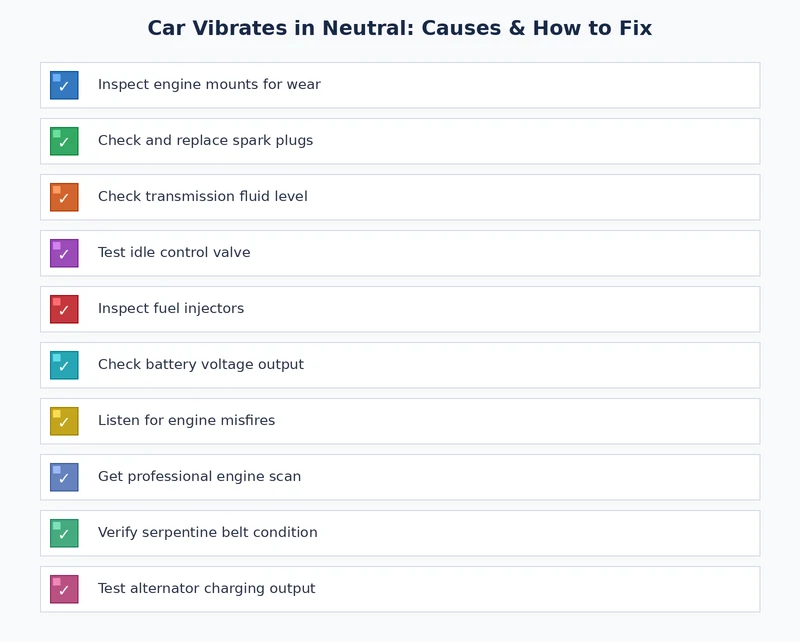
Some neutral vibration fixes are genuinely beginner-friendly. Others involve access problems, specialized equipment, or risk of engine damage if done incorrectly. Knowing the difference saves you time and money in both directions.
Engine and transmission mount replacement also falls within reach for a mechanically confident home mechanic. The main risk is improper engine support — if the engine drops while a mount is unbolted, radiator hoses, wiring harnesses, and the firewall can all sustain expensive damage. Use a proper engine support bar or a floor jack with a protective block, never just a hydraulic jack at an unstable contact point.
A reputable shop that specializes in driveability and engine work will diagnose most neutral vibration problems in a single visit. Expect a diagnostic fee between $75 and $150, which most shops apply toward the repair if you proceed. That fee is money well spent when the alternative is replacing parts randomly.
If you drive a manual transmission and the vibration occurs specifically during clutch engagement rather than when fully in neutral, that is a different mechanical issue. Our post on clutch chatter causes covers that specific diagnosis in detail.
A vibrating car is not always an emergency. But some symptoms behind that vibration are. Misreading the urgency either direction costs you — either an unnecessary tow or an engine that sustains avoidable damage.
These patterns indicate a vibration you can safely drive with for a short time before scheduling a repair:
A stable, low-severity vibration in Neutral that behaves predictably is unlikely to strand you. Avoid high-stress use — towing, extended highway driving — and schedule the repair within the next few days. Do not let "can wait a few days" turn into "can wait several months." Worn mounts continue to degrade, and a mild vibration becomes a catastrophic one.
These are hard stops. Park the car and arrange an inspection before driving it again:
A fully failed engine mount can allow the engine block to contact brake lines, radiator hoses, and the firewall under load. The resulting damage — a severed brake line in particular — costs far more to repair than the $150 to $300 a replacement mount would have cost at first sign of trouble.
It depends entirely on the cause. A mild vibration from worn spark plugs or a dirty fuel injector is safe to drive on short-term. A failed engine mount or a severe misfire indicated by a flashing check engine light is not — both require immediate diagnosis before you drive the vehicle further.
Cold starts run at a higher idle RPM to warm the engine faster. As RPM drops to normal idle after warmup, vibration from ignition or fuel issues often becomes more noticeable. Conversely, cold, stiff mount rubber can also amplify vibration before it warms up and softens. Both patterns point to the same underlying causes.
Yes. Low transmission fluid reduces hydraulic pressure inside the torque converter and valve body. In automatic transmissions, this can cause a shudder or vibration at idle in Neutral or Drive. Check transmission fluid level and condition as part of your initial inspection. Dark or burnt-smelling fluid needs to be changed regardless of the vibration.
This is a classic engine mount symptom. When you engage Drive or Reverse, engine torque loads the mount in a different axis — it may temporarily stabilize the engine's position, reducing the vibration momentarily. It is not a sign the problem has resolved. In some cases it also indicates a torque converter issue that is sensitive to rotational load.
Most mounts last between 60,000 and 100,000 miles. Hydraulic mounts tend to fail earlier than solid rubber units because the internal fluid eventually leaks or degrades. Age and heat cycles matter as much as mileage — a ten-year-old vehicle with modest miles can still have cracked, hardened mounts that no longer absorb vibration effectively.
A failed engine mount left unaddressed can wear out adjacent components: radiator hoses stretch and crack from engine movement, wiring harnesses chafe against engine components, and power steering lines can be damaged by contact with a rocking engine. Ignition misfires, if left to continue, will overheat and melt catalytic converter substrate — a repair that easily exceeds $1,000.
 |
 |
 |
 |

About Sarah Whitfield
Sarah Whitfield is a diagnostics and troubleshooting specialist who spent ten years as an ASE-certified technician before joining the editorial team. She specializes in OBD-II analysis, electrical gremlins, and the kind of intermittent problems that make most owners give up.
Get some FREE car parts & gear.. Or check out the latest free automotive manuals and build guides here.
Disable your ad blocker to unlock all the hidden deals. Hit the button below 🚗
| | | |
