by Sarah Whitfield
Power window failures account for more than 30% of all interior electrical complaints logged at independent repair shops across North America — and a car window grinding noise when rolling up is one of the clearest mechanical distress signals in that category. That harsh scraping or metallic grinding is never random. It points to a specific component under load, and the sooner the source gets identified, the lower the repair bill ends up being.
Most grinding traces back to one of five culprits: a worn window regulator, stripped motor gears, contaminated or dry tracks and channels, broken glass-retention clips, or a malfunctioning anti-pinch sensor assembly. Each has a distinct diagnostic signature. Drivers who've already dealt with other electrical annoyances — like a car radio not working — will recognize the same approach: isolate the component, confirm power delivery, then address the mechanical side.
For a broader look at vehicle electrical and comfort-system failures, the troubleshooting section covers everything from window motors to HVAC faults in detail.
Contents
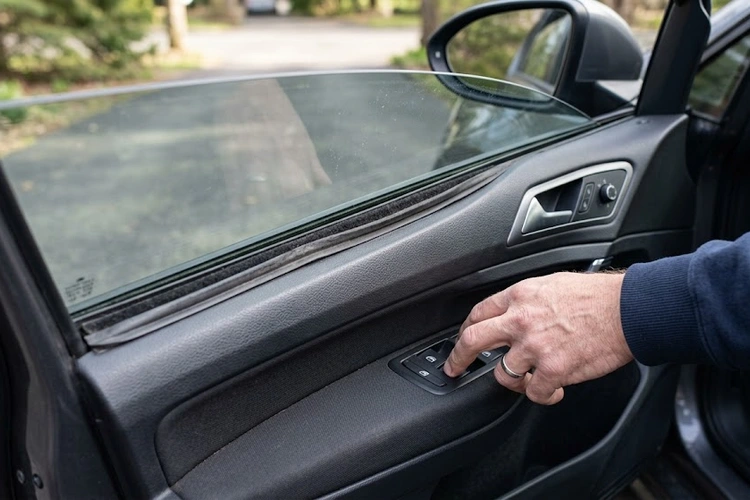
Power windows look simple from inside the cabin — press a button, glass moves. Under the door panel, the system is considerably more involved. A DC motor receives current from the switch assembly and converts electrical energy into rotational torque. That torque drives a regulator — either a scissor-type or cable-driven design — which translates rotation into the vertical motion of the glass pane.
Scissor regulators use an X-shaped arm mechanism pivoting on a central pin. They're common on older vehicles and mechanically robust, but pivot bushings wear smooth over years of cycling, introducing slop that allows the glass to wobble in transit. Cable regulators use two spools and a plastic carrier attached to the glass. They're lighter and quieter than scissor designs, but the cable frays strand by strand under repeated thermal and mechanical stress, and the pulleys crack over time.
The motor connects to the regulator via a small plastic or nylon gear set. These gears are deliberately softer than the motor housing — engineered as sacrificial components. When the window binds against increased resistance, the gears absorb the overload and strip before the motor windings burn. That stripping produces the grinding or skipping sound that most drivers first notice. The design is intentional; the alternative is a dead motor instead of a $30 gear replacement.
Pinpointing the cause requires listening for where the sound originates — top of travel, bottom corner, or throughout the full stroke — and whether it's intermittent or consistent on every cycle.
The regulator takes more mechanical abuse than any other component inside the door. On scissor designs, pivot pins and bushings wear smooth over thousands of cycles, introducing lateral play that causes the glass to rack against the channel walls. On cable regulators, a fraying cable loses tension and the carrier begins to skip. Both failures produce grinding or clicking noises that intensify as the glass rises, because the mechanism works hardest against gravity near the top of travel — exactly where most drivers first hear the sound.
A window that moves sluggishly before the grinding begins almost always has gear wear at the motor output. The nylon drive gear develops flat spots or missing teeth, causing the motor shaft to rotate freely through damaged sections while engaging intermittently on intact teeth. The result is a grinding or skipping noise that syncs with the motor's duty cycle. Pressing the switch harder doesn't help — it accelerates gear destruction by forcing the motor to draw more current through the failed mesh.
Glass runs in felt-lined rubber channels on both vertical sides of the door opening. Over time, the felt dries out, the rubber hardens in UV-exposed areas, or road grime and silica accumulate along the run. Dry channels create friction the regulator motor wasn't designed to overcome; to compensate, it draws more current and increases mechanical stress — producing a grinding or rasping noise along the glass edge rather than from deep inside the door. This cause is especially common on vehicles where a window has sat partially open for extended periods, allowing debris to pack into the lower channel.
The glass bolts to the regulator carrier via plastic retention clips embedded in a channel at the base of the glass. These clips crack under thermal cycling — particularly in climates with large day-to-night temperature swings. A broken or loose clip allows the glass to shift laterally inside the door, grinding against the frame or adjacent rubber seal as it moves. The sound is typically sharper and more localized than regulator noise, and it appears at a consistent, repeatable point in the glass travel rather than varying with speed or temperature.
Modern vehicles with auto-up windows use current-monitoring or Hall-effect sensors to detect obstructions. When the sensor drifts out of calibration or fails, the window may stall mid-travel or reverse unexpectedly while the motor continues attempting to drive in the original direction — producing a grinding buzz at or near the top of the window's range. This is a mechanical-electrical interaction rather than a purely mechanical fault, but the audible signature is nearly identical to gear stripping.
Matching symptoms to cause accurately eliminates unnecessary part replacement. The table below maps the five primary causes to their diagnostic signatures and repair profiles.
| Cause | Primary Sound | Where in Travel | DIY Difficulty | Avg. Part Cost |
|---|---|---|---|---|
| Worn regulator | Grinding / clicking | Throughout or near top | Moderate | $40–$120 |
| Stripped motor gears | Grinding / skipping | Intermittent throughout | Moderate | $30–$90 |
| Dry / contaminated channels | Rasping / squeaking | Throughout full stroke | Easy | $6–$15 |
| Broken glass retention clips | Sharp grinding | Fixed repeatable point | Easy | $8–$25 |
| Anti-pinch sensor failure | Grinding buzz / stall | Top of travel | Hard | $50–$200 |
Two variables define how car window grinding noise when rolling up presents in practice: environmental conditions and recent service history.
In sub-freezing temperatures, rubber window seals stiffen and grip the glass more aggressively than at normal operating temperature. The regulator motor fights amplified seal friction on top of normal mechanical load. Grinding that appears only in cold weather — then fades after a few cycles as the door warms — often indicates borderline regulator or channel wear that temperature pushes over the threshold. Hot weather creates a different failure mode: lubricant in cable regulator pulleys thins and migrates away from contact surfaces, leaving metal-on-metal contact at the highest-load points of the travel arc.
Grinding that starts immediately after a door panel removal, window tint installation, minor side-impact repair, or body shop visit is almost always a reassembly error. Glass retention clips may be incorrectly seated, the regulator carrier may be misaligned on the lower track, or an inner door seal may have been pushed into the glass path. The timing of symptom onset tells most of the diagnostic story here — no grinding before the service, grinding after, means something changed during disassembly.
Drivers troubleshooting other door-area electrical issues concurrently — like heated seats not working — benefit from pulling the door panel once and addressing all faults in a single disassembly to avoid repeated panel removal and clip breakage.
The repair decision depends on which component has failed, what tools are on hand, and comfort level with blind connectors and panel clip systems.
Before ordering a replacement regulator, apply silicone lubricant to the channels and run the window through five complete cycles. If the car window grinding noise when rolling up disappears, lubrication was the entire fix — a $6 can of spray versus a $120 part.
Anti-pinch sensor recalibration on most modern platforms requires OBD-II software capable of reading window motor current signatures — not a standard code reader. Window motor replacement on frameless door designs (common on coupes and convertibles) involves glass removal sequences that risk fracturing the glass without proper suction-cup support tools. Any grinding accompanied by water intrusion into the door cavity warrants professional attention; an improperly reseated vapor barrier leads to moisture infiltration, wiring harness corrosion, and cascading electrical faults.
According to NHTSA vehicle component data, power window mechanisms rank among the most frequently reported electrical system failures in vehicles older than seven years — making proactive inspection a cost-effective habit rather than an optional precaution.
Not all grinding is equally urgent. The direction of likely failure and the vehicle's exposure matter as much as the noise itself.
Act within 24–48 hours if:
Lower urgency — can schedule within a week or two if:
A window stuck in the down position is always a priority repair. Glass sitting inside the door cavity can slide further down, requiring full door disassembly to retrieve — turning a $150 regulator job into a $500+ repair. Intermittent electrical faults like a remote start not working carry far lower urgency by comparison, since they don't expose the vehicle to weather or create accelerating mechanical damage.
DIY window repair has a clear economic case, but it comes with real risks that the parts cost alone doesn't reflect.
Advantages:
Disadvantages and risks:
The economic break-even point for most vehicles: if the shop labor quote exceeds $250 and the replacement part costs under $100, DIY delivers meaningful savings. If the labor quote is under $200, professional service often becomes cost-competitive once panel clips, lubricants, and tool time are factored in honestly.
A grinding noise during window operation most commonly indicates a worn window regulator, stripped motor gears, or dry window channels. The specific cause can usually be narrowed down by noting where in the travel the sound occurs — throughout the full stroke suggests channel friction or regulator wear, while a fixed point in travel often indicates a broken glass retention clip.
Continuing to operate a grinding window accelerates component wear on every cycle. A partially stripped gear set strips faster under repeated load, and a fraying cable regulator is one frayed strand away from dropping the glass into the door. If the motor is running hot to compensate for increased resistance, winding burnout becomes a secondary failure risk within weeks.
Repair cost ranges from $6 for a can of silicone lubricant at the low end to $400–$600 for a professional regulator and motor replacement on a labor-intensive platform. The most common scenario — regulator replacement with standard access — runs $150–$300 at an independent shop, parts and labor included. Glass clip replacement costs under $50 in most cases.
Using a grinding window intermittently while scheduling a repair is generally acceptable if the glass still travels fully and no metal-on-metal contact is present. Operating a window with a stuck or partially failed regulator risks dropping the glass inside the door, which elevates repair cost significantly and creates an immediate security and weather-exposure problem.
WD-40 is a water displacer and light solvent — not a lubricant. Applying it to window channels provides temporary noise reduction but leaves no lasting lubricating film, and the solvent action can accelerate drying of existing rubber seals. White lithium grease or silicone spray is the correct lubricant for window tracks and channels; both maintain a film under the temperature and load cycles a vehicle door experiences.
A factory window regulator on most vehicles lasts 100,000–150,000 miles or roughly 10–15 years under normal operating conditions. Vehicles in climates with extreme temperature swings, high humidity, or significant road dust exposure tend to see regulator failures at the lower end of that range. Frequent partial-window operation — leaving the window cracked rather than fully closed — also accelerates channel seal and cable wear.
A car window grinding noise when rolling up is a time-sensitive problem — the gap between a $15 lubrication fix and a $400 regulator replacement closes with every cycle the window completes under load. Start with the simplest intervention: clean and lubricate the channels, then listen. If the noise persists, pull the door panel, inspect the regulator carrier and glass clips, and replace the worn component before the motor absorbs the full consequences. Scheduling even a basic inspection this week prevents a nuisance from becoming a stranded-window emergency.
 |
 |
 |
 |

About Sarah Whitfield
Sarah Whitfield is a diagnostics and troubleshooting specialist who spent ten years as an ASE-certified technician before joining the editorial team. She specializes in OBD-II analysis, electrical gremlins, and the kind of intermittent problems that make most owners give up.
Get some FREE car parts & gear.. Or check out the latest free automotive manuals and build guides here.
Disable your ad blocker to unlock all the hidden deals. Hit the button below 🚗
| | | |
