by Joshua Thomas
When a car won't accelerate past a certain speed, the instinct is to assume the worst. Engine failure. Transmission collapse. A repair bill that rivals a car payment. In many cases, that instinct is wrong. The actual cause is often a clogged fuel filter, a misfiring sensor, or an electronic safeguard responding exactly as designed — all of which are far less expensive to address than a full engine teardown.
This guide examines every major cause behind the symptom, explains how each one creates a measurable speed ceiling, and outlines the diagnostic steps required to confirm and fix it. Understanding the system connections between fuel delivery, ignition, transmission, and electronics allows for faster, cheaper diagnosis — and prevents the most common repair mistakes.
The car won't accelerate past certain speed category page collects related resources for drivers dealing with performance complaints across a range of conditions.

Contents
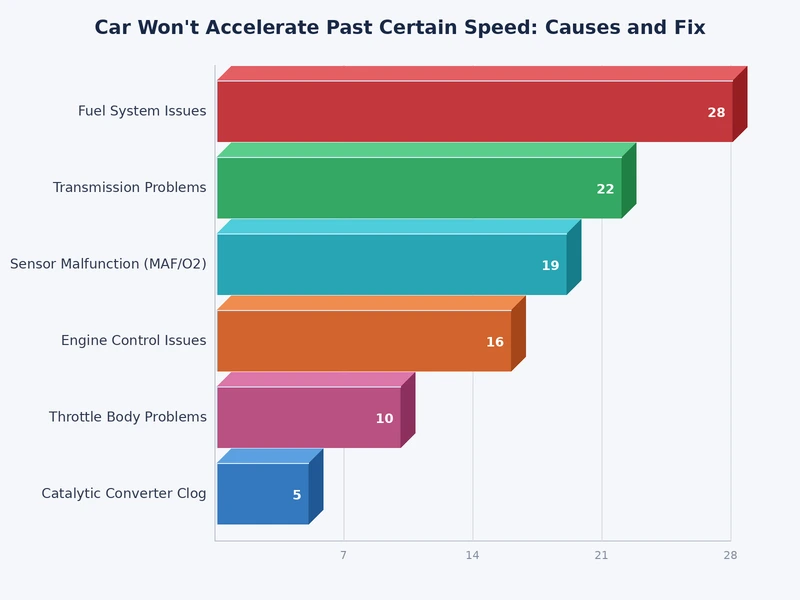
A vehicle that accelerates normally up to 45 mph then abruptly refuses to go faster is exhibiting what mechanics call a speed ceiling or speed cap. The engine may rev, the transmission may shift, but forward momentum plateaus as if an invisible wall has appeared.
Root causes fall into four distinct categories:
The character of the problem provides useful diagnostic clues before any tools are used. A soft ceiling — where the vehicle slows and struggles but might push slightly further under full throttle — typically indicates fuel, ignition, or exhaust restriction. A hard ceiling — where speed locks to an exact value regardless of throttle input — more often points to an electronic safeguard or a transmission fault.
Drivers who also notice an inability to build RPMs under load should cross-reference the car won't rev past certain RPM guide, as the two symptoms frequently share root causes.
Fuel delivery problems represent the single largest category of speed-cap complaints. At low speeds, a marginally functioning fuel system may keep pace with engine demand. At highway speeds — when the engine requires significantly more fuel per cycle — even minor flow restrictions become apparent.
The fuel filter catches particulate contamination before it reaches the injectors. Over time, accumulated debris reduces flow capacity. Early-stage restriction may only manifest at high load; severe restriction can prevent the engine from accelerating past 40–50 mph entirely.
Common symptoms of a clogged fuel filter include:
Most manufacturers specify fuel filter replacement every 20,000–40,000 miles, though many vehicles operate on extended intervals and develop problems well past those marks. Replacement cost is generally $75–$175 parts and labor — among the least expensive fixes in this category.
A weakening fuel pump may generate adequate pressure at idle and low speeds while falling short of the higher demand required for sustained highway driving. Drivers typically describe the problem as the car "running out of steam" between 45 and 55 mph despite full throttle input.
Diagnosis requires a fuel pressure gauge connected directly to the fuel rail. Readings below manufacturer specification — typically 45–65 psi for port-injected engines — confirm inadequate pump output. Critically, pressure should be tested under load, not just at idle. A pump can measure within normal range at rest and still fail to sustain pressure when the engine demands peak flow.
Declining fuel economy often accompanies a weakening pump. The fuel economy suddenly dropped guide covers the overlap between fuel delivery issues and economy complaints in detail.
Clogged injectors deliver irregular spray patterns instead of the finely atomized cone required for complete combustion. At low RPMs, a partially restricted injector may compensate through longer pulse width. At high RPMs — where the ECU has less time per cycle to correct — the shortfall produces misfires, hesitation, and reduced peak power.
Fuel injector cleaner added to the tank addresses mild carbon buildup. Professional ultrasonic cleaning or outright replacement becomes necessary when restriction is severe. Injector replacement costs range from $150 to $600 per injector depending on vehicle type.
Pro tip: Always test fuel pressure under load, not just at idle — a pump that reads normal at rest may still drop below specification when the engine demands peak flow at highway speed.
The combustion system must function within tight tolerances to produce full power. A single misfiring cylinder reduces effective displacement by 12.5 percent on an eight-cylinder engine. Multiple misfires or sensor errors create the conditions for a measurable speed ceiling even when fuel delivery is adequate.
Worn or fouled spark plugs misfire most severely under the electrical demand of high RPM operation. The ECU detects the misfire event, reduces fuel delivery to protect the catalytic converter, and may pull ignition timing — all of which combine to cap output. The symptoms described in the bad spark plug symptoms guide — rough idle, poor fuel economy, and hesitation on acceleration — typically precede a full speed limitation by several thousand miles.
Spark plug replacement intervals by type:
Plug condition should be inspected whenever misfire codes (P0300–P0308) are retrieved, regardless of mileage since last replacement.
The mass airflow (MAF) sensor quantifies air volume entering the engine, providing the ECU with data required to calculate correct fuel injection. A contaminated or failing MAF transmits inaccurate readings. At low speeds, the resulting air-fuel ratio error is minor and may go undetected. At highway speeds, the lean or rich condition degrades combustion efficiency enough to produce noticeable power loss.
Identifying signs of MAF failure:
Cleaning the MAF sensor with dedicated MAF cleaner spray resolves many cases caused by contamination rather than component failure. Replacement costs fall between $80 and $350 depending on make and model.
A partially obstructed catalytic converter creates exhaust back pressure that the engine must work against. The restriction is most acute at higher RPMs when exhaust volume is greatest, producing a clear correlation between speed and power loss. Drivers typically report a hard stop in acceleration above 55–60 mph, sometimes paired with a sulfur smell or subtle exhaust rattling.
The catalytic converter rattling guide covers cases where physical substrate damage accompanies flow restriction. Back pressure testing with an exhaust pressure gauge provides definitive confirmation — acceptable back pressure at idle is below 1.5 psi; readings above 3 psi indicate significant restriction. Converter replacement costs range from $900 to $2,500 depending on location and vehicle.
When the engine runs cleanly and fuel delivery is confirmed adequate, attention shifts to the drivetrain. Transmission problems produce a characteristic symptom: engine RPMs climb while vehicle speed increases only marginally or not at all — torque is being generated but not efficiently transferred to the wheels.
A slipping automatic transmission loses its ability to maintain a firm mechanical connection between the engine and driveshaft under load. The disconnect is most pronounced at higher speeds where torque demands peak. Common underlying causes include:
Transmission fluid should be the first inspection point. Fluid that appears dark brown or black and carries a burnt odor indicates internal component degradation. A fluid and filter service resolves mild cases attributable to fluid condition alone; moderate to severe clutch wear requires internal rebuild or full transmission replacement.
The torque converter couples engine power to the automatic transmission. A worn stator or failing lockup clutch within the converter reduces power transfer efficiency at highway speeds. The symptom pattern differs slightly from a slipping transmission — drivers typically report shuddering during acceleration between 30–45 mph, along with elevated transmission fluid temperatures and a soft ceiling above 60 mph.
Torque converter replacement is a labor-intensive job requiring transmission removal. Total repair costs generally range from $600 to $1,200 depending on vehicle.
Warning: A slipping transmission that goes unaddressed accelerates internal wear rapidly — a minor fluid issue can progress to complete gearbox failure within months under normal highway use.
A significant share of speed-cap complaints involve no mechanical failure at all. Modern vehicles use electronic control systems to protect components and enforce operating parameters — and those systems sometimes create a hard speed ceiling by design.
Limp mode — formally called failsafe mode — is an ECU-triggered protective state that limits engine or transmission output, typically restricting the vehicle to 30–50 mph. The ECU activates it when onboard sensors detect conditions that could cause component damage if full power were maintained.
Common limp mode triggers include:
The reduced engine power warning guide details the dashboard indicators that frequently accompany limp mode activation and the diagnostic steps to identify which trigger is responsible.
Clearing fault codes with an OBD-II scanner without resolving the underlying cause produces immediate reactivation. The root problem must be addressed first.
Manufacturers program electronic speed limiters (ESLs) into most production vehicles, typically activating between 100–155 mph — speeds rarely encountered in everyday driving. However, a secondary category of limiter creates problems at normal highway speeds: aftermarket fleet governors and rental company speed control modules installed on used commercial vehicles.
Drivers who purchase former fleet vehicles, commercial vans, or rental units may inherit speed-limiting hardware that was never disclosed during the sale. These devices typically plug into the OBD-II port or wire inline with the throttle position sensor circuit. Physical inspection of the area beneath the dash and around the OBD-II port is required to identify them.
Systematic diagnosis requires the right instruments. Attempting repairs without testing first is the most expensive diagnostic mistake a driver can make. The following equipment covers the majority of speed-cap scenarios:
| Tool | What It Diagnoses | Approximate Cost | Skill Level Required |
|---|---|---|---|
| OBD-II Scanner (with live data) | Fault codes, sensor readings, limp mode triggers, fuel trims | $30–$200 | Beginner |
| Fuel Pressure Gauge | Fuel pump output, filter restriction, injector return line | $30–$80 | Intermediate |
| Exhaust Back-Pressure Gauge | Catalytic converter restriction, exhaust blockage | $25–$60 | Intermediate |
| Digital Multimeter | MAF sensor output voltage, TPS sweep, sensor ground integrity | $20–$80 | Intermediate |
| Vacuum Gauge | Intake manifold leaks, valve timing, back-pressure indication | $20–$50 | Intermediate |
| Infrared Thermometer | Catalytic converter heat differential, brake drag confirmation | $20–$60 | Beginner |
| Compression Tester | Cylinder health, head gasket integrity, valve condition | $30–$100 | Intermediate |
An OBD-II scanner with live data capability is the logical entry point for any diagnosis. Active fault codes narrow the field immediately. Live data streams — fuel trim values, MAF voltage, throttle position, transmission temperature — allow real-time monitoring of system behavior while the vehicle is driven under conditions that reproduce the problem.
Some diagnostic steps exceed the capability of consumer tools. Professional-grade equipment becomes necessary in the following scenarios:
In these cases, the cost of a professional diagnostic session — typically $100–$175 — is more economical than purchasing specialized equipment for a one-time job.
Misdiagnosis is the primary driver of unnecessary repair costs when a car won't accelerate past a certain speed. The following mistakes appear repeatedly in repair outcome reports.
Documented repair outcomes illustrate how symptoms map to causes under real-world conditions.
Scenario A — Soft cap at 65 mph on a high-mileage sedan: A vehicle with 185,000 miles developed consistent power loss above 65 mph with no warning lights. Fuel pressure tested at 38 psi against a specification of 52 psi. Fuel pump replacement eliminated the ceiling. A fuel filter unchanged for 70,000 miles was replaced simultaneously as preventive maintenance.
Scenario B — Hard cap at 45 mph with transmission shudder: An automatic transmission vehicle entered limp mode at 45 mph following weeks of intermittent shuddering between 30–40 mph. OBD-II scan returned P0741 (torque converter clutch performance). Fresh transmission fluid and filter service resolved the shudder initially. Torque converter replacement was required 5,000 miles later when the shudder returned. The engine surging at idle guide notes that early torque converter wear often presents with surge behavior before progressing to full limp mode activation.
Scenario C — Gradual speed loss on a turbocharged SUV: Top-end power declined progressively over several months. Exhaust back pressure measured 9.2 psi at the port ahead of the converter — well above the 1.5 psi maximum threshold. Catalytic converter replacement fully restored performance. The owner had also noticed intermittent stalling during deceleration, a secondary symptom covered in the car stalls when slowing down guide that correlates with exhaust restriction in certain engine configurations.
Scenario D — Hard cap at 72 mph on a used commercial van: No fault codes were present. Physical inspection revealed a fleet speed governor module inserted into the OBD-II port. Removal restored full speed range. No mechanical or electronic repairs were required.
Not every speed-cap repair is appropriate for home mechanics. The division generally follows complexity and specialized tooling requirements:
The primary consideration is whether the repair requires specialized tools that would cost more to purchase than the professional labor itself. For most fuel and ignition repairs, the tools pay for themselves across multiple uses. For transmission internals and exhaust components, professional service is generally more economical.
The majority of speed-cap problems are predictable and preventable. A proactive maintenance schedule eliminates most common causes before they develop into a roadside incident.
The following intervals address each major speed-cap cause category:
Drivers who monitor fuel economy trends over time gain an early warning system for fuel delivery problems. A 10–15 percent economy drop preceding a speed-cap symptom by several thousand miles is a common pattern.
Several widely repeated misconceptions lead drivers to delay maintenance or pursue ineffective remedies, extending the period during which underlying damage can worsen.
 |
 |
 |
 |

About Joshua Thomas
Joshua Thomas just simply loves cars and willing to work on them whenever there's chance... sometimes for free.
He started CarCareTotal back in 2017 from the advices of total strangers who witnessed his amazing skills in car repairs here and there.
His goal with this creation is to help car owners better learn how to maintain and repair their cars; as such, the site would cover alot of areas: troubleshooting, product recommendations, tips & tricks.
Joshua received Bachelor of Science in Mechanical Engineering at San Diego State University.
Get some FREE car parts & gear.. Or check out the latest free automotive manuals and build guides here.
Disable your ad blocker to unlock all the hidden deals. Hit the button below 🚗
| | | |
