by Sarah Whitfield
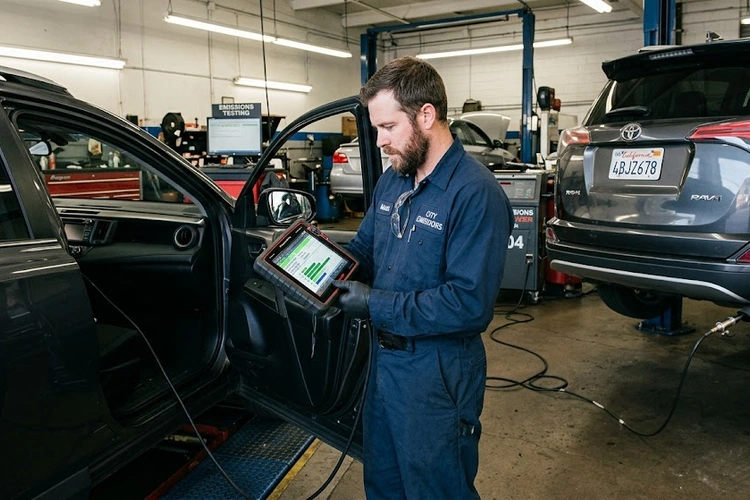
When a car won't pass emissions test requirements, the cause almost always traces back to one of a short list of documented failures — a triggered check engine light, a degraded catalytic converter, or OBD-II readiness monitors that haven't completed their drive cycles. Identifying which failure mode applies converts what feels like a bureaucratic wall into a repair sequence with a clear endpoint.
State-mandated emissions programs — OBD-II plug-in inspections, two-speed idle tests, and ASM dynamometer tests — measure three primary pollutants: hydrocarbons (HC), carbon monoxide (CO), and oxides of nitrogen (NOx). Each pollutant spike traces directly back to a distinct system failure, and each failure has a known diagnostic path that experienced technicians follow without hesitation. Drivers who understand this relationship approach the check engine light reset process with the correct context: clearing the stored code without repairing the underlying fault simply delays the inevitable failure at the next test cycle, adding re-test fees and wasted time to the problem. The sections below cover every common failure cause, the preparation errors that add unnecessary rejections, and the targeted interventions that return vehicles to compliance efficiently.
Contents
Most drivers treat the emissions inspection as a binary pass/fail event, but the test lane runs a precise chemical and electronic audit of the vehicle's combustion efficiency and exhaust aftertreatment performance. Understanding the specific metrics involved makes every downstream repair decision faster and more accurate.
Vehicles manufactured after 1996 are subject to OBD-II-based inspections in the majority of U.S. states, where the inspection station's scanner reads the completion status of up to fifteen self-diagnostic monitors running continuously inside the ECM. The catalyst efficiency monitor, oxygen sensor response monitor, evaporative system integrity monitor, EGR function monitor, and misfire monitor are the five most commonly cited during failures. According to the U.S. Environmental Protection Agency, most states permit one or two incomplete monitors depending on model year, but a single active fault code — a confirmed, illuminated MIL — triggers an automatic disqualification regardless of how many monitors have completed their cycles.
Key readiness monitors and what they verify:
Pre-1996 vehicles without OBD-II systems undergo direct tailpipe sampling, where a probe inserted into the exhaust stream measures HC and CO concentrations at idle and at 2,500 rpm. These tests catch gross emitters that an OBD-II scan would miss entirely because the vehicle lacks the onboard monitoring infrastructure to self-report. A vehicle that fails one test format cannot circumvent the requirement by requesting the other; both formats carry equal legal weight within the applicable model-year brackets defined by each state's program rules.
When a car won't pass emissions test requirements, the failure report identifies which pollutant exceeded the legal threshold, and that single data point narrows the diagnostic field considerably without requiring a full-system teardown. The table below maps each pollutant failure to its primary cause, secondary contributors, and typical repair path.
| Pollutant Over Limit | Primary Cause | Secondary Cause | Typical Repair |
|---|---|---|---|
| High HC | Misfires (fouled plugs, weak coils) | Rich fuel mixture, low compression | Tune-up, compression test, injector cleaning |
| High CO | Rich air-fuel ratio | Faulty O2 sensor, stuck injector | O2 sensor replacement, injector service |
| High NOx | Stuck-closed EGR valve | Lean mixture, coolant system overheating | EGR replacement, cooling system inspection |
| OBD-II Fail (MIL on) | Active confirmed fault code | Incomplete readiness monitors | Diagnose and repair fault, complete drive cycle |
| Failed EVAP | Loose or cracked fuel cap | Failed purge valve, vent valve, or canister | Cap replacement, EVAP component diagnosis |
An illuminated malfunction indicator lamp is an automatic disqualifier in every OBD-II state, full stop. The light signals that at least one fault code has matured past the pending stage and confirmed itself across multiple drive cycles, which means the ECM has high confidence in the fault's existence. Codes that most frequently cause emissions failures include P0420 (catalyst efficiency below threshold), P0440 through P0457 (evaporative emission system), P0300 through P0308 (random and cylinder-specific misfires), and P0171/P0174 (system lean, banks one and two). Erasing the code with a scan tool without correcting the underlying fault causes the monitor to re-run, the condition to re-confirm, and the light to re-illuminate — often before the re-test window closes.
The catalytic converter performs a three-way chemical reaction that oxidizes HC and CO into carbon dioxide and water while simultaneously reducing NOx into nitrogen gas, handling the bulk of a vehicle's emissions compliance load. A converter contaminated by oil burning, silicone intrusion from a degraded coolant seal, or phosphorus from worn piston rings loses substrate efficiency rapidly and cannot process exhaust gases at the rate the ECM expects. An exhaust manifold crack or leaking gasket upstream of the converter introduces unmetered oxygen into the exhaust stream, which corrupts the catalyst monitor's efficiency calculation and triggers P0420 even when the converter substrate itself remains intact — a distinction that saves considerable unnecessary replacement cost when caught during diagnosis.
Elevated HC readings point to incomplete combustion — the engine is igniting fuel but not fully oxidizing it, leaving raw hydrocarbons to exit through the tailpipe. Elevated CO indicates a rich-running condition where more fuel enters the cylinder than the available oxygen can combust. Elevated NOx, the least intuitive of the three, signals excessively lean combustion or abnormally high combustion chamber temperatures caused by a stuck EGR valve, clogged EGR cooler, or a cooling system running above its normal operating range. Vehicles that show hesitation during highway acceleration frequently carry the lean misfire pattern that pushes HC counts past the threshold during the ASM test's loaded, high-speed measurement segment.
A significant share of vehicles that arrive at emissions test lanes are set up to fail before the technician plugs in the scanner — not because of underlying mechanical defects, but because of well-intentioned preparation errors committed in the days immediately preceding the test appointment.
After any fault code is cleared — whether by a repair shop, a dealership, or a personal scan tool — the OBD-II system resets every readiness monitor to "not ready" simultaneously. Those monitors require specific driving conditions to re-run their self-tests: a cold soak below 86°F, a sustained highway segment held at 55 to 60 mph for several minutes, stop-and-go city driving with multiple deceleration events, and a final idle period. The complete manufacturer-specified drive cycle for most domestic and Japanese vehicles requires between one and three days of normal mixed-route driving to fully satisfy all monitors, and arriving at the test lane the same day a repair was completed virtually guarantees a "not ready" rejection that counts as a test failure in most state programs.
After clearing codes or disconnecting the battery, complete at least 100 to 150 miles of varied driving — including a cold start, city stop-and-go, and a sustained highway run — before attempting the emissions test.
Disconnecting the negative battery terminal to erase stored fault codes before the test is a strategy that backfires in two compounding ways. First, the reset wipes all readiness monitors back to "not ready" status, producing the same rejection described above. Second, modern inspection stations log the battery disconnect event as a tampering indicator in several states, which can result in a mandatory waiting period before re-testing is permitted. Vehicles with known oil consumption issues benefit from addressing the consumption source directly rather than masking symptoms; reviewing engine oil color and condition before the test identifies whether active oil burning is contributing HC contamination to the exhaust stream through the PCV system.
Not every emissions failure demands expensive component replacement. A properly maintained vehicle that fails by a narrow margin on one or two pollutants often responds to low-cost interventions that pull the numbers back within legal limits without touching any major drivetrain components.
The drive cycle is the single most effective zero-cost fix available after repairs are complete, provided no remaining fault codes are stored and no new mechanical problems have developed. The generic OBD-II drive cycle sequence follows this pattern:
Vehicles that exhibit stalling behavior during cold-weather starts should not attempt a drive cycle until the underlying cold-start fault is resolved, because incomplete combustion events during the cycle actively prevent the catalyst monitor from completing its efficiency evaluation and may set new pending codes that complicate the readiness picture further.
High HC emissions caused by partially carbonized combustion chambers respond measurably to a fuel system cleaner added to a full tank of premium gasoline before the drive cycle. Formulations containing polyetheramine (PEA) dissolve intake valve carbon deposits and injector tip buildup more effectively than lower-concentration alternatives, and the cleaning action is most pronounced during the sustained highway segment of the drive cycle. Changing the engine oil within 500 miles of the test date removes a secondary HC source: degraded oil with high blow-by saturation introduces additional hydrocarbons through the positive crankcase ventilation system directly into the intake manifold. Checking the condition of the valve cover gasket before the test eliminates another common pathway for oil to enter the intake tract and inflate HC readings at the tailpipe.
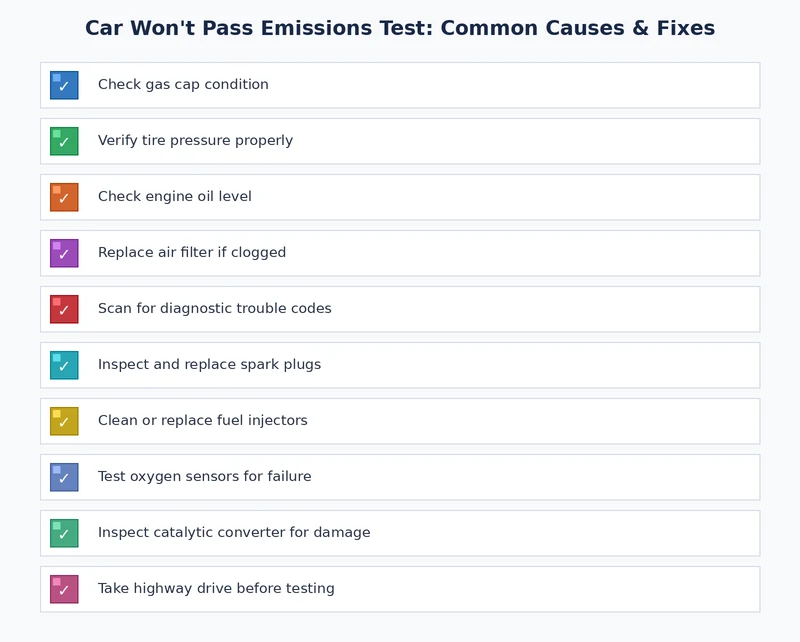
Timing the emissions test correctly avoids re-test fees, wasted trips, and the administrative delay of a recorded failure. Several clear conditions indicate that delaying the appointment is the rational choice, and a few situations exist where showing up with a known marginal issue still makes practical sense.
A scan tool showing three or more incomplete monitors is a reliable signal to postpone the test without exception. Most states allow one incomplete monitor on 1996 through 2000 model year vehicles and zero on 2001 and newer under federal OBD-II testing protocols, though individual state programs vary — consulting the specific state DMV or emissions program guidelines before scheduling matters for borderline cases. The EVAP and catalyst monitors are typically the last two to complete their cycles after a reset, and a readout showing both still in "not ready" status after a full week of normal driving usually points to an unresolved small fault that is actively preventing the monitor from initiating its test sequence. An intake manifold gasket leak that introduces small but persistent vacuum irregularities can prevent the EVAP monitor from building the pressure differential it needs to complete its sealed-system leak test.
Driving directly to the test lane from a cold start is a recurring error on vehicles where the catalyst monitor requires a specific warm-up sequence — including an extended idle and a moderate highway pull — before it records a completed evaluation. A vehicle arriving at the inspection station within the first 8 to 10 minutes of starting from cold means the catalyst hasn't reached the operating temperature window the monitor requires, and the monitor reports "not ready" even when the converter is in perfect condition. That same vehicle, driven 20 to 25 minutes on a mixed route before entering the test lane, often passes without any additional intervention. Vehicles that show rough-running behavior after rain or during cold ambient conditions carry additional risk during the warm-up drive because moisture-induced misfires can set new pending codes that appear mid-cycle and reset the misfire monitor's completion status.
Emissions failures cluster around a small number of recurring scenarios that technicians see repeatedly across different makes and model years. The repair decisions that resolved each scenario demonstrate how the pollutant-specific diagnostic logic connects directly to the test result.
A high-mileage vehicle carrying a P0300 random misfire code alongside 15% positive long-term fuel trim presents one of the most common recurring patterns: a vacuum leak leans out the mixture, the lean mixture generates misfires, and the misfires push HC counts above the threshold during the test's loaded segment. The diagnostic chain runs from the intake system toward the injectors and ignition components in a predictable sequence. In documented repair cases, a failed intake manifold gasket introduced enough unmetered air to push long-term fuel trim above the 10% threshold that reliably flags lean operation in the ECM's adaptive memory. Replacing the gasket and cleaning the injectors returned long-term trim to within ±5% of stoichiometry, and HC counts dropped below the state threshold on the subsequent test cycle without any additional repairs. A persistent exhaust smell inside the cabin accompanying a high-HC failure frequently points to an exhaust leak upstream of the converter that routes unburned hydrocarbons past the catalyst entirely — a separate but equally straightforward problem once identified.
NOx failures rarely present at idle but spike dramatically during the loaded ASM segment of a dynamometer test, which is why vehicles that seem to drive normally in everyday use still fail the inspection. The EGR valve is the primary diagnostic target because its function — recirculating a metered portion of exhaust gas back into the intake charge — directly suppresses peak combustion temperatures and limits NOx formation chemistry. A stuck-closed EGR valve allows combustion chamber temperatures to rise without constraint under load, producing NOx levels that exceed the legal threshold even when the vehicle idles cleanly and pulls smoothly through city traffic. Secondary contributors include a clogged EGR cooler that passes flow but fails to reduce gas temperature effectively, a vacuum-actuated EGR that has lost its diaphragm seal, or a cooling system that allows the engine to run consistently above its designed operating temperature. Confirming that the vehicle doesn't also show hesitation when the AC compressor loads the engine helps eliminate fuel delivery deficiency as a parallel contributing factor, since a fuel-starved engine under compressor load runs leaner and hotter than normal and can generate additive NOx that compounds an EGR problem.
Most vehicles complete all readiness monitors within 100 to 200 miles of mixed driving over two to five days, depending on the manufacturer's specific drive cycle requirements. The catalyst and EVAP monitors typically take the longest because they require precise temperature windows and multiple sequential conditions to run their self-tests. Using a scan tool to verify all monitors show "complete" or "ready" before driving to the test lane eliminates guesswork entirely.
Yes — a loose, cracked, or worn gas cap is one of the most common EVAP system failures and will set a P0442 or P0457 code that illuminates the check engine light and causes an automatic OBD-II test failure. Replacing the gas cap is a low-cost fix, but the code must be cleared and the EVAP monitor must complete its drive cycle successfully before the vehicle is re-tested.
Most states offer a waiver program for vehicles that have exceeded a defined repair cost threshold — typically between $150 and $450 depending on the state and vehicle age — without achieving compliance. The waiver allows registration renewal despite the failure, provided documented proof of qualifying repair expenditures is submitted to the state emissions authority. Waiver eligibility requirements vary significantly by state, so checking the applicable program rules is essential before investing in additional repairs.
Yes, on virtually every OBD-II and tailpipe-test program in the United States. The absence of a converter causes the catalyst monitor to report a confirmed efficiency failure and triggers a P0420 or P0430 code, illuminating the MIL and causing an automatic OBD-II disqualification. On older tailpipe-test vehicles, the raw HC and CO concentrations without a converter present will exceed legal thresholds by a wide margin under any reasonable test condition.
A car that won't pass emissions is never just a paperwork problem — it's the vehicle's diagnostic system pointing directly at a fixable fault, and the test result is the most specific repair direction most owners will ever receive for free.
 |
 |
 |
 |

About Sarah Whitfield
Sarah Whitfield is a diagnostics and troubleshooting specialist who spent ten years as an ASE-certified technician before joining the editorial team. She specializes in OBD-II analysis, electrical gremlins, and the kind of intermittent problems that make most owners give up.
Get some FREE car parts & gear.. Or check out the latest free automotive manuals and build guides here.
Disable your ad blocker to unlock all the hidden deals. Hit the button below 🚗
| | | |
