by Sarah Whitfield
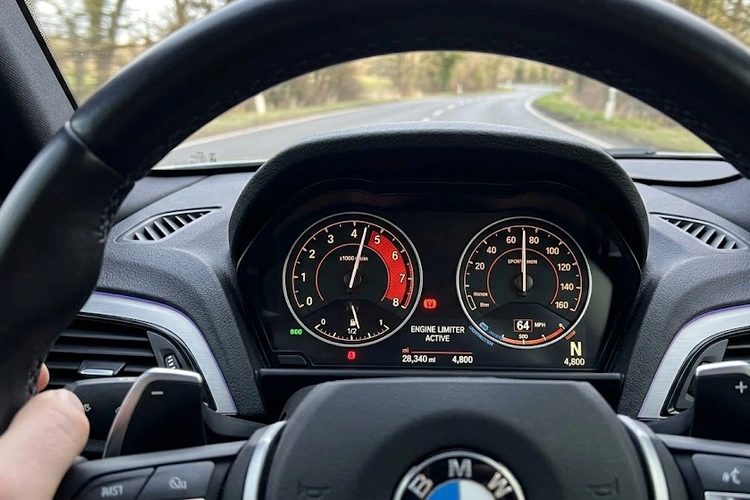
A driver merges onto the interstate, presses the accelerator to pass a slow-moving truck, and the engine climbs to 3,500 RPM — then stops dead. The pedal is floored. The RPM needle does not move. The truck stays in the way.
That scenario is one of the clearest signs that a car won't rev past certain RPM, and it is not a random glitch. The engine management system, fuel system, or a mechanical component is actively limiting output. Identifying which one is the difference between a $15 fix and a $1,500 repair bill. Drivers dealing with related performance drops may also recognize the symptoms described in engine surging at idle — a condition that often shares root causes with RPM ceiling problems.
This guide covers the most common causes, a practical diagnostic workflow, and the best maintenance habits to prevent the problem from returning. All information applies to gasoline-powered passenger vehicles and light trucks with electronic fuel injection.
Contents
The symptom does not always appear the same way. Context matters. The scenario in which the rev limit shows up narrows the list of suspects considerably.
The engine climbs normally through low RPM but hits an invisible wall — usually between 2,500 and 4,000 RPM — under heavy throttle. This pattern strongly suggests a fuel delivery problem. The engine receives enough fuel at light load but cannot keep up with demand during aggressive acceleration. Suspects include:
The car accelerates normally around town but feels throttled at sustained highway RPM. This is a common sign of a transmission entering limp mode — a protective state the OBD (on-board diagnostics) system triggers when it detects an abnormal sensor reading. A failing mass airflow (MAF) sensor or a dirty throttle body can also cap power specifically at higher RPM ranges.
When the engine struggles to rev even in park or neutral, the problem is typically in the air or ignition system rather than fuel volume. Common causes at this stage:
Not every RPM ceiling requires a trip to the dealership. Some causes take fifteen minutes and a basic tool. Others require diagnostic equipment and mechanical experience. The table below sorts the most common causes by difficulty and estimated repair cost.
| Cause | Skill Level | Typical Symptoms Beyond RPM Limit | Estimated Repair Cost |
|---|---|---|---|
| Clogged air filter | Beginner | Reduced power, black exhaust smoke | $15–$30 DIY |
| Dirty MAF sensor | Beginner | Rough idle, poor fuel economy | $10–$25 (cleaner) |
| Fouled spark plugs | Beginner–Intermediate | Misfires, hesitation, hard starts | $30–$100 DIY |
| Clogged fuel filter | Intermediate | Stalling under load, hard starts | $50–$175 with labor |
| Failing fuel pump | Intermediate–Advanced | Whining noise from tank, stalling | $250–$700 with labor |
| Restricted catalytic converter | Advanced | Sulfur smell, heat under car | $500–$1,500 with labor |
| Faulty crankshaft position sensor | Intermediate | Intermittent stalling, no-start | $150–$350 with labor |
| Transmission limp mode | Advanced | Stuck in one gear, warning lights | $100–$1,000+ depending on root cause |
Three causes dominate the beginner-friendly end of the list:
When simple fixes do not resolve the issue, the investigation moves to system-level components. Drivers who also notice a reduced engine power warning on the dashboard are almost certainly dealing with a sensor failure or a transmission protection event — both of which require diagnostic code retrieval before any parts are changed.
Most of the causes listed above are preventable. A consistent maintenance schedule addresses the majority of them before they become drivability problems.
Mechanics consistently point to the same neglected service items when diagnosing RPM limitation complaints:
Drivers who notice a sudden drop in fuel efficiency alongside the RPM problem should read through the causes covered in fuel economy suddenly dropped — fuel delivery and air metering failures often manifest in both symptoms simultaneously.
A basic OBD-II scanner — available for under $30 at any auto parts store — gives drivers a significant diagnostic head start. The general rule:
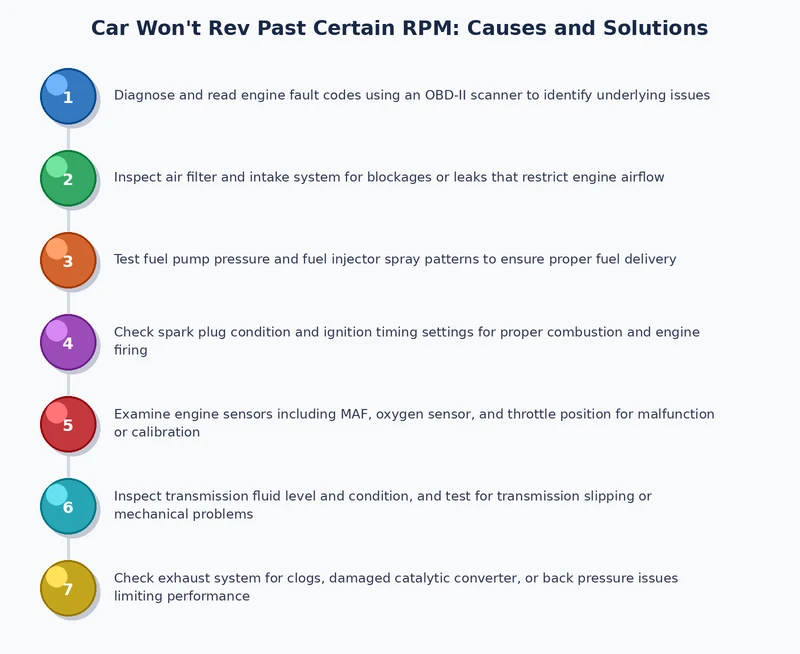
A structured approach prevents wasted parts and money. Follow these steps in order before replacing any component.
If the transmission will not upshift and RPM feels artificially capped, limp mode is the likely culprit. Steps to confirm and address it:
Drivers dealing with related drivability concerns — such as stalling or hesitation — may find overlapping diagnostic steps in the guide covering car backfiring causes, where ignition and fuel delivery faults are examined in detail.
Yes. A failed oxygen sensor sends inaccurate exhaust data to the ECU, which responds by entering a fuel-correction mode that can restrict power and cap usable RPM. The fault almost always stores a P0130–P0167 code series, making it straightforward to identify with an OBD-II scanner.
Short, low-speed trips are generally tolerable, but sustained driving in this condition risks additional damage — particularly if the root cause is a fuel delivery failure starving the engine or a catalytic converter building dangerous heat levels. The vehicle should be diagnosed promptly.
Fuel delivery components that are partially functional can supply adequate volume at light throttle but fail to meet peak demand under wide-open throttle. A weak fuel pump is the most common cause of this load-dependent pattern. Testing fuel pressure at idle versus full throttle confirms or rules it out.
A collapsed or heavily clogged catalytic converter restricts exhaust flow out of the engine. As RPM rises, the engine cannot expel combustion gases fast enough, creating back-pressure that effectively chokes power output and prevents further RPM gains. A technician can measure exhaust back-pressure with a simple gauge at the O2 sensor bung.
Not always. Some conditions — such as a physically restricted air filter or a marginally weak fuel pump — do not always generate a fault code because the sensor readings stay within threshold ranges even as performance degrades. A check engine light is helpful when present, but its absence does not rule out a mechanical problem.
 |
 |
 |
 |

About Sarah Whitfield
Sarah Whitfield is a diagnostics and troubleshooting specialist who spent ten years as an ASE-certified technician before joining the editorial team. She specializes in OBD-II analysis, electrical gremlins, and the kind of intermittent problems that make most owners give up.
Get some FREE car parts & gear.. Or check out the latest free automotive manuals and build guides here.
Disable your ad blocker to unlock all the hidden deals. Hit the button below 🚗
| | | |
