by Sarah Whitfield
Ignition-related defects have generated more than 45,000 consumer complaints in the NHTSA vehicle complaints database, making a car wont shut off scenario one of the most consistently reported electrical failures across all vehicle segments. The engine keeps running after the key is removed, the stop button is pressed, or the vehicle is shifted into park — and the driver is left with few obvious options. The problem rarely appears catastrophic at first, but unaddressed it creates genuine fire risk, battery drain, and theft exposure.
Most cases trace back to a handful of components inside the ignition system. Faulty switches, welded relays, and electrical shorts account for the majority of field reports. The remaining cases involve ECU misbehavior or damaged wiring harnesses — both harder to self-diagnose but still manageable with the right sequence of tests.
Contents
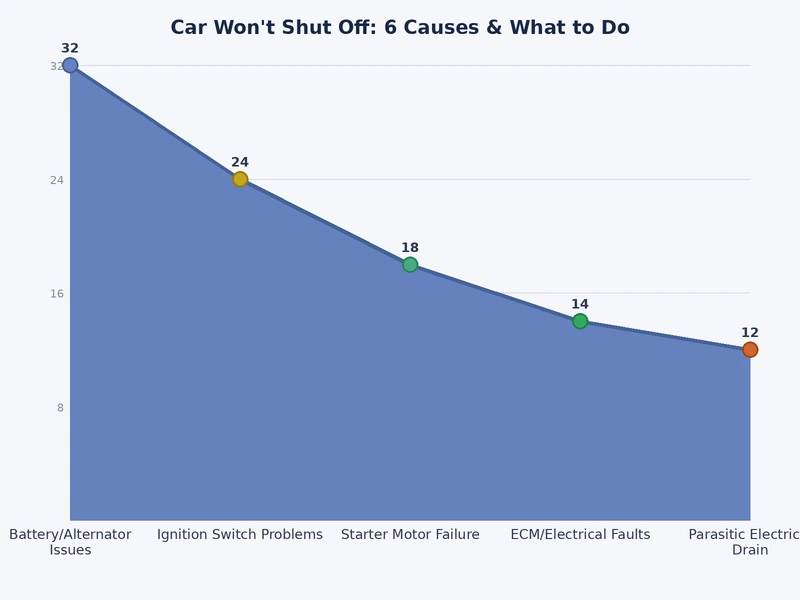
A car wont shut off for one or more of six primary reasons. Narrowing the diagnosis starts with observing what the engine does after the shutdown attempt — does it continue running smoothly, idle roughly, or trigger warning lights? Each pattern points toward a specific failure zone.
The ignition switch is the single most common culprit. It sits behind the key cylinder — or, in push-button vehicles, is actuated by the Body Control Module — and controls current flow to the fuel and ignition circuits. When internal contacts wear, corrode, or fuse together, the switch can no longer interrupt those circuits on command.
GM's high-profile ignition switch recall — covering more than 2.6 million vehicles — remains the most documented example of switch contact burnout cascading into life-safety consequences. Internally fused contacts were the identified mechanism, and the failure mode was intermittent for months before complete failure.
The ignition relay supplies power to critical systems once the ignition switch signals it to close. When the relay's internal contacts weld together — caused by electrical arcing, a voltage spike, or age-related corrosion — current flows continuously regardless of switch position. The engine keeps running because the fuel pump and injectors never lose power.
Pro tip: Locate the ignition relay in the fuse/relay box (the owner's manual shows exact position), then swap it with an identically rated relay pulled from a non-critical circuit. If the engine shuts off normally, the relay was the fault. If the issue recurs after the swap, a repeatedly blown fuse circuit feeding the relay may be delivering abnormal voltage.
Relay failure is especially prevalent in high-humidity climates and vehicles where electrical maintenance has been deferred past the recommended service intervals.
Modern vehicles rely on the Engine Control Unit (ECU) or Body Control Module (BCM) to coordinate shutdown commands across multiple circuits simultaneously. A software glitch, corrupted calibration data, or hardware failure inside the ECU can cause it to ignore or misroute the shutdown signal. Push-button start vehicles are more susceptible because the BCM handles a larger share of the ignition logic directly.
Diagnosing this cause requires an OBD-II scanner capable of reading BCM-specific codes. Consumer-grade scanners rated at $30–$80 often miss these entirely.
A short circuit in the ignition wiring mimics a stuck relay by feeding continuous power to the fuel or ignition circuit. Chafed wiring harness insulation — caused by vibration, heat cycling near the exhaust manifold, or rodent damage — is the most common mechanism. The short bypasses the switch entirely, so the engine receives no off signal regardless of key position.
Electrical faults of this type sometimes generate dashboard anomalies that appear unrelated to shutdown behavior. Cases where all dashboard gauges stop working simultaneously often share the same root cause as ignition circuit faults — a shorted section of the main harness feeding multiple systems at once.
The fuel pump relay is a discrete component from the main ignition relay on most platforms. When its contacts weld shut, the pump continues running after shutdown. The engine itself may actually stop when the ignition circuit opens — but continuous fuel pressurization on older fuel-injected or carbureted systems can sustain combustion briefly or produce crank-like behavior as residual fuel clears the system.
Warning: A fuel pump running continuously with the engine off creates a fire hazard if a fuel line develops even a minor leak. Pull the fuel pump fuse immediately as a precaution while troubleshooting the root cause.
High-mileage vehicles and those with prior accident repairs are prone to harness degradation. Insulation breaks at known stress points — around the firewall grommet, under the instrument panel, and within the steering column harness — can create unintended continuity in the shutdown circuit. Tracing this type of fault requires a wiring diagram and a multimeter set to continuity mode.
Vehicles that have exhibited electrical anomalies following a battery replacement sometimes carry underlying harness issues that were temporarily masked or exposed by the battery swap. Battery disconnection alters ground reference points, which can suddenly make a marginal short detectable.
When a car wont shut off and the driver needs to stop the engine without delay, a clear action sequence reduces risk. Moving methodically — rather than reaching under the hood in traffic — prevents secondary damage.
Disconnecting the negative battery terminal will stop any running engine. This method resets all learned ECU parameters — idle trim, fuel trim, transmission adaptive data — and triggers a relearn period of roughly 50–100 miles before driveability returns to baseline. It is a valid emergency measure, but not a diagnostic step. Disconnecting the battery without identifying the underlying cause means the fault will likely return at the next startup cycle.
Vehicles equipped with transponder-based anti-theft systems may require a re-authentication sequence after reconnection. Consulting the owner's manual before reconnecting prevents lockout situations.
Most car wont shut off failures are preceded by warning signs that routine maintenance would catch. Corroded connectors, aged relays, and worn switches show degraded performance before complete failure — if inspections are scheduled.
Battery health directly affects relay and switch longevity. A weak battery forces elevated current draw through relay contacts during start events, accelerating contact erosion. Annual battery load testing — not simply checking resting voltage — catches marginal batteries before downstream damage occurs.
Wiring inspections should target high-heat and high-vibration zones: the firewall grommet area, the underhood harness running near the exhaust manifold, and the steering column bundle. Cracked or brittle insulation at these points is the documented precursor to the ignition-circuit shorts described above. Combustion anomalies such as spark plug fouling can occasionally produce rough running that owners misdiagnose as a shutdown failure — ruling out combustion-side causes early avoids unnecessary ignition circuit repairs.
Not every car wont shut off scenario requires shop intervention. Relay swaps and fuse pulls are straightforward. ECU and BCM diagnosis, by contrast, demands manufacturer-level scan tools and complete wiring diagrams that are impractical for home use.
ECU and BCM diagnosis requires a manufacturer-specific or professional-grade scan tool — Autel MaxiSys, Snap-on Zeus, dealer-level IDS, or Tech2 equivalents. These platforms run bi-directional relay and circuit actuations, read proprietary module codes, and can command individual outputs to verify circuit integrity. Consumer OBD-II scanners cannot perform these tests.
Note: Replacing a BCM on most late-model vehicles requires VIN-level programming that must be performed by a dealer or a shop with manufacturer programming licenses. A salvage-yard BCM will not function without this step, regardless of whether it fits physically.
Wiring harness repairs that involve splicing into the ignition circuit carry fire risk if the splice work is done incorrectly — improperly joined conductors are a documented ignition fire cause. When harness damage extends beyond a simple connector repair, professional service represents the lower-risk path. Faults that originate in the transmission and generate ECU-level signals — such as an engine that revs but the car won't move — can complicate ignition-shutdown diagnosis by creating conflicting module outputs.
Not every car wont shut off event is a roadside emergency. The correct response depends on what the engine is doing while it runs without authorization.
If the engine runs normally — stable temperature, no warning lights, no fuel smell, no smoke — and the only symptom is refusal to accept a shutdown command, the vehicle can typically be driven a short distance to a repair facility. The risk in this scenario is primarily inconvenience and battery drain, not imminent mechanical failure. The situation should be documented and repaired the same day regardless.
Repair costs for a car wont shut off diagnosis span a wide range depending on the failed component. The estimates below reflect U.S. market averages across independent shops and franchised dealerships.
| Component | Part Cost | Labor (Hrs) | Total Estimate | DIY Feasibility |
|---|---|---|---|---|
| Ignition Relay | $8–$25 | 0.5 | $60–$120 | High |
| Fuel Pump Relay | $10–$30 | 0.5 | $65–$130 | High |
| Ignition Switch | $40–$200 | 1–2 | $140–$400 | Moderate |
| Wiring Harness Repair | $50–$400 | 2–6 | $200–$900 | Low |
| ECU / BCM Replacement + Programming | $200–$1,200 | 1–3 + programming | $400–$2,000 | Low |
| Shop Diagnostic Scan | — | 1 | $90–$160 | N/A |
Relay replacements represent the low-cost end and should always be tested before committing to a more expensive repair path. ECU and BCM replacements sit at the high end — programming costs alone vary significantly by manufacturer, with domestic vehicles typically cheaper to program than European models.
Independent shops generally charge 20–35% less than franchised dealerships for ignition switch and wiring work. For ECU programming, that gap narrows because many independents must subcontract the programming step or purchase manufacturer tool licenses that factor into labor billing.
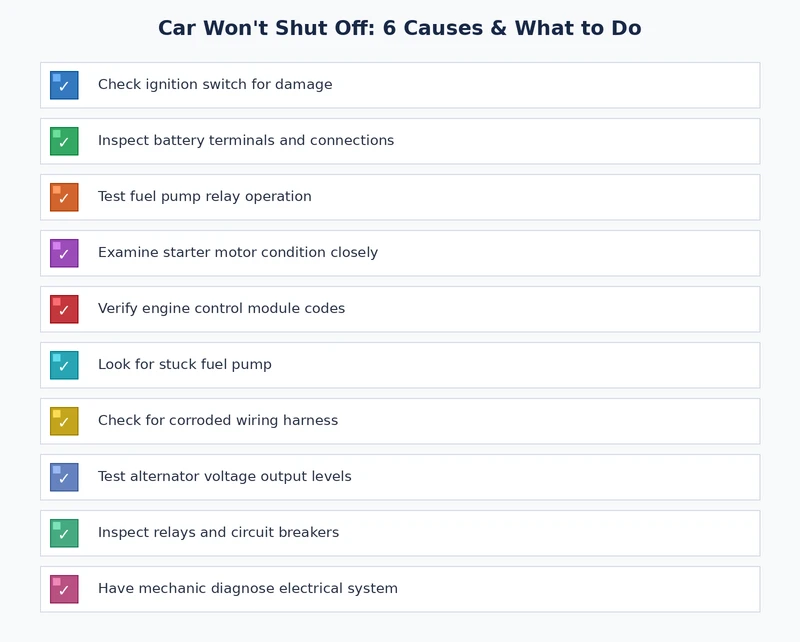
The most common cause is a welded ignition relay or a failed ignition switch with internally fused contacts. Both allow current to flow continuously to the fuel and ignition circuits regardless of key position. ECU or BCM faults produce the same result in push-button start vehicles when the module fails to process the shutdown command.
Short-distance operation to a repair facility is generally acceptable if the engine runs normally with no warning lights, smoke, or fuel smell. Enclosed parking should be avoided entirely. A fuel smell, rising coolant temperature, or underhood smoke changes the calculus to an immediate stop-and-exit scenario regardless of how close the shop is.
Yes. A relay with welded contacts supplies uninterrupted power to its controlled circuits, bypassing the ignition switch entirely. Swapping the relay with a matching spare pulled from a non-critical circuit in the same fuse box is the fastest way to confirm or rule out this cause without any cost.
Pull the ignition relay or the fuel pump fuse first — both are labeled in the under-hood or interior fuse box diagram and will kill the engine within seconds. If the fuse box is inaccessible, disconnecting the negative battery terminal is a reliable last resort. Setting the parking brake and shifting to neutral before any underhood work is standard procedure.
Relay replacement runs $60–$130 at a shop and under $30 DIY. Ignition switch replacement ranges from $140 to $400. Wiring harness repairs span $200 to $900 depending on damage scope and location. ECU or BCM replacement with programming is the most expensive scenario and can reach $2,000 at a dealership on certain platforms.
Disconnecting the battery is safe as an emergency measure but resets ECU learned parameters including idle trim, fuel trim, and transmission shift adaptation. Most vehicles require 50–100 miles of varied driving to fully relearn these values. Some vehicles equipped with transponder anti-theft systems require a re-authentication sequence before normal operation resumes after reconnection.
 |
 |
 |
 |

About Sarah Whitfield
Sarah Whitfield is a diagnostics and troubleshooting specialist who spent ten years as an ASE-certified technician before joining the editorial team. She specializes in OBD-II analysis, electrical gremlins, and the kind of intermittent problems that make most owners give up.
Get some FREE car parts & gear.. Or check out the latest free automotive manuals and build guides here.
Disable your ad blocker to unlock all the hidden deals. Hit the button below 🚗
| | | |
