by Sarah Whitfield
Moisture-related electrical failures account for roughly 12 percent of all roadside breakdown calls logged during rainy-season months, according to data from major automotive service networks, making a car that won't start after rain one of the most common weather-triggered incidents reported to roadside assistance providers. Most of these events trace back to moisture infiltrating electrical connectors, a battery already operating near its minimum threshold, or ignition components that marginal humidity conditions finally push past the point of reliable function. Identifying the specific cause early determines whether the fix is a ten-minute roadside remedy or a scheduled shop visit. Drivers experiencing related electrical behavior — such as those described in the guide on dashboard lights flickering — often find that the same moisture pathways that disrupt instrument circuits affect starting systems in parallel.
Rain introduces humidity and standing water to areas of the vehicle that normally remain dry, and the starting system is particularly vulnerable because it depends on precise electrical connections operating at high current and voltage simultaneously. A single moisture-saturated connector or compromised component can interrupt a chain of events that must complete within milliseconds for the engine to fire.
Contents
Modern engine bays are designed to shed water, but they are not sealed enclosures, and sustained rainfall allows moisture to reach components engineered to remain dry under normal operating conditions. Air intake systems draw in ambient air — and with it, microscopic water droplets that accumulate on sensors, connectors, and ignition components over successive wet cycles. Grille openings, hood gaps, and deteriorated seals around electrical penetrations all serve as infiltration points during heavy rain or when parking on flooded surfaces overnight.
The degree of infiltration depends significantly on vehicle age and service history. Older vehicles with cracked wiring insulation, hardened rubber boots on ignition wires, or compromised distributor cap seals allow moisture to reach high-voltage components directly. Newer vehicles equipped with coil-on-plug ignition systems face fewer of these vulnerabilities but remain susceptible to connector corrosion and sensor signal disruption when seals degrade.
Rain rarely causes a no-start event in a well-maintained vehicle — instead, it reveals pre-existing marginal conditions that had not yet crossed the threshold for failure under dry conditions. A battery at 60 percent health may start the vehicle reliably in warm weather yet fail to deliver adequate cold-cranking amps on a cold, wet morning when internal resistance rises. Spark plug wire insulation with micro-cracks allows current leakage at normal humidity but fails under condensation that forms during a prolonged rain event. Diagnosing rain-specific failures therefore requires evaluating a component's general condition, not searching exclusively for visible water damage.
Spark plugs that become wet from moisture infiltration lose the electrical resistance differential required to produce a spark, effectively short-circuiting the ignition event before combustion can occur. This is among the most common findings when a car won't start after rain, particularly in vehicles with aging plug wire boots or open-cell foam air filters that saturate during heavy rainfall. Removing the plugs, allowing them to dry, and inspecting for carbon fouling or cracking confirms whether simple drying or full replacement is warranted. Vehicles with distributor-based ignition systems are more susceptible than those using coil-on-plug configurations because moisture has more surface area to bridge.
On vehicles equipped with a distributor, the interior of the cap creates a low-pressure zone that draws moist air inward as the engine cools after a run, allowing condensation to form on the rotor and cap contacts. Even a thin film of water on these components disrupts the high-voltage arc required to fire each cylinder in proper sequence. Ignition wire boots that have hardened or cracked allow the same infiltration at individual cylinders. Drying the distributor cap interior with compressed air and applying dielectric grease to all boot connections typically resolves this issue without component replacement.
Pro tip: Applying dielectric grease to ignition wire boots before wet-weather seasons is one of the most cost-effective preventive measures available, and the process takes under 15 minutes on most four-cylinder engines.
Cold rain lowers ambient temperature, which increases the internal resistance of lead-acid batteries and reduces available cold-cranking amperage below the minimum required to spin the starter motor at sufficient speed for ignition. According to the technical overview of lead-acid battery characteristics on Wikipedia, these batteries can lose up to 35 percent of their rated capacity at freezing temperatures compared to performance at 80°F. A battery that tests at acceptable no-load voltage may still fail to deliver the 150 to 200 amperes a starter draws under cold, wet conditions. For further detail on how battery degradation interacts with starter behavior, the article on grinding noise when starting a car addresses the relationship between these two components.
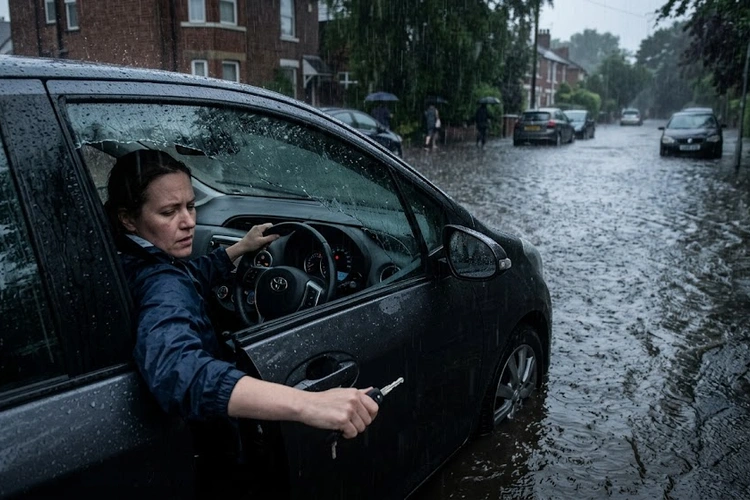
Hydrolock occurs when water enters the combustion chambers in sufficient volume that the pistons — which cannot compress liquid — meet resistance before reaching top dead center, stopping the engine or bending connecting rods on forced cranking attempts. This scenario most often arises when vehicles are driven through standing floodwater that reaches the air intake height, or when a cracked intake tract allows pooled rainwater to drain directly into the intake manifold. Attempting to restart a hydrolocked engine without first clearing the water through the spark plug holes converts a recoverable situation into potentially catastrophic internal damage. Owners who suspect hydrolock should avoid any cranking and seek professional assessment, especially given the risk of water entering the engine oil that commonly accompanies severe water ingestion events.
Position sensors report crankshaft and camshaft location to the engine control module at high speed, and when moisture infiltrates their connectors, the ECM receives erratic or absent signals that prevent fuel injection and ignition timing from functioning correctly. These sensors occupy locations in the engine bay that see significant splash during heavy rain, and their connectors often lack the sealing quality of higher-priority components. Symptoms include no-start conditions that clear after the vehicle dries, intermittent stalling on cold starts in rain, and stored fault codes related to timing signal errors. A code reader displaying P0335 or P0340 points directly to this class of failure, aligning with patterns described in the guide on car cranks but won't start.
The ignition switch routes battery voltage to the starter relay and ECM, and internal corrosion or contact wear can be exposed by the marginal humidity of a rain event, producing an intermittent no-start that may clear on the second or third attempt as switch contacts warm and dry. Because the failure is inconsistent, diagnosis is more challenging than for component failures with obvious physical causes. The detailed walkthrough at how to start a car with a bad ignition switch covers the specific symptoms and bypass methods applicable to this failure mode, including the tap test and voltage-drop measurement that distinguish switch wear from wiring problems.
A systematic visual inspection before calling a tow resolves a significant percentage of rain-related no-start events without tools or significant expense. The following items should be checked in order of accessibility and statistical likelihood:
Attempting a restart is reasonable when the vehicle was parked in light to moderate rain with no signs of floodwater exposure, and when the engine cranks normally but does not fire — indicating the starter motor and battery are supplying adequate power. Calling for professional assistance is appropriate when the engine does not crank at all despite a known-good battery, when the vehicle was driven through or parked in standing water above wheel-hub height, or when smoke appears from the engine bay, a situation warranting immediate attention as outlined in the article on smoke coming from under the hood.
Warning: Repeatedly cranking a flooded or hydrolocked engine risks bending connecting rods and damaging starter motor windings — if the engine does not fire within three short cranking attempts, diagnose before continuing.
Repair costs vary considerably depending on root cause and whether the work is completed by the owner or a shop. The table below reflects typical price ranges at independent repair facilities in the United States, excluding dealer markup premiums.
| Cause | DIY Parts Cost | Shop Labor + Parts | DIY Difficulty |
|---|---|---|---|
| Wet spark plugs (dry and reinstall) | $0 | $60–$120 | Easy |
| Spark plug set replacement | $20–$80 | $120–$250 | Easy–Moderate |
| Distributor cap and rotor | $15–$50 | $100–$200 | Easy |
| Ignition wire set | $30–$100 | $120–$300 | Easy |
| Battery replacement | $80–$200 | $150–$350 | Easy |
| Crankshaft position sensor | $25–$90 | $150–$350 | Moderate |
| Ignition switch replacement | $30–$120 | $150–$400 | Moderate–Hard |
| Hydrolock repair (connecting rod damage) | N/A | $1,500–$5,000+ | Professional only |
Battery swaps, spark plug replacement, and distributor cap work fall within the skill range of most vehicle owners with basic hand tools, and an OBD-II code reader further narrows the diagnosis before any parts are purchased. Position sensor replacement and ignition switch work require precise disassembly procedures that benefit from a vehicle-specific service manual, while hydrolock repair is categorically a professional task because assessing the extent of internal damage requires partial engine disassembly.
Preventive maintenance aimed at moisture entry points substantially reduces the likelihood that a car won't start after rain, and most measures add minimal cost to routine service intervals. Replacing ignition wires and distributor components on schedule — typically every 60,000 to 100,000 miles — removes the primary high-voltage moisture pathways in older ignition systems before they become failure points. Applying dielectric grease to all electrical connectors during any service that involves disconnecting them creates a moisture barrier that persists for years without reapplication. Battery testing at each oil change identifies cells approaching end of service life before cold weather reveals the weakness. The overall state of a vehicle's weatherproofing also shows in interior symptoms — drivers noticing windshield fogging on the inside may find that the same cabin seal degradation affecting interior humidity is contributing to engine bay moisture levels as well.
Drivers in high-rainfall regions benefit from targeted measures beyond standard service intervals. Parking with the vehicle's nose oriented away from prevailing wind during heavy rain reduces the volume of water directed into the grille and air intake path. Moisture-displacing spray applied to the engine bay after washing or before predicted storm events creates a temporary hydrophobic film over ignition components without affecting heat dissipation. Inspecting and replacing cracked hood seals and grille-area foam gaskets every few years removes infiltration channels that factory designs expected to remain intact through the vehicle's service life. For vehicles with known ignition sensitivity to moisture, a manufacturer-recommended engine cover or aftermarket ignition component shield offers a low-cost, permanent layer of protection that requires no periodic reapplication.
In cases where surface moisture on ignition components or spark plugs is the sole cause, the vehicle will often start without issue once temperatures rise and condensation evaporates — though the underlying wear that allowed moisture access persists and will likely produce the same failure during the next significant rain event.
Rain lowers ambient temperature, which increases the internal resistance of lead-acid batteries and reduces the cold-cranking amperage they can deliver; a battery at marginal health may perform adequately in warm and dry conditions but fall below the starter motor's minimum current requirement when cold, wet conditions raise the starting threshold.
If the vehicle starts normally and shows no warning lights, driving after an overnight rain event is generally safe; owners should monitor for rough running or hesitation during the first few miles, particularly watching for symptoms that overlap with those described in the article on car cranks but won't start.
Slow cranking with a no-start after rain most commonly indicates a battery weakened by cold temperature, though it can also point to a starter motor drawing excessive current due to moisture in its brush contacts; a battery load test is the recommended first diagnostic step before pursuing other component-level checks.
Vehicles exposed to floodwater that reached air intake height should not be cranked until a qualified technician has inspected the intake tract, air filter housing, and engine oil for water contamination, as premature cranking attempts can convert a recoverable hydrolock situation into a catastrophic engine failure involving bent connecting rods.
 |
 |
 |
 |

About Sarah Whitfield
Sarah Whitfield is a diagnostics and troubleshooting specialist who spent ten years as an ASE-certified technician before joining the editorial team. She specializes in OBD-II analysis, electrical gremlins, and the kind of intermittent problems that make most owners give up.
Get some FREE car parts & gear.. Or check out the latest free automotive manuals and build guides here.
Disable your ad blocker to unlock all the hidden deals. Hit the button below 🚗
| | | |
