by Sarah Whitfield
A car that won't start after sitting is almost always caused by one of seven predictable problems — most of which any driver can diagnose in a driveway with basic tools. Dead batteries account for the majority of cases, but stale fuel, corroded terminals, and rodent damage all make regular appearances.
When a vehicle sits unused for days, weeks, or months, certain components degrade faster than under regular use. The longer the car sits, the higher the chance that multiple issues stack on top of each other. Pinpointing the root cause quickly saves money and avoids replacing parts that don't actually need it.
For vehicles that briefly crank or fire before dying right away, the problem often overlaps with a related condition covered in Car Starts Then Dies: 7 Causes & How to Fix. Both guides together cover the full range of sitting-related starting failures.
Contents
A no-start condition after storage follows predictable patterns. The table below summarizes all seven causes — storage window, repair difficulty, and whether most drivers can handle it at home.
| Cause | Typical Storage Time | Repair Difficulty | DIY Friendly? |
|---|---|---|---|
| Dead or discharged battery | 2–4 weeks | Easy | Yes |
| Corroded battery terminals | Any duration | Easy | Yes |
| Stale or evaporated fuel | 1–3 months | Moderate | Mostly |
| Failed fuel pump | 6+ months | Hard | No |
| Gummed carburetor / injectors | 3–6 months | Moderate | Partially |
| Rodent damage to wiring | Any duration | Variable | Partially |
| Seized engine | 2+ years | Very hard | No |
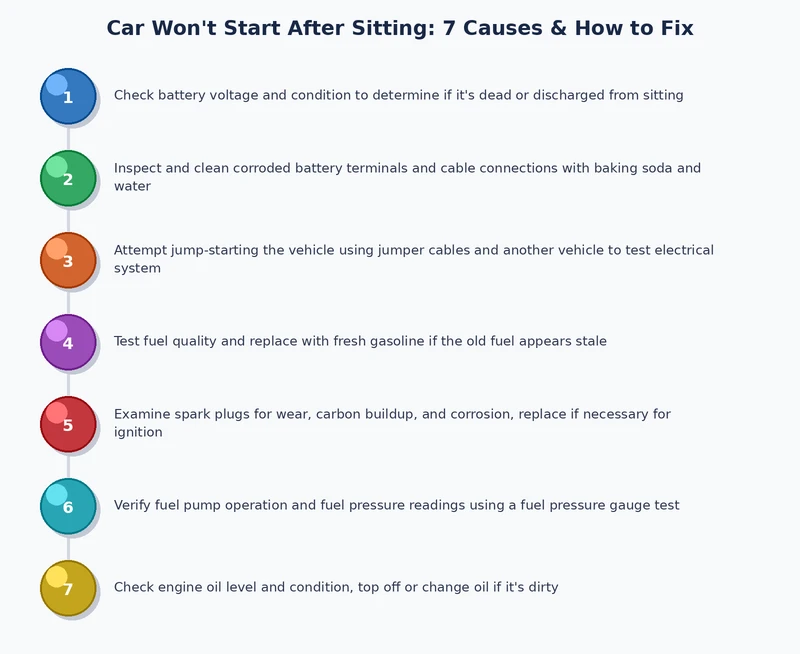
The battery self-discharges when a car sits idle. Modern vehicles draw a small parasitic load (continuous current drain from computers and electronics) even with the engine off. Over two to four weeks, this can pull most batteries below the minimum voltage required to crank an engine.
Lead-acid batteries — the type found in nearly all gasoline-powered vehicles — are especially vulnerable to complete discharge, which causes irreversible sulfation (crystalline buildup on the internal plates) and dramatically shortens battery life.
Signs of a dead battery:
Fix: Jump-start using jumper cables or a portable jump starter, then drive for at least 30 minutes to recharge via the alternator. If the battery discharges again within a few days, replacement is needed. Most automotive batteries last three to five years.
A fully charged battery can still fail to start an engine if heavy corrosion on the terminal posts creates enough resistance to block current flow. White or greenish powder buildup on the terminals is the telltale sign.
Fix: Disconnect the negative terminal first, then the positive. Scrub both posts and cable ends with a wire brush dipped in a baking soda-and-water solution. Rinse, dry, and reconnect positive first. A thin coat of dielectric grease prevents future buildup.
Gasoline begins degrading after about 30 days. Over three to six months, volatile compounds evaporate, leaving behind a gummy varnish that can clog fuel injectors, stick float valves in carburetors, and prevent proper combustion. Ethanol-blended fuel — standard at most pumps — degrades faster than non-ethanol gasoline and actively absorbs moisture from the air.
Fix: Add fresh gasoline and a high-concentration fuel system cleaner. For tanks with heavily degraded fuel, drain and refill entirely. Severely varnished injectors may require professional ultrasonic cleaning. Adding a fuel stabilizer before any planned storage period prevents degradation entirely.
Problems with fuel delivery — not just fuel quality — can also block starting. For a closer look at one common culprit, see Fuel Pressure Regulator Symptoms & How to Test.
The in-tank fuel pump relies on gasoline to lubricate and cool its motor. Running habitually on a near-empty tank or sitting with very low fuel accelerates internal wear. After extended storage, the pump motor can seize or its internal check valve can fail, preventing fuel from reaching the injectors even when the engine cranks normally.
Signs:
Fix: Fuel pump replacement is a shop-level repair on most modern vehicles, requiring the fuel tank to be dropped. Not a practical DIY job for the average driver.
Older vehicles with carburetors are especially prone to sitting damage. Stale fuel deposits varnish inside tiny passages and jets, blocking fuel flow completely. Modern fuel-injected engines can develop partially clogged injectors after several months of inactivity — enough to prevent a cold start even when fresh fuel is added.
Fix for carbureted engines: Disassemble the carburetor, soak all metal parts in carburetor cleaner overnight, and blow out passages with compressed air. Severely damaged carburetors are often cheaper to replace than rebuild. Fix for fuel-injected engines: Start with a high-concentration injector cleaner in fresh fuel. If the engine still runs poorly after that, professional cleaning or injector replacement is the next step.
Mice, rats, and squirrels regularly nest inside parked vehicles and chew through wiring harnesses, vacuum hoses, and fuel lines. A single severed wire can prevent the engine from starting entirely. Chewed fuel lines create a genuine fire hazard.
Signs:
Fix: Inspect the entire engine bay before attempting to start. Repair all chewed wires using proper automotive connectors and heat-shrink tubing — not electrical tape alone. Replace any damaged fuel lines immediately and inspect the tank for contamination.
An engine that has sat for years without being started can seize internally. Engine oil drains away from upper components — the valve train, cylinder walls, and piston rings — over time, leaving bare metal surfaces in contact when the starter attempts to crank the engine. This is rare for storage periods under one year, but common in multi-year storage, especially when the last oil change was long overdue.
Signs:
Fix: Remove the spark plugs and inject penetrating oil — Marvel Mystery Oil or a dedicated engine-freeing product — into each cylinder. Let it soak for 24 to 48 hours, then attempt to turn the crankshaft by hand. Severe seizure requires professional engine work. Once the engine finally starts, listen closely for abnormal noises — the guide on Engine Ticking Sound at Startup explains what different sounds typically indicate and how urgent each one is.
Misconceptions about storage no-starts are widespread. Several beliefs lead drivers to misdiagnose problems and replace parts that don’t need it.
A car that won’t start after sitting has a starting problem — not a warm-up problem. These are distinct conditions. If an engine won’t crank or fire, waiting longer or repeatedly turning the key won’t change anything. The cause needs to be addressed directly.
Most sitting-related no-starts are battery or fuel issues, not internal engine damage. Jumping to costly diagnoses before checking the basics — battery charge, terminal cleanliness, fuel condition — leads to unnecessary shop visits and parts purchases that don’t fix the real problem.
Modern vehicles draw higher parasitic loads from electronics than older models did. A brand-new car left for six weeks without being started can develop a dead battery just as easily as a ten-year-old one — sometimes faster, because of more always-on modules.
A battery maintainer (trickle charger) costs less than a single replacement battery and eliminates the most common storage no-start entirely — one of the highest-value tools a vehicle owner can keep in the garage.
Knowing which repairs fall within DIY range and which genuinely require professional tools saves time and avoids frustration.
For issues that surface after the car starts successfully but runs poorly — such as an abnormally high idle — the guide on Idle Speed Too High: 7 Common Causes & Solutions covers the most likely culprits.
Both approaches work. The right choice depends on the vehicle’s condition, how long it sat, and the owner’s honest assessment of their skill level.
Prevention is far cheaper than repair. A few straightforward steps taken before storage nearly eliminate the chance of a car that won’t start after sitting.
Skipping a pre-start inspection after long storage is where most damage occurs. Before turning the key:
For vehicles that develop post-storage running problems — particularly stalling during slow turns or parking maneuvers — see Car Stalls When Turning: 6 Causes & How to Fix for a detailed breakdown of that specific condition. General maintenance guides are also available through the car care and maintenance category.
Most vehicles can sit for two to four weeks before a dead battery becomes a real risk, depending on the age of the battery and the vehicle’s parasitic drain. Fuel degradation starts around 30 days. For storage beyond three months, multiple systems are at risk — battery, fuel, and potentially the fuel pump.
Sometimes. A battery that has been deeply discharged once may recover and hold a charge if it’s otherwise in good condition. However, repeated deep discharges cause irreversible sulfation that permanently reduces capacity. If a battery discharges again quickly after recharging, replacement is the practical solution.
Yes, in moderate to severe cases. Degraded gasoline loses the volatile compounds needed for ignition. The gummy residue it leaves behind can clog injectors or carburetor jets enough to prevent starting entirely. Mild degradation may just result in rough running, but fuel older than six months in a sitting vehicle is a common no-start cause.
The battery — always. It accounts for the majority of sitting-related no-starts and takes under five minutes to check or jump. If the battery tests good and the terminals are clean, move to the fuel system next. Following this order avoids unnecessary diagnosis of more complex systems.
Yes. Fuel pump damage from sitting is less about an empty tank and more about extended non-use. The pump’s internal motor and check valve can corrode or seize even with fuel present, particularly after six months or more of inactivity. Low fuel levels accelerate the problem significantly.
Rodents enter through the air intake, exhaust pipe openings, gaps around wiring grommets, and any unsealed opening in the firewall or undercarriage. A closed cabin provides no protection for the engine bay. Covering intake and exhaust openings with steel mesh or wire during long storage is an effective deterrent.
For mildly degraded fuel (one to two months old), diluting with fresh gasoline and adding a fuel system cleaner is generally sufficient. For fuel that has been sitting for six months or longer — especially if there is visible varnish or the fuel smells strongly chemical — draining the tank first gives a more reliable result and protects the fuel pump and injectors.
The most expensive repair on a car that won’t start after sitting is almost always the one caused by skipping five minutes of inspection before turning the key.
 |
 |
 |
 |

About Sarah Whitfield
Sarah Whitfield is a diagnostics and troubleshooting specialist who spent ten years as an ASE-certified technician before joining the editorial team. She specializes in OBD-II analysis, electrical gremlins, and the kind of intermittent problems that make most owners give up.
Get some FREE car parts & gear.. Or check out the latest free automotive manuals and build guides here.
Disable your ad blocker to unlock all the hidden deals. Hit the button below 🚗
| | | |
