by Sarah Whitfield
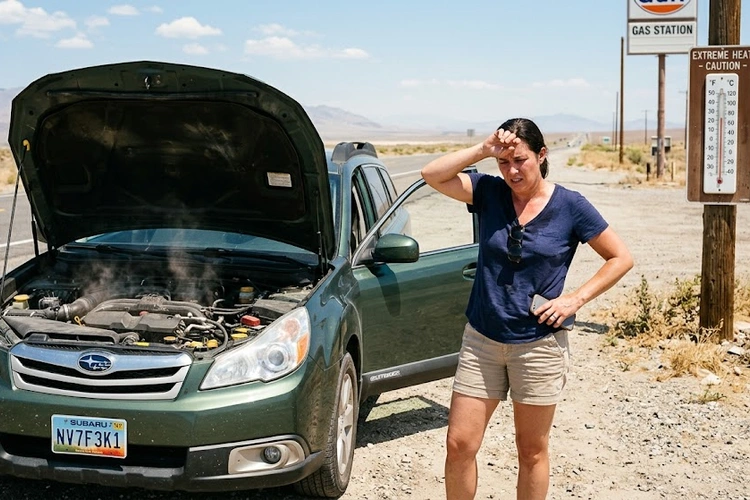
Have you ever returned to your car after a long afternoon in a parking lot, turned the key, and received nothing in response? A car won't start in hot weather for reasons that are entirely distinct from cold-weather failures — and treating them the same way guarantees wasted time and unnecessary repairs. This guide identifies 7 specific causes, explains exactly how to recognize each one, and gives you clear, actionable fixes. If your engine turns over but does not fire, the car cranks but won't start diagnostic category covers that specific failure pattern in detail.
Hot weather imposes unique stress on your vehicle's battery, fuel system, starter motor, and sensors. Each component fails differently under heat. Work through the causes below methodically. Guessing is not a strategy.
Contents
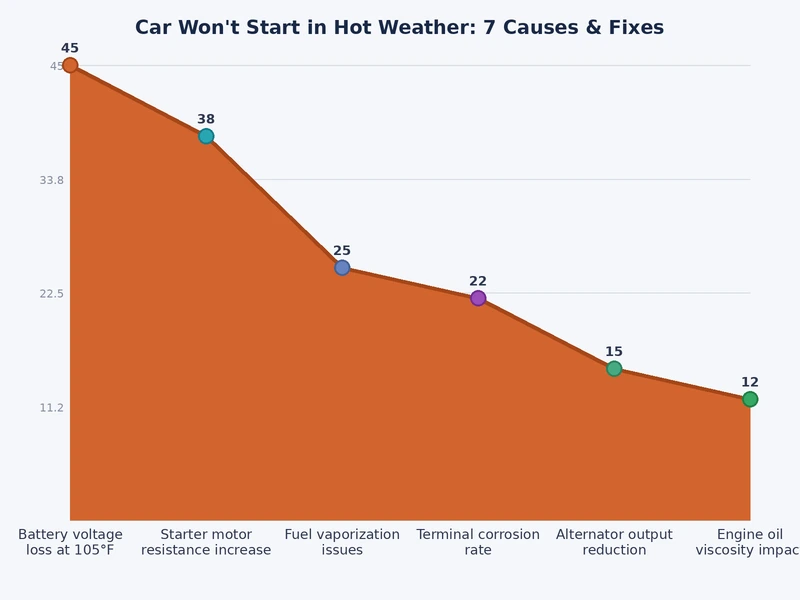
The battery is the single most common reason a car won't start in hot weather. Heat accelerates the rate of internal chemical reactions inside the battery, which corrodes the lead plates and evaporates electrolyte fluid. A battery that performed adequately in spring may fail completely once summer temperatures peak.
If the battery case appears swollen or distorted, stop using the vehicle immediately. A swollen car battery is a genuine safety hazard — internal pressure buildup can cause the case to rupture. Replace it before attempting any further diagnosis.
Vapor lock occurs when fuel vaporizes inside the fuel lines before it reaches the injectors or carburetor. The resulting gas bubbles block liquid fuel delivery. This phenomenon is far more common in older carbureted vehicles, but modern fuel-injected engines are not immune under extreme underhood heat.
Vapor lock is a recognized phenomenon in automotive engineering. Wikipedia's entry on vapor lock notes that higher fuel volatility — common in summer-blend fuels — increases susceptibility, a relevant point for drivers in regions with extreme heat.
In-tank electric fuel pumps rely on surrounding fuel for cooling. When fuel levels run low, the pump loses that thermal buffer and operates at elevated temperatures. Sustained heat exposure degrades the pump motor, and peak summer conditions can push a marginal pump into complete failure.
Pro Tip: Never let your tank drop below one-quarter full in summer. Fuel actively cools the in-tank pump — running low in hot weather is one of the fastest ways to destroy the pump prematurely.
The starter motor sits adjacent to the exhaust manifold on many engine configurations. After a hot engine shuts down, radiant heat from the manifold soaks into the starter housing. Elevated temperatures increase electrical resistance within the starter windings, reducing the motor's ability to draw sufficient current for cranking.
A flooded engine has excess raw fuel in the combustion chamber, creating a mixture too rich to ignite. In hot weather, fuel that evaporates from a heat-soaked engine can over-enrich the intake charge during restart attempts, particularly if you have cranked the engine multiple times without success.
The Evaporative Emission Control system captures fuel vapors from the tank and routes them into the intake for combustion. A failed purge valve or vent valve allows vapor pressure to build inside the fuel tank. Under hot conditions, this pressure differential disrupts normal fuel delivery and makes starting difficult or impossible.
For a complete breakdown of each EVAP fault code and the specific components associated with each, read the EVAP leak symptoms and diagnostic guide. It covers P0440, P0441, and P0442 in precise detail and explains the smoke testing procedure used for definitive diagnosis.
Heat causes certain sensors to fail intermittently. The crankshaft position sensor (CKP) is the most well-known offender — it tells the ECU when to fire the ignition, and a heat-degraded sensor produces an erratic or absent signal. Without a CKP signal, the engine will not start. The coolant temperature sensor and mass airflow sensor are secondary suspects. A dirty throttle body also disrupts the air-fuel ratio at startup.
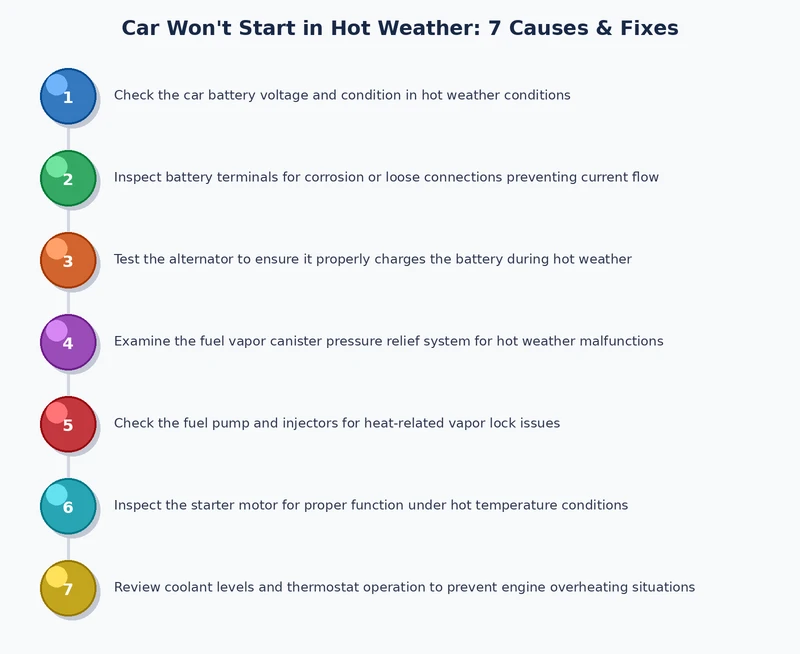
Do not guess and do not panic. Work through this sequence in order every time you face a hot-weather no-start event. Each step eliminates at least one cause.
Warning: Never attempt to jump-start a battery that is visibly swollen, cracked, or leaking fluid. Doing so risks a hydrogen gas explosion. Evacuate the area and call for professional assistance.
Misidentifying a hot-weather no-start as a cold-weather problem leads to incorrect repairs. The failure mechanisms are fundamentally different. The table below clarifies the distinction across every major system.
| Factor | Hot Weather No-Start | Cold Weather No-Start |
|---|---|---|
| Battery behavior | Heat degrades plates; capacity drops permanently | Cold reduces cranking amps temporarily; recovers when warm |
| Fuel system | Vapor lock, fuel pump failure, pressure loss | Fuel gelling (diesel), sluggish injector response |
| Starter motor | Heat soak raises resistance; worst immediately after shutdown | Cold thickens internal grease; adds mechanical drag |
| Sensor behavior | Intermittent failure when hot; resolves after cooling | Generally stable; oil pressure sensor issues more common |
| Timing of failure | After parking in direct sunlight or post short trips | First start of the morning after overnight cold soak |
| Resolution without repair | 20 to 30 minutes of cooling often restores function | Warm-up time, block heater, or jump-start required |
| Most likely fix | Battery replacement, fuel pump, CKP sensor | Battery replacement, fuel system service |
Morning starts occur before underhood temperatures climb. After hours of sun exposure, battery capacity drops, fuel lines absorb heat and become susceptible to vapor lock, and the starter motor operates in a high-resistance thermal state. The combination of these factors — none of which is present in a cool morning start — explains the pattern precisely.
Yes. Voltage at rest measures stored charge, not the battery's ability to deliver cranking amps under load. A battery can read 12.6V at rest and still fail a load test. Heat degrades the internal plate structure, reducing current delivery capacity independent of the state of charge. Always load-test, not just voltage-test, a battery you suspect.
The defining characteristic is resolution with time. If your car refuses to start immediately after shutdown in hot weather but starts normally after sitting for 20 to 30 minutes without any other intervention, vapor lock is the most probable cause. A cranking engine that fires easily after cooling confirms it.
No. Pouring cold water on a hot engine can crack the cylinder head, warp the exhaust manifold, and shatter hot glass components. Allow the engine to cool naturally. If you want to accelerate cooling safely, open the hood to allow convective airflow — nothing more.
Wait a minimum of 20 minutes before attempting a restart. For vehicles with known vapor lock tendencies or a history of heat soak issues, 30 to 45 minutes provides more reliable results. Repeated cranking attempts without waiting deplete the battery and can flood the engine, compounding the original problem.
Yes, indirectly. A dirty throttle body disrupts idle air control and the air-fuel mixture at startup. In combination with heat stress on the fuel system, it can push a marginal start condition into a full no-start. Cleaning the throttle body is a low-cost step worth performing on any vehicle with more than 60,000 miles that exhibits hot starting difficulty.
The most common explanations are vapor lock clearing as fuel cools and returns to liquid state, a heat-soaked starter motor recovering as resistance drops with temperature, or a thermally failing sensor returning to an operational state. The pattern of failure when hot and recovery when cool is the diagnostic signature of all three causes.
Plan for replacement every three years in climates with sustained summer heat above 90°F (32°C). In temperate climates, five years is a reasonable service interval. Do not wait for the battery to fail — a proactive replacement before summer is far less disruptive than a no-start in a parking lot at midday.
A car that won't start in hot weather is telling you something specific about one of its systems — the battery, the fuel pump, the starter, or a sensor. Use the diagnostic sequence in this guide to identify the cause before ordering parts or calling a shop. Start with a battery load test this week, keep your fuel tank above one-quarter full, and schedule a full pre-summer inspection if your vehicle has more than three years on the original battery. A small investment in preventive maintenance now eliminates the far larger cost — and inconvenience — of a roadside failure in peak summer heat.
 |
 |
 |
 |

About Sarah Whitfield
Sarah Whitfield is a diagnostics and troubleshooting specialist who spent ten years as an ASE-certified technician before joining the editorial team. She specializes in OBD-II analysis, electrical gremlins, and the kind of intermittent problems that make most owners give up.
Get some FREE car parts & gear.. Or check out the latest free automotive manuals and build guides here.
Disable your ad blocker to unlock all the hidden deals. Hit the button below 🚗
| | | |
