by Sarah Whitfield
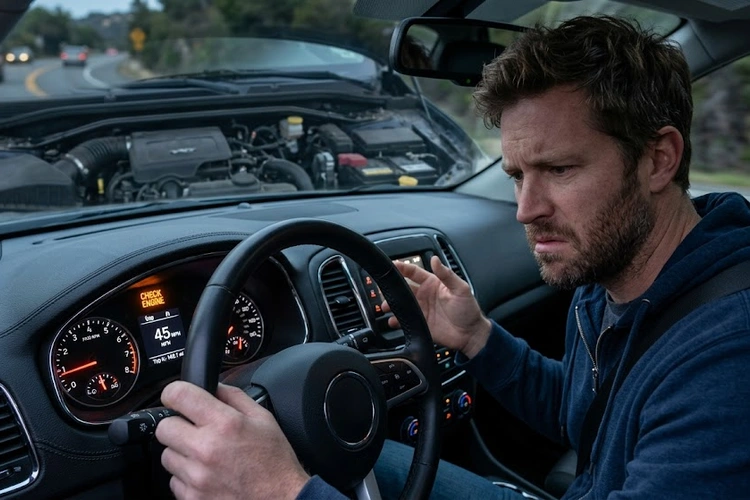
Over 40 million vehicles on American roads have an active check engine light at any given moment, according to the Car Care Council. The striking part: most of those drivers report no performance problems at all. If you have a check engine light on but car runs fine, you're not alone — and you're not necessarily in danger. But you do need answers, and you need them soon.
The check engine light — officially called the Malfunction Indicator Lamp (MIL) — is connected to your car's OBD-II onboard diagnostics system. When any sensor reads outside its expected range, the system logs a fault code and switches on the light. That code is stored in memory. The light itself doesn't tell you what it means. You have to read it.
This guide covers the 8 most common causes, how to diagnose them, and exactly what to do next. Once you've fixed the problem, see our full walkthrough on how to reset the check engine light to clear the code properly.
Contents
Your engine control module (ECM) monitors dozens of sensors continuously. When any reading falls outside the accepted range, the ECM logs a diagnostic trouble code (DTC) and switches on the check engine light. There are over 200 possible DTCs linked to this light alone — ranging from emission system inefficiency to ignition misfires to sensor circuit failures.
The key point: a DTC is a symptom report, not a death sentence. Many codes describe conditions that don't affect drivability at all. The light doesn't distinguish between urgent and minor — that's your job, with the help of a scan tool.
The behavior of the light tells you how urgently to act:
A solid check engine light with no drivability symptoms is the most common scenario drivers encounter. That's the focus of this guide.
Since 1996, all cars sold in the U.S. are required to have a standardized OBD-II port. Any compatible scan tool plugs in and reads stored codes in seconds. Most auto parts stores — AutoZone, O'Reilly, Advance Auto Parts — perform this scan for free. A basic Bluetooth OBD-II adapter costs $20–$30 and pairs with free phone apps to show live sensor data.
Never guess at causes without reading the code first. A free scan is always your first step.
The following eight causes account for the vast majority of cases where the light is on but the vehicle continues to run normally with no obvious symptoms.
This is the single most common cause across all vehicles. A loose, cracked, or missing gas cap triggers an EVAP (Evaporative Emission Control System) leak code — typically P0455 or P0456. If the light appeared shortly after a fill-up, start here before anything else.
Oxygen sensors (O2 sensors) measure unburned oxygen in the exhaust stream. A degrading sensor sends inaccurate data to the ECM, affecting the air-fuel ratio calculation. Early-stage O2 sensor failure often produces zero noticeable driving symptoms — but it quietly degrades fuel efficiency.
The catalytic converter (cat) converts toxic exhaust gases into less harmful compounds. When it degrades below the OBD-II efficiency threshold, the ECM logs a P0420 code. Early-stage cat degradation almost always produces no drivability symptoms — the car feels completely normal while the converter slowly loses function.
Pro tip: Don't replace the catalytic converter on a P0420 code without testing first. A failing upstream oxygen sensor produces the exact same code. Diagnose the O2 sensor before spending $300–$2,000 on a new cat.
The mass airflow sensor (MAF) measures the volume of air entering the engine intake. The ECM uses this data to calculate the correct amount of fuel to inject. A contaminated or failing MAF sends inaccurate readings — enough to trigger a fault code without necessarily causing rough running at low loads.
Worn spark plugs or a weakening ignition coil cause intermittent misfires. Mild or occasional misfires can go completely unnoticed during normal city driving — the engine feels fine — but the ECM still logs every misfire event it detects.
The EVAP system captures fuel vapors from the gas tank and routes them into the engine for combustion rather than venting to the atmosphere. A cracked vapor hose, failing purge valve, or degraded charcoal canister creates a vapor escape that triggers a fault code — with no impact on how the car drives.
If your light appeared right after filling the tank, see our targeted breakdown of the check engine light on after a gas fill-up for step-by-step diagnosis.
The EGR (Exhaust Gas Recirculation) valve routes a portion of exhaust gas back into the intake manifold to lower combustion temperatures and reduce nitrogen oxide (NOx) emissions. A stuck-closed EGR valve sets a fault code but has no immediate effect on how the engine feels at normal driving loads.
A weak battery or failing alternator causes voltage fluctuations that confuse multiple sensors simultaneously. The ECM logs readings that appear out-of-range — triggering fault codes for systems that are actually working fine. If you see multiple unrelated codes appear at the same time, test the battery and charging system before replacing any other parts.
Diagnosis follows a clear three-step sequence. Don't skip ahead to parts replacement without completing all three.
A solid check engine light with no symptoms is generally a low-urgency situation. But certain combinations of warning signs change that calculation entirely.
Even in this low-urgency scenario, get the code read within 2–3 days. Ignoring a stored fault doesn't make it go away. Left unaddressed, minor issues frequently develop into expensive ones.
Warning: Driving on a flashing check engine light for more than a few miles can permanently destroy the catalytic converter — a repair that runs $300–$2,000. Pull over and have the car towed or diagnosed on the spot.
Watch for other dashboard warning lights appearing alongside the check engine light. A traction control light or low tire pressure light appearing at the same time may indicate a broader sensor or electrical issue worth diagnosing together in a single visit.
Several of the most common causes have simple DIY fixes that cost almost nothing. Work through these in order before scheduling a shop appointment.
Costs vary by vehicle make, model, and local labor rates. The figures below reflect typical independent shop pricing. Dealer rates generally run 20–30% higher. DIY parts costs assume you're doing your own labor.
| Cause | Common Code(s) | DIY Parts Cost | Shop Total (Parts + Labor) | Urgency |
|---|---|---|---|---|
| Loose or faulty gas cap | P0455, P0456 | $0–$25 | $10–$35 | Low |
| Oxygen sensor | P0136, P0141, P0171 | $30–$80 | $150–$350 | Medium |
| Catalytic converter | P0420, P0430 | $150–$1,200 | $300–$2,000 | Medium |
| MAF sensor | P0100, P0101 | $50–$150 | $150–$350 | Medium |
| Spark plugs / ignition coils | P0300–P0312 | $20–$120 | $100–$400 | Medium |
| EVAP system leak | P0440–P0456 | $20–$150 | $100–$400 | Low–Medium |
| EGR valve | P0400–P0403 | $50–$200 | $200–$500 | Low–Medium |
| Battery or alternator | Various | $100–$300 | $200–$650 | Medium–High |
Most check engine light causes in this guide are preventable. The light is a symptom management system — the underlying problems develop from deferred maintenance and ignored minor issues.
No. If the light is solid and your car runs normally, you can drive for a few days while arranging a diagnosis — but ignoring it long-term lets minor faults develop into expensive damage. Get the code read within 2–3 days and address the root cause. A flashing light is never safe to drive on; stop immediately.
Sometimes. If the fault condition resolves itself — such as a gas cap you've retightened — the ECM will clear the code automatically after 3 consecutive clean drive cycles and switch the light off. But if the underlying problem persists, the light stays on or returns shortly after being manually cleared.
Yes, in virtually every U.S. state that requires smog inspections. An active check engine light is an automatic failure regardless of what the code is. Clearing the code right before the test also fails — the OBD monitors need 1–3 drive cycles to run and confirm all systems are clean before the car is considered ready for testing.
 |
 |
 |
 |

About Sarah Whitfield
Sarah Whitfield is a diagnostics and troubleshooting specialist who spent ten years as an ASE-certified technician before joining the editorial team. She specializes in OBD-II analysis, electrical gremlins, and the kind of intermittent problems that make most owners give up.
Get some FREE car parts & gear.. Or check out the latest free automotive manuals and build guides here.
Disable your ad blocker to unlock all the hidden deals. Hit the button below 🚗
| | | |
