by Sarah Whitfield
Over 40 million vehicles on American roads are driving right now with a check engine light active, according to annual data from CarMD. That figure makes one thing clear — it is one of the most common and most misunderstood warning signals in a car. But here is what most drivers do not realize: a check engine light flashing and a solid, steady light are two entirely different problems, and they demand two entirely different responses.
Treating a flashing light like a minor nuisance can turn a $60 spark plug replacement into a $2,000 catalytic converter job. This guide breaks down what each light type means, what causes them, and exactly what to do when one appears. Drivers who already know their fault code and want to clear the light can find the process covered in detail at how to reset the check engine light.
Contents
The check engine light — officially called the malfunction indicator lamp (MIL) — connects to the car's onboard computer, known as the ECU (Engine Control Unit). When the ECU detects a fault, it stores a diagnostic trouble code and turns on the light. The way the light behaves tells drivers a great deal about how serious the problem is.
A steady, solid glow means the ECU has stored a fault code but is not detecting a critical, active failure right now. The engine is still running within tolerable limits.
A flashing or blinking light means the engine is actively misfiring right now. Unburned fuel is entering the exhaust system with every misfire. That raw fuel superheats the catalytic converter — the emissions device built into the exhaust system — and can melt its internal structure within a few miles of driving.
| Light Behavior | What It Signals | Urgency Level | Safe to Drive? |
|---|---|---|---|
| Solid / Steady | Stored fault code, no active engine failure | Schedule repair soon | Usually yes (short trips) |
| Flashing / Blinking | Active engine misfire happening now | Stop immediately | No — risk of major damage |
A flashing check engine light almost always traces back to an active engine misfire. The ECU detects incomplete combustion and immediately signals the driver. Here are the most common root causes.
A misfire happens when one or more cylinders fail to ignite the air-fuel mixture correctly. Each misfiring cylinder sends unburned fuel straight into the exhaust. Modern engines fire hundreds of times per minute, so even a small misfire rate causes rapid damage downstream.
Common misfire causes:
The catalytic converter chemically converts harmful exhaust gases before they exit the tailpipe. Under normal operation, exhaust gases arrive hot but predictable. A misfire floods the converter with raw gasoline, raising internal temperatures far beyond design limits. Continued driving with a check engine light flashing can melt the converter's ceramic honeycomb in minutes. Replacement costs range from $1,000 to $3,000 depending on the vehicle — making a timely stop the most cost-effective decision a driver can make. Checking bad catalytic converter symptoms can help determine whether damage has already occurred before a repair visit.
A severely rich (too much fuel) or lean (too little fuel) mixture causes misfires even with healthy spark plugs and coils.
A solid check engine light covers a wide range of faults. Some are trivial. Others require prompt attention. Here are the most common causes drivers encounter.
This is the single most common cause of a solid check engine light. The EVAP (evaporative emission control) system monitors fuel vapors. A loose cap lets vapors escape and triggers a P0455 or P0457 leak code. Tightening or replacing the gas cap ($10–$20) often clears the light on its own after a few normal drive cycles. No scanner required.
Pro tip: If the check engine light appeared right after a fill-up, check the gas cap first — tighten it until it clicks and drive normally for a day before assuming the worst.
Oxygen sensors (O2 sensors) measure unburned oxygen in the exhaust stream to help the ECU fine-tune the fuel mixture. A failing sensor sends incorrect readings, leading to poor fuel economy, rough idle, and higher emissions. Most vehicles have two to four O2 sensors. Replacing a bad one promptly prevents secondary damage to the catalytic converter.
The flashing versus solid distinction is the primary guide. But other symptoms change the calculus even for a solid light. Here is how to read the full picture.
In any of these situations: reduce speed, pull off the road safely, shut off the engine, and do not restart it. Call for roadside assistance or a tow truck.
In this case, it is generally reasonable to drive carefully to a repair shop or auto parts store for a free code scan. Avoid extended highway driving until the code is identified.
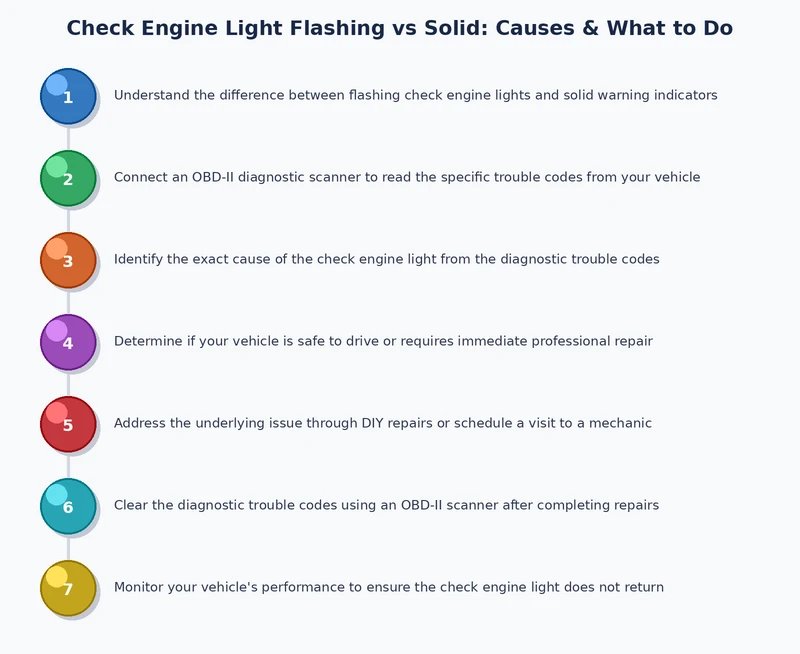
Taking the right steps in the right order prevents further damage and keeps repair costs manageable. Here is the recommended process for either type of light.
All vehicles made after 1996 are required under EPA regulations to support the OBD-II (On-Board Diagnostics, second generation) standard. This makes fault codes readable with any compatible tool.
Major auto parts chains offer free OBD-II scans at the counter. This is a smart first stop before scheduling any paid diagnostic time at a shop.
The right tool depends on the budget and how deep the diagnosis needs to go. Beginner tools handle the majority of check engine light situations. Advanced equipment is for persistent or intermittent faults that basic scanners cannot resolve.
| Tool | Price Range | Best Use Case | Skill Level |
|---|---|---|---|
| Basic OBD-II reader | $20–$60 | Read and clear codes | Beginner |
| Bluetooth adapter + app | $15–$40 | Live sensor data on smartphone | Beginner |
| Free in-store scan | $0 | One-time code check | Beginner |
| Bi-directional scanner | $200–$1,500+ | Full system diagnosis, component tests | Advanced |
| Smoke machine | $50–$400 | Finding vacuum and EVAP leaks | Intermediate–Advanced |
Repair bills for a check engine light vary enormously. The difference between a $15 fix and a $3,000 repair often comes down to how quickly the driver responds — especially when the light is flashing.
| Cause | DIY Parts Cost | Shop Total (Parts + Labor) | Urgency |
|---|---|---|---|
| Loose gas cap | $0–$15 | $0–$25 | Low |
| Oxygen sensor | $20–$90 | $150–$350 | Moderate |
| Spark plugs (full set) | $20–$80 | $150–$350 | High (if flashing) |
| Ignition coil (single) | $30–$100 | $150–$400 | High (if flashing) |
| Fuel injector (single) | $30–$80 | $250–$600 | High (if flashing) |
| Mass airflow sensor | $25–$100 | $200–$400 | Moderate |
| Catalytic converter | $150–$600 (part only) | $1,000–$3,000 | Very High |
The catalytic converter is the most expensive single outcome. It is almost always avoidable by pulling over promptly when the check engine light flashing condition occurs. Ignoring a $60 spark plug replacement can directly cause a $2,000+ repair.
Preventing the check engine light from appearing is mostly a maintenance discipline. A few consistent habits handle the majority of triggers.
 |
 |
 |
 |

About Sarah Whitfield
Sarah Whitfield is a diagnostics and troubleshooting specialist who spent ten years as an ASE-certified technician before joining the editorial team. She specializes in OBD-II analysis, electrical gremlins, and the kind of intermittent problems that make most owners give up.
Get some FREE car parts & gear.. Or check out the latest free automotive manuals and build guides here.
Disable your ad blocker to unlock all the hidden deals. Hit the button below 🚗
| | | |
