Check Gauges Light On: What It Means and What to Do

by Sarah Whitfield

The check gauges light on the dashboard signals that one or more instrument readings have moved outside a safe operating range — and the vehicle requires immediate attention. Ignoring it can lead to serious engine damage or a roadside breakdown. Understanding what triggers the check gauges light on — and how to respond — can prevent a minor issue from becoming a costly repair.

This guide covers the most common causes, a step-by-step response process, and the mistakes drivers make when the warning appears.
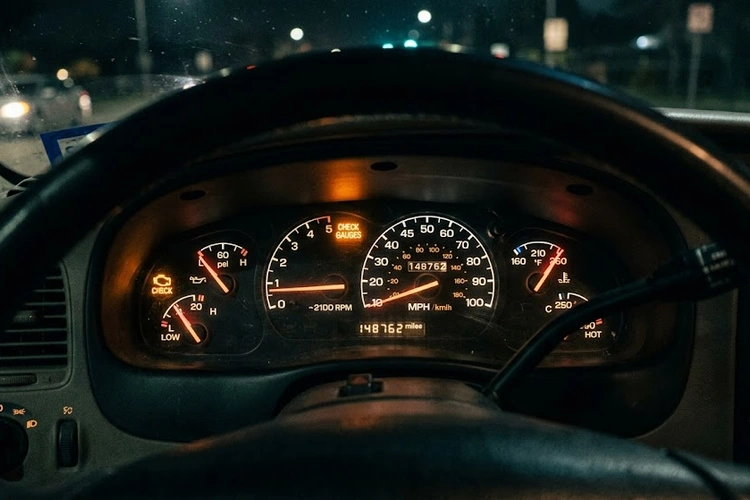
Check gauges light on dashboard warning indicator in a car instrument cluster
Figure 1 — The check gauges warning light illuminated on a vehicle instrument cluster, indicating an out-of-range reading.

What the Check Gauges Light Actually Means

The Instrument Cluster Explained

The instrument cluster (the panel of dials and indicators behind the steering wheel) continuously monitors critical vehicle systems. Most clusters include gauges for engine oil pressure, coolant temperature, battery voltage, and fuel level. Some vehicles also display transmission temperature or turbo boost pressure.

When any one of these readings crosses a threshold defined by the manufacturer, the check gauges light activates. It does not identify the specific problem on its own — it simply directs attention to the cluster so the driver can identify which needle is out of range.

Which Gauges Trigger the Warning

Not every gauge on the dashboard can trigger the check gauges light. The warning is typically linked to the following:

  • Oil pressure gauge — Drops below the safe minimum (usually under 25 PSI at idle)
  • Coolant temperature gauge — Climbs into the red zone, indicating overheating
  • Voltmeter (battery voltage) — Falls below approximately 12V or exceeds 15V
  • Fuel level gauge — On some vehicles, reaching reserve triggers the light
  • Transmission temperature gauge — Present on trucks and performance vehicles

Identifying which gauge is out of range is the first priority after the light appears.

How to Respond When the Check Gauges Light Comes On

Immediate Steps to Take

Speed and calmness both matter. Panicking and pulling over erratically can create a safety hazard. Follow a structured response:

  1. Do not ignore the light. Acknowledge it immediately.
  2. Glance at the instrument cluster. Identify which gauge needle is reading abnormally low or high.
  3. Reduce speed gradually. Avoid hard acceleration until the cause is identified.
  4. Find a safe location. If the oil pressure or temperature gauge is in the danger zone, pull over as soon as it is safe to do so.
  5. Turn off the engine. For oil pressure or overheating warnings, shut the engine off promptly to prevent damage.
  6. Allow the engine to cool. Wait at least 15 minutes before opening the hood if the temperature gauge was high.
  7. Check fluid levels. Inspect engine oil, coolant, and battery terminals with the engine off and cooled.

Pro tip: Never open the radiator cap on a hot engine — pressurized coolant can cause severe burns. Always wait until the temperature gauge reads cool before checking the coolant reservoir.

Reading Individual Gauges

Each gauge has a normal operating band. Most vehicles mark this with a midpoint or green zone. The following guide applies to the majority of passenger cars and light trucks:

Gauge Normal Range Danger Zone Likely Cause If Out of Range
Oil Pressure 25–65 PSI (driving) Below 20 PSI Low oil level, worn pump, oil leak
Coolant Temperature 195–220°F (91–104°C) Above 240°F (116°C) Low coolant, thermostat failure, radiator blockage
Battery Voltage 13.7–14.7V (engine running) Below 12V or above 15V Failing alternator, weak battery, bad connection
Fuel Level Above the E marker At or below E Low fuel — refuel immediately
Transmission Temp 175–225°F (79–107°C) Above 250°F (121°C) Low trans fluid, clogged cooler, heavy towing

The Most Common Causes Behind the Warning

Low Oil Pressure

Low oil pressure is the most serious cause of the check gauges light on. Driving with insufficient oil pressure — even briefly — can cause catastrophic engine wear. Common reasons include:

  • Oil level that has dropped below the minimum mark on the dipstick
  • An oil leak, either internal (valve seals, piston rings) or external (gaskets, drain plug)
  • A worn or failing oil pump that cannot circulate oil adequately
  • Use of the wrong viscosity oil for the climate or engine specification
  • A faulty oil pressure sensor sending incorrect readings

Checking the oil level is the first step. If the level is correct and the pressure gauge still reads low, the vehicle should not be driven until a mechanic inspects the oil pump and sensor.

Engine Temperature and Voltage Issues

An overheating engine is the second most urgent cause. If the coolant temperature gauge climbs toward the red zone, it typically indicates one of the following:

  • Coolant level is low due to a leak or gradual evaporation — see the guide on coolant level keeps dropping for a detailed breakdown of causes
  • The thermostat has failed in the closed position, preventing coolant circulation
  • The radiator fan is not engaging at low speeds or during idle
  • The radiator itself is blocked with debris or internal scale buildup

Voltage issues tend to be less immediately dangerous but still require prompt diagnosis. A reading below 12 volts with the engine running almost always points to an alternator that is not charging the battery properly. A reading above 15 volts suggests an alternator that is overcharging, which can damage the battery and electrical components.

Beginner vs. Experienced Driver Approaches

What Beginners Should Do

Drivers who are unfamiliar with vehicle mechanics should follow a conservative, safety-first approach:

  • Stop driving if oil pressure or temperature is in the red — these two situations carry the highest risk of permanent engine damage.
  • Call for roadside assistance rather than attempting a diagnosis on an unfamiliar vehicle.
  • Do not add fluids randomly. Adding the wrong coolant type or overfilling engine oil can worsen the problem.
  • Consult the owner's manual for the vehicle's specific gauge ranges and recommended fluid specifications.
  • Document what was visible on the cluster — a photo of the dashboard with the warning active helps the mechanic during diagnosis.

What Experienced Drivers Should Check

Drivers with mechanical knowledge can perform a more thorough roadside assessment before deciding whether to continue or stop. Recommended steps include:

  1. Check the engine oil level and condition using the dipstick — dark, gritty oil may indicate it is overdue for a change.
  2. Inspect the coolant reservoir level when the engine is cool. A car leaking antifreeze but not overheating may still show a low coolant reading that triggers the warning.
  3. Inspect visible belt condition — a snapped serpentine belt will disable both the alternator and water pump simultaneously.
  4. Check battery terminals for corrosion, which can create false low-voltage readings.
  5. Use an OBD-II scanner (on-board diagnostics port reader) to pull any stored fault codes that may accompany the gauge warning.

Experienced drivers should also note whether the warning appeared at idle, under load, or at highway speed. This context significantly narrows the list of probable causes for a mechanic.

Mistakes That Make the Check Gauges Warning Worse

Ignoring the Warning

Dismissing the check gauges light as a sensor glitch is the single most damaging mistake a driver can make. While faulty sensors do occur, the risk of assuming that is the case — and being wrong — far outweighs the inconvenience of stopping to investigate.

  • Continuing to drive with low oil pressure can seize the engine within minutes, resulting in a repair bill of several thousand dollars.
  • Driving with an overheating engine can warp the cylinder head (the top portion of the engine block that seals the combustion chambers), requiring a head gasket replacement or full engine rebuild.
  • Ignoring a low voltage warning can result in the vehicle stalling mid-drive as battery reserves deplete.

Misreading the Gauges

Several common misinterpretations lead drivers to either overreact or underreact:
  • Confusing the oil pressure gauge with the oil life monitor. The oil pressure gauge measures real-time hydraulic pressure. The oil life monitor is a maintenance reminder — a completely separate system.
  • Assuming a hot temperature gauge always means a coolant leak. A malfunctioning thermostat or blocked radiator can cause overheating even when coolant is at the correct level.
  • Reading the voltmeter only at startup. Battery voltage is naturally lower before the engine runs. The alternator brings it back to the 13.7–14.7V range within seconds. A persistent low reading with the engine running is the actual red flag.
  • Overlooking the fuel gauge on vehicles where it is tied to the check gauges system — running out of fuel is easily preventable.
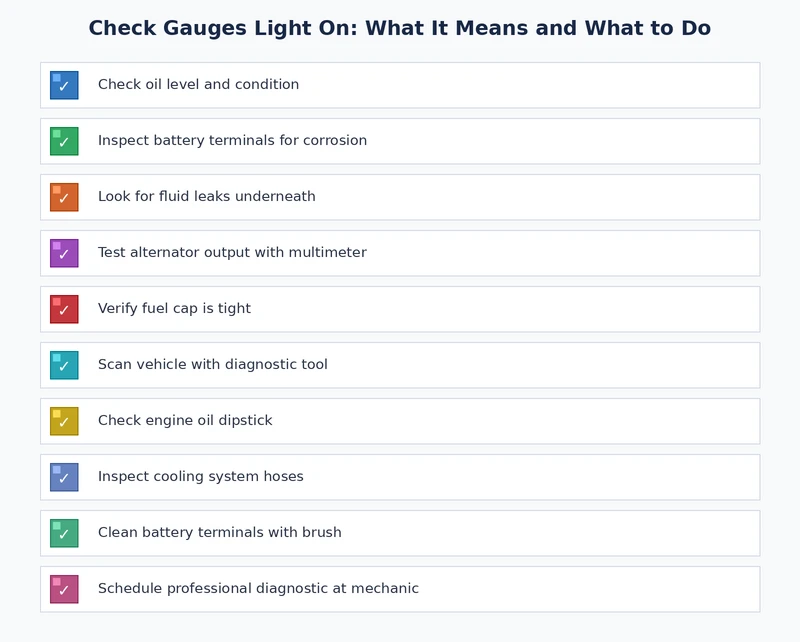
Check gauges light on response checklist showing oil pressure, temperature, and voltage inspection steps
Figure 2 — A visual checklist for responding to the check gauges light on, covering oil, coolant, voltage, and fuel inspection steps.

Frequently Asked Questions

Can the check gauges light come on without a real problem?

Yes. A faulty sensor — particularly an oil pressure sensor or temperature sensor — can trigger the check gauges light even when all fluid levels and systems are functioning correctly. However, drivers should not assume a sensor fault without first verifying that all gauges are reading normally. A mechanic can use a scan tool and manual pressure test to confirm whether the sensor or the underlying system is at fault.

Is it safe to drive with the check gauges light on?

It depends on which gauge is out of range. A fuel gauge approaching empty poses little immediate mechanical risk — refueling resolves it. However, a low oil pressure or high coolant temperature reading requires the vehicle to be stopped immediately. Continuing to drive under those conditions risks severe and permanent engine damage within a short distance.

How much does it cost to fix the issue behind the check gauges warning?

Repair costs vary widely depending on the cause. Topping off engine oil or coolant costs under ten dollars. Replacing an oil pressure sensor typically runs between sixty and one hundred fifty dollars. An alternator replacement ranges from three hundred to six hundred dollars including labor. A blown head gasket from prolonged overheating can cost one thousand to two thousand dollars or more, making early diagnosis the most cost-effective approach.

Next Steps

  1. Pull over safely and identify which gauge is out of range before driving any further — do not continue if oil pressure or engine temperature is in the red zone.
  2. With the engine off and cooled, check the engine oil level using the dipstick and inspect the coolant reservoir level; top off with the correct fluid specification if either is low.
  3. Inspect the battery terminals for corrosion and check that all connections are tight; clean terminals if buildup is visible before ruling out a voltage issue.
  4. Use an OBD-II scanner to retrieve any stored fault codes and cross-reference them with the gauge reading to narrow the diagnosis before visiting a mechanic.
  5. Schedule a shop inspection if the warning light returns after fluid levels are confirmed correct — a failing sensor, oil pump, thermostat, or alternator will require professional diagnosis and replacement.

About Sarah Whitfield

Sarah Whitfield is a diagnostics and troubleshooting specialist who spent ten years as an ASE-certified technician before joining the editorial team. She specializes in OBD-II analysis, electrical gremlins, and the kind of intermittent problems that make most owners give up.

Get some FREE car parts & gear.. Or check out the latest free automotive manuals and build guides here.

Disable your ad blocker to unlock all the hidden deals. Hit the button below 🚗