by Sarah Whitfield
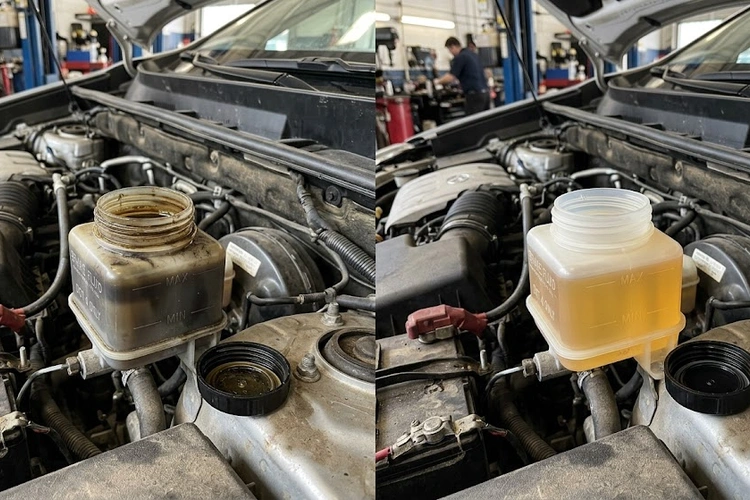
Has the brake fluid in the reservoir ever looked more like used motor oil than a clear liquid? That appearance has a specific name — dark brake fluid — and it demands immediate attention.
Dark brake fluid does not merely look unpleasant. It indicates absorbed moisture, oxidized inhibitors, and accumulated particulates that degrade hydraulic performance. Left unaddressed, contaminated fluid can corrode calipers, damage wheel cylinders, and compromise ABS modulator valves — all before the driver notices any change in pedal feel.
This guide examines the causes of brake fluid discoloration, what different shades indicate, and when a flush becomes non-negotiable. Drivers who have spotted visible fluid loss beneath the vehicle should also review brake fluid leak symptoms to rule out a more urgent hydraulic concern before focusing on fluid color alone.
Contents
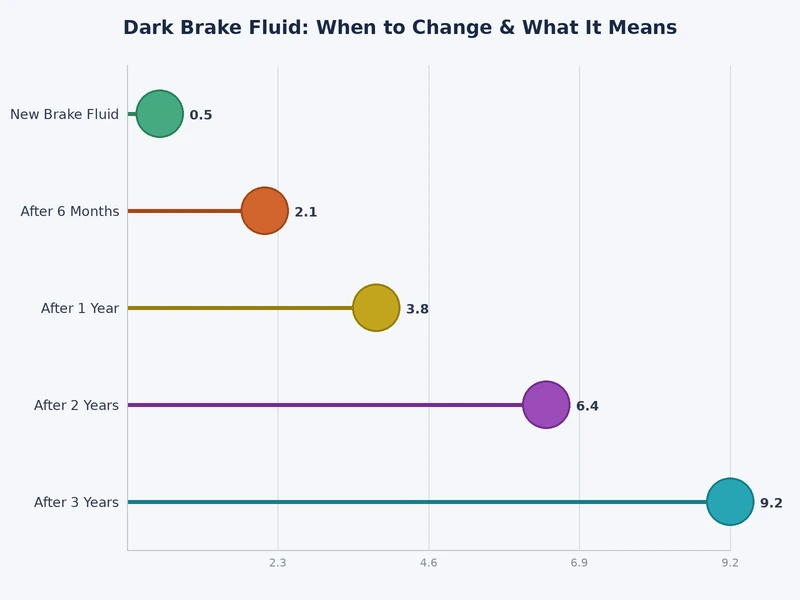
New brake fluid is nearly transparent, ranging from clear to pale yellow depending on the formulation. Most DOT-rated brake fluids — including DOT 3, DOT 4, and DOT 5.1 — share this light appearance when fresh. Over time, the fluid absorbs moisture and thermal byproducts. The color shifts to amber, then brown, and eventually approaches a near-black sludge in severely neglected systems.
The progression is gradual. A driver who inspects the reservoir only during annual service may be surprised to find fluid that has turned almost black. That color signals years of accumulated moisture, depleted inhibitor chemistry, and potentially corroded internal components operating without adequate protection.
Brake fluid is hygroscopic by nature. Glycol-ether-based formulas — covering DOT 3, DOT 4, and DOT 5.1 — actively draw moisture from the atmosphere through microscopic permeation in brake hoses and seals. As water content rises, the fluid's dry boiling point drops measurably. At 3% water content, the wet boiling point of DOT 3 falls to approximately 140°C, well within reach under aggressive urban driving.
The dark color itself originates from two sources: oxidized corrosion inhibitor packages and fine metallic debris shed from corroding brake components. The inhibitors protecting rubber seals and metal bores are consumed over time. Once depleted, corrosion accelerates throughout the hydraulic circuit. This explains why dark brake fluid frequently accompanies early-stage seal failure or pitting inside caliper bores.
DOT 5 silicone fluid resists moisture absorption and maintains a lighter color over time. However, it is incompatible with ABS-equipped vehicles and cannot be mixed with glycol-based fluids under any circumstances. The vast majority of modern passenger vehicles require glycol formulations, making moisture management a routine priority.
Topping off a DOT 4 system with DOT 3 fluid is one of the most common errors in brake maintenance. While the two formulas are chemically compatible, DOT 3 carries a lower dry boiling point. Adding it pulls the blended system's overall threshold downward. During extended downhill driving or emergency stops, that reduced margin increases vapor lock risk significantly.
Adding DOT 5 silicone to a glycol-based system creates a more serious problem. The two fluids do not blend. Phase separation produces inconsistent hydraulic pressure, a mushy pedal, and damage to rubber seals designed for glycol compatibility. The specification printed on the reservoir cap is the definitive reference — it should be consulted before opening any fluid bottle.
The reservoir cap contains a rubber diaphragm that limits atmospheric moisture from reaching the fluid. A cracked, missing, or improperly seated cap allows humid air to circulate freely inside the reservoir. This dramatically accelerates water absorption — even in vehicles that are otherwise well-maintained and serviced on schedule.
Brief exposure during fluid additions also introduces measurable moisture. Leaving the cap off for even a few minutes on a humid day allows water vapor to contact the fluid surface. This parallels a problem seen in other closed fluid systems: contamination from small, overlooked entry points. Drivers familiar with the causes of milky oil on a dipstick will recognize the same principle — water intrusion in sealed automotive fluid systems rarely arrives in large quantities, but it accumulates steadily over time.
Brake fluid warrants inspection at every oil change interval. The visual check requires less than a minute. The fluid should appear light in color and sit between the MIN and MAX marks on the translucent reservoir. Any fluid that has shifted to amber or beyond warrants a more thorough assessment of water content using a test strip or electronic refractometer.
Mileage-based flush intervals vary by manufacturer, but a common benchmark is every two years or 30,000 miles, whichever arrives first. Vehicles used for towing, mountain driving, or occasional track use should observe shorter intervals. Repeated heat cycles degrade inhibitor packages faster than the gradual thermal exposure of routine commuter driving.
Dark brake fluid alone justifies scheduling a flush. Several accompanying symptoms, however, indicate the situation has moved beyond routine maintenance. A soft or spongy pedal suggests moisture-induced vapor formation in the hydraulic lines. A burning smell after braking — without evidence of a dragging pad — often indicates localized fluid boiling in a caliper.
Drivers who have experienced car shaking at low speed during braking should treat degraded fluid as one possible contributor to uneven hydraulic pressure. In such cases, a flush should accompany a full brake inspection rather than serve as a standalone remedy. Replacing the fluid without examining pad thickness and caliper function leaves the root cause unresolved.
A competent home mechanic can perform a brake fluid flush with a modest set of tools. The essential items include a brake bleeder kit — vacuum or pressure type — clear plastic tubing, a collection container, and the correct fluid to the vehicle's specification. A fluid transfer pump or turkey baster is useful for drawing old fluid from the reservoir before introducing fresh fluid at the top.
Nitrile gloves are strongly recommended throughout the process. Brake fluid is corrosive to painted surfaces and mildly irritating to skin on prolonged contact. Immediate cleanup with water prevents paint damage on nearby body panels. Eye protection is advisable when working near pressurized bleeder fittings.
Professional shops employ pressurized power-bleeding machines that cycle fluid through the entire system rapidly. These tools ensure complete displacement of old fluid, including fluid trapped within ABS hydraulic modulator circuits. Home bleeding methods — even when executed correctly — can leave contaminated fluid in ABS passages where it causes the most long-term harm.
Electronic moisture testers and refractometers provide quantitative readings of water content by percentage, removing ambiguity from the visual assessment. Some shops offer complimentary fluid testing during multi-point inspections. This option is worth requesting, particularly for vehicles approaching the two-year replacement threshold.
The precision required in brake hydraulics extends to related systems on the same vehicle. The hydraulic clutch circuit, for example, demands the same discipline regarding fluid contamination — a point addressed in the discussion of clutch chatter causes, where degraded hydraulic fluid contributes to erratic engagement in some cases.
Brake fade is the loss of braking force that occurs when the system overheats. It manifests in two forms: pad fade, which occurs when friction material exceeds its thermal limit, and fluid fade, which occurs when brake fluid boils inside calipers or lines. Dark brake fluid — with its elevated moisture content and reduced boiling point — is the primary driver of fluid fade in neglected systems.
Steam bubbles generated by boiling fluid compress under pedal pressure rather than transmitting hydraulic force. The result is a pedal that sinks toward the floor with diminished braking effect. Fluid fade is especially dangerous on extended descents or during emergency stops in traffic. Drivers who notice a popping noise when braking alongside a soft or inconsistent pedal should treat the combination as a safety-critical concern requiring professional diagnosis without delay.
Degraded brake fluid corrodes the metal and rubber components it contacts. Caliper pistons, master cylinder bores, and ABS solenoid valves are particularly vulnerable to pitting and surface oxidation. Corrosion compromises internal sealing surfaces, leading to bypass leaks, uneven brake bias across axles, and ultimately hydraulic component failure.
Rubber seals interact with contaminated fluid differently than with fresh fluid. As inhibitor packages are depleted, seals begin to swell or harden depending on the nature of the degradation. Once seals fail, fluid escapes the hydraulic circuit. Neighboring components — including strut mounts and suspension hardware in close proximity to calipers — can suffer secondary damage from contaminated fluid spray over time.
The cost of a brake fluid flush is a fraction of the cost of replacing a master cylinder or ABS modulator. Preventive maintenance eliminates these downstream expenses entirely.
| Fluid Condition | Appearance | Estimated Water Content | Recommended Action |
|---|---|---|---|
| New / Fresh | Clear to pale yellow | Less than 1% | No action needed |
| Lightly Used | Light amber | 1–2% | Monitor; flush interval approaching |
| Moderately Degraded | Amber to brown | 2–3% | Schedule flush within three months |
| Heavily Degraded | Dark brown | 3–4% | Flush immediately |
| Severely Contaminated | Near-black with visible sediment | Above 4% | Flush and inspect all brake components |
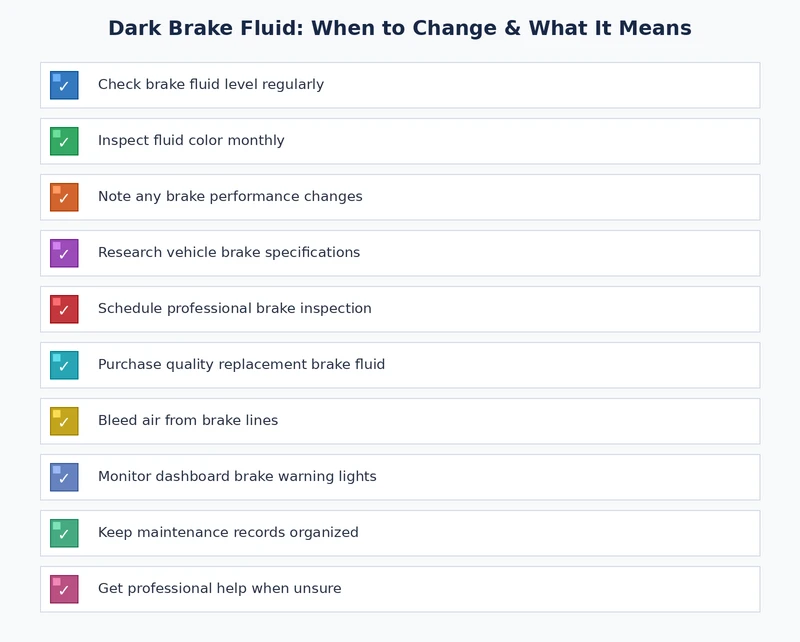
Visual inspection provides a reasonable estimate of fluid condition, but it is not precise. Fluid that appears amber may already contain 2.5% water — beyond the threshold at which boiling point reduction becomes operationally significant. Brake fluid test strips and electronic refractometers offer more reliable readings. Both are available at most automotive retailers for under $20, making routine testing a practical option for home mechanics.
The industry standard threshold for replacement sits at 3% water content for DOT 3 and DOT 4 fluids. Above this level, the wet boiling point drops into a range where city driving can generate enough localized heat to produce vapor. Testing fluid at the reservoir, however, does not capture the condition of fluid inside calipers. Caliper fluid runs hotter and degrades faster than reservoir fluid, meaning the actual system condition is typically worse than what the reservoir sample alone suggests.
A low fluid level in the reservoir does not automatically indicate a leak. As brake pads wear, caliper pistons extend further outward, drawing fluid from the reservoir to fill the expanded caliper volume. A gradual decline in fluid level corresponding to pad wear is expected and normal. A rapid or unexplained drop — particularly when accompanied by a soft pedal — points toward a hydraulic leak somewhere in the system.
Sudden fluid loss combined with the warning signs outlined in the brake fluid leak symptoms guide requires professional evaluation before the vehicle is driven further. Hydraulic failure in a brake system is not a manageable inconvenience — it is a safety emergency.
Owners maintaining high-mileage vehicles should apply the same vigilance to brake fluid that they apply to other fluid systems. Just as a slow tire leak can go unnoticed until it becomes hazardous, gradual brake fluid contamination may not trigger dashboard warnings until hydraulic pressure has already been compromised in meaningful ways.
Topping off brake fluid is appropriate in a limited set of circumstances. If the fluid level has dropped due to normal pad wear, and the existing fluid is still light in color with no visible contamination, adding a small quantity of the correct fluid specification is a reasonable interim measure. This should always be followed by a visual inspection of pad thickness to confirm that wear — not a leak — caused the level drop.
Topping off is not a substitute for a flush. Adding fresh fluid to a reservoir already containing degraded fluid does not meaningfully improve the hydraulic system's condition. The dilution effect is minimal given the small reservoir volume relative to total system capacity. Fresh fluid added at the top does not travel through calipers and lines simply by being present in the reservoir.
A complete brake fluid flush replaces all fluid in the system — reservoir, lines, calipers, and, when performed correctly with proper equipment, ABS hydraulic circuits. This process removes contaminants, restores boiling point margins to specification, and replenishes depleted inhibitor packages throughout the system. The procedure typically takes 30 to 60 minutes at a professional shop.
For vehicles that have not had a fluid change in several years, a flush combined with a thorough brake inspection frequently surfaces secondary issues. Worn seals, marginal pad thickness, or early caliper corrosion are often discovered during the bleeding process. This is consistent with the diagnostic value seen when investigating other hydraulic components — inspecting wheel cylinder condition during a flush can identify slow internal leaks that would otherwise go unnoticed until pedal travel becomes excessive or braking becomes asymmetrical.
In practical terms, topping off addresses a symptom. Flushing addresses the underlying condition. For any vehicle showing dark brake fluid, a complete flush is the correct and complete response.
Dark brake fluid indicates moisture absorption, oxidized inhibitor additives, and accumulated metallic debris from internal brake components. The discoloration reflects a fluid that has degraded beyond its effective service life. Both the discoloration and the contaminants it represents pose a risk to braking performance, component longevity, and overall hydraulic integrity.
Driving with dark brake fluid is inadvisable for any extended period. While the vehicle may stop normally under routine light-braking conditions, heavily contaminated fluid carries a meaningful risk of vapor lock under hard braking or prolonged downhill driving. The prudent approach is to schedule a flush promptly rather than defer on the assumption that normal driving will not stress the system.
Most manufacturers recommend a complete brake fluid flush every two years or 30,000 miles, whichever arrives first. Vehicles subjected to demanding use — towing, mountain driving, or track events — benefit from shorter intervals. The owner's manual provides the manufacturer's specific recommendation and should always serve as the primary reference for service scheduling.
Yes. Heavily contaminated brake fluid with high moisture content produces vapor bubbles when subjected to heat. These bubbles compress under pedal pressure rather than transmitting hydraulic force, causing the pedal to feel soft, spongy, or inconsistent. A pedal that slowly descends toward the floor under sustained pressure is a particularly serious symptom that warrants immediate professional diagnosis.
Fresh brake fluid is clear to pale yellow. Light amber indicates normal aging and is generally acceptable if the moisture content remains within specification. Brown or dark fluid indicates significant degradation requiring a flush. Near-black fluid with visible sediment represents severe contamination that demands immediate replacement and a full inspection of all hydraulic brake components.
Mixing incompatible fluids can accelerate degradation and alter the fluid's appearance. Introducing DOT 3 into a DOT 4 system lowers the blended boiling threshold and may disrupt the inhibitor balance. Introducing DOT 5 silicone into a glycol-based system causes phase separation — the fluids do not blend — which can damage rubber seals and produce inconsistent hydraulic pressure throughout the circuit.
Degraded brake fluid can compromise ABS modulator valves through corrosion and sediment accumulation. ABS solenoids operate within precise hydraulic tolerances. Contaminated fluid containing metallic particles or corrosion byproducts can cause solenoid sticking, delayed ABS activation, or fault codes stored in the ABS control module. Regular fluid maintenance protects ABS hardware with the same effectiveness it protects calipers and master cylinders.
 |
 |
 |
 |

About Sarah Whitfield
Sarah Whitfield is a diagnostics and troubleshooting specialist who spent ten years as an ASE-certified technician before joining the editorial team. She specializes in OBD-II analysis, electrical gremlins, and the kind of intermittent problems that make most owners give up.
Get some FREE car parts & gear.. Or check out the latest free automotive manuals and build guides here.
Disable your ad blocker to unlock all the hidden deals. Hit the button below 🚗
| | | |
