by Sarah Whitfield
What's that musty smell coming through the vents — and why does the AC feel noticeably weaker than it used to? Those are two of the most telling dirty cabin air filter symptoms, and most people drive for months without ever connecting the dots. The cabin air filter sits quietly behind the glove box or under the dashboard, cleaning every breath of air that enters the passenger compartment. When it gets clogged, the effects ripple outward in ways that are easy to mistake for something more expensive — or easy to dismiss entirely.
Our team has put together a thorough breakdown of every major symptom, why each one happens, and what most people realistically need to do about it. We've also covered replacement costs and long-term maintenance practices that help most drivers avoid the mistakes we see repeated all the time. For a full service schedule, our guide on how often to change a car's cabin air filter is worth reading alongside this one.
Contents
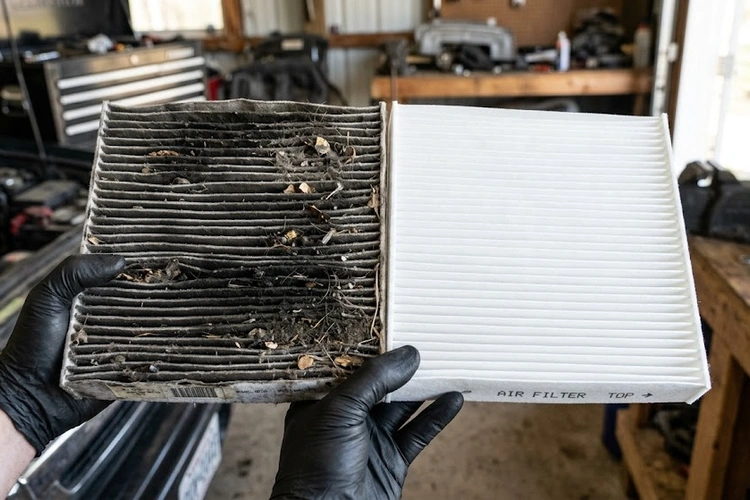
Most people are aware the cabin air filter exists. Fewer understand exactly what it's up against every single drive. The short answer: almost everything airborne that tries to enter through the vehicle's HVAC (heating, ventilation, and air conditioning) system.
The cabin air filter is typically located in one of three spots depending on the vehicle:
According to the U.S. Environmental Protection Agency, concentrations of some pollutants in enclosed spaces — including vehicle cabins — can run two to five times higher than outdoor air levels. A working cabin filter is one of the few real defenses against that buildup while driving.
A standard cabin air filter is designed to catch:
Premium activated carbon filters go a step further, absorbing gases and odors as well. That added capability fades as the filter ages, regardless of how clean the surface looks.
There's no single timeline that applies to every vehicle. Driving conditions vary wildly, and the filter responds accordingly. A car driven mostly on clean highways may go 20,000 miles without noticeable degradation. One driven daily through city construction zones might need a new filter in under 10,000 miles.
Conditions that accelerate clogging:
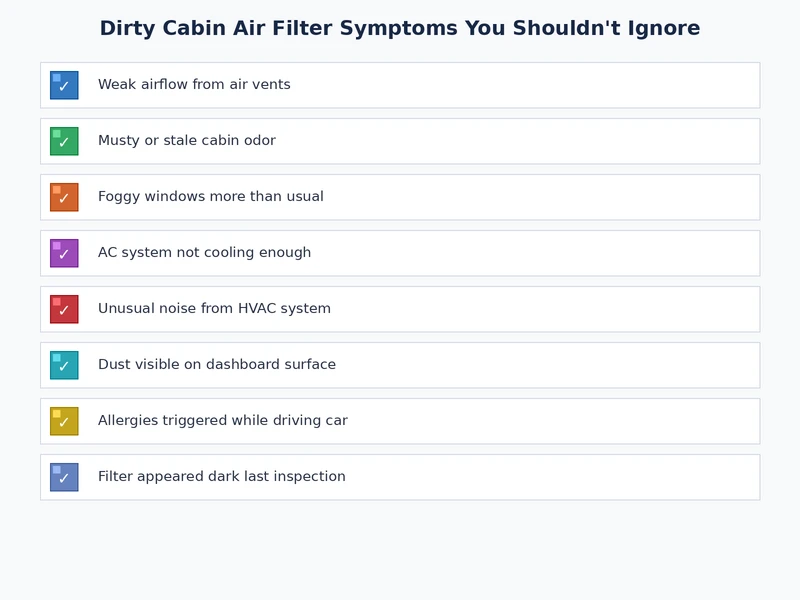
The dirty cabin air filter symptoms outlined below don't always appear together. Many of them closely mimic other HVAC problems. That overlap is exactly why so many people end up chasing the wrong diagnosis — and spending money on the wrong repair first.
Reduced airflow is the most consistent and reliable sign of a clogged filter. When the filter medium is packed with debris, less air passes through regardless of fan speed setting.
What most people notice first:
These symptoms are easy to misread. Our team has seen situations where people replaced the blower motor resistor or assumed a refrigerant leak was responsible — when a straightforward filter swap would have resolved everything. If the AC is also icing over intermittently, a closer look at why car AC systems freeze up can help rule out secondary causes.
A dirty filter doesn't just block airflow — it becomes a breeding ground for mold and bacteria over time. Those microorganisms produce the musty, stale, or sour smells that fill the cabin when the fan turns on.
Common odor patterns tied to a clogged cabin filter:
Persistent cabin odors that don't resolve after a filter replacement may have a deeper source. Our team recommends checking out our guide on diagnosing strange car smells if the problem continues — the evaporator coil or drain line may also need attention.
Pro Tip: Running the fan in recirculation mode with a dirty filter makes odor problems significantly worse — outside fresh air at least dilutes the buildup. Our team recommends switching to fresh-air intake mode as a first step while troubleshooting any cabin smell.
Noise is a less obvious but genuine indicator. When airflow is severely restricted, the blower motor works harder to push air through. That extra strain occasionally produces a faint whistling or wheezing from the vent area.
Other less-common but real symptoms worth noting:
| Symptom | Most Likely Cause | Also Worth Checking |
|---|---|---|
| Weak airflow at high fan speed | Clogged filter restricting air passage | Blower motor, blower resistor |
| Musty smell from vents | Mold and bacteria in saturated filter | Evaporator coil, drain line |
| AC takes long to cool cabin | Reduced airflow across evaporator | Refrigerant level, condenser |
| Dusty cabin despite regular cleaning | Particles bypassing worn filter medium | Filter housing seal condition |
| Whistling from vent area | Air forced through tight restriction | Duct connections, blend door |
| Windshield fogs longer to clear | Reduced defroster airflow | Heater core, blend door actuator |
Our team sees the same patterns repeatedly. The symptoms are real, the diagnosis is often straightforward, but many people end up spending significantly more than necessary before arriving at the obvious answer.
Weak airflow leads many people to assume the blower motor is failing. A musty smell sends others to the dealership asking about mold treatments or full AC system flushes. These aren't unreasonable instincts — both scenarios can produce the same symptoms — but they're expensive first guesses when a cabin filter inspection takes two minutes and costs nothing.
Common misdiagnoses our team encounters:
The cabin air filter should always be the first thing ruled out when any of these symptoms appear. It's the lowest-cost, highest-probability fix available — and checking it requires no tools and no mechanical background on most vehicles.
The other mistake is simply ignoring early symptoms. A slightly musty smell or marginally weaker airflow is easy to tune out. Most people adapt to it gradually until the situation becomes serious.
What tends to happen when replacement is deferred too long:
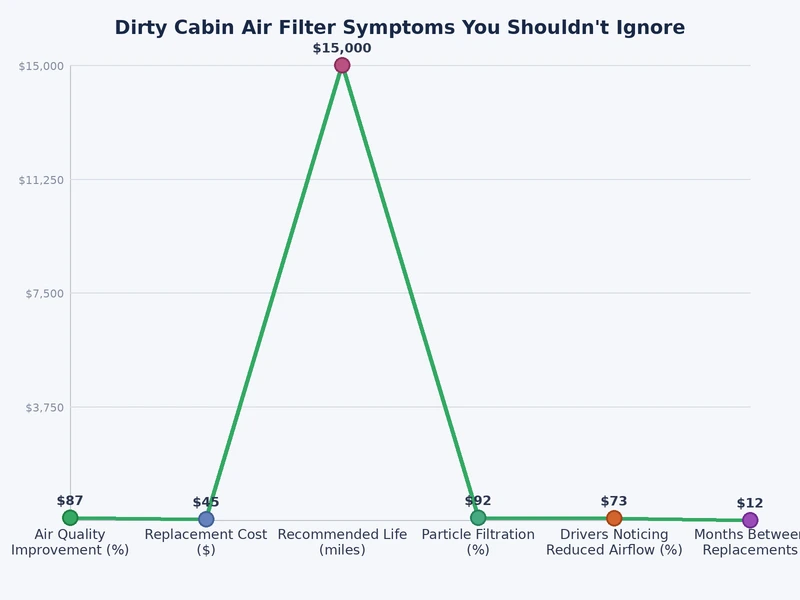
Most manufacturers set a baseline recommendation of every 12,000 to 15,000 miles. That interval drops meaningfully in dusty environments, high-pollen climates, or any area affected by wildfire smoke.
Replacing the cabin air filter is one of the few car maintenance tasks most people can handle without tools or mechanical experience. Getting it right means knowing when to do it and what to buy — not just that it needs to be done.
Some guides suggest tapping or vacuuming a cabin filter to extend its life. Our team considers this acceptable only as a short-term bridge — not a substitute for actual replacement.
Situations where a quick clean is acceptable:
Situations where replacement is the only real answer:
Not all cabin filters perform equally. Most vehicles accommodate one of three main types:
The right choice depends on driving environment. A basic filter works well on clean roads. An activated carbon filter earns its slight premium in city traffic, near industrial areas, or anywhere wildfire smoke is a seasonal concern.
One reason dirty cabin air filter symptoms go unaddressed for so long is the assumption that fixing it will be expensive. In most cases, it's one of the most affordable items on any maintenance list.
The cost range is wide, but the DIY end is genuinely low. Here's what a realistic breakdown looks like across the common service options:
| Service Option | Typical Cost | Notes |
|---|---|---|
| DIY — basic particulate filter | $10–$20 | 5–15 minutes, no tools needed on most vehicles |
| DIY — activated carbon filter | $25–$50 | Best choice for odor problems and urban environments |
| Independent shop (filter + labor) | $40–$70 | Worth it if the filter location is awkward to access |
| Dealership (filter + labor) | $60–$110 | Most expensive route — rarely necessary for this job |
| Evaporator mold treatment (if neglected) | $100–$350+ | Required when mold spreads beyond the filter itself |
The numbers make the case clearly. Catching the problem early costs $10–$50. Letting it go long enough for mold to colonize the evaporator coil turns that into a $100–$350 job — sometimes more, depending on access and the extent of contamination.
The financial argument for regular replacement is straightforward, but the benefits extend beyond avoiding one expensive repair.
Long-term benefits our team consistently observes when maintenance is kept current:
Cabin filter maintenance is one of the few car care habits where the effort-to-benefit ratio is almost always strongly favorable. Most people who establish a mileage-based reminder rarely encounter the more serious downstream problems that come with extended neglect.
Most manufacturers recommend replacing the cabin air filter every 12,000 to 15,000 miles under normal driving conditions. Vehicles operated in dusty environments, high-pollen regions, or areas prone to wildfire smoke may need replacement as often as every 8,000 to 10,000 miles. Our team advises doing a visual inspection at every oil change — if the filter looks noticeably dark or compacted, it's time regardless of mileage.
A severely clogged filter won't stop the AC compressor from running, but it can reduce cooling effectiveness to the point where it feels like the system has stopped working. Restricted airflow limits how much cooled air reaches the cabin and can cause the evaporator coil to ice over under certain conditions. Replacing the filter is always worth trying before assuming a refrigerant leak or compressor problem is responsible.
Driving with a dirty cabin air filter is generally safe in the short term — it won't damage the engine or trigger immediate mechanical failure. However, air quality inside the cabin degrades significantly, which matters more for passengers with respiratory conditions. Extended neglect can also allow mold to colonize the HVAC system, making the eventual repair considerably more involved and expensive than a straightforward filter swap.
The most commonly reported description is musty or mildew-like — similar to a damp basement. Some people describe it as earthy or dusty rather than moldy, particularly in drier climates. The smell is usually most noticeable when the fan first turns on after the vehicle has been sitting. An activated carbon filter helps address odors that go beyond what a standard particulate filter can handle.
 |
 |
 |
 |

About Sarah Whitfield
Sarah Whitfield is a diagnostics and troubleshooting specialist who spent ten years as an ASE-certified technician before joining the editorial team. She specializes in OBD-II analysis, electrical gremlins, and the kind of intermittent problems that make most owners give up.
Get some FREE car parts & gear.. Or check out the latest free automotive manuals and build guides here.
Disable your ad blocker to unlock all the hidden deals. Hit the button below 🚗
| | | |
