by Sarah Whitfield
Is your car shaking at idle, hesitating when you press the accelerator, or stalling at every red light? Dirty throttle body symptoms are frequently the cause — and the fix costs far less than most drivers expect. The throttle body controls the volume of air entering your engine. When carbon deposits (hardened residue from combustion byproducts and oil vapor) coat its interior walls, the engine loses the precise air-fuel balance it needs to run smoothly. The effects ripple across your driving experience in ways that feel alarming but are often straightforward to correct. This guide covers every major symptom, shows you how to perform the cleaning yourself, and explains when cleaning is no longer sufficient.
Before examining symptoms, note that the throttle body does not work in isolation. It operates alongside the idle air control valve, which fine-tunes airflow at low engine speeds. When both components carry deposits, the symptoms overlap and diagnosis becomes more demanding. Addressing the throttle body first is the logical starting point.
Contents
The throttle body is a valve housing that sits between the air intake duct and the engine's intake manifold. At its center is a butterfly plate — a round disc on a rotating shaft. When you press the accelerator, the plate pivots open and allows more air into the combustion chambers. The engine control module (ECM) measures that incoming airflow and adjusts fuel injection to match. The result is the power output you demand from your right foot.
Modern vehicles use an electronic throttle control (ETC) system, often called drive-by-wire. There is no mechanical cable connecting the pedal to the throttle body. Instead, a sensor reads pedal position and sends a voltage signal to a small motor inside the throttle body housing. This system allows the ECM to modulate airflow with precision — but it also means even thin carbon deposits disrupt the sensor's readings and produce symptoms that feel electronic rather than mechanical.
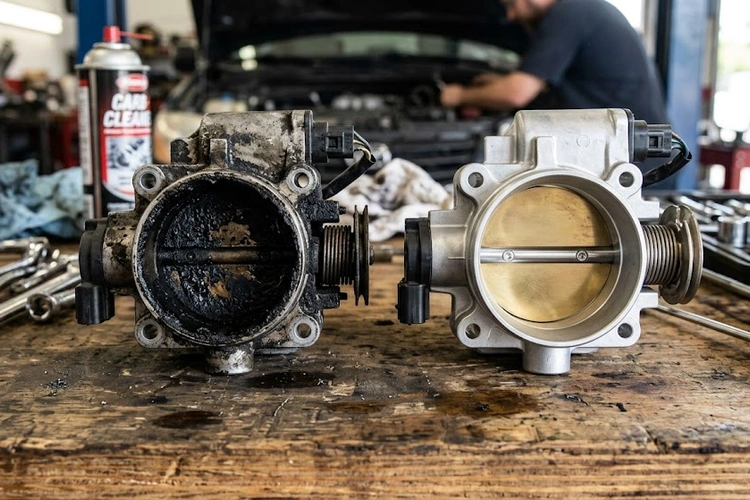
Every gasoline engine produces blowby gases — a mixture of unburned fuel, oil vapor, and combustion byproducts that escapes past the piston rings into the crankcase. The positive crankcase ventilation (PCV) system routes these gases back into the intake to be re-burned rather than vented to the atmosphere. Over tens of thousands of miles, the oily residue in those gases coats the throttle body's interior walls and butterfly plate with a sticky film. That film traps airborne carbon particles, and the layers harden into a thick, rough deposit. Direct-injection engines suffer this problem at an accelerated rate because fuel enters the cylinder directly, so no fuel spray washes the intake side of the throttle body clean between combustion events.
Recognizing dirty throttle body symptoms early prevents misdiagnosis and unnecessary parts replacement. The symptoms below are consistent across most makes and models. When several appear together, a contaminated throttle body is a very likely cause.
A rough, shaky idle is the most common dirty throttle body symptom. The engine vibrates unevenly at a standstill because the deposits have narrowed the air passage, disrupting the airflow the ECM expects. You may notice the RPM gauge hunting — rising and falling in an irregular pattern — instead of holding steady. The ECM attempts to compensate by adjusting fuel trim (the real-time correction to the fuel injection quantity), but the adjustment eventually reaches its limit. At that point, the engine stalls. Stalling most commonly occurs when you decelerate to a stop or shift into neutral.
A contaminated butterfly plate hesitates before opening fully. Press the accelerator and you feel a stumble or a flat spot before the engine picks up speed. This is throttle lag, and it is most dangerous when merging onto a highway or overtaking another vehicle. Some drivers also experience surge — the engine briefly accelerates, then drops back to the previous speed — during steady cruising on the highway. Rich running (too much fuel relative to air) accompanies these symptoms and increases fuel consumption noticeably. If you detect unusual exhaust odors alongside poor performance, the guide on how to diagnose strange car smells helps you interpret what those odors indicate about your engine's condition.
A dirty throttle body produces specific diagnostic trouble codes (DTCs). The most common are P0505 (idle control system malfunction), P0506 (idle speed lower than expected), and P0507 (idle speed higher than expected). Some vehicles also store mass airflow (MAF) sensor codes when deposits distort the incoming airflow signal. A scan tool identifies which codes are present. In many cases, cleaning the throttle body clears these codes permanently — though you must erase them manually with the scan tool after the cleaning is complete.
Cleaning resolves the vast majority of dirty throttle body problems. A smaller number of cases require full replacement. Distinguishing between the two saves you from wasted effort and inaccurate repair estimates.
Cleaning is the correct first step in nearly every situation. The symptoms described above — rough idle, throttle lag, idle-related check engine codes — trace directly to carbon accumulation in almost all cases. If your vehicle exceeds 30,000 miles and the throttle body has never been serviced, contamination is the most probable explanation. Cleaning restores the original diameter of the air passage, allows the butterfly plate to move freely through its full range of motion, and lets the position sensor read accurately again. The total cost for a DIY cleaning is under twenty dollars.
Replacement becomes necessary when the throttle body motor, position sensor, or butterfly plate shaft has suffered mechanical or electrical damage. Warning signs include: a grinding sensation when the plate moves, a plate that sticks open or closed regardless of how thoroughly you clean it, or a throttle position sensor code — P0120 through P0124 — that returns within hours of cleaning and code clearing. Physical damage to the butterfly plate itself (bending or cracking from a backfire event or debris ingestion) also requires replacement. The table below summarizes the decision criteria.
| Condition | Recommended Action | Typical Cost |
|---|---|---|
| Carbon buildup, no physical damage | Clean with throttle body cleaner spray | $8–$20 (DIY) |
| Idle-related codes (P0505–P0507) only | Clean, then clear codes with scan tool | $8–$20 (DIY) |
| Butterfly plate physically bent or cracked | Replace throttle body assembly | $150–$400 |
| TPS fault codes persist after cleaning | Replace throttle body or sensor | $100–$350 |
| Drive-by-wire motor failure (plate sticks) | Replace complete throttle body assembly | $200–$500 |
Throttle body cleaning is one of the most accessible maintenance tasks available to a home mechanic. It requires no specialized equipment. Budget 30 to 45 minutes on most vehicles.
Start with a cold engine. Disconnect the negative battery terminal before you begin. On drive-by-wire vehicles, the butterfly plate is spring-loaded and can snap shut without warning while power is present. Removing battery power eliminates that hazard entirely.
Loosen the hose clamp on the air intake duct — the large rubber tube connecting the air filter housing to the throttle body inlet. Slide the duct free and set it aside. You now have direct access to the throttle body opening. Use your finger or the handle of a screwdriver to hold the butterfly plate open while you work.
Spray throttle body cleaner generously onto the interior walls, the face of the butterfly plate, and into the gap around the plate's edges. Let the cleaner dwell for 30 seconds. Scrub with the soft-bristle brush, paying close attention to the ridge of carbon that typically accumulates along the plate's circumference. Wipe away the loosened deposits with a clean shop towel. Repeat the spray-scrub-wipe cycle until the towel comes away clean and the interior shows bare, shiny metal.
Reinstall the air duct and tighten the clamp securely. Reconnect the battery. Start the engine and allow it to idle for five to ten minutes. The idle may hunt briefly while the ECM relearns the baseline airflow through the now-clean throttle body — this is completely normal. On certain Toyota and Honda models, a specific throttle relearn procedure (a defined idle sequence outlined in the service manual) accelerates this adaptation. Clear stored fault codes with your scan tool after the relearn is complete. Monitor idle quality over the next several cold starts to confirm the symptoms have resolved.
Consistent maintenance habits extend the interval between cleanings and protect the throttle body from the accelerated wear that leads to costly replacement.
According to the U.S. Environmental Protection Agency, a properly maintained engine produces fewer blowby gases — the primary source of throttle body contamination. Adhering to the manufacturer's oil change interval is the single most effective prevention measure. Fresh oil of the correct viscosity reduces blowby, keeps the PCV system operating efficiently, and limits the volume of oily vapor that re-enters the intake. Degraded oil produces far more vaporized residue per combustion cycle. Change your oil on schedule, and you significantly extend the time before deposits reach a level that causes symptoms. Plan to inspect and clean the throttle body at every 30,000-mile service interval, even if symptoms are absent. A light cleaning at 30,000 miles takes ten minutes. A hardened deposit at 90,000 miles takes considerably longer.
A clogged or poorly sealed air filter allows fine particles into the intake stream. Those particles mix with the oily film on the throttle body walls and accelerate deposit formation dramatically. Replace the engine air filter at the interval specified in your owner's manual — typically every 15,000 to 30,000 miles, shortened for dusty driving environments. Inspect the intake duct and its clamps for cracks or loose connections that allow unfiltered air to bypass the filter entirely. Unfiltered air carries abrasive grit directly onto the throttle plate and position sensor. A related maintenance concern involves the timing chain, which also accumulates contamination-related wear over high mileage. If you hear unusual sounds from the top of the engine after cleaning the throttle body, review the guide on timing chain noise symptoms to determine whether a separate issue needs attention. For drivers who store a vehicle for extended periods, the guide on how to maintain a car that sits unused for months covers the additional precautions that protect the intake system during dormancy.
Clean the throttle body every 30,000 miles as a standard maintenance interval. Vehicles operating in dusty or stop-and-go traffic conditions may benefit from cleaning every 20,000 miles. Direct-injection engines accumulate deposits faster than port-injection engines and warrant the shorter interval.
A severely contaminated throttle body can prevent a cold start, but this is uncommon. More typically, a very dirty throttle body causes extended cranking, stalling immediately after start-up, or an inability to maintain idle once the engine fires. True no-start conditions more often involve the fuel system or ignition.
Most throttle body cleanings take 30 to 45 minutes for a home mechanic working at a comfortable pace. The process is straightforward: remove the intake duct, spray and scrub the housing, reinstall, and allow the ECM to relearn idle parameters. Professional shops typically charge one hour of labor.
Do not use carburetor cleaner on a modern throttle body. Carburetor cleaner contains aggressive solvents that damage the plastic housings, rubber seals, and sensor components common in electronic throttle control systems. Use a cleaner specifically labeled for throttle bodies, which is formulated to be safe on these materials.
Ignoring dirty throttle body symptoms allows deposits to harden further and accumulate additional layers. Over time, the butterfly plate may bind on the deposits and lose its full range of motion. Fuel economy worsens, performance degrades progressively, and the risk of a stall in traffic increases. Early cleaning is always less costly than deferred maintenance.
Yes. A clean throttle body restores accurate airflow measurement, which allows the ECM to calculate the correct fuel injection quantity. Rich running — the fuel waste that accompanies a restricted air passage — stops. Most drivers report a noticeable improvement in fuel economy within the first tank of fuel after a successful cleaning.
 |
 |
 |
 |

About Sarah Whitfield
Sarah Whitfield is a diagnostics and troubleshooting specialist who spent ten years as an ASE-certified technician before joining the editorial team. She specializes in OBD-II analysis, electrical gremlins, and the kind of intermittent problems that make most owners give up.
Get some FREE car parts & gear.. Or check out the latest free automotive manuals and build guides here.
Disable your ad blocker to unlock all the hidden deals. Hit the button below 🚗
| | | |
