by Sarah Whitfield
A dome light left on overnight can drain your car battery completely in as little as four to eight hours, leaving you with an engine that won't start and a morning that's already off to a rough start. When your dome light stays on after you close every door and shut off the ignition, it pulls a steady current from your battery around the clock, and that kind of invisible drain adds up fast. The good news is that the most common causes are simple to find and fix on your own driveway without a trip to the shop.
This guide walks you through every common reason a dome light stays on, how to run a step-by-step diagnosis with basic tools, and when it actually makes sense to hand the job off to a mechanic. Because a stuck dome light is one of the sneakier reasons behind a car battery that keeps dying, catching it early can save you from a far more expensive problem down the road.
Contents
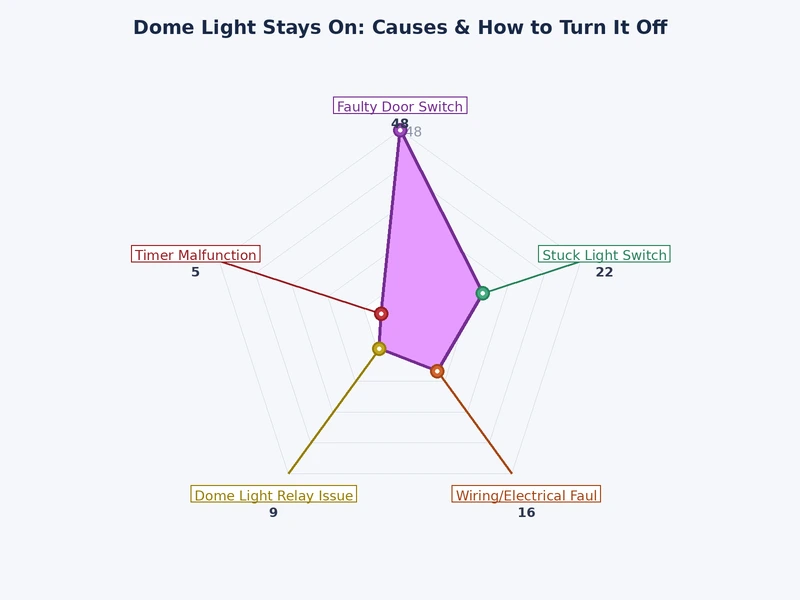
When your dome light stays on after closing all the doors, the problem almost always falls into one of three buckets: a switch or sensor that's stuck in the wrong position, a setting you or someone else changed accidentally, or an electrical fault somewhere along the wiring circuit. Knowing which bucket you're dealing with lets you go straight to the right fix rather than working through a long list of guesses.
The door jamb switch — the small button-shaped sensor nestled into the door frame that your door presses when it closes — is the most common culprit when a dome light stays on. When this switch gets stuck in the open position, either from dirt, corrosion, or a worn plunger, your car's body control module (BCM) thinks a door is still ajar and keeps the light running. These switches are inexpensive, usually under fifteen dollars, and are easy to swap out in about twenty minutes. A failed door jamb switch can also affect other accessories, so if you're seeing other quirks at the same time, check out our guide on interior car lights not working for a broader look at related electrical faults.
Every vehicle has a dome light control knob or slide switch that lets you force the light permanently on, keep it off entirely, or run it in door-triggered mode. If anyone in your car nudged this switch to the "on" position — which happens surprisingly often during cleaning, reaching for something overhead, or in tight parking situations — the light will stay on no matter what the doors do. This is worth checking before you do anything else because it's a ten-second fix with a 100% success rate when it's the cause.
A less common but trickier cause is a short circuit or chafed wire inside the door wiring harness, particularly in the flexible rubber conduit (the accordion-shaped boot where wires travel between the car body and the door). Over time, repeated door opening and closing can crack or wear through wire insulation in that boot, causing wires to contact each other and send a false signal to the dome light circuit. According to the Wikipedia overview of automotive lighting systems, interior lighting circuits in modern vehicles share ground paths with multiple accessories, which means a single wiring fault can affect more than just the dome light.
| Cause | How Common | DIY Difficulty | Typical Repair Cost |
|---|---|---|---|
| Dome light switch left on "on" | Very common | Trivial | Free |
| Stuck door jamb switch | Very common | Easy | $5–$25 |
| BCM software glitch | Occasional | Moderate | $50–$150 (reset) |
| Chafed door harness wire | Less common | Moderate | $30–$200 |
| Incorrect fuse installation | Rare | Easy | $2–$10 |
| Failed door latch position sensor | Rare | Moderate | $20–$80 |
Understanding the three basic positions on your dome light control switch makes it much easier to rule out user error before you start pulling door panels apart, and it helps you choose a default setting that protects your battery over the long term.
The "door" setting — often shown as a small car-door icon or labeled "auto" — activates the dome light whenever any door opens and shuts it off a few seconds after all doors are closed and latched. The "off" position keeps the light dark regardless of door activity, which some drivers prefer for privacy or to avoid distractions at night. The "on" position forces the dome light to stay illuminated continuously, and it's the setting that most commonly causes an accidental all-night drain when someone forgets to switch it back before parking.
Keeping your dome light in "door" mode is the safest setting for battery health — you get cabin lighting when you need it, and it shuts off automatically once everyone is inside and the doors are closed.
Some vehicles include a timed delay feature that dims the dome light gradually over thirty to sixty seconds in door mode, giving you a little extra light after you get in and sit down. If your car has this feature and you want to preserve it, make sure whoever works on your interior electrical system doesn't accidentally disable it by replacing a BCM or resetting the system without reprogramming the delay. Vehicles without the delay feature are slightly more vulnerable to the "I just checked the back seat quickly" drain scenario, so building a habit of glancing at the overhead light before you walk away is worth developing.
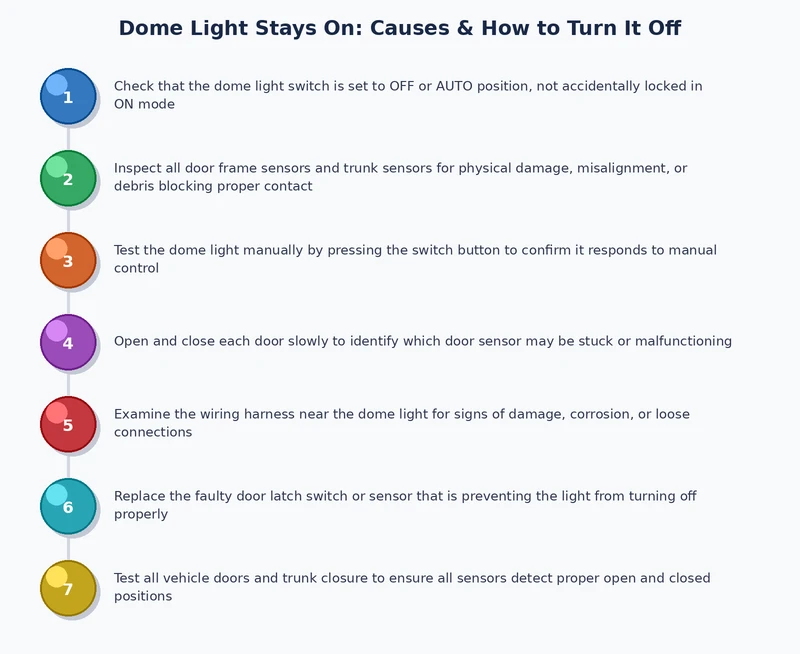
Working through this problem from the simplest fix to the more involved ones saves you time and keeps you from replacing parts you don't actually need. Each step below takes only a few minutes and either resolves the issue or rules out one more cause before moving on.
Find your dome light switch on the overhead console or directly on the light housing and confirm it's set to "door" mode rather than the "on" position. This costs you about ten seconds and solves the problem more often than you'd expect, especially after someone has been adjusting things in the backseat or after a car detail where someone wiped down the headliner.
With all doors closed, press each door jamb switch firmly by hand and feel for a clean, crisp click as the plunger depresses and returns. A switch that feels mushy, stays partially compressed, or doesn't spring back reliably is almost certainly stuck and needs attention. You can try spraying a small shot of electrical contact cleaner into the switch housing to free a sticky plunger before committing to a replacement, and in many cases that's all it takes.
A basic digital multimeter costs around $15 at any auto parts store and lets you confirm a faulty door switch in under two minutes — a skill that will pay off on dozens of future electrical jobs around your car.
Set your multimeter (a handheld device that measures voltage, resistance, and current) to DC voltage mode, probe the two terminals on the door jamb switch with all doors closed, and check for continuity. A working switch should show no continuity when the door is shut and continuity when the door is open. If your readings are reversed — showing a closed circuit even with the door latched — you've confirmed the faulty switch and can move straight to replacement.
Pull your owner's manual, locate the interior lighting fuse in the fuse box diagram, and remove it for a quick visual inspection. A healthy fuse shows a solid, unbroken metal strip through the plastic window; a blown fuse shows a visible gap or a dark smear inside. While the panel is open, trace the visible wiring near the door hinges for any signs of frayed insulation, bare copper, or pinched sections that could be causing a back-feed. If you're also noticing problems with other lights in your vehicle at the same time, your taillights not working alongside the dome light can point toward a shared ground issue rather than an isolated switch failure.
The majority of dome light problems sit comfortably in DIY territory, but a handful of scenarios genuinely call for professional help, and pushing through those on your own can create new problems or run up unnecessary costs in parts you don't need.
Having the right tools on hand before you start keeps the job moving and prevents those frustrating mid-task runs to the parts store. None of these items are expensive, and most are useful enough to keep in a basic car maintenance kit going forward.
The most likely cause is a door jamb switch that's stuck in the open position, which makes your car think a door is still ajar even after it's fully latched and closed. A misset overhead control switch — accidentally bumped to the "on" position — is the other very common reason, and it's worth checking that first before doing any diagnostic work on the switches themselves.
Yes, it absolutely can, and it happens faster than most drivers expect — typically within four to eight hours depending on your battery's current state of charge and age. An older battery with reduced capacity may die in as little as two to three hours under a continuous dome light draw, which is why addressing a dome light that stays on should be a same-day priority rather than something you put off.
If the overhead switch is physically faulty and you can't get it into the "off" or "door" position, you can pull the interior lighting fuse as a temporary measure to prevent battery drain until you replace the switch. Driving without interior lighting is generally safe in the short term, but you should replace the switch promptly because the fuse also protects other lighting circuits in most vehicles.
If the cause is a misset switch, it costs nothing at all. A replacement door jamb switch runs between five and twenty-five dollars for most vehicles, and you can install it yourself in about twenty minutes with basic tools. If the problem traces back to a BCM fault or complex wiring short, professional diagnosis and repair typically runs between fifty and two hundred dollars depending on the shop and the extent of the wiring damage.
A door jamb switch is a small spring-loaded push-button sensor mounted in the door frame opening — you'll see it as a small cylindrical or rectangular component that the door physically presses against when it closes. Most vehicles have one switch per door, though some older models share a single switch for the rear doors. They're usually visible without removing any panels, which makes them easy to test and replace.
Intermittent behavior usually points to a door jamb switch with a worn or corroded plunger that makes inconsistent contact, triggering the dome light randomly rather than continuously. It can also result from a door latch that isn't fully engaging on the first close, especially if the door requires extra effort to shut — in that case, adjusting or lubricating the door striker plate often resolves both the latch issue and the intermittent light at the same time.
Driving with your dome light on is not technically dangerous in the way a mechanical fault would be, but the light can create reflections on the windshield at night that reduce your visibility and increase eye strain on longer drives. Beyond the visibility issue, the continuous draw on your battery means that any unplanned stop — or a slightly longer trip than expected — raises the risk of coming back to a car that won't start, so it's worth resolving the issue before making any extended drives.
 |
 |
 |
 |

About Sarah Whitfield
Sarah Whitfield is a diagnostics and troubleshooting specialist who spent ten years as an ASE-certified technician before joining the editorial team. She specializes in OBD-II analysis, electrical gremlins, and the kind of intermittent problems that make most owners give up.
Get some FREE car parts & gear.. Or check out the latest free automotive manuals and build guides here.
Disable your ad blocker to unlock all the hidden deals. Hit the button below 🚗
| | | |
