by Sarah Whitfield
A client once described his pickup's highway ride as feeling like "the seat was giving his back a massage." He laughed it off for weeks, until the driveshaft separated entirely at 65 mph and left him stranded in the median. Catching driveshaft vibration symptoms early is the difference between a scheduled shop visit that costs a few hundred dollars and a tow truck call that costs you a full day and twice the money.
The driveshaft carries rotational force from the transmission to the drive axle, and when any component along that assembly wears or falls out of balance, you feel the consequence through the floorboard, the seat, or the steering wheel. These problems frequently get misdiagnosed as wheel imbalance, bad motor mount symptoms, or worn suspension components, which is why understanding the specific pattern of your vibration matters as much as knowing that one exists. On CarCareTotal, we cover the full range of drivetrain issues that affect real drivers, and this guide walks you through what driveshaft vibration looks like in practice, what causes it, what it costs to fix, and when you need to act today rather than next week.
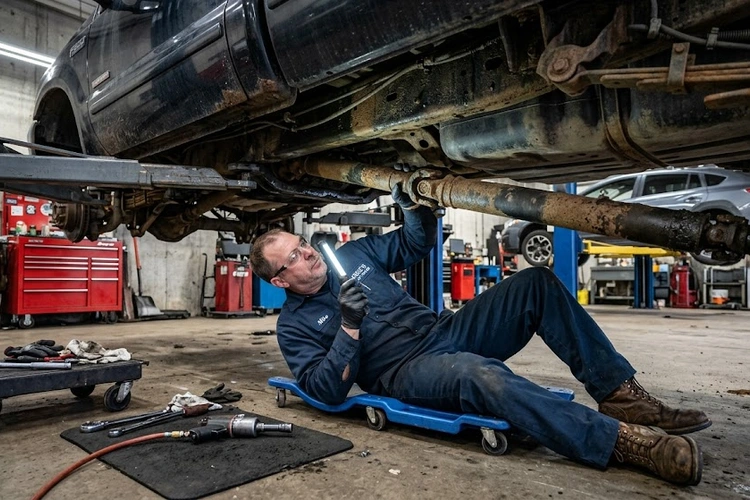
Contents
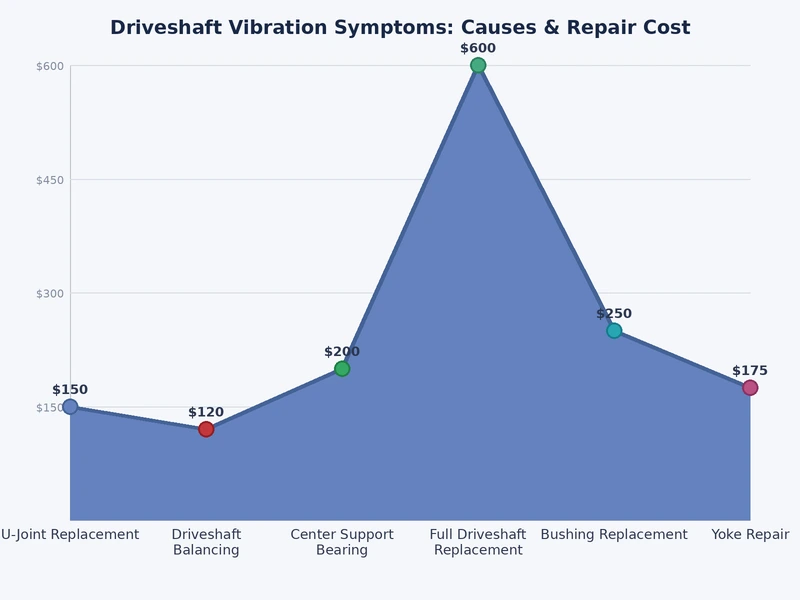
Driveshaft vibration symptoms are not always dramatic in their early stage, which is exactly what makes them dangerous. Drivers rationalize the sensation as rough pavement, a bumpy load in the bed, or the truck "just running a little rough." The key to accurate self-diagnosis is recognizing that driveshaft-related vibration changes with speed and engine load in ways that other common problems do not replicate.
The most characteristic presentation is a rhythmic shudder that appears between 45 and 75 mph, intensifies through a defined speed band, and then smooths out again as you accelerate past it or decelerate below it. This pattern separates driveshaft imbalance from a tire balance problem, because a tire imbalance typically builds continuously with speed rather than peaking at a specific range and fading. The vibration travels primarily through the floorboard and seat, and in trucks with a two-piece driveshaft it often concentrates beneath the center console where the carrier bearing is mounted. If the shudder appears alongside difficulty accelerating past a certain speed, the driveshaft deserves investigation alongside other drivetrain components, as both symptoms can share a common root cause in drivetrain wear.
A worn U-joint often announces itself with a pronounced clunk when you shift from drive to reverse, or when you apply light throttle from a complete stop. The noise comes from the U-joint's loose trunnion cross knocking against its yoke, and it is most audible at low speed when the driveshaft rotates slowly and the impact is not smoothed out by rotational inertia. You may also feel a shudder during hard acceleration that disappears once you reach cruising speed — this is consistent with a U-joint that binds at a specific rotational angle before the shaft picks up enough speed to push through it. According to the National Highway Traffic Safety Administration, drivetrain component failures are a leading contributor to loss-of-control incidents, which frames early detection as a safety responsibility rather than an optional maintenance choice.
Three mechanical failures produce the overwhelming majority of driveshaft vibration cases. Knowing which one you are dealing with determines the urgency of the repair and what you should expect to pay.
Universal joints allow the driveshaft to flex as the suspension moves while transmitting torque at an angle between the transmission and the axle. Each joint consists of a cross-shaped trunnion held in four needle-bearing caps, and when those bearings wear dry or rust out — a process accelerated by missing grease or road salt intrusion — you get the clunk-and-vibration combination described above. U-joint replacement is one of the more affordable driveshaft repairs, but ignoring the symptom until the joint fails completely can damage the yoke on the transmission output shaft or the differential input flange, which escalates the repair bill significantly.
Two-piece driveshafts — standard on most full-size trucks, vans, and longer rear-wheel-drive cars — use a center support bearing mounted to the vehicle frame to stabilize the midpoint of the shaft. When the rubber isolator in that bearing deteriorates or the bearing itself collapses, the driveshaft runs out of true and generates highway-speed vibration that feels nearly identical to a tire imbalance. The diagnostic tell is that this vibration does not respond to wheel balancing, because the rotating imbalance is in the shaft itself, not in the wheel assembly.
A driveshaft bent by a curb strike, off-road impact, or improper jack contact will vibrate at all speeds above approximately 20 mph, with intensity scaling directly with vehicle speed. A shaft that has lost its factory balance weights — small counterweights welded on that are occasionally knocked off during undercarriage work — behaves similarly. Shops correct a mild imbalance by adding weights on a dedicated balancer, but a bent shaft requires full replacement regardless of how minimal the bend appears to the eye.
| Failure Component | Primary Symptom | DIY Feasible? | Repair Cost Range |
|---|---|---|---|
| U-joint (single) | Clunk on gear change, vibration under load | Yes, with press tool | $150–$350 |
| Center support bearing | Highway shudder peaking at specific speed | Moderate difficulty | $200–$450 |
| Driveshaft balance | Speed-proportional vibration, no clunk | No — requires spin balancer | $75–$175 |
| Bent driveshaft | Constant vibration above 20 mph | No — replacement required | $400–$1,200 |
| CV axle / joint (FWD/AWD) | Clicking on turns, vibration under throttle | Yes, with experience | $100–$350 |
Most driveshaft failures are preventable with straightforward maintenance that requires far less time than the repair it prevents. The driveshaft operates under continuous rotational stress with no redundancy — when it fails, the vehicle stops moving — so a proactive approach is the only sensible strategy.
Many U-joints on trucks and larger SUVs have grease fittings — commonly called zerk fittings — that accept a standard grease gun. At every oil change, spend two minutes on every fitting until you see fresh grease purging from around the seal, and you will dramatically extend the working life of those joints. U-joints without fittings are sealed at the factory and cannot be regreased; they are engineered to last the life of the joint, but in practice they fail sooner than serviceable types, especially in climates where roads are salted through winter. Note that sealed joints are not inferior — they are simply designed for replacement rather than maintenance, and your inspection interval matters more than your grease schedule when you have them.
Every 30,000 miles, or annually in harsh operating conditions, have a technician check U-joint play by gripping the driveshaft near each joint and applying rotational force in both directions while the drivetrain is locked. Any detectable movement that is not immediately taken up indicates bearing wear. The carrier bearing rubber should be visually checked for cracking or sagging, which are reliable early indicators of impending collapse. On AWD vehicles, scheduling this inspection alongside a review of front axle components makes financial sense, since an AWD system fault and a driveshaft issue can share common causes and are far more economical to address during the same shop visit than in two separate appointments.
Not every vibration demands an immediate roadside stop, but some driveshaft conditions are genuinely dangerous and need to be addressed within hours. The distinction comes down to the severity of the symptom and whether the structural integrity of the shaft itself is at risk.
Pull over and arrange a tow if you hear a loud bang followed by sudden vibration, if the shudder becomes severe and erratic at any speed, or if you notice the undercarriage making contact with the road surface. A separated driveshaft can drop while the vehicle is moving and vault the rear end or cause immediate loss of directional control — this is not a situation you manage by driving carefully to the nearest shop at 30 mph. Symptoms that also affect your ability to steer, such as vibration through the steering wheel combined with pulling to one side, warrant immediate inspection because you may be dealing with a failing sway bar link or a worn ball joint compounding the driveshaft problem, which changes the risk level entirely.
If the vibration worsens suddenly or you hear a metallic bang from underneath, stop driving immediately — a dropped driveshaft can cause instantaneous loss of vehicle control with no warning.
A mild, consistent shudder at highway speed that has been present for less than two weeks and has not increased in intensity is something you can reasonably schedule for a diagnostic appointment within the week rather than treating as a roadside emergency. During that window, avoid towing, avoid carrying heavy cargo loads, and keep highway speeds below 60 mph if the vibration is notable at higher speeds. Drive with your full attention on whether the symptom changes — any sudden worsening is the signal to stop and call for assistance rather than pressing on to your destination.
Driveshaft problems are among the most commonly misdiagnosed drivetrain issues because their symptom profile overlaps with several other failures. Knowing what is myth and what is mechanical reality helps you steer the diagnostic conversation at the shop rather than simply accepting the first suggestion.
Wheel balance is the first explanation most shops offer for highway vibration, and statistically they are right often enough to make it the logical first step. But if you have already balanced the tires twice and the vibration persists unchanged, the driveshaft is the next suspect — not a third balance attempt. The distinguishing pattern is that driveshaft vibration is felt predominantly through the seat and floorboard rather than the steering wheel, and it peaks within a specific speed band rather than growing uniformly with speed. Worn strut symptoms can also produce highway vibration that resembles a wheel balance problem, so a thorough undercarriage inspection covers both suspension and driveshaft in a single pass and is worth requesting rather than sequencing them as separate appointments.
A worn U-joint does not honor your service schedule. The bearing wear that produces the initial clunk accelerates once the protective grease is depleted or contaminated, and the timeline from first symptom to complete failure can be as short as a few weeks of daily driving. Waiting is a calculated gamble, and the downside is a driveshaft that separates at speed on a busy road rather than a predictable repair carried out on your schedule. If the vibration is accompanied by a sense of looseness in the drivetrain — the kind of vague disconnection that sometimes gets reported alongside a loose or wobbly gear shifter in vehicles with column-mounted linkages — prioritize the diagnosis rather than deferring it.
There is a well-defined boundary between what an informed car owner can accomplish at home and what requires specialized equipment. Staying on the correct side of that boundary saves time and prevents you from damaging components that were still serviceable before you touched them.
With the vehicle safely supported on jack stands, grip the driveshaft close to each U-joint and apply rotational force in both directions while the transmission is in park and the parking brake is fully set. Any play — any movement at all that is not immediately taken up by the drivetrain — indicates bearing wear that needs attention. Look for rust streaks radiating outward from the U-joint caps, which signals that the bearing seals have failed and moisture has entered the joint. Check the carrier bearing rubber for visible cracking or sagging. Inspect the shaft surface for dents, bends, or small weld marks where balance weights were once attached but have since fallen off. This inspection takes under 15 minutes and gives you a clear picture of whether you are dealing with a normal wear item or something more urgent.
U-joint replacement requires a hydraulic press or a dedicated U-joint press tool to remove and install bearing caps without damaging the yoke — attempting this procedure with a hammer and socket set destroys more yokes than it saves, and a damaged yoke turns a $200 repair into a $600 one. Driveshaft balancing requires a spin balancer that no home garage realistically contains. Diagnosing a bent shaft accurately requires a dial indicator taking runout measurements at multiple points along the shaft's length. For AWD and front-wheel-drive vehicles, CV axle replacement also falls into the professional category unless you have specific experience and the correct puller tools for the job.
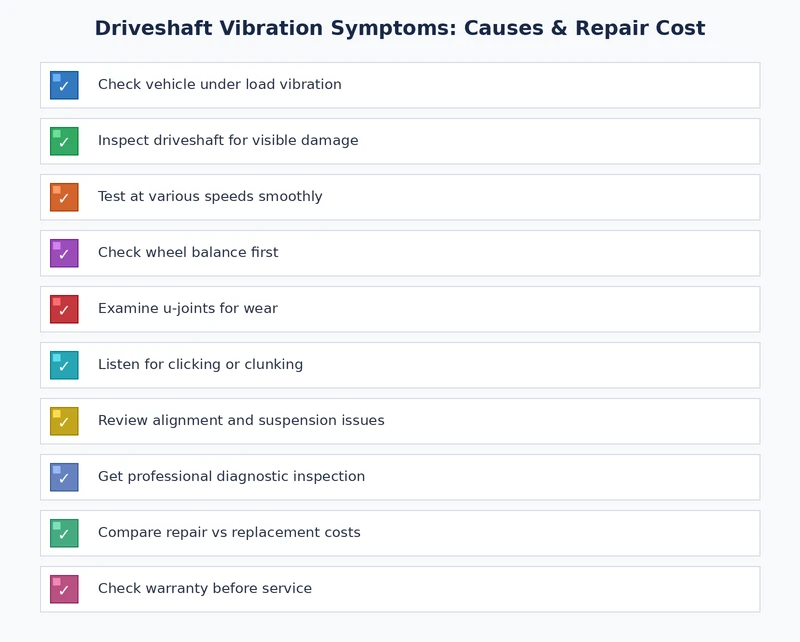
The most common driveshaft vibration symptoms are a rhythmic shudder that peaks within a defined highway speed band, a clunking noise when shifting between drive and reverse, and a shudder during hard acceleration from a stop. The vibration typically travels through the seat and floorboard rather than primarily through the steering wheel, which is a useful distinguishing detail.
You can drive carefully to a shop if the vibration is mild and stable, but avoid highway speeds, heavy loads, and towing. Stop immediately if the shudder worsens suddenly, you hear a bang from underneath the vehicle, or the ride becomes erratic and unpredictable — those are signs the shaft may be close to separating.
A single U-joint replacement runs $150 to $350 at most shops. A center support bearing replacement costs $200 to $450. Full driveshaft replacement on a truck or full-size SUV ranges from $500 to $1,200 with labor, depending on whether a remanufactured or OEM shaft is used and how accessible the shaft is on your specific vehicle.
Tire imbalance builds gradually and continuously with speed and is felt most strongly in the steering wheel. Driveshaft vibration peaks within a specific speed band, is most pronounced in the seat and floorboard, and is often accompanied by a clunk when you change gears — something a tire imbalance never produces on its own.
Yes. A U-joint that fails completely can damage the transmission output yoke or differential input flange, converting a $200 repair into a job that costs several times more. In a catastrophic failure at highway speed, the separated shaft can contact the road surface and cause immediate loss of vehicle control, which makes early replacement both a financial and a genuine safety decision.
Front-wheel-drive vehicles do not use a traditional rear driveshaft, but their CV axles perform the same torque-transfer function. A failing CV joint clicks audibly on turns and vibrates under throttle input — symptoms that overlap with traditional driveshaft vibration symptoms and carry the same urgency when they appear in your daily driving.
Every 30,000 miles is the standard interval for most vehicles, or annually if you operate in regions with heavy road salt, frequent off-road conditions, or regular towing. If your U-joints have grease fittings, service them at every oil change — consistent lubrication is the single most effective way to delay the onset of driveshaft vibration symptoms and extend joint life.
 |
 |
 |
 |

About Sarah Whitfield
Sarah Whitfield is a diagnostics and troubleshooting specialist who spent ten years as an ASE-certified technician before joining the editorial team. She specializes in OBD-II analysis, electrical gremlins, and the kind of intermittent problems that make most owners give up.
Get some FREE car parts & gear.. Or check out the latest free automotive manuals and build guides here.
Disable your ad blocker to unlock all the hidden deals. Hit the button below 🚗
| | | |
