by Sarah Whitfield
Ever wondered why rear brakes produce that specific scratching, grinding, or thumping sound that disc brakes almost never replicate? Drum brake noise follows predictable mechanical patterns tied to predictable causes, and our team has spent years cataloging every variation — from the harmless morning squeal to the urgent metal-on-metal grind that signals immediate structural damage. Understanding those patterns transforms an alarming sound into a solvable diagnostic puzzle, and this guide walks through exactly how our team identifies and fixes each one.
Drum brakes remain standard rear-axle equipment across a wide range of vehicles, and their enclosed cast iron design makes them uniquely vulnerable to moisture accumulation, road debris intrusion, and hardware corrosion that open disc assemblies rarely experience to the same degree. Our experience consistently shows that most drum brake noise traces back to three overlapping failure categories: worn friction material, contaminated contact surfaces, and failed hardware components. Correctly identifying the category on the first inspection attempt eliminates unnecessary parts replacement and prevents the same complaint from returning within weeks. For a broader look at brake noise across all assembly types, our team recommends starting with our overview of brake squealing causes before diving into drum-specific diagnostics.
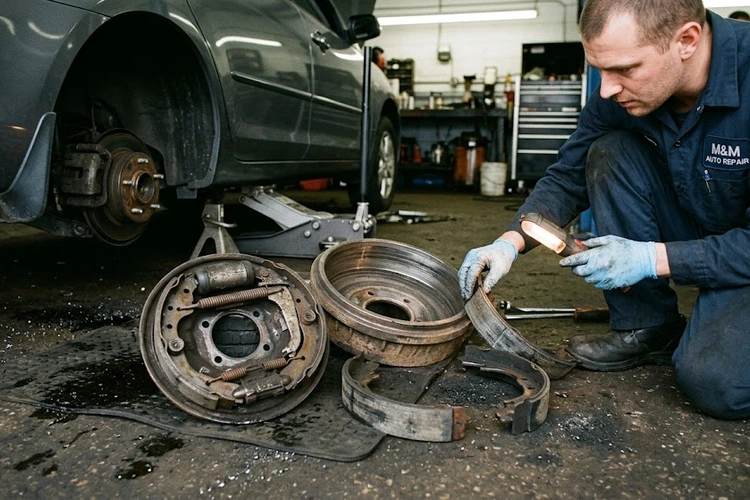
Contents
Fresh drum brake assemblies produce a characteristic light squeal during the first few hundred miles of operation, particularly during the initial morning stop after overnight condensation has deposited surface rust on bare cast iron drum surfaces. This iron oxide layer — thin, uniform, and entirely predictable on uncoated cast iron — creates brief abrasive contact that clears within the first full brake application and leaves no lasting damage on properly maintained drums. Our team consistently reassures drivers who report this specific symptom, because it requires no intervention and poses zero mechanical risk to the assembly.
Beyond the benign category, drum brake noise escalates into warning territory when sounds become consistent, metallic, rhythmic, or synchronized with wheel rotation speed rather than disappearing after one or two stops. A grinding sound that correlates directly with vehicle speed nearly always indicates metal-on-metal contact between the shoe backing plate and drum friction surface, meaning the friction lining has worn through completely. Our team treats continuous metallic grinding as a stop-driving situation — continued operation scores the drum surface and converts a relatively simple shoe replacement into a full drum-and-shoe job that costs significantly more.
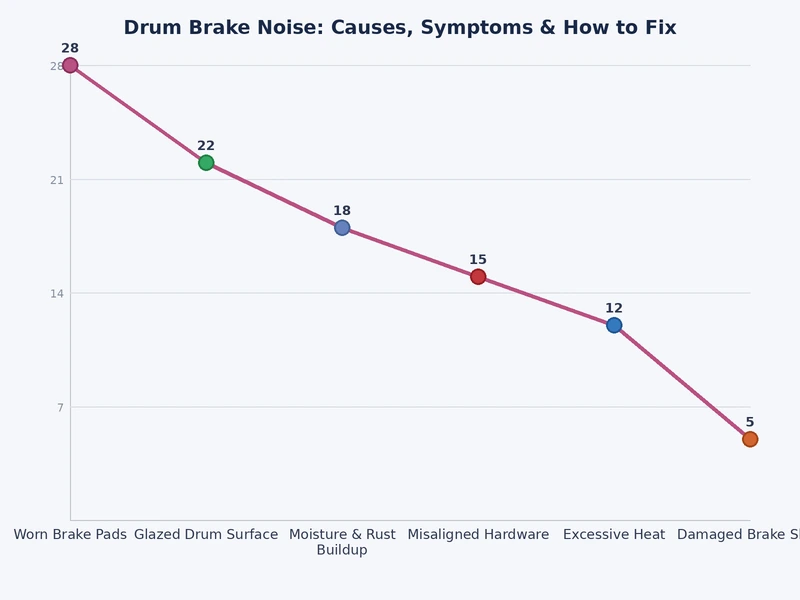
Our team's diagnostic experience consistently shows that drum brake noise traces back to a short list of well-understood mechanical failure modes, and the enclosed nature of the drum assembly accelerates several of these categories — particularly hardware corrosion — that open disc brake systems simply don't experience to the same degree. Identifying the correct root cause on the first inspection requires matching the noise signature to its specific mechanical mechanism rather than defaulting to the most common repair.
Friction lining wear is the most straightforward cause of drum brake noise, but glazing — where shoe contact surfaces harden and vitrify from repeated thermal cycling without adequate cooling intervals — produces equally severe squealing from linings that still measure technically adequate thickness. Glazed shoes present a shiny, glass-smooth contact surface rather than the matte, slightly textured appearance of healthy friction material, and they produce a consistent high-pitched squeal that resists any surface treatment. Our team measures lining thickness at the thinnest point near the shoe ends, because uneven wear from seized adjusters creates localized failures that midpoint measurements miss entirely.
According to Wikipedia's overview of drum brake mechanics, the self-energizing action that defines drum brake operation makes these assemblies particularly sensitive to lining surface condition. A glazed or contaminated lining produces dramatically less friction than its measured thickness suggests, which is why thickness alone is an incomplete diagnostic criterion.
Wheel cylinder seepage — a common failure mode in high-mileage drum assemblies — saturates the friction lining with hydraulic fluid that permanently reduces friction coefficient and generates a distinctive high-pitched squeal under moderate braking force. Axle seal failure produces identical contamination with gear oil rather than brake fluid, and both failure modes create symptoms similar enough that our team always traces the contamination source rather than assuming either one. Drivers who notice unusual burning smells accompanying brake noise should treat this as confirmation that fluid contamination or severe lining glazing has progressed to a point requiring immediate disassembly.
Our team never attempts to restore contaminated linings through solvent cleaning — the contamination penetrates through the full lining thickness and resurfaces even after thorough surface treatment, making replacement the only reliable solution.
Return springs, hold-down pins, self-adjuster star wheels, and shoe anchor contact pads all require periodic lubrication and eventual replacement, yet the majority of vehicles never receive this service until abnormal noise forces a disassembly. Corroded hardware binds shoe movement against the backing plate, creates constant low-level drag contact with the drum surface, and generates persistent grinding or squeal that easily misdiagnoses as a worn shoe problem without a thorough hardware inspection. Our team replaces the complete hardware kit with every drum brake service — the material cost difference between a hardware kit and a second full disassembly makes this decision straightforward on every vehicle regardless of age.
Matching the specific noise character to its mechanical cause is the fastest diagnostic path available, and our team uses the following reference table as a consistent starting point before physical inspection confirms the root cause and urgency level:
| Noise Type | When It Occurs | Most Likely Cause | Urgency Level |
|---|---|---|---|
| Morning grind — clears within 1–2 stops | First brake application of the day only | Surface rust on cast iron drum | None — monitor periodically |
| Continuous metallic grinding | Every braking event, all conditions | Worn shoes, metal-on-metal drum contact | Immediate — stop driving |
| Consistent high-pitched squeal | All braking conditions, every stop | Glazed shoes or contaminated lining | Within 1 week |
| Rhythmic thumping — speed-dependent frequency | During and between brake applications | Out-of-round drum or lodged debris | Within 1–2 weeks |
| Squeal specifically in reverse | Backing up only, not forward braking | Seized self-adjuster, shoe dragging | Within 1 week |
| Continuous dragging or rubbing sound | Constant at all speeds, not just braking | Seized shoe or collapsed wheel cylinder | Within 3 days |
Drum brakes respond more dramatically to environmental conditions than disc brakes because the enclosed design traps road salt, moisture, and debris against friction surfaces for extended periods between brake applications. Our team sees a consistent spike in drum brake noise complaints in early spring, when winter road salt accumulation has had months to corrode hardware components and pit drum contact surfaces to the point where smooth shoe engagement becomes impossible. Vehicles that sit unused for extended periods develop severe drum surface corrosion that produces alarming grinding sounds on first use — a symptom that typically self-resolves after several firm brake applications, though hardware inspection is still warranted after prolonged storage.
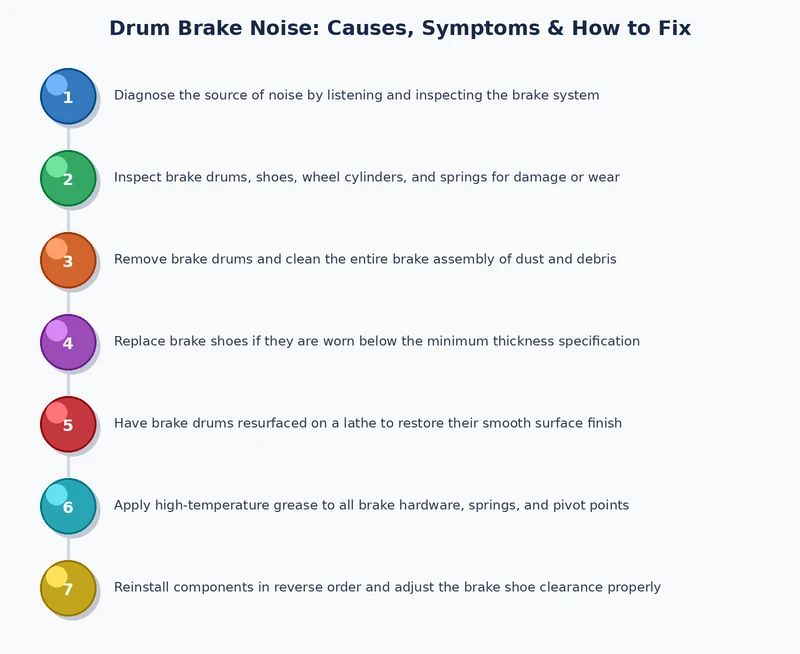
New brake shoes require a proper bedding sequence to transfer a thin, uniform layer of friction material onto the drum contact surface, and skipping this procedure produces glazing, uneven contact patches, and persistent noise within the first few hundred miles of service. Our team follows the same progressive-stop bedding protocol for drums that we detail in our brake pad break-in guide, adapted for the lower peak temperatures characteristic of rear drum assemblies. The sequence involves ten to twelve progressive stops from moderate speeds with full cooling intervals between each application — our team considers this step non-negotiable on every new shoe installation regardless of how experienced the installer is.
The most frequently observed mistake in drum brake servicing is reinstalling original springs, adjusters, and hold-down hardware to avoid the incremental cost of a replacement kit — a decision that almost invariably reproduces the original noise complaint within weeks of service completion. Old return springs lose their rated tension through fatigue, seized star wheel adjusters remain functionally seized even after cleaning attempts, and worn hold-down pins allow shoe movement that generates noise against the backing plate at every brake application. Equally damaging is applying lubricant to the wrong contact points — any lubricant reaching the friction lining surface or drum interior creates exactly the contamination failure described earlier in this guide.
Drum brake noise frequently gets misattributed to wheel bearings, heat shields, or suspension components — particularly when the noise appears intermittently or correlates with cornering inputs rather than brake pedal pressure specifically. Our team always performs a drum-specific diagnostic test: releasing the parking brake completely, driving at low speed, and applying light brake pressure to observe whether the noise intensifies, changes pitch, or disappears with pedal force. Drivers experiencing rear-end vibration alongside brake noise should also review our speed-specific vibration diagnosis guide, because worn wheel bearings and drum brake problems frequently coexist on high-mileage rear axle assemblies and produce overlapping symptoms.
Our team receives more drum brake noise inquiries in wet weather than any other condition, and the scenario is nearly always identical: a vehicle sits overnight in rain or heavy dew, surface rust forms on the bare cast iron drum, and the first brake application of the morning produces a grinding sound alarming enough to make most drivers suspect catastrophic failure. The rust layer that forms overnight on uncoated cast iron is genuinely abrasive and creates real grinding contact during that first stop — but it clears within one to three brake applications and leaves no lasting damage on drums that haven't already exceeded their maximum diameter specification. Our team's standard answer to this complaint is inspection first, parts replacement only if the drums show wear-related scoring rather than fresh surface rust.
A memorable case from our team's experience involved persistent rear-end squealing that survived two complete drum brake services — new shoes, new springs, new hardware — only to be traced ultimately to a corroded heat shield vibrating at a frequency that closely matched drum rotation speed. Drivers who encounter noise surviving a complete and properly executed drum service should review our heat shield rattle diagnosis guide, because the physical proximity of heat shields to drum assemblies creates convincing acoustic mimicry that wastes significant diagnostic time. Our team has also encountered apparent brake squeal that turned out to be timing chain noise transmitted through the chassis, particularly on vehicles where both symptoms appeared at similar low-speed parking conditions.
A seized self-adjuster on a single rear drum — a frequent finding on vehicles with more than 80,000 miles and no drum service history — creates asymmetric braking force that manifests as a vehicle pull toward the affected side under moderate pedal pressure, which most drivers and some technicians initially diagnose as a wheel alignment concern rather than a brake system issue. Our team verifies drum brake adjustment as part of every alignment-related inspection, and drivers who want to understand proper alignment verification between professional services can reference our wheel alignment checking guide for the home-inspection protocol our team recommends.
A complete drum brake service requires a specific tool set and parts list prepared before disassembly begins, because the variety of spring configurations, adjuster designs, and backing plate layouts across different vehicle platforms makes mid-service interruptions for missing components both common and entirely preventable with proper preparation.
Before beginning disassembly, our team also recommends confirming the noise source by reviewing our belt squeal diagnosis guide — accessory belt noise frequently transmits through the firewall and chassis in ways that convincingly mimic rear brake noise in the passenger compartment, and confirming the true source location saves unnecessary disassembly time.
It depends entirely on the noise type. Surface rust morning grind clears within one stop and requires no action whatsoever. Glazed shoe squeal typically allows one to two weeks of careful driving before the condition progresses further. Continuous metallic grinding indicates complete shoe wear with metal-on-metal drum contact — our team classifies this as a stop-driving situation where the vehicle should not be operated until the repair is completed, because continued use scores the drum surface and dramatically increases total repair cost.
Surface rust noise from overnight condensation is the only form of drum brake noise that genuinely self-corrects — it resolves within one or two brake applications at the start of the day and requires no service or monitoring beyond awareness that it exists. All other forms of drum brake noise, including glazed shoes, worn friction material, seized hardware, and fluid contamination, worsen progressively with continued driving. Our team's consistent observation is that deferred drum brake service converts lower-cost shoe replacements into higher-cost drum replacement jobs when the underlying cause is allowed to progress unchecked.
Drum brakes use a self-energizing design where forward drum rotation actually assists shoe application force during normal forward braking — the leading shoe wedges more firmly against the drum as wheel speed increases. In reverse, this self-energizing effect is absent or reversed entirely, which means any looseness, seized adjuster, or improper shoe-to-drum clearance becomes immediately audible as squeal or scrape during backward movement. Our team consistently finds a seized or under-adjusted self-adjuster as the root cause of reverse-specific drum brake noise, and the correct fix is complete adjuster replacement combined with proper shoe gap adjustment rather than any surface treatment of the existing components.
Drum brake noise is never just a sound — it's the system communicating exactly what it needs, and listening on the first occurrence saves everything that follows.
 |
 |
 |
 |

About Sarah Whitfield
Sarah Whitfield is a diagnostics and troubleshooting specialist who spent ten years as an ASE-certified technician before joining the editorial team. She specializes in OBD-II analysis, electrical gremlins, and the kind of intermittent problems that make most owners give up.
Get some FREE car parts & gear.. Or check out the latest free automotive manuals and build guides here.
Disable your ad blocker to unlock all the hidden deals. Hit the button below 🚗
| | | |
