by Diego Ramirez
Electric car maintenance is fundamentally simpler than gas car ownership — the drivetrain contains roughly 20 moving parts compared to over 2,000 in a conventional ICE vehicle. That mechanical reality translates directly into fewer service intervals and lower lifetime costs. Our team has worked through both drivetrains extensively, and the differences in what actually needs attention are worth mapping precisely for anyone building a long-term ownership plan around our core vehicle maintenance principles. The electric car maintenance calendar looks nothing like the gas car equivalent — which is both the appeal and the learning curve.
What remains constant across both drivetrains often gets overlooked in that enthusiasm. Tires, brake fluid, cabin filters, and wiper blades still demand regular attention. Skipping them because an EV "doesn't need much maintenance" is the most common oversight our team encounters in the field.
Contents
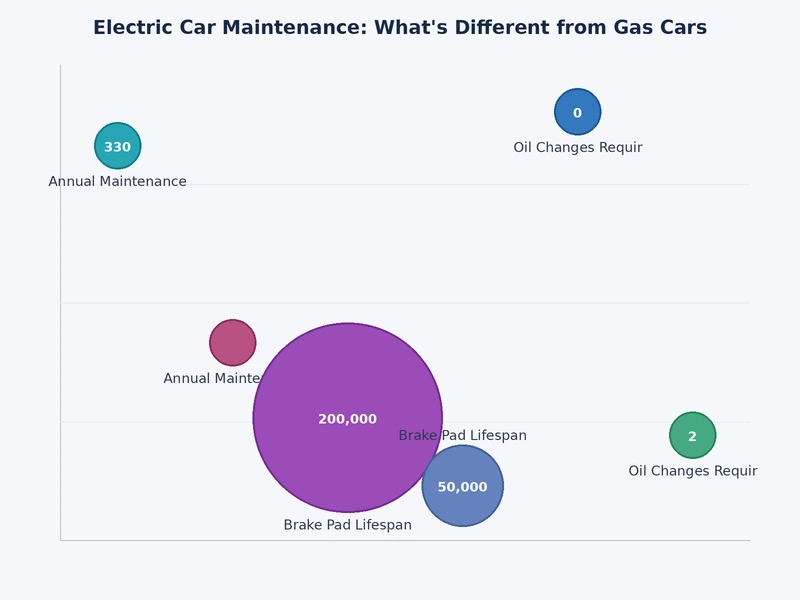
The most dramatic shift in electric car maintenance isn't a new task added to the calendar — it's the wholesale elimination of entire service categories. No oil changes. No spark plug replacements. No timing belt, exhaust system repairs, or transmission fluid services. According to the U.S. Department of Energy, EV owners typically spend around 40% less on maintenance over a vehicle's lifetime compared to conventional car owners. Our team's own cost tracking across vehicles in the fleet bears that figure out consistently.
The table below maps the full picture — what disappears, what stays, and what shifts in interval:
| Service Item | Gas Car Interval | Electric Car Interval | Notes |
|---|---|---|---|
| Engine oil & filter | Every 5,000–10,000 mi | Not applicable | No combustion engine |
| Spark plugs | Every 30,000–100,000 mi | Not applicable | No ignition system |
| Transmission fluid | Every 30,000–60,000 mi | Not applicable (most models) | Single-speed reduction gear only |
| Exhaust / catalytic converter | Inspect annually | Not applicable | No exhaust system |
| Brake pads & rotors | Every 25,000–70,000 mi | Every 50,000–100,000+ mi | Regen braking dramatically reduces hydraulic wear |
| Tires | Every 25,000–50,000 mi | Every 20,000–40,000 mi | Higher torque and vehicle mass accelerate wear |
| Cabin air filter | Every 15,000–25,000 mi | Every 15,000–25,000 mi | Same interval; HEPA units clog without obvious odor cues |
| Battery thermal coolant | Every 30,000–50,000 mi | Every 50,000–100,000 mi | Separate from HVAC loop; critical for pack longevity |
| 12V auxiliary battery | Every 3–5 years | Every 3–5 years | EVs retain a conventional 12V system for accessories |
| Brake fluid | Every 2 years or per OEM spec | Every 2–3 years | Moisture absorption occurs regardless of reduced heat cycling |
Our recommended inspection cadence follows a quarterly rhythm for visual and functional checks, with deeper system reviews at annual service intervals. The process is systematic once the unique components are understood — most of it requires no special tools beyond an OBD-II adapter with EV-profile support.
The high-voltage pack is the most critical and most expensive component in any EV. Pack health assessment starts with the vehicle's own diagnostic screens and is extended through third-party OBD-II applications that read EV-specific PIDs unavailable through standard protocols.
Modern EVs use a dedicated liquid-cooled circuit to regulate pack temperature during charging and discharge — separate from the cabin HVAC loop. Our team flushes this circuit on the manufacturer's recommended schedule, typically in the 50,000 to 100,000 mile range. Low coolant level in the thermal management circuit directly throttles maximum charge rate and accelerates cell degradation at the pack extremes.
Most EV manufacturers specify a low-conductivity coolant formulation for the battery thermal loop — mixing it with standard automotive coolant can trigger BMS faults and void the pack warranty outright.
The difference between an EV that retains 90% pack capacity after 150,000 miles and one that degrades to 75% usually comes down to a handful of habitual decisions made daily. Our team sees these patterns consistently across the vehicles we evaluate and service over multi-year observation periods.
Lithium cell chemistry degrades fastest at the voltage extremes — fully charged and deeply discharged states both accelerate capacity loss over time. Practical daily charging management is the highest-leverage intervention available to EV owners.
The same diligence that applies to 12V auxiliary battery care pays dividends on an EV. Our detailed review of how to extend car battery life covers the charging and storage principles that apply across both lead-acid auxiliaries and the lithium main pack.
Heat is a lithium battery's primary long-term enemy. Parking in shade, pre-conditioning the cabin while still plugged in during summer, and avoiding extended periods at high state of charge in hot conditions all compound into measurable capacity preservation across a pack's service life. Cold weather reduces usable range temporarily but doesn't permanently degrade the pack when managed correctly — pre-conditioning while plugged in is the single most effective winter operation tactic, as it warms the pack to optimal temperature without drawing on stored energy.
Several high-impact electric car maintenance tasks require nothing more than attention and basic tools — no specialized EV knowledge needed. Our team considers these foundational regardless of drivetrain:
Reduced drivetrain complexity creates a particular category of neglect — the assumption that an EV maintaining its range and performance numbers is fully healthy. Our team has catalogued the most consistent patterns across vehicles that develop avoidable problems.
Regenerative braking substantially extends hydraulic pad and rotor life — this is well established. But it introduces a different and less discussed problem. When hydraulic brakes go months between uses at meaningful force levels, rotors develop surface corrosion and brake fluid absorbs moisture without the heat cycling that would normally flag degradation through feel and performance.
Our team periodically performs deliberate hard stops in controlled conditions to clean rotor surfaces and verify hydraulic response is intact. The full spectrum of brake fade symptoms is as relevant to EV ownership as to conventional vehicles — the thermal dynamics differ, but the hydraulic circuit is identical.
Other consistent mistakes our team documents:
When something goes wrong with an EV, the diagnostic approach differs structurally from gas car troubleshooting. Most issues surface through onboard systems first, and the diagnostic sequence starts with data rather than physical inspection. OBD-II tools with EV-specific protocol support are the entry point, not the engine bay.
Sudden or progressive range drops have identifiable root causes in the vast majority of cases. Working through them systematically avoids misdiagnosis:
Reduced charging speed and failed sessions are the most frequent EV owner complaints after range concerns. The diagnostic path is methodical:
A focused toolkit bridges standard car maintenance and EV-specific diagnostics without requiring a full professional setup. These are the items our team considers non-negotiable for serious EV owners:
The cost difference is substantial and well-documented. The U.S. Department of Energy puts lifetime EV maintenance costs at roughly 40% below comparable ICE vehicles. Eliminating oil changes, spark plugs, exhaust systems, and transmission services accounts for the majority of that gap. Tire replacement costs slightly more due to higher vehicle mass and torque loading, but that doesn't offset the overall savings.
The pack itself has no scheduled service interval beyond monitoring. The thermal management coolant loop that keeps the pack at optimal temperature requires a flush every 50,000 to 100,000 miles depending on manufacturer specifications. The pack is replaced when State of Health drops below the threshold where range and performance no longer meet operational needs — typically well beyond 150,000 miles with proper charging habits.
Yes, but far less frequently than gas vehicles. Regenerative braking handles most deceleration without engaging the hydraulic system, extending pad and rotor life to 50,000–100,000+ miles in many cases. However, brake fluid still requires periodic replacement due to moisture absorption, and rotors can develop surface corrosion if the hydraulic system goes too long without use at meaningful force levels.
The vehicle will not power on, even if the high-voltage main pack is fully charged. The 12V auxiliary system operates independently to power the vehicle's computer, contactors, and accessories. It degrades on a conventional lead-acid timeline regardless of the main pack's health. Replacing it proactively at the 4–5 year mark avoids an unexpected no-start situation that often gets misdiagnosed as a main pack problem.
Measurably so. EVs are heavier than equivalent gas models due to the battery pack, and their electric motors deliver maximum torque from a standstill. Both factors accelerate tire wear, particularly at the contact patch. Our team recommends monthly pressure checks — not just TPMS-triggered checks — and tighter rotation intervals than the gas car equivalent. Choosing tires rated for EV loads when replacing also pays dividends in longevity.
Most electric car maintenance outside the high-voltage systems is fully within the capability of any competent independent shop — tires, brakes, cabin filters, wiper blades, 12V battery, alignment. High-voltage system work (pack diagnostics beyond OBD-II, battery module replacement, thermal loop repairs) requires proper training, tooling, and safety protocols. Many independent shops are investing in EV certification, so dealer-only service is increasingly a market issue, not a capability one.
Cold weather temporarily reduces range and slows charging speed — neither represents a maintenance failure. What cold weather does demand is pre-conditioning: warming the pack to optimal temperature while still plugged in before departure. This preserves range and protects the pack from the stress of high-rate charging when cold. In extreme climates, more frequent inspection of the thermal management coolant level is also warranted.
In our observation, the most consistent mistake is assuming low maintenance means no maintenance. The reduced service calendar creates genuine complacency around the tasks that remain — tire pressure, brake fluid, cabin filters, and 12V battery monitoring. These are unglamorous, inexpensive tasks that have outsized impact on safety and long-term reliability. The second most common is chronic use of DC fast charging as the primary charging method, which measurably accelerates pack degradation over a multi-year timeline.
 |
 |
 |
 |

About Diego Ramirez
Diego Ramirez is a maintenance and care specialist who has been wrenching on cars since he was sixteen. He focuses on fluid changes, preventive care routines, paint protection, and the small habits that turn a five-year-old car into a fifteen-year-old car.
Get some FREE car parts & gear.. Or check out the latest free automotive manuals and build guides here.
Disable your ad blocker to unlock all the hidden deals. Hit the button below 🚗
| | | |
