by Sarah Whitfield
What does a rhythmic metallic knocking sound beneath the hood actually mean — and how serious is it? Engine knocking noise is one of the most urgent mechanical warnings a vehicle can produce, and the cause determines whether a simple fuel switch resolves it or a full engine rebuild is required. Our team has diagnosed this condition across hundreds of vehicles. The pattern is consistent: early intervention saves engines.
Engine knocking noise occurs when the fuel-air mixture inside a cylinder ignites unevenly, creating competing flame fronts and destructive pressure spikes. Causes range from a mismatched fuel grade to catastrophic bearing failure. Readers seeking a complete diagnostic reference can explore our dedicated guide on engine knocking noise causes, which covers the full diagnostic picture. This post examines all seven primary causes in depth, along with the tools required to locate the source, practical fixes, prevention strategies, and the thresholds that make professional repair non-negotiable.
Contents
Engine knock — also called detonation or pinging — is the phenomenon where fuel-air mixture in the cylinder ignites before the spark plug fires, or simultaneously in multiple locations. According to Wikipedia's entry on engine knocking, the pressure wave produced by colliding flame fronts is distinct from ordinary combustion pressure and measurably more destructive to engine components. This is not a vague rattle. It is a specific combustion failure with direct consequences for engine integrity.
In a properly tuned engine, the spark plug fires at a precise moment — typically a few degrees before top dead center. The mixture ignites from one point and burns outward in a single, controlled flame front. Combustion pressure rises smoothly and pushes the piston down in a linear stroke. This is the design condition the engine is built to sustain indefinitely.
Knock occurs when secondary ignition events happen before or alongside the primary spark. Two or more flame fronts collide inside the cylinder. The resulting pressure spike is sharp, localized, and uncontrolled. Over time, these spikes erode piston crowns, damage rod bearings, and score cylinder walls. A single severe knock event can crack a piston. Repeated mild knock over thousands of miles causes cumulative damage that shortens engine life significantly.
Using a fuel grade below the manufacturer's specification is the single most common cause. Low-octane fuel ignites more easily under compression. In high-compression engines that specify premium fuel, regular-grade gasoline detonates prematurely before the spark fires. The resolution is immediate: fill the tank with the correct octane rating. The knock typically disappears within a few miles once the fuel mixture corrects.
Carbon deposits accumulate over time on piston crowns and cylinder walls — particularly in direct injection engines that lack port washing. These deposits form hot spots that ignite the fuel-air mixture before the spark fires. A professional fuel-system cleaning or walnut blasting procedure removes these deposits effectively. Most vehicles with direct injection benefit from this service every 30,000 to 50,000 miles.
Spark plugs past their service life produce inconsistent ignition. A weak or poorly timed spark disrupts the controlled burn and contributes to detonation. Oil-fouled plugs present a related failure mode — contamination degrades the electrode gap and insulator. Our detailed guide on oil on spark plugs explains how contamination degrades plug performance and the replacement intervals that apply across common engine types.
Modern engines include a knock sensor mounted on the engine block. It detects the vibration frequency associated with detonation and signals the ECU to retard ignition timing in response. When the sensor fails, the ECU receives no warning signal. Knock events that the system would otherwise correct continue unchecked. Fault codes P0324, P0325, and P0330 correspond to knock sensor circuit failures and confirm this cause quickly.
Engine oil maintains a thin protective film between the crankshaft journals and the connecting rod bearings. When oil drops below the minimum level on the dipstick, that film breaks down. Metal-to-metal contact produces a deep, rhythmic knock that intensifies with engine speed and load. Our team treats any low-oil knock as an emergency condition until the oil level is confirmed and corrected. This is one of the fastest paths to catastrophic engine failure.
Fuel injectors that are clogged or mechanically degraded spray uneven fuel patterns. This produces an inconsistent air-fuel ratio across individual cylinders. An overly lean mixture — too much air relative to fuel — detonates more readily under compression. The resulting knock often affects only one or two cylinders. Our guide on bad fuel injector symptoms outlines the full range of indicators that distinguish injector problems from other misfire sources, including fuel trim codes and rough idle patterns.
Rod bearing wear is the most mechanically severe cause on this list. The connecting rods develop excessive clearance around the crankshaft journals as the bearing material wears away. The result is a loud, low-pitched knock that worsens under acceleration and load. This condition does not resolve itself. It requires engine disassembly, crankshaft measurement, and bearing replacement — and in severe cases, crankshaft machining or replacement as well.
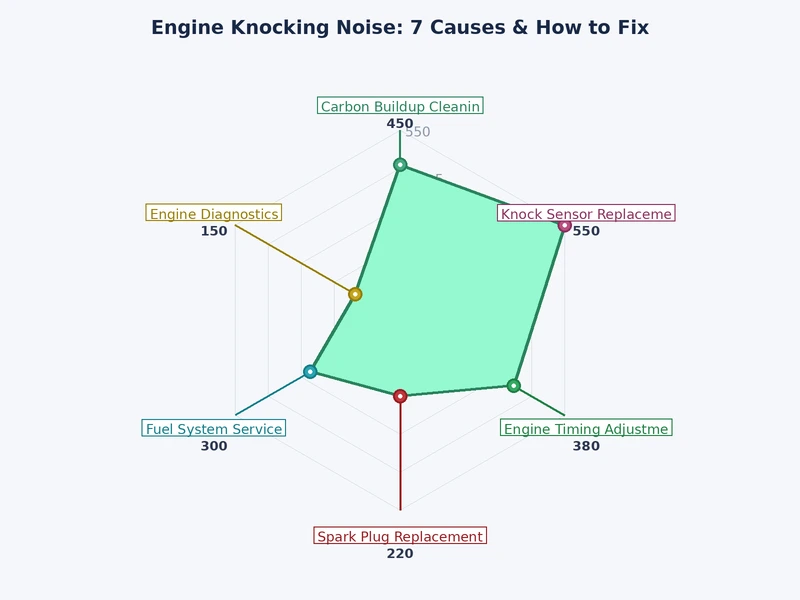
Accurate diagnosis before repair prevents unnecessary part replacement. Two tools are essential for isolating engine knock causes efficiently.
An OBD-II scanner retrieves stored and pending fault codes from the engine control unit. Knock-related codes — P0324 (knock control system error), P0325 (knock sensor 1 circuit malfunction), and P0330 (knock sensor 2 circuit malfunction) — confirm that the ECU has registered detonation events. Scanners with live data capability allow real-time monitoring of knock sensor voltage and ignition timing retard. This shows whether the ECU is actively compensating for knock during a test drive. Our team considers live data capability essential for any in-depth engine knock diagnosis.
A mechanic's stethoscope — a rigid metal probe connected to an earpiece — transmits sound vibrations directly from the engine block surface. Touching the probe to the valve cover, cylinder head, and lower block in sequence isolates whether the knock originates from the top end (valve train) or the bottom end (bearings). This distinction is critical: top-end noise is typically less urgent than bottom-end noise. The tool costs under $30 and eliminates significant guesswork before any disassembly begins.
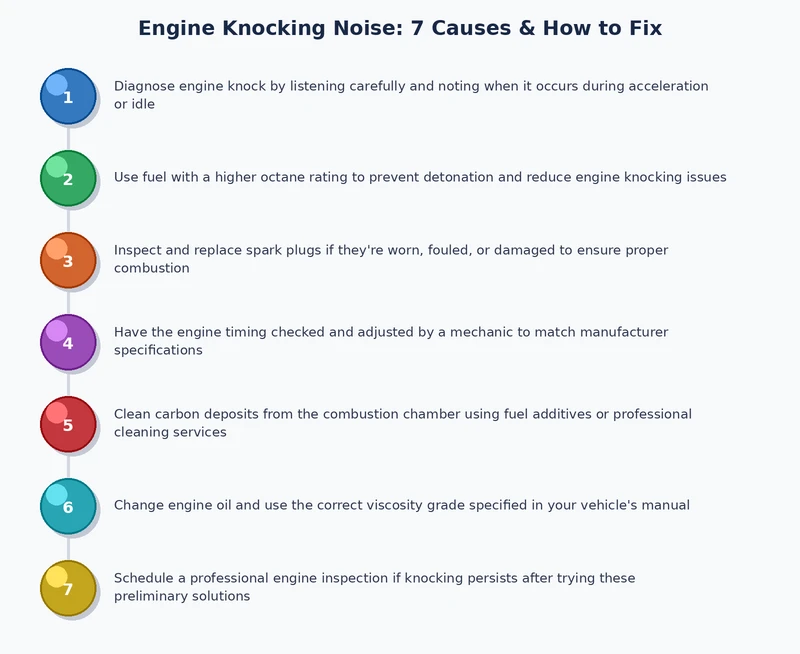
The majority of engine knock cases have straightforward resolutions that do not require professional labor. Our team recommends addressing these steps in order before considering more invasive repairs:
These four steps resolve mild knock in the majority of real-world cases. If knock persists after all four are addressed, the cause is mechanical and further diagnosis is required before driving continues.
Knock caused by worn rod bearings requires engine disassembly. A machine shop measures bearing clearances with a micrometer and replaces worn bearing shells. Crankshaft journals are inspected for scoring and machined if necessary. Knock sensor replacement is a moderate job — typically two to three hours of labor depending on sensor location and engine layout. Direct injection carbon cleaning via walnut blasting requires specialized shop equipment and is not a viable DIY procedure on most vehicles.
Prevention is consistently less expensive than repair. Our team recommends these practices as standard operating procedure for all vehicles:
Switching fuel grades, cleaning the fuel system, or replacing spark plugs costs between $20 and $200 in most cases. These repairs restore combustion efficiency and protect long-term engine life. The value calculation is straightforward: small expenditures prevent failures that cost ten to one hundred times more.
Rod bearing replacement requires disassembly, machining, and reassembly. Total costs typically range from $1,500 to $3,000 depending on the engine and whether the crankshaft requires resurfacing. Our team advises comparing this figure directly against the vehicle's current market value. When a repair exceeds 60 to 70 percent of the vehicle's worth, a replacement engine or a different vehicle deserves serious consideration.
| Cause | Repair | Estimated Cost | DIY Feasible? |
|---|---|---|---|
| Low-octane fuel | Switch to correct fuel grade | $0–$5 per fill-up difference | Yes |
| Carbon deposits | Fuel-system cleaner or walnut blast | $15–$300 | Partial |
| Worn spark plugs | Plug replacement | $20–$150 | Yes |
| Faulty knock sensor | Sensor replacement | $150–$500 | Moderate |
| Low engine oil | Oil top-off or full oil change | $5–$80 | Yes |
| Bad fuel injectors | Injector cleaning or replacement | $100–$800 | Moderate |
| Worn rod bearings | Engine teardown and bearing replacement | $1,500–$3,000 | No |
Not all engine knocking noise carries the same urgency. Our team draws a firm line between conditions that permit brief continued operation and those that require immediate engine shutdown.
A loud, persistent knock that intensifies under acceleration is the signature of rod bearing failure in progress. Continued operation risks complete engine seizure — a condition where the connecting rod fractures the engine block and destroys the engine entirely. Our team's position is unambiguous: when deep, rhythmic knock appears under load, the engine must be shut down immediately and the vehicle towed. A tow fee of $100 to $300 is negligible compared to the cost of replacing a seized engine, which routinely exceeds $5,000.
Yes — and the severity depends on how long the condition persists and what causes it. Mild knock from a fuel-grade mismatch resolved within a few miles causes minimal lasting damage. Sustained knock from worn rod bearings or persistent detonation erodes piston crowns, scores cylinder walls, and destroys bearing surfaces permanently. Our team consistently finds that engines brought in with the worst internal damage are those where knock was present for weeks or months before the owner sought diagnosis.
There is no fixed answer — the acceptable driving distance depends entirely on the cause. A knock triggered by the wrong fuel grade is not immediately destructive and allows brief continued operation to reach a fuel station. A knock from worn rod bearings can lead to engine seizure within miles. Our team's recommendation is to treat any persistent knock as urgent until the cause is confirmed. If the source cannot be identified quickly, stopping and arranging diagnosis is the correct course of action.
No. Higher-octane fuel resolves knock caused specifically by premature detonation from a low-octane fuel grade. It has no effect on mechanical causes such as worn rod bearings, a failed knock sensor, or carbon hot spots. If switching to the correct premium fuel grade does not eliminate the knock within a full tank, the cause is mechanical rather than fuel-related, and further physical diagnosis is required before additional driving.
 |
 |
 |
 |

About Sarah Whitfield
Sarah Whitfield is a diagnostics and troubleshooting specialist who spent ten years as an ASE-certified technician before joining the editorial team. She specializes in OBD-II analysis, electrical gremlins, and the kind of intermittent problems that make most owners give up.
Get some FREE car parts & gear.. Or check out the latest free automotive manuals and build guides here.
Disable your ad blocker to unlock all the hidden deals. Hit the button below 🚗
| | | |
