by Sarah Whitfield
Engines operating below their optimal temperature consume up to 30% more fuel than a properly warmed engine — and an engine running cold is one of the most under-diagnosed problems on the road. The temperature gauge barely moves. The heater blows lukewarm air. Fuel economy quietly tanks. Most drivers chalk it up to a cold morning and never investigate further.
That's a mistake. A persistent cold-running condition is almost always a mechanical fault, not a seasonal nuisance. Left untreated, it accelerates wear, ruins fuel trims, and causes emissions failures that shouldn't be happening. The cooling system is a precision circuit, and when something breaks the temperature regulation loop, every part of the engine pays for it.
This guide covers the causes of an engine running cold, how to confirm which one is at fault, and what to do about it. Drivers who suspect the cooling system should also review the bad thermostat symptoms that frequently overlap with this condition — the two problems share a lot of common ground.
Contents
Engines are engineered to run hot — not dangerously hot, but within a tight band, typically 195–220°F depending on the make. Below that range, combustion is inefficient, oil lubrication suffers, and emissions systems can't do their job. When an engine consistently fails to reach that range, something specific is preventing it.
The thermostat is a wax-pellet valve that sits between the engine block and the radiator. During a cold start, it stays closed. That traps coolant inside the engine block and lets it heat up quickly. Once the coolant hits operating temperature — typically around 195°F — the thermostat opens and begins routing coolant through the radiator to shed excess heat.
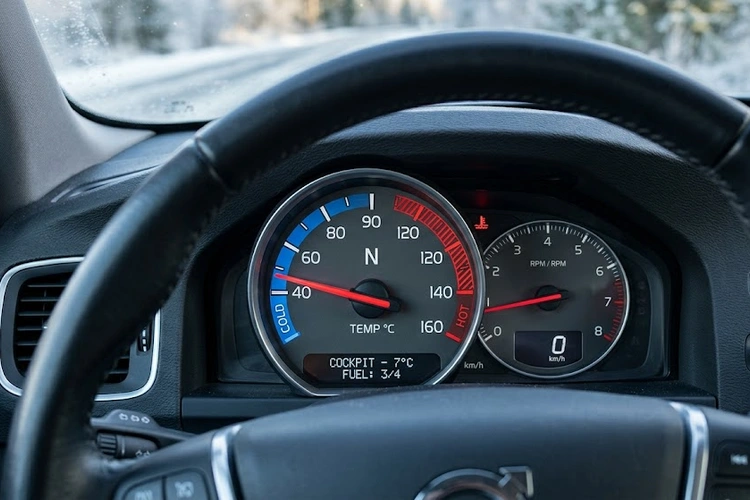
When the thermostat fails in the open position, that cycle never completes. Coolant circulates continuously through the radiator from the moment the engine starts. The radiator bleeds off heat nonstop. The engine temperature climbs slowly, plateaus far below the intended range, and stays there. On the dashboard, the gauge barely moves off the cold mark — or rises to one-third of the normal range and stops.
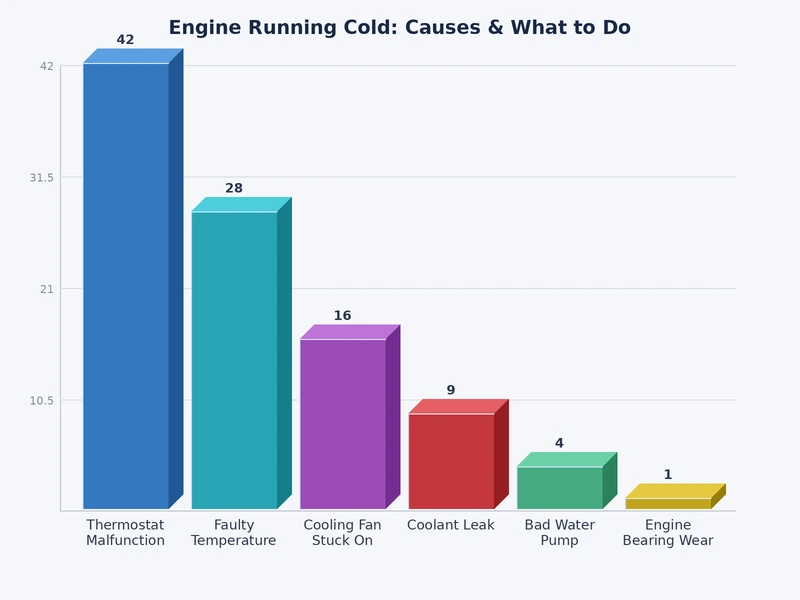
This is the single most common cause of an engine running cold, by a large margin. The full symptom picture — including heater output, fuel trim changes, and check engine codes — is covered in detail in the bad thermostat symptoms guide.
A replacement thermostat costs $10–$30 at most auto parts stores. It's one of the highest-value repairs a driver can perform themselves — low cost, high impact, and accessible on virtually every engine.
A faulty coolant temperature sensor (CTS) is the second most likely suspect. The CTS feeds temperature data to the engine control unit. When it fails low — sending a signal that suggests the engine is colder than it actually is — the ECU runs a permanently rich fuel mixture. The gauge may read correctly while the engine management behaves as if it's perpetually in cold-start mode. Performance drops, fuel economy falls, and the spark plugs carbon up faster than normal.
Air pockets in the cooling system can also disrupt temperature regulation. Air doesn't transfer heat the way coolant does. A significant air bubble near the thermostat housing delays or prevents the thermostat from sensing accurate temperature, which means it may open late, open only partially, or behave erratically. This is most common after a coolant flush or any cooling system repair where the system wasn't properly bled afterward.
In rare cases, a cracked or corroded thermostat housing can cause enough coolant bypass to keep temperatures suppressed. According to the Wikipedia overview of automotive thermostats, the wax pellet mechanism is highly reliable — but it does degrade with age and mileage, particularly in vehicles with acidic coolant that hasn't been changed on schedule.
The most expensive mistake in cooling system diagnosis is replacing the thermostat before confirming it's actually faulty. A few targeted checks narrow the field fast without wasting money on guesswork.
After 10–15 minutes of normal driving, a healthy engine should sit in the middle third of the temperature gauge. That's the design target — not the bottom quarter, not the top quarter. If the gauge sits persistently low after a reasonable warm-up period, the cooling system has a problem worth investigating.
One complication: many manufacturers program the gauge to move slowly and display within a narrow "normal" band, intentionally dampening the display to avoid driver alarm from brief fluctuations. That means a gauge that reads in the lower portion of "normal" could actually be masking an engine that's running cooler than intended. A gauge that barely moves at all — even after 20 minutes of highway driving — is almost always pointing to a stuck-open thermostat.
An OBD-II scan tool bypasses the gauge entirely. Reading the Engine Coolant Temperature (ECT) PID via live data gives the actual number the ECU is seeing. If the scan tool reads 150°F while the gauge shows the engine as warm, the gauge is incorrect. If both show low temperatures after extended driving, the thermostat is the clear suspect.
An infrared thermometer pointed at the thermostat housing and upper radiator hose adds another data point. A properly functioning thermostat will show a sharp temperature difference between those two points at cold start — the upper hose should be cool until the thermostat opens. If both are warm from the first minute of operation, the thermostat is stuck open and not closing at startup.
| Symptom Pattern | Most Likely Cause | Key Diagnostic Step |
|---|---|---|
| Gauge stuck low, heater blows cold air | Thermostat stuck open | Compare live ECT scan data; infrared test upper radiator hose at startup |
| Gauge reads normal, engine runs rich, poor fuel economy | Faulty coolant temperature sensor | Test CTS resistance with multimeter vs. manufacturer's temperature-resistance chart |
| Temperature fluctuates erratically after coolant service | Air pocket in cooling system | Bleed cooling system; run engine with reservoir cap off until thermostat cycles |
| Cabin cold, engine temperature gauge normal | Heater core blockage or blend door failure | Check heater core inlet and outlet hose temperatures; inspect blend door actuator |
| Cold running with rough idle and check engine light | CTS or stuck thermostat with fueling codes | Pull codes; look for P0128 (coolant below thermostat regulating temperature) |
Drivers who notice cold cabin air despite a normal engine temperature reading should investigate heater core failure symptoms separately. The heater core and thermostat are in the same circuit, but they fail differently — and a blocked heater core can make the whole system look like a cold-running engine problem when it isn't.
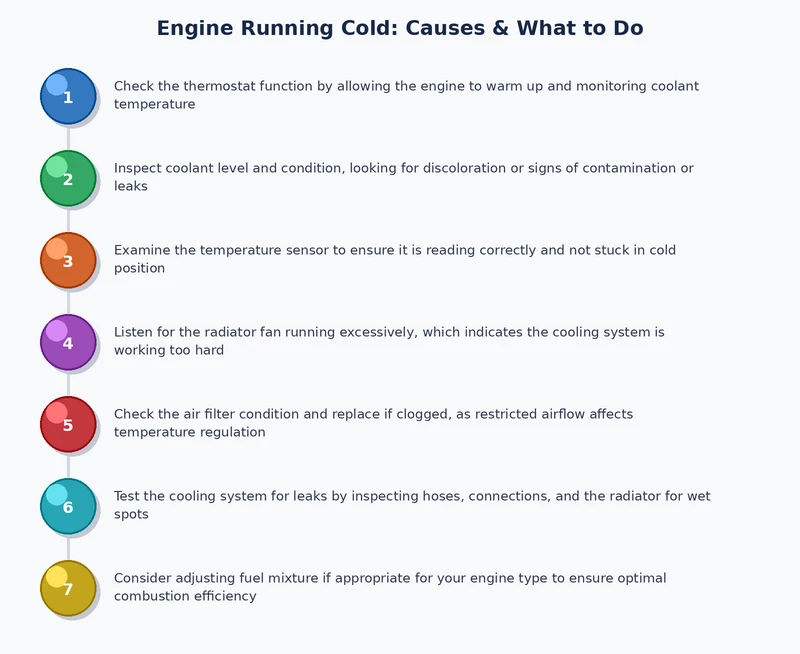
Once the faulty component is confirmed, the actual repair is usually fast and inexpensive. The thermostat is the most common fix, and it's one of the easier jobs in engine maintenance. The CTS is even simpler.
The thermostat sits inside a housing, usually bolted to the engine block near the top of the cooling system. Replacing it involves draining a portion of the coolant, removing two or three bolts from the housing, swapping the thermostat and its gasket or O-ring, and refilling the system. On most four-cylinder engines, the process takes under an hour.
The step most DIYers skip is properly bleeding the cooling system after refill. Air trapped in the system after a thermostat job causes the same erratic temperature behavior that prompted the repair in the first place. Many vehicles have a dedicated bleeder valve on the cooling system, typically near the thermostat housing or on the upper radiator hose. On vehicles without one, running the engine with the reservoir cap off — allowing air to escape as the thermostat cycles open — achieves the same result.
Replacing the thermostat gasket or O-ring at the same time is non-negotiable. Reusing an old seal is a false economy. Coolant leaks around the thermostat housing after a repair are almost always caused by a reused gasket that compressed and failed to seal properly.
Never install a thermostat with a lower temperature rating than the OEM spec — a "cooler" thermostat doesn't prevent overheating, it just guarantees the engine runs cold permanently.
If the thermostat replacement doesn't resolve the issue — or if scan data points to a sensor problem rather than a thermostat — the CTS is the next component to test. The sensor is a simple resistive device: resistance decreases as coolant temperature rises. Testing it involves removing the sensor, placing it in water heated to a known temperature, and measuring its resistance with a multimeter. If the reading doesn't match the manufacturer's spec chart, the sensor is faulty.
CTS replacement is one of the simplest jobs on any engine. The sensor threads directly into the engine block or coolant passage. Cost runs $15–$40 for most applications. The repair itself takes 20–30 minutes.
If cold air in the cabin persists after both repairs, the problem may lie further down the heating circuit. The blend door actuator symptoms guide is worth reviewing — a failed actuator sends all airflow through the cold duct regardless of the heater setting, which looks and feels identical to a cold-running engine from the driver's seat.
An engine running cold below the normal operating range doesn't always trigger an immediate warning light. That silence encourages inaction. It also encourages guessing — and guessing in cooling system diagnosis tends to compound the problem.
Running an engine consistently below operating temperature causes real, cumulative damage. Engine oil is formulated to lubricate at operating temperature — thick, cold oil doesn't protect bearings, cam lobes, or cylinder walls the way fully warm oil does. Fuel that doesn't combust completely leaves carbon deposits on intake valves, injectors, and piston crowns. The catalytic converter never reaches the temperature needed to reduce harmful emissions effectively.
There's also a direct link between cold running and unusual smells from the exhaust and engine bay — unburned fuel and carbon buildup both produce distinctive odors. The guide on diagnosing strange car smells can help identify whether incomplete combustion is already affecting the exhaust system. And drivers who notice any metallic rattling at cold startup should check timing chain noise symptoms — cold, thick oil is one of the known contributors to timing chain wear and stretch.
The thermostat is cheap enough that many people replace it first and ask questions later. That's understandable — but it leads to frustration when the symptoms persist after a new thermostat is installed. Thermostats can be tested off the vehicle by submerging them in a pot of water heated to the rated opening temperature and watching for movement. A thermostat that opens correctly at the right temperature is not the problem, and replacing it changes nothing.
The correct sequence is always: gather data, identify the most likely fault, test that specific component, then replace it if confirmed faulty. Jumping straight to parts replacement is a shortcut that rarely saves time and frequently costs more in the end.
Most cold-running engine problems are preventable. The thermostat and CTS are wear items. Treating them accordingly — rather than waiting for failure — is the smarter approach.
Coolant degrades over time and becomes acidic. Acidic coolant corrodes cooling system components from the inside: thermostat housings, water pump impellers, and the wax element inside the thermostat itself. Following the manufacturer's coolant replacement interval — typically every two to five years depending on coolant type — protects the entire system and dramatically extends thermostat life.
During a coolant flush, it makes sense to inspect the thermostat since the housing is already disassembled. A thermostat with more than 100,000 miles on it is a candidate for proactive replacement during a flush. While the cooling system is being serviced, it's also worth verifying the cabin heating circuit is fully functional. A failing blower motor resistor — which controls fan speed — can make the heater feel cold even when coolant temperature is perfectly normal.
Vehicles that sit unused for months face specific cooling system risks. Coolant loses its additives and can stratify in the system. Rubber seals and gaskets dry out. The wax element inside the thermostat can seize in a partially open position — not fully open, not fully closed, just sluggish and unreliable. Before returning a stored vehicle to regular use, the cooling system deserves a full inspection: coolant condition, thermostat operation, and hose integrity. The comprehensive guide on maintaining a car that sits unused for months covers every system worth checking before putting the vehicle back on the road.
An engine running cold means it fails to reach its normal operating temperature range — typically 195–220°F — after a reasonable warm-up period. The temperature gauge stays low, the heater may blow lukewarm air, and fuel economy drops. The most common cause is a thermostat stuck in the open position, though a faulty coolant temperature sensor or air pocket in the cooling system can produce similar symptoms.
Yes. Running an engine consistently below operating temperature causes increased fuel consumption, incomplete combustion, carbon buildup on valves and pistons, and accelerated wear on bearings and cylinder walls due to thick, under-warmed oil. The catalytic converter also fails to reach its activation temperature, which can cause emissions test failures over time.
A thermostat stuck in the open position is the most common cause by a wide margin. It allows coolant to circulate continuously through the radiator from startup, preventing the engine from ever building up heat to the intended operating range. The part is inexpensive and the repair is straightforward for most DIYers.
The key distinction is this: a stuck-open thermostat will show low actual coolant temperatures on an OBD-II scan tool. A faulty CTS will show low temperatures on the scan tool even when the engine is genuinely hot — and an infrared thermometer on the engine block will confirm the real temperature is normal. Testing the CTS resistance with a multimeter against the manufacturer's spec chart confirms or rules it out quickly.
It often does. Diagnostic trouble code P0128 — "Coolant Temperature Below Thermostat Regulating Temperature" — is specifically designed to flag this condition. However, the light doesn't always appear immediately, especially in older vehicles with less aggressive monitoring thresholds. The absence of a check engine light doesn't mean the cooling system is operating correctly.
If the thermostat is the cause, the part costs $10–$30 and a DIY repair is straightforward. A shop will typically charge $100–$200 including labor for a thermostat replacement. A coolant temperature sensor costs $15–$40 for the part, with similar labor rates. These are among the most affordable repairs in the entire drivetrain.
 |
 |
 |
 |

About Sarah Whitfield
Sarah Whitfield is a diagnostics and troubleshooting specialist who spent ten years as an ASE-certified technician before joining the editorial team. She specializes in OBD-II analysis, electrical gremlins, and the kind of intermittent problems that make most owners give up.
Get some FREE car parts & gear.. Or check out the latest free automotive manuals and build guides here.
Disable your ad blocker to unlock all the hidden deals. Hit the button below 🚗
| | | |
