by Joshua Thomas
You walk out to your car after a night of heavy rain. The engine turns over, then stumbles — rough idle, a shudder through the cabin, maybe a check engine light blinking at you. Most drivers assume the worst. In reality, an engine that runs rough after rain is one of the more predictable problems in automotive diagnostics, and the cause almost always points to moisture infiltrating the ignition or intake system.
This guide covers every realistic cause — from a wet distributor cap to a cracked coil boot — and walks you through how to diagnose and fix each one without guessing. If misfires are already part of the picture, reviewing the full spectrum of engine misfire symptoms before buying parts will save you time and money.
Contents
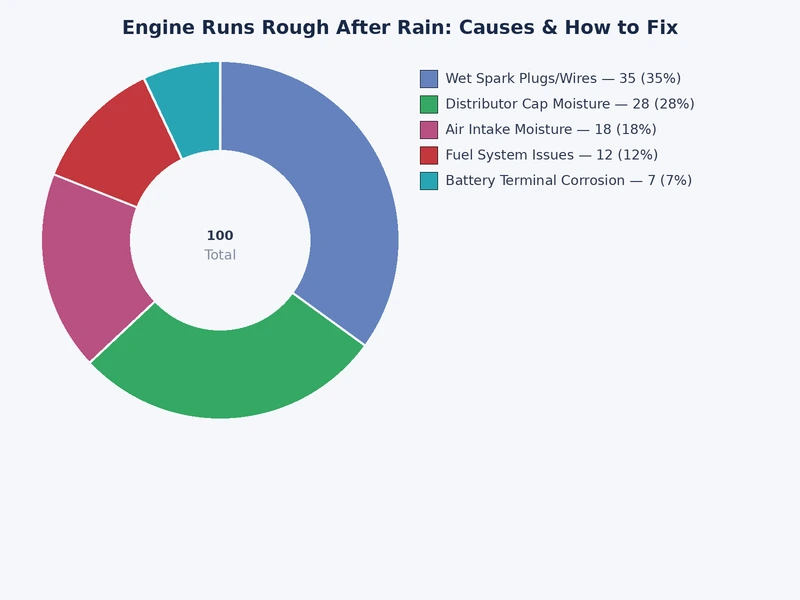
Internal combustion runs on a precise chain of events. Fuel, air, spark — in the right ratio, at the right moment. Moisture disrupts that chain at multiple points simultaneously. The ignition system is especially vulnerable. High-voltage spark generation relies on controlled arcing across engineered gap geometries. Water is a far better conductor than the air gaps it's supposed to arc across, and it opens unintended low-resistance paths that bleed off spark energy before it ever reaches a plug gap.
Rain doesn't have to flood your engine bay to cause problems. Overnight condensation alone is enough. Temperature drops pull moisture from humid air directly onto coil towers, plug boots, and distributor caps. Hard rain drives water through weatherstripping gaps around the hood. Engine wash-downs — particularly those aimed at the firewall — are another frequent culprit that mechanics see repeatedly.
Cracked or deteriorated plug wire insulation acts like a wick. Water draws into the crack, sits against the conductor, and creates a resistive path to ground. The spark takes the path of least resistance and never delivers adequate energy to fire the cylinder.
A wet distributor cap develops carbon tracking — thin carbonized channels that form between terminals as surface moisture enables low-energy arcing. Each arc deposits carbon, and each deposit makes the next arc easier. Eventually, a cylinder misfires on every cycle. Seeing P0300 random misfire codes immediately after rainfall almost always traces back to a distributor cap or compromised coil boot — not the plugs themselves.
Pro tip: Carbon tracking inside a distributor cap is invisible until you look with a focused flashlight at a low angle. Rotate the cap under direct light before you condemn the spark plugs.
Not all rain-related rough running is ignition-related. Some causes are mechanical. Some involve the intake or fuel trim. The diagnostic challenge is separating the quick, inexpensive fixes from the faults that require more time on the lift.
Wet spark plug wells are the most common culprit on modern coil-on-plug engines. If your valve cover gasket is already seeping, oil accumulates at the base of each plug well. Rain adds water to that contamination. The coil sits in a degraded environment, insulation breaks down fast, and you get a misfire on the affected cylinder. Checking for a valve cover gasket leak early in the diagnosis eliminates a common compounding factor.
A clogged or contaminated throttle body is worth checking too. Carbon deposits and oil film behave differently when wet — they can cause erratic idle that looks rain-triggered but clears once the throttle plate warms and deposits dry out.
Cracked intake manifold gaskets can draw moisture into the intake tract during heavy rain events. This leans out the mixture momentarily, causing stumbling that appears rain-triggered but is actually a standing vacuum leak made temporarily worse by humidity. Similarly, a coil that's borderline functional in dry conditions will fail outright when moisture lowers its insulation resistance below the threshold for reliable spark generation. These faults won't resolve with drying alone.
Open the hood immediately after a rough start. Look for visible condensation on coil packs, plug boots, and wiring harnesses. Use a flashlight to check inside each plug well — lift the coils and look straight down. Any water in a plug well is a confirmed problem. Clear it with compressed air or a lint-free rag before reinstalling anything.
Inspect plug wire boots for cracks and brittleness. Good silicone is supple and returns to shape when squeezed. Degraded rubber stays compressed or flakes at the edges. On older vehicles, check the distributor cap for hairline cracks, corroded terminals, and the carbon rotor button for excessive wear.
Before purchasing any parts, connect an OBD-II scanner and pull live data alongside stored codes. Cylinder-specific misfire codes — P0301 through P0308 — tell you exactly which cylinder is affected. Multiple affected cylinders suggest a distributor cap, coil rail, or shared electrical fault. A single P030X code points to that cylinder's coil, boot, wire, or plug. Chasing misfires without code data wastes time and money.
You don't need a dealer-level scanner to handle this diagnosis. A mid-range OBD-II reader, a digital multimeter, and a can of electrical contact cleaner cover the vast majority of rain-related rough running cases. The table below maps each tool to its specific role in this diagnosis.
| Tool | Diagnostic Use | Approximate Cost |
|---|---|---|
| OBD-II Scanner | Cylinder-specific misfire codes (P030X), live misfire counts per cylinder | $30–$120 |
| Digital Multimeter | Coil primary/secondary resistance, plug wire resistance per foot | $20–$60 |
| Ignition Spark Tester | Confirms spark presence at plug; surfaces intermittent misfires under load | $10–$25 |
| Compressed Air / Blow Gun | Clears water from plug wells and distributor cap interior | $10–$30 |
| Dielectric Grease | Seals plug boot interiors against future moisture intrusion at reinstall | $5–$12 |
| Electrical Contact Cleaner | Displaces moisture from coil towers, cap terminals, and harness connectors | $6–$14 |
Start with the easiest access point. Remove each coil pack or plug wire boot one at a time. Spray electrical contact cleaner into the boot interior and onto the coil tower. Let it flash off — it displaces water and evaporates without residue. Reinstall with a thin coat of dielectric grease on the inside of the boot. This eliminates moisture as a variable for that cylinder immediately.
If rough running persists after drying, pull the spark plugs. Wet plugs — particularly those sitting in contaminated wells — should be inspected for physical damage, fouling, and gap erosion. Replace any plug that shows cracking, heavy deposits, or gap wear beyond spec. On distributor-equipped vehicles, remove the cap and inspect the interior for carbon tracks, corroded brass terminals, and cracks in the bakelite body. A cracked cap warrants immediate replacement — it will never seal reliably again regardless of how dry it gets.
Measure coil resistance with your multimeter. Primary winding resistance typically reads between 0.3–1.5 ohms; secondary winding between 6,000–15,000 ohms. Specifications vary by manufacturer — confirm against your service data. Any coil reading open circuit or shorted on either winding fails the test and should be replaced.
If ignition components test clean, shift attention to the intake side. Remove the air intake hose and inspect the throttle blade and bore for heavy carbon deposits. A wet throttle body with contaminated surfaces can produce idle instability that closely mimics an ignition miss. Clean the blade and bore with throttle body cleaner applied to a lint-free cloth. Check the air filter — a soaked paper element chokes airflow and richens the fuel mixture dramatically. If rain entered through the cowl or a poorly sealed airbox, the filter may be saturated. A dirty throttle body combined with a wet air filter is a surprisingly common double-failure that diagnoses as a severe rough idle post-rain.
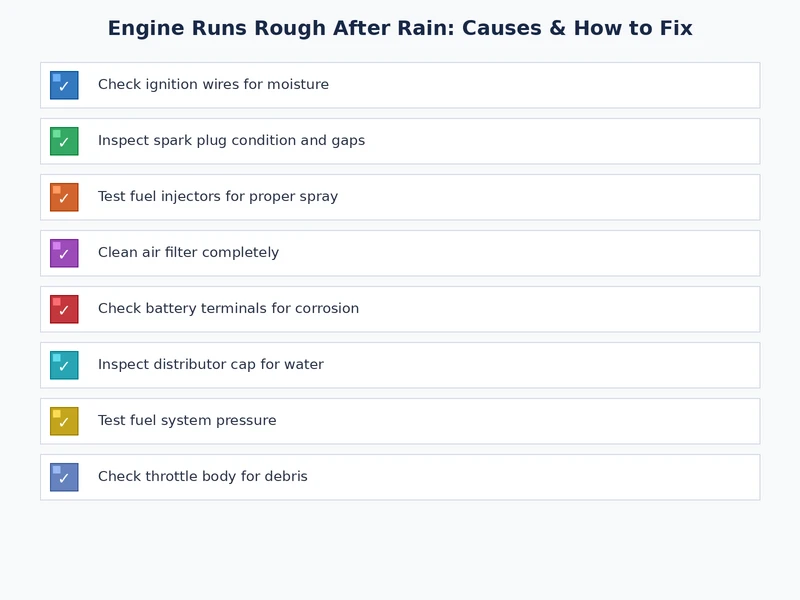
The most common mistake is assuming the problem will dry out and stay gone. It often clears temporarily — and then comes back worse after the next rainstorm. Each wet-dry cycle degrades insulation further, accelerates carbon tracking, and deepens corrosion on terminals. A coil boot that survived ten rainstorms may fail completely on the eleventh. Catching it early means a $15 boot replacement. Waiting means a failed coil, a misfiring cylinder for weeks, and potentially a plug seized into the head from repeated thermal cycling in contaminated conditions.
Warning: If your engine runs rough after rain but the condition never fully clears as the engine warms, you're likely dealing with a component failure — not simple moisture evaporation. Don't keep driving and hoping it resolves on its own.
Cheap aftermarket ignition wires are a false economy on vehicles that regularly see moisture exposure. Low-grade silicone insulation doesn't seal plug boots to spec, and wire resistance often runs above the acceptable range — producing weak spark in dry conditions and outright failure when wet. Spend the extra money on OEM-specification or premium aftermarket wires with correct boot geometry for your application. Replacing only one wire in a high-mileage set is almost never the right call — the rest are equally degraded. Replace the full set and distributor cap together whenever any single component fails resistance testing.
Ignition systems carry service intervals that most drivers ignore until a failure forces the issue. Iridium and platinum spark plugs are rated for 60,000–100,000 miles, but plug boots and wires degrade faster — especially in high-humidity or high-heat climates. Inspect boots annually for cracking and hardness. Apply fresh dielectric grease inside each boot at every plug service interval. Distributor caps and rotors — where still used — are typically replaced every 30,000 miles or at each plug service, whichever comes first. According to Wikipedia's overview of ignition systems, modern coil-on-plug designs eliminate several failure points present in distributor systems, but moisture ingestion remains a shared vulnerability across both architectures.
Dielectric grease applied to plug boot interiors at each service is the single highest-value preventive measure available. It blocks water intrusion and makes future boot removal easier by preventing the boot from bonding to the coil tower. Electrical contact cleaner sprayed onto coil tower bases and cap terminals after any engine wash displaces water before it can cause arcing damage.
Evaluate your air intake setup if your vehicle uses an aftermarket cold-air intake. Many drop into low cowl positions that ingest water during heavy rain — a known tradeoff that stock airboxes are specifically designed to avoid. Heat shields and sealed airbox covers that redirect water away from the filter are available for most common platforms and are worth the investment if you drive in wet climates regularly.
Rain introduces moisture that creates low-resistance paths in your ignition system — allowing spark to arc to ground instead of firing the plug. Once the engine heats up and moisture evaporates, spark delivery returns to normal. This intermittent pattern is the defining characteristic of a moisture-related ignition fault rather than a failed component.
Yes. A soaked paper air filter severely restricts airflow, causing a rich mixture and rough idle. Rain can saturate the filter if water enters through the cowl vent or a poorly sealed airbox. Inspect and replace the filter if it's wet or within its service interval — it's one of the cheapest fixes on the list.
Pull an OBD-II scanner first. Multiple cylinder misfires (P0300 plus several P030X codes simultaneously) suggest a shared component like a distributor cap or coil rail. A single-cylinder P030X code points to that cylinder's individual coil, boot, wire, or plug. The pattern of affected cylinders is your most reliable diagnostic indicator.
It can. Standing water in a plug well accelerates rust inside the threaded bore, which can cause the plug to seize during removal. In severe cases, water displacement into the combustion chamber risks hydraulic lock. Address water in plug wells immediately — dry them with compressed air before the vehicle is driven further.
Spark plugs are often not the problem. The fault is typically upstream — in the boot, coil tower, wire, or distributor cap. A plug can appear visually clean while receiving zero spark due to arcing somewhere in the delivery path. Pull codes, then test the coil resistance and inspect the boot interior before condemning the plugs.
Directly yes. A leaking valve cover gasket allows oil to accumulate in plug wells. When rain adds water to that contamination, the coil sits in a corrosive mixture that degrades insulation far faster than moisture alone. Fixing the gasket leak is a prerequisite to solving rain-related misfires on engines with this condition.
Surface moisture on coil towers and cap terminals typically evaporates within 10–20 minutes of running the engine at operating temperature. Water inside plug wells or soaked into wire insulation takes longer and may not fully clear. If rough running persists beyond 20–30 minutes of warm operation, you're dealing with a component fault rather than simple evaporation.
 |
 |
 |
 |

About Joshua Thomas
Joshua Thomas just simply loves cars and willing to work on them whenever there's chance... sometimes for free.
He started CarCareTotal back in 2017 from the advices of total strangers who witnessed his amazing skills in car repairs here and there.
His goal with this creation is to help car owners better learn how to maintain and repair their cars; as such, the site would cover alot of areas: troubleshooting, product recommendations, tips & tricks.
Joshua received Bachelor of Science in Mechanical Engineering at San Diego State University.
Get some FREE car parts & gear.. Or check out the latest free automotive manuals and build guides here.
Disable your ad blocker to unlock all the hidden deals. Hit the button below 🚗
| | | |
