by Sarah Whitfield
You merge onto the highway and press the gas. The engine bogs, shudders, and dies. Traffic behind you isn't stopping. That moment — when acceleration triggers a stall — is both dangerous and deeply frustrating. Engine stalls when accelerating represent a specific class of failure that demands systematic diagnosis, not guesswork. If you've landed here, you're likely dealing with one of the seven causes covered in this troubleshooting guide.
The combustion cycle requires precisely timed air, fuel, and spark delivered in correct proportion under load. When any one element fails to scale with throttle demand, combustion collapses. Your engine stalls. The good news: most causes follow a predictable pattern, and most repairs are achievable without a dealership visit.

Contents
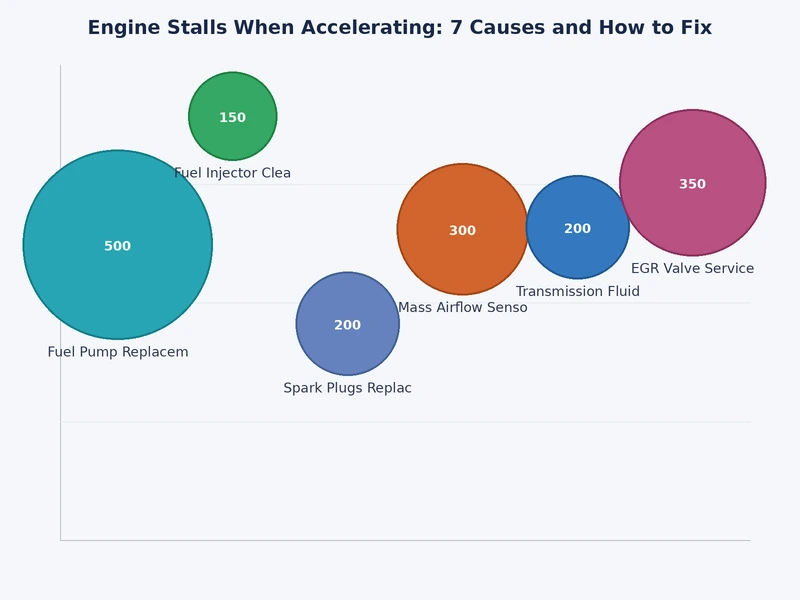
When you press the accelerator, the throttle plate opens wider. More air enters the intake manifold. The ECU — reading signals from the MAF sensor, TPS, and O2 sensors simultaneously — increases injector pulse width to maintain the stoichiometric ratio. For gasoline engines, that target sits at approximately 14.7:1 air-to-fuel, as documented by the U.S. Department of Energy's fuel economy research. Disturb that balance under load, and combustion fails.
Under hard acceleration, fuel demand spikes sharply. The fuel pump must maintain system pressure while delivering higher volume. The injectors must atomize cleanly under that pressure. If either component falters — if pressure drops or spray pattern degrades — the mixture goes lean. A lean misfire under load is not a momentary stumble. It is a stall. The engine cannot sustain combustion without the fuel quantity the load demands.
A car that idles smoothly but stalls the moment you apply throttle has a load-dependent fault. That single observation cuts your suspect list in half before you touch a single tool.
Components like the fuel pump, crankshaft position sensor, and throttle position sensor may function adequately at low demand and fail only when the ECU calls for rapid change. A vehicle that idles without complaint but stalls on every throttle application carries a specific, diagnosable profile. That distinction is your first and most important clue.
These seven causes account for the overwhelming majority of acceleration stalling complaints across all makes and model years. They are ordered by diagnostic frequency — the most commonly confirmed cause appears first.
1. Dirty or Failing MAF Sensor. The mass airflow sensor is the ECU's primary input for fuel calculation. Contamination from oil vapor or fine airborne debris distorts its voltage signal. The ECU injects the wrong fuel quantity based on that false reading. Under light throttle, the error is small enough to tolerate. Under hard acceleration, the miscalculation becomes a stall.
2. Weak Fuel Pump. A pump that holds adequate pressure at idle often cannot sustain pressure when demand increases at wide-open throttle. Pressure drops, the mixture leans out, and combustion fails. This is a classic load-dependent failure — the pump appears functional in every other situation until you stress it.
3. Clogged Fuel Injectors. Partially blocked injectors deliver inconsistent spray patterns and reduced flow volume. The affected cylinder receives less fuel than the ECU commanded. Under acceleration, the deficit triggers a misfire severe enough to kill the engine. Hard carbon deposits from poor-quality fuel or extended service intervals are the primary cause of injector fouling.
4. Faulty Throttle Position Sensor (TPS). The TPS reports throttle angle to the ECU in real time as a 0–5V signal. A failing TPS sends erratic voltage — a dropout, a flat spot, or an out-of-range reading. The ECU receives conflicting input and cannot properly manage fuel delivery or ignition timing. The result is a stumble or full stall on throttle application.
5. Crankshaft Position Sensor (CKP) Failure. The CKP provides the timing pulse the ECU needs to fire injectors and ignition coils in sequence. An intermittent CKP failure — often triggered by heat soak after the engine reaches operating temperature — cuts that signal without warning. Without it, the ECU cannot time combustion events. The engine stalls instantly. This cause is among the most misdiagnosed in the industry because it rarely logs a code on the first failure event.
6. Vacuum Leak. A cracked intake hose, failed manifold gasket, or disconnected vacuum line introduces unmetered air into the intake stream. The ECU cannot compensate fast enough when you snap the throttle open. The air-fuel ratio spikes lean instantaneously. Drive-by-wire systems that rely entirely on sensor data for airflow calculation are particularly vulnerable to this failure mode.
7. Torque Converter Clutch (TCC) Lockup Failure. In automatic transmissions, the TCC locks the torque converter at cruising speed to improve efficiency. A TCC that engages prematurely at low speed — before the engine can handle the mechanical load — behaves exactly like dropping a manual clutch at idle. The engine stalls. Drivers typically blame the engine or fuel system, and the transmission goes uninvestigated for weeks.
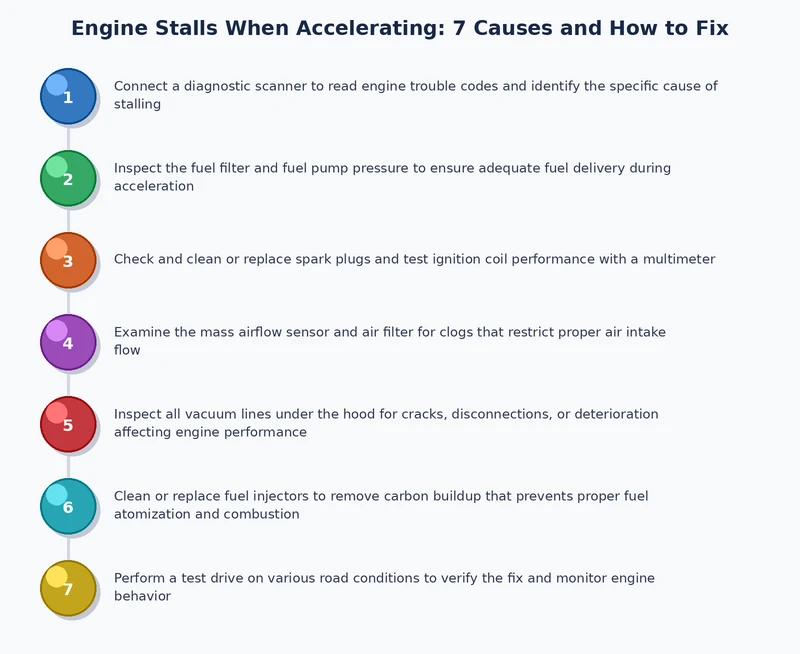
Connect an OBD-II scanner before removing a single component. Stored codes, pending codes, and freeze-frame data narrow your diagnosis before you spend a dollar. No codes do not mean no fault — intermittent sensor failures frequently leave no permanent trace in the PCM's memory.
Record all fault codes and examine your long-term fuel trim (LTFT) values. LTFT above +10% confirms a lean condition — your investigation starts with the MAF sensor, vacuum integrity, and fuel pressure. LTFT below -10% indicates a rich condition or a stuck-open injector. Freeze-frame RPM and load values at the time of the stall event reveal whether the fault is idle-range or load-range.
Test fuel pressure at idle and under hard throttle using a mechanical gauge teed into the Schrader valve on the fuel rail. A pump that reads 45 psi at idle but falls to 25 psi at wide-open throttle is failing. Port-injected systems require 35–65 psi. Direct injection systems operate between 200–2,000 psi depending on engine load, and require a high-pressure gauge on the high-pressure rail.
Unplug the MAF sensor and perform a short test drive. If the stalling stops, the sensor is your culprit — the ECU falls back to a conservative base fuel map and removes the bad signal from the equation.
For TPS diagnosis, monitor live voltage sweep with a scan tool as you open the throttle slowly from idle to wide-open. The signal must sweep cleanly from approximately 0.5V to 4.5V without dropout, flat spots, or spikes. Any discontinuity in that sweep is a definitive fault — replacement is required. These same load-dependent symptoms appear when a car loses power going uphill, where sustained throttle demand exposes identical fuel delivery and sensor failures.
MAF cleaning takes ten minutes and costs under $10. Remove the sensor from the intake tube. Spray the wire or film elements with dedicated MAF cleaner — not brake cleaner, not carburetor cleaner, both of which damage the sensing elements. Allow full drying before reinstalling. This repair resolves a significant proportion of LTFT-driven stalling complaints on vehicles with over 60,000 miles, particularly those with oiled aftermarket air filters that migrate oil onto the sensor.
Throttle body cleaning follows a similar process but requires an idle relearn afterward on virtually all drive-by-wire systems. The ECM stores learned idle airflow values that become invalid after the throttle bore is cleaned. Skip the relearn and you introduce a new idle quality complaint on top of the original fault. Consult your OEM service documentation for the correct relearn sequence before you begin.
Replace the fuel filter before condemning the pump. A $15–$30 filter replacement rules out restriction as the cause of inadequate pressure before you commit to a $300 pump job. If pressure still drops under load with a new filter installed, the pump requires replacement. On most modern vehicles the pump is a module inside the tank. Plan for a two-to-three hour job if you're handling it yourself, plus tank-sealing materials and a new fuel pump strainer.
For injector service, choose professional ultrasonic cleaning over fuel tank additives. Ultrasonic flow-bench testing confirms both flow rate and spray pattern after cleaning. Additives dissolve light varnish deposits but cannot clear the hard carbon fouling that causes partial blockage in high-mileage injectors.
A smoke machine is the professional standard for vacuum leak detection. Pressurize the intake system and watch for smoke escaping at gasket faces, vacuum port fittings, throttle body base, and intake manifold joints. Smoke testing finds leaks that spray testing misses, particularly at intake manifold gaskets where physical access for carb-spray application is restricted.
Without a smoke machine, use propane enrichment or careful carburetor cleaner application around suspected areas while monitoring idle speed on a scan tool. A rise in idle RPM confirms a leak at the application point. Mark every location before proceeding to repair — multiple simultaneous leaks are common on high-mileage engines with original rubber vacuum lines.
Before condemning the torque converter itself, pull the transmission dipstick. Degraded, dark fluid with a burnt smell causes TCC shudder and sticking — a fluid and filter service often resolves early-stage cases before mechanical damage progresses.
Scan for TCC-specific fault codes — P0740 (TCC Circuit Malfunction) and P0741 (TCC Performance/Stuck Off) are the primary indicators. A transmission fluid and filter service resolves many early-stage TCC complaints at a fraction of the cost of a converter replacement. For proper service intervals, see our guide on how often to change transmission fluid.
A restricted catalytic converter creates exhaust backpressure that manifests as stalling under acceleration. Measure backpressure by threading a gauge into the upstream O2 sensor bung. More than 1.5 psi at idle signals restriction. Intake vacuum that drops sharply under acceleration and recovers slowly points directly to exhaust obstruction. For the full symptom picture, see signs of a bad catalytic converter.
The fuel pump is the default assumption in every acceleration stalling complaint. It is frequently the wrong one. A dirty MAF sensor, a failing CKP, or a vacuum leak produces symptoms identical to pump failure at a fraction of the replacement cost. Technicians who skip fuel pressure testing and scan data before ordering a pump replace components that test within specification — and the stalling continues. Diagnosis before parts replacement is not optional.
Throttle body cleaning is legitimate preventive maintenance. It is not a diagnostic substitute. A clean throttle body on an engine with a failing CKP sensor or degraded injectors changes nothing about the root cause. More importantly, cleaning a drive-by-wire throttle body without performing the idle relearn procedure introduces a new idle quality fault. The attempted fix becomes an additional problem requiring resolution.
The PCM logs a diagnostic trouble code only after detecting the same failure signature across multiple defined drive cycles. An intermittent CKP or TPS fault that triggers a single stall event typically leaves no stored code. A scan that returns "no codes" on a stalling vehicle is not clearing your suspect list. It is telling you the failure hasn't yet crossed the PCM's logging threshold — not that the vehicle is fault-free.
The ranges below reflect typical independent shop pricing across common domestic and import platforms. DIY figures assume you own basic hand tools and an OBD-II scanner. Labor rates are based on a $120/hr shop rate, which is average for most U.S. metropolitan markets.
| Component | DIY Parts Cost | Shop Labor | Total Shop Estimate |
|---|---|---|---|
| MAF Sensor Cleaning | $7–$10 | 0.3 hr | $40–$70 |
| MAF Sensor Replacement | $25–$120 | 0.5 hr | $100–$220 |
| Throttle Position Sensor | $20–$80 | 0.5–1 hr | $100–$200 |
| Crankshaft Position Sensor | $30–$100 | 1–2 hr | $130–$280 |
| Fuel Filter | $15–$40 | 0.5–1 hr | $80–$150 |
| Fuel Pump (in-tank module) | $80–$300 | 2–4 hr | $250–$700 |
| Injector Cleaning (4-cyl, ultrasonic) | $40–$80 | 1–2 hr | $150–$350 |
| Vacuum Leak Repair | $5–$50 | 1–3 hr | $80–$400 |
| Torque Converter Replacement | $150–$400 | 6–10 hr | $700–$1,800 |
The MAF sensor, TPS, CKP, and fuel filter are strong DIY candidates. All are accessible on most platforms with basic hand tools, and none require module programming on the majority of vehicles. The fuel pump is achievable for an intermediate DIYer but carries contamination risk if tank sealing is compromised during reassembly. The torque converter is a transmission-out job requiring a lift, a transmission jack, and specialized tooling — that work belongs in a qualified transmission shop.
A faulty O2 sensor degrades long-term fuel trim calibration over time, but it rarely causes a direct acceleration stall on its own. It is more likely to produce poor fuel economy and sluggish throttle response. If you have an O2 sensor code alongside a stalling complaint, diagnose the primary load-bearing causes first — MAF, fuel pressure, TPS — before replacing the O2 sensor.
Heat soak is the defining characteristic of crankshaft position sensor failure. The sensor's internal circuitry breaks down at operating temperature, cutting the timing signal to the ECU. The engine stalls and often refuses to restart until it cools down completely. A hot-only stall with no stored fault codes is a CKP sensor failure until proven otherwise by live data testing.
No. A stall at highway speed or during a lane change is a direct collision risk. Drive the vehicle only to a safe location for immediate diagnosis. Do not attempt extended driving or highway use until you have identified and resolved the underlying fault.
Low oil does not directly cause acceleration stalling. Critically low oil pressure can trigger a protective engine shutdown on vehicles equipped with an oil pressure cutoff relay, but that is a separate mechanism from the fuel, ignition, and sensor faults covered here. Check oil level as part of your baseline inspection, then focus diagnosis on the systems outlined in this guide.
Listen for a high-pitched whine from the fuel tank area at startup — a healthy pump produces a brief low hum that fades within two seconds of key-on. A whining pump under sustained throttle load, extended cranking on a hot restart, and erratic fuel pressure readings at wide-open throttle are the early warning signs of a pump approaching failure.
Worn spark plugs increase the ignition system's voltage demand and can contribute to misfires under the higher cylinder pressure of acceleration. If your plugs are at or beyond their service interval, replacing them is valid maintenance that may reduce stalling frequency. However, plugs alone rarely explain a consistent stall-on-acceleration pattern — complete the fuel pressure and sensor diagnostics described above regardless of plug condition.
 |
 |
 |
 |

About Sarah Whitfield
Sarah Whitfield is a diagnostics and troubleshooting specialist who spent ten years as an ASE-certified technician before joining the editorial team. She specializes in OBD-II analysis, electrical gremlins, and the kind of intermittent problems that make most owners give up.
Get some FREE car parts & gear.. Or check out the latest free automotive manuals and build guides here.
Disable your ad blocker to unlock all the hidden deals. Hit the button below 🚗
| | | |
