by Sarah Whitfield
Have you ever sat at a stoplight and felt your engine rhythmically rise and fall in RPM on its own, as if it can't quite decide what it wants to do? That unsettling phenomenon is engine surging at idle, and while it can feel alarming, most causes are diagnosable and fixable without a dealership visit. The root issue is almost always a disruption in the precise air-fuel-spark balance your engine needs to maintain a stable idle, and once you identify which system is misbehaving, the repair path becomes straightforward. Whether it's a cracked vacuum line, a fouled sensor, or a failing idle control valve, you'll find the full picture in this guide.
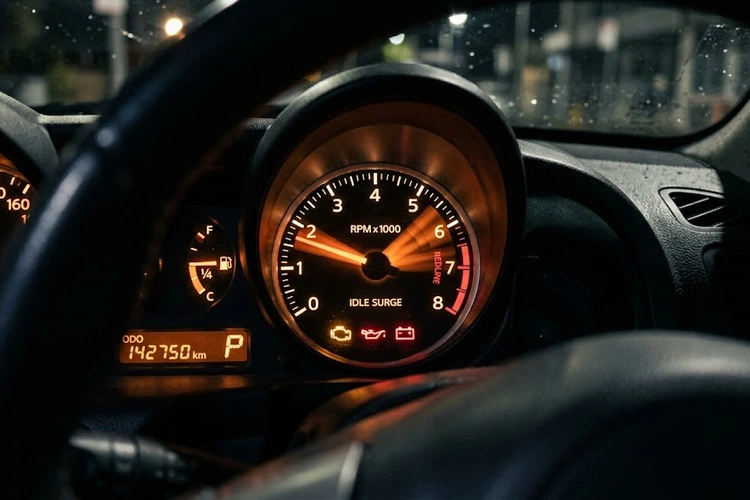
Engine surging at idle shows up across virtually every make and model, and it tends to worsen progressively if ignored. On fuel-injected vehicles, the ECU compensates briefly but eventually runs out of authority to mask the underlying fault, which is when the check gauges light or a check engine light often appears alongside the surging. Understanding the cause before throwing parts at it saves both time and money.
Contents
Chasing an idle surge without the right tools is an exercise in frustration, because the symptoms overlap across a dozen different faults and guessing costs more than the tools themselves. Your diagnostic process becomes far more targeted when you approach it with at least two instruments in hand.
A mid-range OBD-II scanner that streams live PIDs — short-term and long-term fuel trims, MAF grams-per-second, MAP voltage, and IAC duty cycle — tells you immediately whether the ECU is commanding a lean or rich correction and by how much. Short-term fuel trim values above +10% at idle almost always point to an unmetered air source, typically a vacuum leak or a faulty MAF reading, and that single data point narrows your search considerably. Free apps paired with a Bluetooth ELM327 adapter can read these values if a dedicated scanner isn't available, though dedicated units are faster to navigate under the hood.
A smoke machine pressurizes the intake tract and reveals vacuum leaks that are otherwise invisible to the eye — cracked intake boots, split hoses, and leaking gaskets all show up as wisps of smoke before you've touched a single component. If you don't have access to a smoke machine, a vacuum gauge connected to a manifold port gives you a dynamic reading: a steady low-vacuum needle combined with a hunting RPM points directly at a metered-air disruption, while a wildly oscillating needle with a normal average suggests an ignition misfire contributing to the surge. According to NHTSA vehicle defect guidance, recurring driveability complaints tied to idle quality are among the most commonly reported issues on vehicles past the 60,000-mile mark.
Pro tip: Always pull live fuel trim data before opening the hood — it points you toward the right system in under two minutes and prevents costly misdiagnosis.
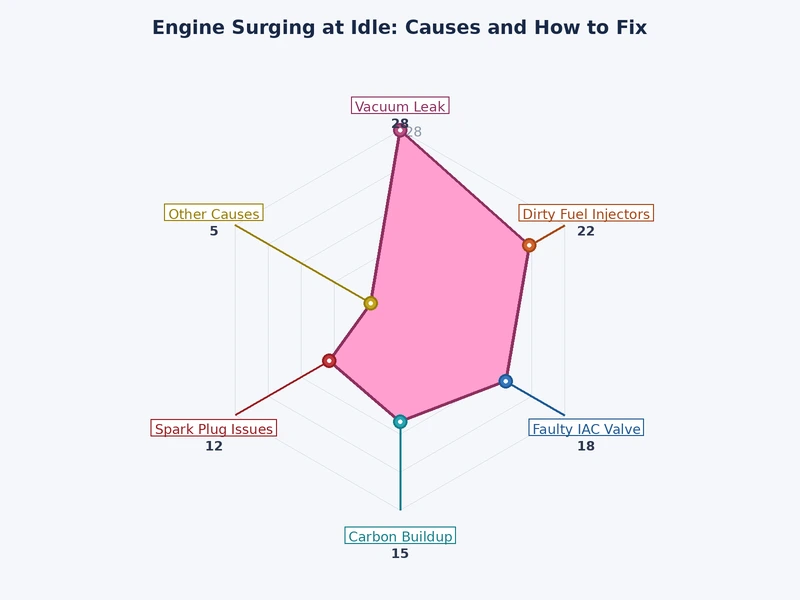
Engine surging at idle traces back to a relatively short list of systems, and the majority of cases fall into three categories: unmetered air entering the intake, fuel delivery problems, and sensor faults feeding the ECU bad data. You'll rarely find all three at once, but they can interact and compound each other, particularly on higher-mileage vehicles where seals and sensors have aged together.
A vacuum leak is the single most common cause of idle surge on fuel-injected engines, because any air that bypasses the MAF sensor goes unaccounted for and forces the ECU into an endless correction cycle that manifests as RPM oscillation. The most vulnerable points are the intake manifold gaskets, the PCV system hoses, brake booster lines, and the large intake boot between the airbox and throttle body — all of which harden and crack with heat cycling over time. Even a pinhole crack in a small vacuum hose can introduce enough unmetered air to produce a noticeable surge at idle, particularly when the engine is cold and running open-loop. A related symptom you might also encounter is the engine stalling when slowing down, which often shares a vacuum leak root cause with idle surge.
The idle air control valve — or on drive-by-wire systems, the electronic throttle body — manages idle speed by varying airflow around the throttle plate, and carbon buildup or electrical failure in this component produces a classic hunting idle where RPM cycles between roughly 500 and 1,000 RPM in a steady rhythm. Cleaning the IAC valve with throttle body cleaner resolves the issue in many cases when the valve itself is mechanically sound but simply coated in deposits; if the internal stepper motor has failed, replacement is the only reliable fix. On vehicles with electronic throttle control, the ECU can sometimes relearn the correct idle position after a battery disconnect, which is worth attempting before replacing the throttle body assembly.
A contaminated or failing mass airflow sensor sends incorrect airflow data to the ECU, causing it to miscalculate injector pulse width and produce a fuel mixture that's either too lean or too rich to sustain a stable idle, with the RPM oscillating as the closed-loop system hunts for equilibrium. Cleaning the MAF sensor wire with dedicated MAF cleaner — not brake cleaner, which leaves residue — often restores normal operation when the sensor element is simply contaminated rather than damaged. MAP sensor faults tend to produce similar symptoms on speed-density calibrated engines, and a failed coolant temperature sensor is another overlooked contributor, since the ECU uses coolant temp to set the initial target idle speed. If your surging is accompanied by unexpected instrument behavior, reviewing what the reduced engine power warning means can add useful context to your diagnosis.
Warning: Never spray carburetor cleaner around the intake while the engine is running to locate vacuum leaks — use propane or a dedicated smoke machine to avoid a fire hazard.
Several persistent beliefs about idle surge lead vehicle owners down expensive dead ends, and it's worth addressing them directly before you commit time and money to a repair that won't solve anything.
Switching to premium fuel when experiencing idle surge is one of the most common responses, but fuel octane has essentially no effect on idle quality under normal operating conditions — octane rating governs knock resistance under load, not idle stability, and spending more per gallon won't change anything if the underlying cause is a vacuum leak or sensor fault. Similarly, fuel injector cleaner additives are unlikely to resolve a genuine idle surge, though they're not harmful if the vehicle's fuel injectors are mildly dirty and contributing to a rough rather than hunting idle.
A slightly elevated and variable idle immediately after a cold start is intentional ECU behavior — the engine runs open-loop on a warm-up enrichment map until coolant temperature reaches operating range, and the idle will naturally be higher and somewhat less steady during this period. The concern arises when the surging persists beyond the first two to three minutes of operation, or when it appears at full operating temperature, which reliably signals a real fault rather than normal behavior. Car backfiring during this warm-up phase alongside idle surge is a stronger indicator of an ignition or fueling fault worth investigating promptly.
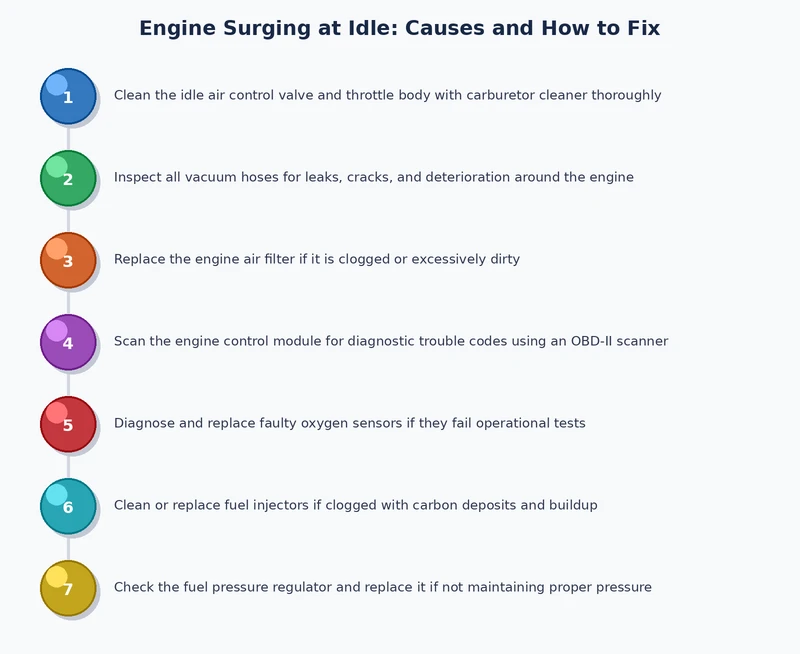
The most effective approach to fixing engine surging at idle follows a logical sequence that rules out the cheapest and most common faults first, rather than jumping to expensive component replacement based on intuition alone.
Begin with a code scan and live fuel trim data, then inspect all visible vacuum hoses and intake components for cracks, disconnections, or soft spots that collapse under vacuum. Clean the IAC valve and MAF sensor before replacing either, since cleaning resolves a significant percentage of cases and costs almost nothing. If fuel trims remain elevated after addressing air leaks, test fuel pressure at the rail — a weak pump or failing regulator produces lean conditions that mimic vacuum leak symptoms. Spark plugs and ignition coils are worth inspecting if the surge feels more like a rhythmic miss than a smooth RPM oscillation, since a cylinder dropout at idle can present as a surge depending on engine displacement and cylinder count.
Faults involving the ECU itself, internal injector balance issues, or cam/crank sensor correlation errors generally require professional-grade diagnostic equipment that goes beyond what consumer OBD scanners can access, and attempting to repair these without the right tools typically introduces new faults. If you've addressed the common causes and the surge persists, a shop with a factory-level scan tool can perform relative compression tests and injector balance tests that isolate the fault quickly and accurately.
Pro insight: Recheck fuel trim data after every repair step — it's the fastest way to confirm whether your fix actually solved the underlying cause or only masked a symptom.
Repair costs for engine surging at idle vary considerably depending on which system is at fault and whether you're doing the work yourself or paying shop labor rates. The table below covers the most common repair items with realistic price ranges to help you budget accurately.
| Repair Item | DIY Parts Cost | Difficulty | Likelihood of Resolving Surge |
|---|---|---|---|
| Vacuum hose replacement (per hose) | $5 – $20 | Easy | High if leak confirmed |
| IAC valve cleaning | $8 – $15 (cleaner) | Easy | Moderate |
| IAC valve replacement | $30 – $120 | Easy–Moderate | High if valve faulty |
| MAF sensor replacement | $50 – $200 | Easy | High if sensor confirmed bad |
| Intake manifold gaskets | $20 – $80 | Moderate–Hard | High if leak confirmed |
| Throttle body cleaning | $10 – $15 (cleaner) | Easy | Low–Moderate |
| Fuel pressure regulator | $25 – $100 | Moderate | Moderate if fuel pressure low |
| Spark plugs (full set) | $20 – $80 | Easy–Moderate | Low–Moderate |
Shop labor for an idle surge diagnosis typically runs one to two hours at prevailing rates, putting the diagnostic fee alone between $100 and $200 before any parts are ordered, which is why doing the preliminary code scan and visual inspection yourself can meaningfully reduce your total bill. Complex repairs involving intake manifold removal or throttle body replacement on interference-fit engines can push total shop costs to $400 or more, though the majority of engine surging at idle cases on common domestic and Asian-market vehicles fall well below that threshold when caught before additional damage occurs. Keeping up with routine sensor and filter maintenance — a practice covered in detail in our guide to engine surging causes — reduces the probability of reaching that repair tier significantly.
Engine surging at idle is your engine asking a simple question — and the answer is almost always in the data, not the parts bin.
 |
 |
 |
 |

About Sarah Whitfield
Sarah Whitfield is a diagnostics and troubleshooting specialist who spent ten years as an ASE-certified technician before joining the editorial team. She specializes in OBD-II analysis, electrical gremlins, and the kind of intermittent problems that make most owners give up.
Get some FREE car parts & gear.. Or check out the latest free automotive manuals and build guides here.
Disable your ad blocker to unlock all the hidden deals. Hit the button below 🚗
| | | |
