by Sarah Whitfield
Our team first encountered it on a 2019 Chevy Silverado brought in for routine service — a faint gasoline smell at idle and a check engine light that had been on for three weeks. The scan tool pulled a P0442 before the hood was fully open. That single small-leak code is among the most common triggers for EVAP leak symptoms across every make and model on the road today.
The Evaporative Emission Control (EVAP) system seals fuel vapor inside a closed loop, preventing raw hydrocarbon emissions from escaping into the atmosphere. When any part of that loop develops a breach — cracked hose, failed purge valve, degraded gas cap seal — the OBD-II monitor flags it with a Diagnostic Trouble Code. P0440, P0441, and P0442 each point to a distinct failure mode. Our team has documented the diagnostic patterns, root causes, and repair paths for all three across hundreds of service cases.
Contents
The EVAP system became a federally mandated standard under EPA-driven emissions regulations codified through the 1990s. Every gasoline-powered passenger vehicle sold in the U.S. since 1996 runs a fully monitored EVAP system under OBD-II. The core function is straightforward: capture fuel vapor generated in the gas tank and route it back into the combustion cycle rather than venting it to atmosphere.
The ECM runs EVAP monitor tests under specific drive cycle conditions — cold start, steady-state highway cruise, and extended engine-off soak. During a sealed test, the ECM closes the vent valve and briefly commands the purge valve open to draw vacuum. The FTP sensor then tracks the rate of pressure decay. A leak allows the system to equalize faster than calibrated thresholds permit.
Small leaks at the .020" threshold require multiple failed monitor runs before a code sets. Large leaks at .040" or greater typically set on the first or second failed cycle. This explains why many EVAP codes appear days or weeks after the actual fault develops — and why drivers often can't connect the symptom to a specific event.
EVAP leak symptoms span a wide range in severity. The system has no direct effect on engine output, so most drivers go weeks without connecting the fuel smell to the check engine light. Our team has documented the following patterns across diagnostic cases on all three platforms.
A raw gasoline smell — strongest at idle, immediately after fueling, or in an enclosed garage — is the most commonly reported EVAP leak symptom. The odor typically originates from one of four points:
Our experience tracking fuel-related odor complaints — covered in our guide on how to diagnose strange car smells — confirms that EVAP faults account for the largest share of fuel-odor cases that don't involve an active liquid fuel leak.
Unlike misfire codes or lean/rich fuel trim faults, EVAP codes rarely cause drivability changes. The MIL illuminates. The engine runs normally. Many drivers and quick-lube technicians treat these as low-priority. Our team considers that a mistake. A saturated charcoal canister, left unaddressed, can eventually contribute to hard cold starts and an excessively rich condition at idle — both of which do affect drivability and fuel economy over time.
Any stored P0440, P0441, or P0442 code triggers an automatic failure in OBD-II-based emissions programs. Affected states include California, New York, Texas, Colorado, and roughly 30 others with mandatory testing. The vehicle must not only clear the code but also pass the EVAP monitor to completion — a distinction that catches many drivers off-guard after a quick code-clear at the parts store.
Warning: Clearing an EVAP code without completing the repair resets the monitor to "incomplete" status. Most state programs treat an incomplete EVAP monitor as a test failure — the vehicle must complete two to three full drive cycles before the monitor status updates and a retest becomes valid.
These three codes share the same system but represent distinct failure modes. Knowing which code is stored — and whether companion codes are present — narrows the component search significantly before any physical diagnosis begins.
P0440 — Evaporative Emission System Malfunction
P0440 is a general system-integrity fault. The ECM detected a loss of EVAP containment but has not isolated the source. It frequently appears as a parent code before a more specific sub-code populates. Root causes span the full component range: loose gas cap, cracked EVAP hose, failed vent valve, or canister damage.
P0441 — EVAP System Incorrect Purge Flow
P0441 indicates the ECM detected unexpected vapor flow during the purge monitor sequence. The purge solenoid is commanded closed, but MAP or FTP sensor readings indicate flow that should not be present. A stuck-open purge valve is the leading cause. A leaking vacuum line at the purge circuit or a cracked purge hose can also trigger this code on older naturally aspirated platforms.
P0442 — EVAP System Small Leak Detected
P0442 is statistically the most common EVAP code across all makes and models. It flags a leak at the .020" threshold — the smallest breach the OBD-II standard is calibrated to detect. Gas cap failure triggers approximately 60% of P0442 events in our experience. The remaining causes split between cracked hoses, degraded vent valve seals, and hairline canister cracks.
Pro Insight: On GM trucks and SUVs, a P0442 paired with P0449 (vent solenoid circuit fault) points directly to the vent valve assembly — a documented failure pattern on Silverado and Tahoe platforms past 80,000 miles that warrants targeted component inspection before running a full smoke test.
| Code | Fault Classification | Leak Threshold | Primary Cause | Typical Repair Cost |
|---|---|---|---|---|
| P0440 | General system malfunction | Any size | Gas cap, cracked hose, vent valve | $10–$200 |
| P0441 | Incorrect purge flow | N/A (flow fault) | Stuck-open purge solenoid | $25–$150 |
| P0442 | Small leak detected | .020" equivalent | Gas cap, minor hose crack | $10–$300 |
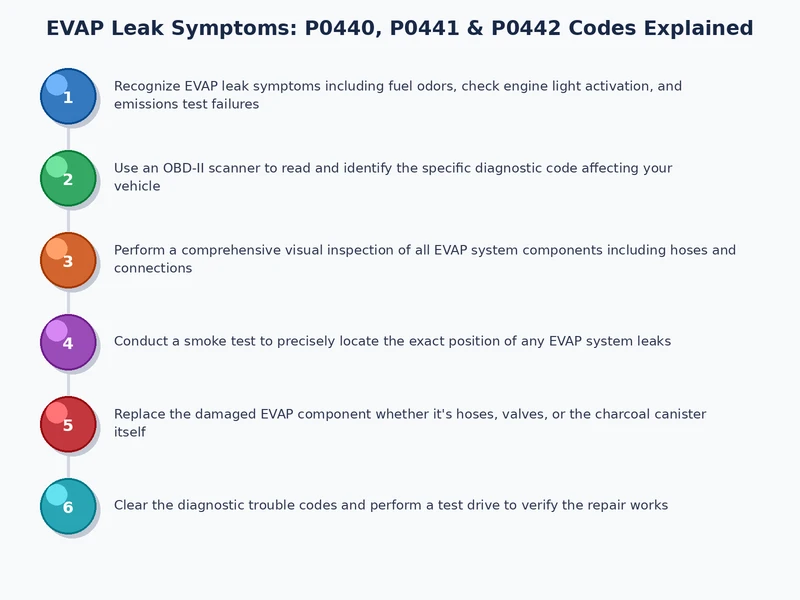
Best diagnostic practice starts at the least expensive, most accessible component and works systematically inward. Our team follows this sequence on every EVAP case regardless of make, model, or code combination.
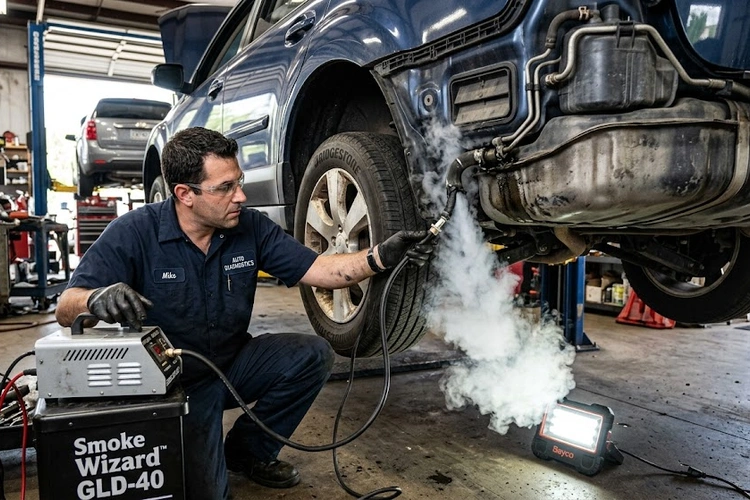
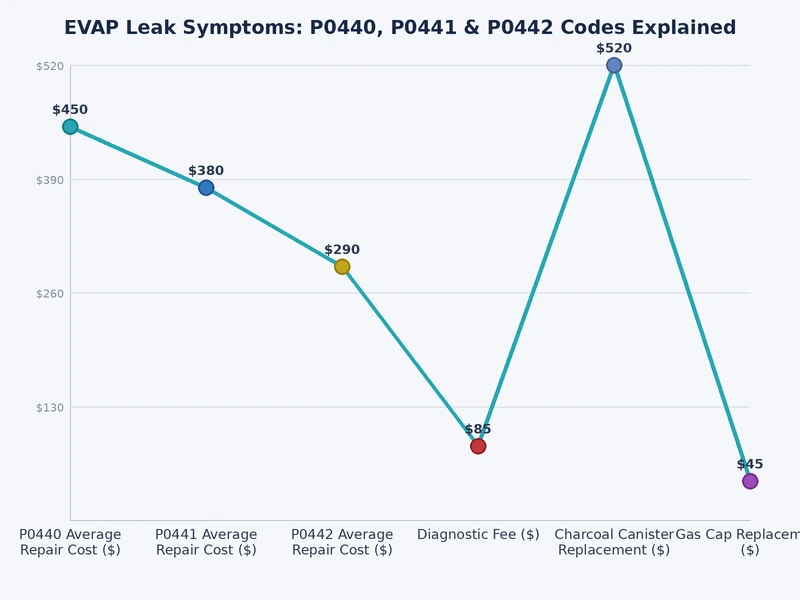
The smoke test is the industry standard for EVAP leak isolation. Most independent shops charge $75–$150 for the procedure, which takes 20–40 minutes depending on vehicle complexity.
A stuck-open purge valve — the primary P0441 cause — is isolated with a hand vacuum pump or a bi-directional scan tool.
Tip: Most OEM-equivalent purge valves cost $15–$45. Our team recommends replacing the purge valve and vent valve simultaneously on vehicles over 100,000 miles — the labor overlap makes dual replacement cost-effective relative to a second diagnostic visit.
EVAP repairs span a wide accessibility range. Gas cap replacement requires no tools. Fuel tank vapor port sealing requires tank removal. Understanding which repairs fall within typical DIY capability prevents unnecessary shop costs — and unnecessary complications.
These repairs carry minimal risk. The systematic component-by-component approach mirrors the method our team applies when diagnosing other under-hood leak faults — including the process documented in our coverage of differential fluid leak symptoms, where methodical elimination drives the repair decision rather than guesswork.
Our team considers any repair requiring fuel tank removal to be professional territory unless the technician has direct platform-specific experience.
Most EVAP system failures are predictable. Temperature cycling, fuel volatility, and component age degrade the system on a consistent timeline. Proactive maintenance reduces repeat codes and extends system life across high-mileage vehicles.
| Component | Inspection Interval | Typical Failure Age | Notes |
|---|---|---|---|
| Gas cap | 50,000 mi / 5 years | 7–10 years | Replace proactively; low cost |
| Purge valve | 80,000–100,000 mi | 10–12 years | Test with vacuum pump at inspection |
| Vent valve | 80,000–100,000 mi | 10–12 years | Replace alongside purge valve for efficiency |
| Charcoal canister | 100,000–150,000 mi | 12–15 years | Inspect for cracks; check for liquid fuel saturation |
| EVAP hoses | 75,000 mi / visual | 8–12 years | Flex-test for brittleness at every major service |
Vehicles operating in extreme temperature environments — desert Southwest heat or northern sub-zero winters — degrade EVAP components faster than regional averages. High-mileage vehicles at 150,000-plus miles with no documented EVAP service are strong candidates for proactive canister and valve replacement, particularly when other emission-related codes appear alongside the EVAP fault.
Extended storage compounds the problem. Fuel degradation inside the canister contributes to vent valve sticking and FTP sensor drift over time. Our team's documentation on how to maintain a car that sits unused for months covers fuel system stabilization and EVAP-specific precautions for vehicles coming out of long-term storage.
In most cases, EVAP leak symptoms don't directly reduce measured fuel economy. The system operates independently of combustion efficiency under normal conditions. However, a stuck-open purge valve can introduce excess vapor into the intake at idle, causing a mildly rich condition that marginally affects economy on some platforms — particularly four-cylinder engines with sensitive fuel trim calibration.
A P0442 alone does not affect vehicle safety or drivability. The engine runs normally. The primary consequences are a failed emissions test and ongoing hydrocarbon vapor release — the environmental concern the EVAP system was designed to eliminate. Our team recommends addressing the fault within one to two fuel cycles rather than deferring it indefinitely.
Most platforms require two to three complete drive cycles — including a cold start, steady highway cruise, and an extended engine-off soak — for the EVAP monitor to run to completion and register as "ready." Some manufacturers publish a specific drive cycle procedure that satisfies the monitor faster under controlled conditions. The monitor status must show "complete" before an emissions retest is valid.
P0441 most frequently indicates a stuck-open purge solenoid, but it isn't the only cause. A cracked purge hose, a leaking vacuum line at the purge circuit, or a deteriorated fuel pressure regulator vacuum port can trigger the same code on older naturally aspirated platforms. A hand vacuum pump test and a visual hose inspection confirm or rule out the solenoid before any parts are ordered.
EVAP codes frequently coexist with unrelated faults — misfires, oxygen sensor codes, or MAF codes — without any causal connection. The OBD-II system stores each fault independently based on its own monitor criteria. Our team treats each stored code as a separate diagnostic case unless a shared root cause, such as a large vacuum leak affecting both fuel trim and EVAP pressure, directly links them.
EVAP leak symptoms are easy to underestimate — the car drives fine, the fuel smell seems minor, and the codes look harmless compared to misfire or transmission faults. Our team recommends treating any stored P0440, P0441, or P0442 as a priority repair rather than a nuisance light. Starting with a gas cap replacement and a thorough visual hose inspection resolves the majority of cases for under $50 — but that outcome depends entirely on following a systematic diagnostic sequence from the beginning.
 |
 |
 |
 |

About Sarah Whitfield
Sarah Whitfield is a diagnostics and troubleshooting specialist who spent ten years as an ASE-certified technician before joining the editorial team. She specializes in OBD-II analysis, electrical gremlins, and the kind of intermittent problems that make most owners give up.
Get some FREE car parts & gear.. Or check out the latest free automotive manuals and build guides here.
Disable your ad blocker to unlock all the hidden deals. Hit the button below 🚗
| | | |
