by Sarah Whitfield
Water dripping from an exhaust pipe is normal in most cases. Condensation (water vapor converting back into liquid inside the pipe) is a natural byproduct of combustion and requires no action from the driver. The situation demands attention only when the dripping is excessive, discolored, accompanied by unusual smoke, or persists well after the engine reaches full operating temperature.
Identifying the difference between harmless condensation and a genuine mechanical failure can save a vehicle owner thousands of dollars. The troubleshooting category covers dozens of similar symptoms in detail. This guide walks through every cause of exhaust pipe dripping water, explains the warning signs that separate the routine from the serious, and outlines the exact steps drivers should take in each scenario.

Contents
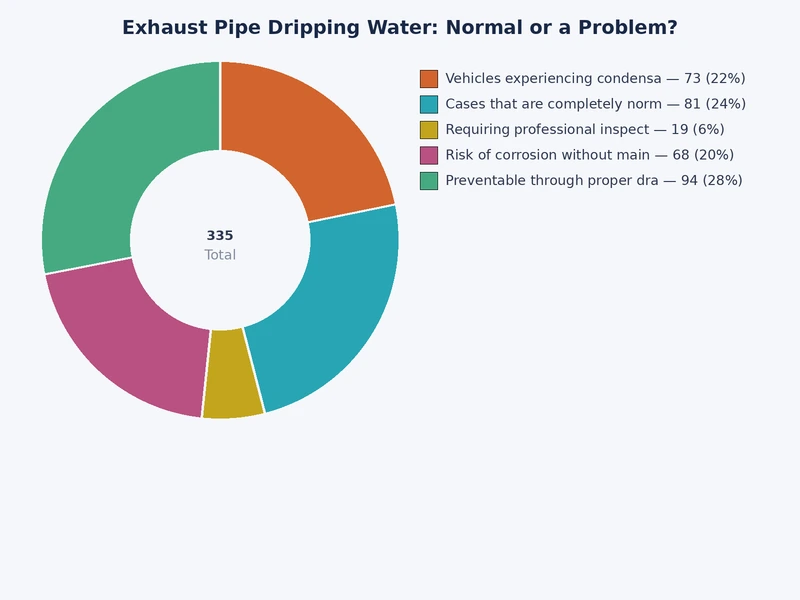
Internal combustion engines burn a mixture of fuel and air inside the cylinders. This chemical reaction produces heat, carbon dioxide, and water vapor as natural outputs. According to Wikipedia's entry on internal combustion engines, water is a primary byproduct of hydrocarbon fuel combustion — an unavoidable result of the chemistry involved. That vapor travels through the exhaust manifold, catalytic converter, muffler, and out the tailpipe.
When the exhaust system is cold — as it always is at startup — the pipe walls have not yet reached the temperatures required to keep water in vapor form. The vapor condenses against those cooler surfaces and drips out of the tailpipe as liquid water. This is entirely normal. The water produced is clear, has no significant odor, and stops accumulating once the system heats up.
A fully warmed exhaust system runs at temperatures between 400°F and 800°F depending on the section of pipe. At those temperatures, moisture simply vaporizes before it can collect. This is why the dripping associated with normal condensation always stops after a few minutes of driving — not because the vehicle is malfunctioning, but because the system is working exactly as designed.
Condensation volume increases significantly in cold climates. Lower ambient temperatures cause moisture to form on pipe walls faster and in larger quantities. Drivers in northern states or high-altitude regions may notice substantial puddles under the tailpipe during winter months. This is not a malfunction. It is physics.
Frequent short trips compound the effect. A vehicle that rarely travels more than three or four miles at a stretch never gives the exhaust system enough time to reach full operating temperature. Moisture accumulates on each trip and never fully evaporates. Over time, this accelerates interior corrosion — a legitimate concern addressed in the long-term care section below — but the dripping itself is still just condensation.
Humid environments add another layer. The intake air carries more moisture into the combustion chamber, which increases the water vapor produced during each combustion cycle. In both hot-humid and cold-humid climates, exhaust dripping during warmup is heavier than in arid regions and still entirely normal.
Pro Tip: Place a clean white cloth under the tailpipe for thirty seconds after startup. If only clear water transfers to the fabric with no oily film, colored staining, or sweet smell, the drip is harmless condensation and requires no further action.
Not all exhaust dripping is benign. Several mechanical failures produce liquid at the tailpipe that resembles condensation at first glance but signals far more serious internal damage. Knowing what to look for — and what to smell — makes the difference between a missed diagnosis and an early catch.
Steam and white exhaust smoke look nearly identical from a distance. The distinction is behavior. Steam dissipates within a few seconds and leaves no lingering cloud. White smoke from a serious mechanical failure hangs in the air, billows in dense clouds, and persists long after the engine has reached operating temperature.
White smoke almost always indicates coolant (antifreeze) entering the combustion chamber. When coolant passes through a breach in the head gasket — the seal between the engine block and the cylinder head — it enters the cylinder, mixes with fuel and air, and burns. The combustion of coolant produces that characteristic thick white smoke. The smell is sweet rather than acrid. Once a driver identifies that combination of sweet smell and lingering white smoke, the diagnosis is nearly certain: coolant is burning inside the engine.
This is a serious failure. Driving with a blown head gasket accelerates damage exponentially. The coolant contaminating the combustion chamber also finds its way into the engine oil, turning it into a milky, foamy mixture that loses all lubricating ability. Bearing failure and complete engine seizure are the endpoints of this chain if the vehicle continues to operate.
An internal coolant leak — one that feeds into the combustion chamber rather than dripping externally onto the ground — produces a specific set of symptoms. The coolant reservoir level drops without any visible puddle beneath the vehicle. The engine runs warmer than normal. The temperature gauge climbs faster after startup and may reach the high end of the normal range before settling. In advanced cases, the gauge enters the danger zone.
A failing water pump accelerates coolant loss and contributes directly to overheating, which in turn stresses the head gasket. Drivers experiencing dropping coolant levels alongside unusual exhaust output should review the guide on 7 warning signs of a failing water pump before the situation becomes an emergency. Identifying a water pump problem early costs a fraction of the repair bill that results from a warped cylinder head caused by overheating.
The oil dipstick delivers one of the most reliable indicators of head gasket failure. Pull it out and examine the oil on the tip carefully. Normal oil is amber or dark brown and has a consistent, smooth texture. Oil contaminated by coolant appears milky, foamy, or has a light caramel color similar to a milkshake. Any milkiness in the oil is a stop-driving situation.
Blue or gray smoke from the exhaust indicates oil burning in the combustion chamber. Worn piston rings or degraded valve stem seals allow engine oil to enter the cylinder, where it combusts alongside the fuel mixture. The tailpipe deposits a dark, greasy residue around its opening. The vehicle may consume oil faster than normal — needing a top-off between scheduled changes.
Oil burning is distinct from condensation dripping, but both symptoms can coexist in an engine with advanced internal wear. The presence of blue smoke alongside water dripping at the tailpipe suggests multiple seal failures, which demands professional inspection immediately. Neglecting oil changes shortens seal life dramatically. Understanding how long engine oil lasts in a car and adhering to that schedule is one of the most effective ways to prevent this type of wear from developing in the first place.
Warning: White or blue smoke combined with water dripping at the tailpipe is never a coincidence. This pairing almost always points to active internal engine damage that becomes more expensive with every mile driven.
A methodical approach to diagnosis saves both time and money. Most drivers can rule out the serious causes through careful observation and a few straightforward tests before involving a professional mechanic.
Begin with the vehicle parked on clean, dry pavement and the engine cold. Start the engine and stand at a safe distance to observe the tailpipe output. Note the color and density of any vapor or smoke. After ten minutes of idling, check whether the dripping has stopped. If it has, condensation was the cause. If it continues, further investigation is warranted.
Examine the puddle left under the tailpipe while the engine warms. Clear water with no sheen on the surface is condensation. A rainbow-like iridescent film indicates oil contamination. A sweet odor near the puddle points to coolant. Any discoloration in the dripping liquid narrows the diagnosis considerably.
Move to the engine bay. Check the coolant reservoir level against the min and max markings on the side of the tank. A level below the minimum line without any external leak visible on the ground is a strong indicator of internal coolant consumption. Next, pull the engine oil dipstick and examine the oil. Any milky or foamy appearance confirms coolant mixing with oil — head gasket failure until proven otherwise. An unusual exhaust smell combined with poor engine performance may also indicate catalytic converter problems; the guide on signs of a bad catalytic converter explains those symptoms in full.
| Observed Symptom | Most Likely Cause | Urgency | Recommended Next Step |
|---|---|---|---|
| Clear drip, stops within 10 minutes of driving | Normal condensation | None | No action required |
| Heavy clear drip, persists after full warm-up | Rich fuel mixture or early-stage coolant leak | Moderate | Schedule diagnostic scan within one week |
| White billowing smoke with sweet smell | Coolant entering combustion chamber | High | Stop driving; seek repair immediately |
| Blue or gray smoke, oily residue at tailpipe | Oil burning due to worn seals or piston rings | High | Professional diagnosis required without delay |
| Milky or foamy oil on dipstick | Head gasket failure — coolant mixing with oil | Critical | Do not drive; arrange tow to repair shop |
| Sweet smell from exhaust, coolant reservoir dropping | Internal coolant leak — combustion or water jacket breach | High | Pressure-test the cooling system |
An OBD-II (On-Board Diagnostics, second generation) scan tool adds critical information to any exhaust diagnosis. Codes related to cylinder misfires, coolant temperature readings, and oxygen sensor performance often appear before the driver notices visible symptoms. Many auto parts retailers offer free code reading as a walk-in service. Running a scan at the first sign of abnormal exhaust output costs nothing and can prevent guesswork repairs.
Establishing a brief cold-start observation habit requires under two minutes and catches problems in their earliest stages. Before backing out of the driveway, glance in the rearview mirror at the tailpipe. Normal condensation produces a thin, brief white puff that clears within seconds. Anything thicker, more persistent, or colored differently warrants a second look before driving off.
After a drive, park on clean pavement and let the vehicle sit for five minutes. Then check beneath the car. A small clear puddle directly under the tailpipe is expected and harmless. Any liquid visible forward of the rear axle — near the transmission, engine bay, or mid-chassis — requires identification. Combining this habit with regular fluid level checks creates a reliable picture of overall drivetrain health over time.
The frequency of dripping changes with the seasons. Drivers should expect more condensation drip during winter months and less during summer. A sudden increase in dripping during warm weather, however, is not normal seasonal variation. It is a symptom that demands attention. Unexplained changes in exhaust behavior — especially appearing alongside other malfunctions — should prompt a full vehicle inspection.
The check engine light frequently illuminates before exhaust symptoms become obvious. Cylinder misfires caused by spark plug fouling from oil or coolant intrusion trigger fault codes that point directly to the source of the problem. Pulling codes at the very first sign of unusual exhaust behavior — rather than waiting for the situation to worsen — compresses the diagnostic timeline dramatically.
Unrelated systems sometimes share failure points with the exhaust. Coolant temperature sensor failures, for example, affect both the temperature gauge reading and fuel trim calculations, which in turn affects combustion completeness and exhaust output. Addressing multiple symptoms together through a code scan reveals connections that would otherwise take considerable time and expense to trace manually. Issues like a remote start not working can sometimes share diagnostic ground with other sensor or electrical faults, making a comprehensive scan worthwhile whenever multiple symptoms appear simultaneously.
Best Practice: Keep an OBD-II reader in the vehicle at all times. Reading codes immediately at the first sign of any symptom cuts diagnostic time in half and eliminates the guesswork that leads to unnecessary part replacements.
Water inside the exhaust system accelerates interior rust. Vehicles used primarily for short trips accumulate moisture on every journey without fully heating the system to burn it off. Over months and years, this trapped moisture corrodes mufflers, resonators, intermediate pipes, and the connections between them. The eventual result is exhaust leaks — a hazard that allows carbon monoxide to enter the cabin, not simply a cosmetic concern.
The most effective prevention is the simplest: take the vehicle on a sustained highway drive at least every two weeks. Twenty minutes at highway speed heats the entire exhaust system thoroughly, vaporizes accumulated moisture, and deposits it safely out the tailpipe rather than allowing it to sit in the pipe walls. Drivers who cannot avoid short-trip patterns for extended periods should schedule this kind of maintenance drive intentionally.
In regions where road salt is used during winter, exterior exhaust corrosion accelerates rapidly. Salt attacks the underside of the vehicle aggressively. Professional undercoating applied to exterior exhaust components — or high-temperature exhaust paint for accessible pipe sections — meaningfully extends system life in harsh climates. Inspection of exhaust hangers (the rubber mounts that hold the pipe in position) should be part of every annual service, as cracked or broken hangers allow the exhaust to sag and stress pipe joints.
Exhaust system health is inseparable from overall engine condition. An engine running on schedule with clean oil, healthy coolant, and properly functioning sensors burns fuel efficiently and produces normal amounts of water vapor. An engine running with degraded fluids, worn seals, or sensor faults generates abnormal exhaust output that gradually damages downstream components including the catalytic converter and oxygen sensors.
Oil changes on schedule remain the single highest-return maintenance investment. Degraded engine oil loses its ability to condition and lubricate seals. Worn seals allow oil to migrate past piston rings and valve stems into the combustion chamber, producing the blue smoke and oil burning described in the warning signs section. The type of oil matters as well. Full synthetic oil maintains viscosity and seal-conditioning properties across a wider temperature range than conventional oil. The detailed comparison of synthetic blend vs full synthetic oil explains which formulation delivers better long-term protection in different driving conditions and climates.
Cooling system maintenance is equally critical. Coolant degrades over time, becoming acidic. Acidic coolant attacks the aluminum and iron surfaces of the cooling system — including the head gasket seating area and water pump impeller. Following the manufacturer's coolant flush interval, typically every two to five years depending on coolant type, prevents this progressive deterioration. Neglecting coolant flushes is a leading contributor to the head gasket failures that produce white smoke, excessive exhaust dripping, and catastrophic repair bills.
Normal condensation costs nothing. The serious mechanical failures that produce exhaust dripping symptoms carry significant repair bills. The figures below reflect typical independent shop pricing inclusive of parts and labor. Dealership prices run higher, often by twenty to forty percent.
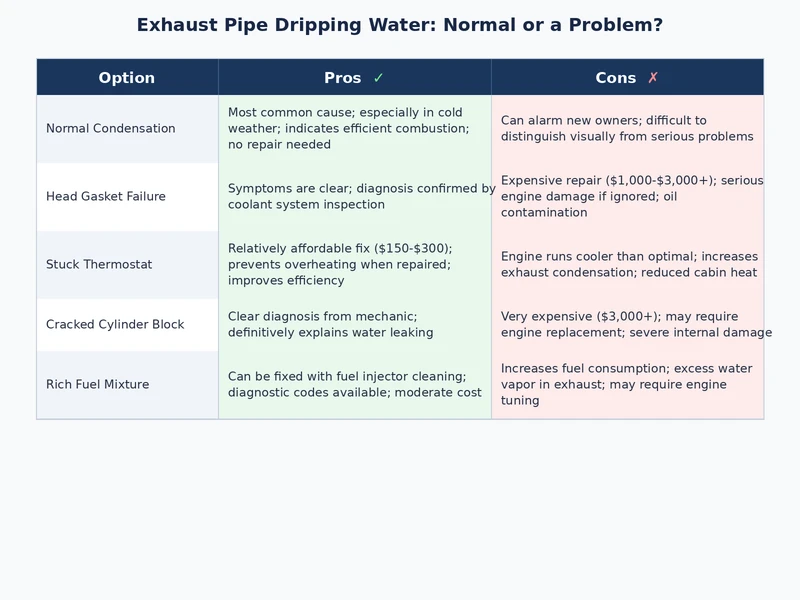
Head gasket failure carries the highest stakes of any exhaust-related failure. Every mile driven with a confirmed blown head gasket allows coolant to further contaminate engine oil, which strips lubrication from crankshaft bearings and cylinder walls. The progression from a repairable head gasket failure to a complete engine replacement — which costs $5,000 to $10,000 on most vehicles — can unfold within a few hundred miles of continued operation. The math on early repair is unambiguous.
Observation, fluid checks, and OBD-II code reading fall well within the ability of any attentive vehicle owner. Replacing a muffler, resonator, or exhaust pipe section is achievable for drivers with basic mechanical skills, access to a jack and safety stands, and patience with rusted fasteners. These are legitimate DIY tasks that carry modest risk.
Head gasket replacement is categorically different. It requires complete disassembly of the upper engine, precision torquing of fasteners to exact specifications, cylinder head resurfacing evaluation, and often coolant system pressure testing both before and after the repair. Errors in this repair cause immediate and total engine failure. Valve seal replacement on many modern engines similarly demands camshaft removal and specialized tools. For any repair that requires opening the engine, professional service is the correct choice without exception. The cost of a competent mechanic is always less than the cost of a failed amateur repair on a critical internal component.
Yes, in most cases it is completely normal. Condensation forms inside the exhaust system during cold starts because combustion produces water vapor that condenses on the cooler pipe walls. This dripping stops once the exhaust system reaches full operating temperature, typically within five to ten minutes of driving.
The key indicators are color, smell, and timing. Clear water that stops dripping after the engine warms up is harmless condensation. White smoke with a sweet smell that persists after warm-up, blue or gray smoke, oily residue around the tailpipe opening, or milky oil on the dipstick all indicate serious mechanical problems requiring immediate diagnosis.
Thick white smoke that lingers in the air and carries a sweet odor almost always indicates coolant burning inside the combustion chamber. This is typically caused by a blown head gasket — the seal between the engine block and the cylinder head — allowing coolant to enter the cylinder. This is a serious failure that demands immediate professional repair.
Yes. A blown head gasket allows coolant to enter the combustion chamber, where it burns and exits the tailpipe as steam or white smoke. In some cases, unburned coolant accumulates in the exhaust pipe and drips out. This is accompanied by a dropping coolant reservoir level, sweet-smelling exhaust, and often milky oil on the dipstick.
Cold weather significantly increases condensation volume. Lower ambient temperatures accelerate the conversion of exhaust water vapor into liquid on the cool pipe walls. Drivers in cold climates or those making frequent short trips during winter months will notice more dripping than usual. This is normal seasonal behavior and not a sign of mechanical failure.
It depends entirely on the cause. If the dripping is normal condensation that stops after warm-up, driving is completely safe. If the dripping is accompanied by white smoke, sweet smells, coolant loss, or milky oil, the vehicle should not be driven until the cause is diagnosed. Continuing to drive with a head gasket failure or coolant contamination causes progressive engine damage.
A failing catalytic converter does not typically cause increased water dripping on its own, but it can cause incomplete combustion that leads to abnormal exhaust output. A damaged converter may also crack internally, which can affect how exhaust gases and moisture move through the system. Signs of catalytic converter failure include reduced engine performance, rotten-egg smells, and rattling from beneath the vehicle.
Repair costs vary widely by cause. Normal condensation costs nothing. Water pump replacement typically runs $300 to $700. Head gasket replacement — the most common serious cause — ranges from $1,200 to $3,000 at an independent shop. Delaying head gasket repair dramatically increases the risk of engine failure, which can cost $5,000 to $10,000 or more to address.
Exhaust pipe dripping water is one of the most commonly misunderstood vehicle symptoms — alarming in appearance but harmless in the vast majority of cases. The next step is straightforward: observe the color, smell, and duration of the drip during the next cold start, check the coolant reservoir and oil dipstick, and use the diagnostic table in this guide to determine whether the vehicle needs professional attention or simply needs more time to warm up. Drivers who spot the serious warning signs early — white smoke, sweet smells, milky oil — should stop driving immediately and arrange a cooling system pressure test before the damage compounds further.
 |
 |
 |
 |

About Sarah Whitfield
Sarah Whitfield is a diagnostics and troubleshooting specialist who spent ten years as an ASE-certified technician before joining the editorial team. She specializes in OBD-II analysis, electrical gremlins, and the kind of intermittent problems that make most owners give up.
Get some FREE car parts & gear.. Or check out the latest free automotive manuals and build guides here.
Disable your ad blocker to unlock all the hidden deals. Hit the button below 🚗
| | | |
