by Sarah Whitfield
Does a faint hissing noise from the engine bay signal something genuinely dangerous, or is it just another minor quirk that most drivers can safely ignore for a few more months? Exhaust leak symptoms are among the most commonly misread warning signs in automotive diagnostics, and our team consistently finds that early identification prevents both expensive downstream failures and serious carbon monoxide exposure risks. The six signs covered in this guide — from audible clues to fuel economy drops — each carry distinct diagnostic weight, and understanding them makes the difference between a straightforward gasket replacement and a catalytic converter failure that multiplies repair costs. Our experience across hundreds of exhaust inspections confirms that a methodical approach to these symptoms produces the best outcome every time.
The exhaust leak symptoms that matter most are the ones that appear in combination, because multiple simultaneous indicators almost always point to a more advanced breach requiring immediate attention rather than a watch-and-wait approach. Beyond the mechanical concerns, the composition of exhaust gas — including carbon monoxide, hydrocarbons, and nitrogen oxides — explains why even a small upstream breach demands prompt diagnosis and repair.

Contents
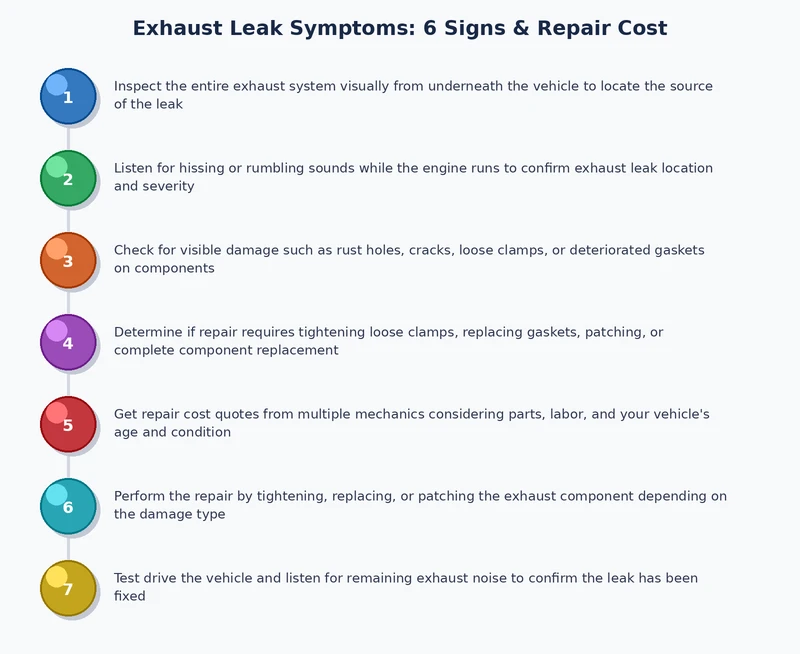
Our team approaches exhaust diagnostics by working through a consistent symptom checklist, because each sign points to a specific location or severity level within the system. Catching multiple symptoms together almost always indicates a more advanced leak, while an isolated sign typically suggests an early-stage breach that remains manageable with targeted component repair.
A rhythmic ticking or hissing noise that intensifies during cold starts and gradually diminishes as the engine reaches operating temperature is one of the earliest and most reliable exhaust leak symptoms. The sound typically originates from a cracked manifold or a deteriorating manifold gasket, where high-pressure exhaust gases escape through a narrow gap on every combustion cycle. Our team consistently notes that the noise changes character between cold and hot conditions because metal expands with heat, occasionally sealing a hairline crack just enough to reduce the audible signature temporarily.
Vehicles displaying this hissing pattern alongside an unexplained engine knocking noise should be inspected carefully for both exhaust leaks and combustion chamber issues simultaneously, since the two conditions can coexist and produce overlapping auditory signatures that complicate initial diagnosis.
An exhaust leak positioned upstream of the oxygen sensor disrupts the feedback loop that the engine management system relies on to calculate an accurate air-fuel ratio, and the resulting mixture imbalance reduces combustion efficiency in ways that translate directly into sluggish throttle response and reduced power output. Our experience shows that technicians frequently misattribute this sluggishness to fuel delivery issues, and the significant symptom overlap with car sputtering when accelerating can add meaningful time to the diagnostic process.
A burnt, sulfurous, or sharp chemical odor entering through the HVAC system or firewall gaps is among the most urgent exhaust leak symptoms, because it directly indicates that combustion gases are finding a path into the passenger compartment. Carbon monoxide is odorless and colorless, but the other compounds present in exhaust gas — including partially burned hydrocarbons and sulfur dioxide — produce a detectable smell that should never be attributed to normal vehicle operation. Our team classifies any persistent exhaust odor inside the cabin as an immediate stop-driving situation without exception.
When exhaust gases bypass a properly functioning upstream oxygen sensor, the ECU defaults to a richer fuel mixture to compensate for what it interprets as an oxygen-lean condition, and this sustained over-fueling reduces overall fuel efficiency by a measurable and quantifiable margin. Most people notice a gradual increase in refueling frequency before other performance symptoms become clearly apparent, which makes declining fuel economy an underappreciated early indicator of a developing exhaust issue. Our team recommends tracking fuel economy trends alongside any concurrent fuel system symptoms to build a complete picture before committing to a single diagnostic conclusion.
Black soot deposits or orange rust streaking concentrated around flange connections, gasket edges, or flex pipe end fittings represent physical evidence of escaping exhaust gases leaving carbon residue on the surrounding metal surfaces. This visual symptom is particularly valuable in diagnostics because it often identifies the exact leak point before audible or performance symptoms have developed enough to be unmistakable. A thorough under-vehicle inspection with a compact flashlight and telescoping mirror reveals these deposits on manifold faces, catalytic converter flanges, and mid-pipe weld joints without requiring the vehicle to be raised on a lift.
An exhaust leak that introduces ambient air near an upstream oxygen sensor can trigger a lean fuel mixture code — most commonly P0171 or P0174 — which illuminates the check engine light and stores a fault in ECU memory that persists until the root cause is corrected. Our team finds that a significant number of technicians pursue fuel system diagnostics first when these codes appear, without considering an exhaust leak as the primary driver. A thorough understanding of the full range of dashboard warning light meanings helps contextualize these codes within the broader symptom picture before committing to a particular diagnostic path.
Our team has documented exhaust leak patterns across a wide range of vehicle types and model years, and failure modes tend to cluster around specific components depending on vehicle age, regional climate, and typical driving patterns. Understanding where leaks most commonly originate helps focus the inspection and avoids wasted diagnostic time chasing false leads.
Cast iron and stainless steel manifolds expand and contract through thousands of thermal cycles over a vehicle's service life, and the gaskets that seal them against the cylinder head gradually lose both clamping force and material integrity as accumulated heat cycles mount. Vehicles operated in cold climates experience accelerated gasket degradation because the temperature differential between a cold start and full operating temperature is more severe and more frequent across a typical year. Our team identifies manifold gasket failures as the single most common origin of exhaust leak symptoms in vehicles with more than 80,000 miles of accumulated use.
Flex pipes are braided stainless sections engineered specifically to absorb drivetrain movement and road vibration, and they develop cracks or end-connection separation after prolonged exposure to heat cycling and sustained mechanical stress. Mid-pipe cracks typically appear at weld seams or tight bends, where metal fatigue concentrates under long-term vibrational load. Vehicles already showing car burning oil symptoms often experience accelerated flex pipe corrosion, because oil vapor in the exhaust stream deposits carbon residue that traps moisture against the metal and promotes rust from the inside outward.
Pinpointing an exhaust leak precisely requires a combination of basic hand tools and more specialized diagnostic equipment, and our team consistently recommends starting with the simplest visual and auditory approach before moving to technical instrumentation.
A dedicated exhaust smoke tester introduces inert smoke into the system under slight positive pressure, and any breach becomes immediately visible as smoke drifts from the leak point — even in locations that are otherwise completely inaccessible to direct visual inspection. Professional-grade smoke testers range from approximately $300 to over $1,500 depending on capacity and included accessories, and most independent repair shops now include smoke testing as a standard component of their exhaust diagnosis workflow. Our team considers the smoke test the single most definitive diagnostic method for confirming an exhaust leak's location before ordering components or scheduling repair labor.
Proactive maintenance significantly extends the service life of exhaust components and reduces the probability of leak development between scheduled service intervals, and our team recommends integrating exhaust checks into the standard service routine rather than treating them purely as reactive measures triggered by obvious symptoms.
Rust is the primary long-term structural threat to exhaust system integrity in any region where road salt is applied during winter months, and applying a high-temperature exhaust coating or ceramic paint to exposed mild steel components prolongs service life significantly over untreated surfaces. Our team also recommends avoiding consistent short-trip driving patterns wherever practical, because engines that rarely reach full operating temperature allow condensation to accumulate inside the exhaust system and accelerate internal pipe wall corrosion over time. Stainless steel aftermarket replacement components offer substantially superior corrosion resistance compared to factory mild steel parts and represent a sound long-term investment for vehicles intended to remain in service beyond 150,000 miles.
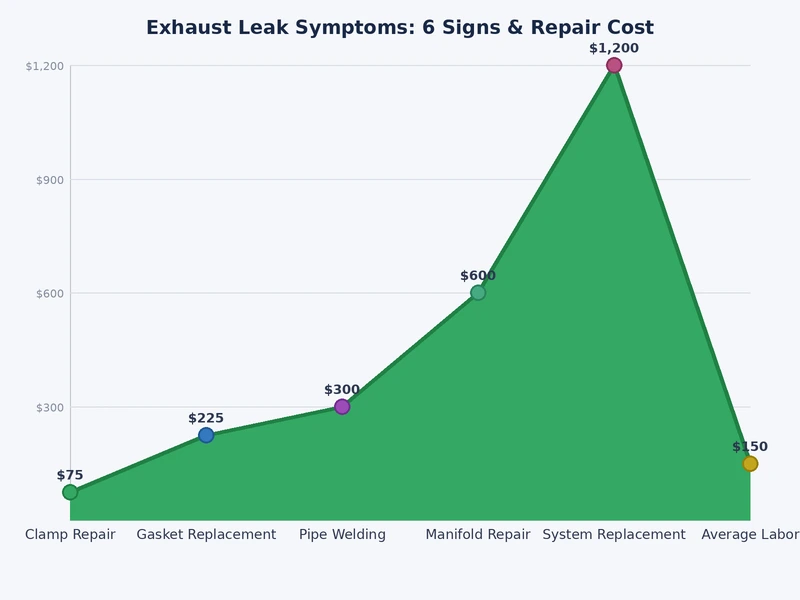
Repair costs for exhaust leaks vary considerably depending on the leak location, vehicle make and model, local labor rates, and whether work is performed by a dealership, independent shop, or a capable home technician with the appropriate tools. The table below summarizes typical cost ranges across the most commonly encountered repair scenarios.
| Component | Parts Cost | Labor Cost | Total Estimate |
|---|---|---|---|
| Exhaust Manifold Gasket | $20–$80 | $150–$400 | $170–$480 |
| Exhaust Manifold (full replacement) | $100–$400 | $200–$500 | $300–$900 |
| Flex Pipe | $30–$120 | $80–$200 | $110–$320 |
| Mid-Pipe / Intermediate Pipe | $50–$200 | $80–$250 | $130–$450 |
| Weld Repair or Patch | $20–$60 | $60–$150 | $80–$210 |
| Catalytic Converter Flange Gasket | $15–$50 | $80–$200 | $95–$250 |
Manifold gasket replacement is a viable DIY project for anyone with intermediate mechanical experience, a calibrated torque wrench, and a basic socket set, though access difficulty varies significantly based on engine orientation and underhood packaging. Flex pipe replacement typically requires only a reciprocating saw or pipe cutter, a slip-fit coupler or basic welding capability, and a floor jack with safety stands, placing it among the more approachable DIY exhaust repairs in terms of required skill level. Professional repair is strongly recommended whenever seized manifold bolts are a possibility — a common complication on older vehicles operating in salt-belt regions — because bolt extraction carries a genuine risk of cylinder head thread damage that can escalate the total repair bill dramatically.
The decision between a targeted component repair and a full system replacement depends on the overall condition of the existing exhaust system, the vehicle's age and expected remaining service life, and the economic relationship between the repair cost and the vehicle's current market value. Our team applies a consistent set of criteria to guide this decision across all vehicle types and mileage ranges.
An exhaust leak that allows carbon monoxide or other combustion gases to enter the passenger cabin poses a serious and immediate health risk, and our team classifies any cabin exhaust odor as a stop-driving situation without exception. Even leaks that remain fully outside the cabin degrade engine performance over time and can cause catalytic converter damage if the resulting lean-mixture condition goes unaddressed for an extended period.
An exhaust leak upstream of the primary oxygen sensor disrupts the air-fuel ratio feedback loop, which typically causes the engine to run in an uncorrected lean or rich state and produces tailpipe emissions readings outside legal limits. Our team has observed numerous vehicles fail state emissions inspections due to exhaust leaks that generated persistent lean mixture codes and elevated hydrocarbon output at the tailpipe.
The timeline depends heavily on the leak's location and severity — a small mid-pipe crack may cause only gradual performance degradation over several months, while a manifold gasket failure can trigger catalytic converter damage within weeks if the resulting lean-running condition sends unburned oxygen downstream consistently. Our team recommends treating any confirmed exhaust leak as a repair to schedule within days rather than weeks, regardless of how minor the initial symptoms appear.
Most people describe the odor as a combination of sulfur, burnt rubber, and a sharp chemical quality that is distinctly different from normal cabin smells, and which tends to be most noticeable when the HVAC system is set to recirculate cabin air or when windows are lowered at low speed in traffic. The smell may present intermittently at first, appearing primarily during hard acceleration or extended idling before becoming more persistent as the leak progresses.
 |
 |
 |
 |

About Sarah Whitfield
Sarah Whitfield is a diagnostics and troubleshooting specialist who spent ten years as an ASE-certified technician before joining the editorial team. She specializes in OBD-II analysis, electrical gremlins, and the kind of intermittent problems that make most owners give up.
Get some FREE car parts & gear.. Or check out the latest free automotive manuals and build guides here.
Disable your ad blocker to unlock all the hidden deals. Hit the button below 🚗
| | | |
