by Sarah Whitfield
An exhaust manifold leak produces a sharp, metallic ticking noise from the engine bay, and that symptom alone is sufficient reason to schedule an immediate inspection. Left unaddressed, escaping combustion gases degrade fuel economy, corrupt upstream oxygen sensor readings, and introduce carbon monoxide into the cabin — a risk no driver should accept at any level.
The exhaust manifold collects hot gases from each cylinder and routes them toward the catalytic converter and downstream exhaust components. When the manifold gasket fails or the manifold casting develops a crack, those gases bypass the intended sealing surface and escape at the joint. Recognizing exhaust manifold leak symptoms at the earliest stage gives you the opportunity to repair the fault before it escalates into catalytic converter damage or a persistent emissions failure. For context on how this component fits into the broader exhaust architecture, see our category guide on straight-pipe exhaust systems.
Contents
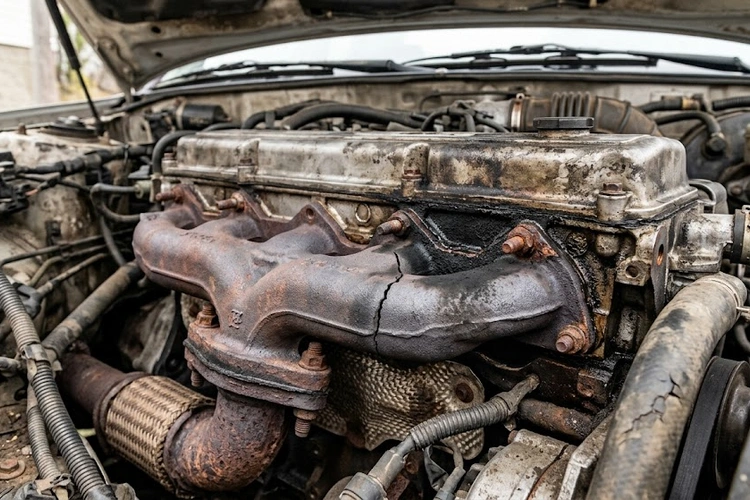
The exhaust manifold is a cast-iron or fabricated stainless-steel component that endures extreme thermal cycling every time the engine starts and returns to ambient temperature. Cast iron expands and contracts at a predictable but substantial rate, and after years of repeated cycling, even a factory manifold can develop hairline cracks along runner welds or mounting flanges. Stainless manifolds, more common on performance and turbocharged applications, resist cracking better but are not immune to warping under sustained high-load conditions. The exhaust manifold gasket positioned between the manifold and the cylinder head bears the cumulative stress of this cyclic loading, and it is typically the first component to surrender.
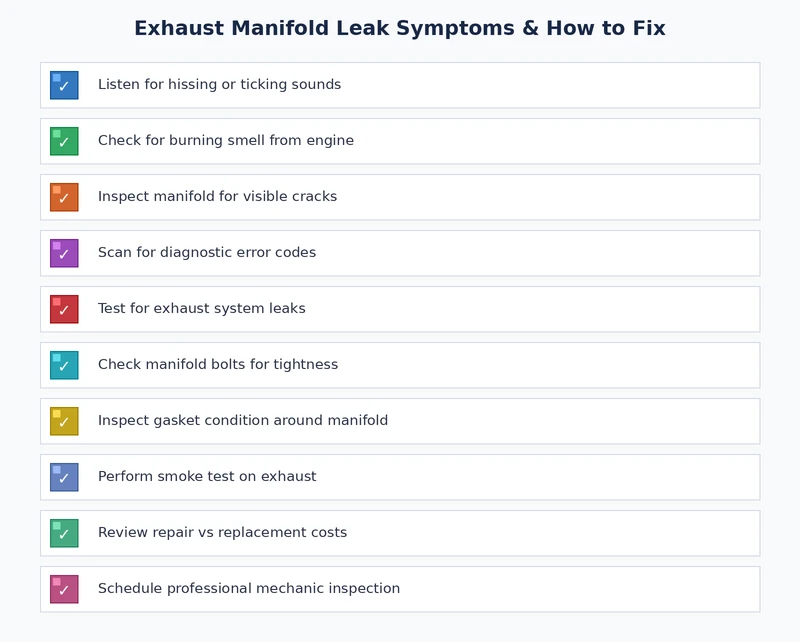
The most reliable exhaust manifold leak symptoms present themselves through sound and smell long before any dashboard warning illuminates. A metallic ticking or tapping noise that accelerates with engine RPM and diminishes once the engine reaches full operating temperature is the definitive auditory indicator. The sound originates because a cold, contracted gasket seals more tightly at startup; as it expands with heat, the leak widens, then partially closes again at temperature. You will also detect a sharp, acrid exhaust odor inside the cabin or immediately under the hood during cold starts, which confirms that combustion gases are escaping before reaching the catalytic converter. A heat shield rattle can mimic some of these ticking characteristics, so a deliberate under-hood inspection with the engine cold and running is essential to isolate the source before disassembly.
As the leak progresses, the upstream oxygen sensor receives skewed readings because ambient air infiltrates the exhaust stream at the breach point, creating a false lean signal. The ECU responds by richening the fuel mixture, which degrades economy and can trigger a P0300 random misfire code or an O2 sensor rationality fault. Turbocharged applications suffer additional performance penalties: the escaping gases reduce effective backpressure upstream of the turbocharger scroll, diminishing spool rate and measurable boost pressure at the intake manifold. In advanced leaks, combustion gases briefly ignite on the hot manifold casting, producing a faint popping sound that is distinct from the rhythmic ticking of a gasket failure.
The most compelling argument for prompt repair is occupant safety. Carbon monoxide from a manifold leak enters the cabin through the firewall, HVAC fresh-air intake, or floor pan gaps — particularly when the heater draws air near the engine bay. This risk is most acute in cold weather, when windows remain closed and the system described in our guide to heater core failure symptoms forces recirculated air through a contaminated path. Beyond safety, a leaking manifold actively destroys downstream hardware: raw, unburned hydrocarbons reaching an overheated catalytic converter substrate can melt the honeycomb structure, converting a $200 gasket job into a $900–$2,500 catalyst replacement.
A gasket replacement on an accessible, naturally aspirated four-cylinder engine falls within the skill set of an intermediate home mechanic who owns a torque wrench and a stud extractor set. The procedure requires removing the air intake duct, heat shields, the O2 sensor connector, and between six and ten manifold fasteners, depending on the engine family. Cleaning both mating surfaces thoroughly, verifying manifold flatness with a straightedge and feeler gauge, and installing the new gasket to the manufacturer's torque specification in the correct center-out sequence completes the core task. Diagnostic familiarity with adjacent failures — such as the patterns covered in our guide to valve cover gasket leak symptoms — helps you distinguish exhaust-side from oil-side noise before committing to disassembly.
Broken studs, warped manifold flanges, and turbocharged installations elevate the complexity beyond typical home-shop capability. Extracting a broken exhaust stud requires a left-hand drill bit, penetrating oil, and often a professional heat source to avoid damaging cylinder head threads. Manifold resurfacing requires a precision surface grinder unavailable outside a machine shop. Turbocharged applications add coolant and oil lines, high-pressure clamps, and a dense component layout that substantially increases the risk of collateral damage during amateur removal.
Gasket pricing varies significantly by engine family and material specification. OEM gaskets command a 40–60% premium over quality aftermarket equivalents. Multi-layer steel gaskets deliver superior durability on high-heat and turbocharged applications and represent the correct choice whenever the original OEM part was also MLS construction.
| Repair Scenario | DIY Parts Cost | Shop Labor (hrs) | Total Shop Estimate |
|---|---|---|---|
| Gasket only — 4-cyl, naturally aspirated | $15–$45 | 1.5–2.5 | $150–$350 |
| Gasket only — V6 or V8 | $30–$90 | 2.5–4.5 | $280–$600 |
| Gasket plus manifold replacement | $90–$350 | 3.5–6.0 | $450–$950 |
| Broken stud extraction plus gasket | $40–$80 (extraction kit) | 2.0–4.0 added | $350–$700 |
| Turbocharged application — gasket only | $45–$120 | 4.0–7.0 | $500–$1,100 |
Shop labor rates range from $95 to $175 per hour depending on geography and dealer versus independent pricing. A straightforward four-cylinder gasket replacement at an independent shop typically falls between $150 and $300 in labor alone. Complications — seized studs, manifold resurfacing, catalytic converter replacement — escalate the total cost materially and reinforce the case for addressing exhaust manifold leak symptoms at the earliest audible stage rather than waiting for secondary damage to accumulate.
The following conditions require you to limit driving to essential trips only and reach a shop within 24 hours:
A faint cold-start tick that disappears entirely at operating temperature, produces no cabin odor, triggers no fault codes, and causes no measurable fuel economy decline represents an early-stage breach that tolerates a planned repair window of one to three weeks. Schedule the repair promptly regardless, because the leak will not resolve independently and early intervention prevents the stud corrosion and manifold warpage that substantially increase complexity and cost. Before finalizing your diagnosis, consult our guide to timing chain noise symptoms to rule out valve-train sources of rhythmic ticking that present similarly under cold operating conditions.
An exhaust manifold leak produces a sharp, metallic ticking or tapping noise that increases in frequency with engine RPM and is most prominent during cold starts. The sound diminishes or disappears once the engine reaches full operating temperature, as thermal expansion temporarily closes the gap at the gasket breach point.
Short-distance driving is possible, but you should not continue operating the vehicle normally with a confirmed exhaust manifold leak. Carbon monoxide can enter the cabin through the HVAC system and firewall gaps, presenting a serious health hazard. Every additional drive cycle also widens the breach and accelerates damage to the catalytic converter and oxygen sensors.
A factory exhaust manifold gasket typically lasts 80,000–150,000 miles under normal operating conditions. Vehicles subject to frequent cold starts in low ambient temperatures, sustained high-load driving, or improper fastener torque during a previous repair will experience premature failure outside this range.
Yes. A manifold leak introduces ambient air into the exhaust stream near the upstream oxygen sensor, generating a false lean reading that prompts the ECU to enrich the fuel mixture. This fuel delivery disruption creates combustion inconsistency across affected cylinders and commonly produces a P0300 random misfire code or individual cylinder misfire faults.
Start the engine cold and listen carefully near the cylinder head-to-manifold junction with the hood open and the engine at idle. Run a cold, damp rag slowly along the manifold perimeter; steam or rapid evaporation at a specific point confirms the leak location. Soot deposits and carbon discoloration on the manifold flange provide additional visual confirmation of the breach.
Not necessarily. An exhaust manifold leak most commonly originates at the gasket between the manifold and the cylinder head rather than from a crack in the casting itself. A cracked manifold produces identical symptoms but requires full manifold replacement rather than a gasket swap, and is confirmed through visual inspection or a dye-penetrant test on the casting surface.
Prolonged neglect causes progressive stud corrosion, manifold warpage, catalytic converter substrate destruction, and permanent O2 sensor calibration shift. A repair that costs $150–$350 at the gasket stage can escalate to $900–$2,500 once the catalytic converter requires replacement, and carbon monoxide exposure risk increases with every thermal cycle that widens the breach.
The ticking you hear on a cold morning is not a minor inconvenience — it is an exhaust manifold leak in its cheapest, most correctable form, and every mile you drive past it converts an affordable gasket repair into an expensive cascading failure.
 |
 |
 |
 |

About Sarah Whitfield
Sarah Whitfield is a diagnostics and troubleshooting specialist who spent ten years as an ASE-certified technician before joining the editorial team. She specializes in OBD-II analysis, electrical gremlins, and the kind of intermittent problems that make most owners give up.
Get some FREE car parts & gear.. Or check out the latest free automotive manuals and build guides here.
Disable your ad blocker to unlock all the hidden deals. Hit the button below 🚗
| | | |
