by Sarah Whitfield
Does your front windshield stay fogged no matter how long you run the heat? A front windshield defroster not working is one of the most dangerous visibility failures a driver can face — and it almost never fixes itself. The good news: five specific causes cover the vast majority of failures, and most are diagnosable in your driveway.
The front defroster is not the same as the rear window grid. It relies entirely on your car's HVAC system — blower motor, heater core, blend doors, and climate controls — to push warm, dry air across the windshield. When any link in that chain breaks, your glass stays cold and foggy. This guide identifies each cause, explains the fix, and tells you when to call a professional.
If your vehicle also has uneven heating, our guide on car AC blowing hot on one side covers closely related HVAC failures with significant overlap in diagnosis.
Contents
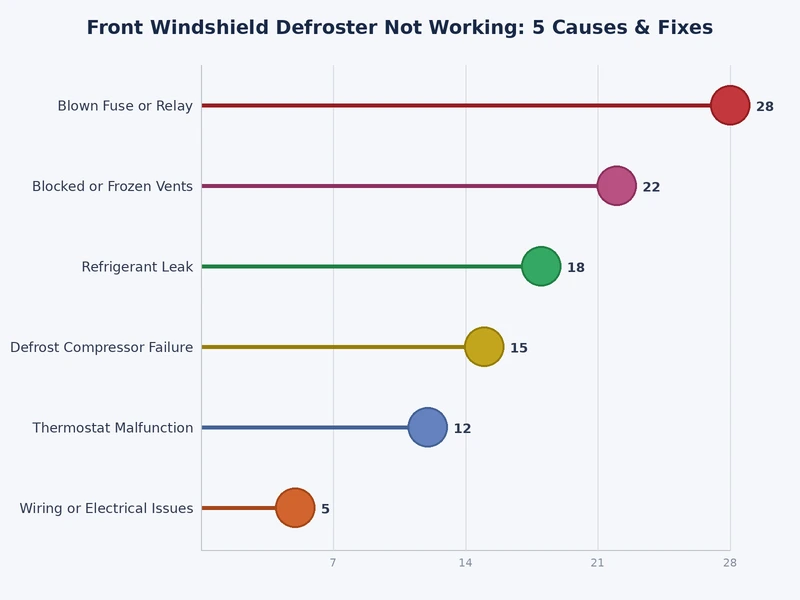
Each cause below produces a distinct symptom pattern. Match what you observe to the description, and you narrow the diagnosis before touching a tool.
The defroster circuit runs through a dedicated fuse — sometimes two — and often a relay. A blown fuse cuts power to the blower motor, the climate control panel, or both simultaneously. This is the first thing to check. It costs nothing beyond a replacement fuse, and it takes five minutes.
Look for fuses labeled HVAC, BLOWER, A/C, or DEFROST in your fuse box diagram. Vehicles typically have a fuse box under the hood and a second one under the dashboard. A blown fuse shows a visible broken wire inside the plastic housing when held up to light.
No air through the vents means no defroster — period. The blower motor drives all airflow across the windshield. When it fails completely, the cabin stays silent at every fan speed. A partial failure is more common: the blower works on high speed only, which points to a failed blower motor resistor rather than the motor itself.
Resistors are inexpensive ($20–$60) and accessible on most vehicles without removing the dashboard. A dead motor requires replacement of the full assembly, a moderate-difficulty DIY job.
The blend door controls the ratio of hot and cold air entering the cabin. A small electric actuator moves this door on command from the climate control system. When the actuator fails, the door defaults to one position — usually fully cold or fully recirculated air. You get airflow, but it never warms up regardless of temperature setting.
A repetitive clicking or ticking noise from behind the dashboard is the diagnostic signature of a failing blend door actuator. The sound appears when you adjust the temperature or start the vehicle.
The heater core is a miniature radiator mounted inside the dashboard. Hot engine coolant circulates through its fins, and the blower pushes cabin air across them to produce heat. A clogged core — from scale buildup in old, degraded coolant — restricts flow and reduces heat output dramatically. A leaking core loses coolant internally, producing a sweet smell inside the cabin and foggy windows that originate from the inside surface.
Heater core issues often appear alongside other cooling system symptoms. Our guide on coolant temperature sensor symptoms covers related warning signs that appear when the cooling circuit is compromised.
Modern vehicles route all climate commands through an electronic control module. A failed module sends no signal to the blower, blend door actuators, or temperature controls. The dashboard buttons become unresponsive. Climate display screens may show error codes or go blank entirely.
Module failures are less common than the mechanical causes above, but they are more expensive to address — often requiring programming after replacement on late-model vehicles.
| Cause | Primary Symptom | DIY Difficulty | Typical Repair Cost |
|---|---|---|---|
| Blown fuse or relay | No power to controls or blower | Easy | $5–$20 |
| Failed blower motor / resistor | No airflow or airflow at high speed only | Moderate | $20–$400 |
| Faulty blend door actuator | Airflow present but always cold; dash clicking | Moderate | $100–$350 |
| Clogged or leaking heater core | Little/no heat; sweet smell; fogging from inside | Hard | $400–$1,100 |
| Climate control module failure | Unresponsive controls; display errors | Hard | $300–$900 |
Pull your owner's manual and identify every fuse associated with the HVAC system. Replace any blown fuse with an identical amperage rating — never substitute a higher-amp fuse. If the replacement fuse blows immediately, a short circuit exists somewhere in the circuit downstream. Stop and trace the wiring before installing another fuse.
Relays can fail without showing visible damage. Swap a suspect relay with an identical one from another slot — horn and fuel pump relays are often the same part number. If the defroster comes back to life, you have your answer.
Test every fan speed setting in sequence. If the blower runs on speed 4 but not speeds 1–3, the resistor has failed. Locate it near the blower motor housing — typically behind the glove box. Replacement takes under an hour on most vehicles.
If the motor produces no sound at any speed, use a multimeter to check for voltage at the motor connector. Voltage present with no motor movement means the motor has seized internally and needs replacement. No voltage points back to the fuse, relay, or module.
Some vehicles allow a position recalibration by disconnecting the battery for 10 minutes, then slowly cycling the temperature from cold to hot after reconnection. This resets the actuator's position memory. The clicking stops in roughly 30% of cases without any part replacement.
When recalibration fails, the actuator requires physical replacement. Most are accessible behind the glove box or under the lower dashboard panel. The job runs 1.5–3 hours for a DIYer with basic tools and a repair manual for the specific vehicle.
Pro tip: Before purchasing a blend door actuator, search your vehicle's year, make, and model alongside "HVAC TSB" — many manufacturers issued Technical Service Bulletins covering this exact failure, sometimes with extended warranty coverage that makes the repair free at the dealership.
MAX A/C recirculates cold interior air. It fogs the windshield faster than doing nothing. Always use the dedicated front defrost button — identified by a windshield icon with upward arrows — which overrides the recirculation setting and draws outside air. This distinction alone resolves fog-related complaints that have nothing to do with a broken system.
The heater core requires a full, pressurized coolant circuit to produce heat. A low reservoir means reduced heat output even when the core itself is undamaged. Check coolant level before pulling any component. A drop in coolant without external puddles under the car points directly to an internal heater core leak.
Vehicles that overheat in specific conditions often share root causes with defroster failures — our guide on cars that overheat with AC on covers the cooling system dynamics involved.
Aftermarket anti-fog coatings treat a symptom, not a cause. If the defroster fails entirely, no coating sustains clarity at highway speed in cold weather. Diagnose the HVAC system first. Window treatments are a supplement to a working system — not a replacement for one.
Warning: Driving with a fogged windshield is a moving violation in most jurisdictions. NHTSA data identifies reduced visibility as a primary factor in winter weather crashes. Do not drive until defroster function is restored.
The heater core shares coolant with the entire engine cooling circuit. Old, acidic coolant deposits scale inside the core's narrow passages and slowly starves it of flow. Most manufacturers specify a coolant flush every 30,000–50,000 miles. Use the exact coolant formulation listed in your owner's manual — mixing types accelerates internal corrosion and accelerates heater core failure.
A clogged cabin air filter chokes airflow through the entire HVAC system. Reduced airflow means weaker defroster performance at every fan speed. Replacement takes under 10 minutes on most vehicles and costs $15–$30 for the filter. It also eliminates the musty, dusty odor that accompanies restricted airflow.
Cycle through every blower speed and temperature setting in October before you need the system in an emergency. A failing resistor or sluggish actuator shows up clearly under controlled testing. Catching it early gives you time to order parts and make the repair without time pressure.
Electrical failures in one system sometimes reflect problems in a shared fuse box. If your brake lights fail around the same time, our guide on brake lights not working explains how overlapping circuits produce simultaneous failures.
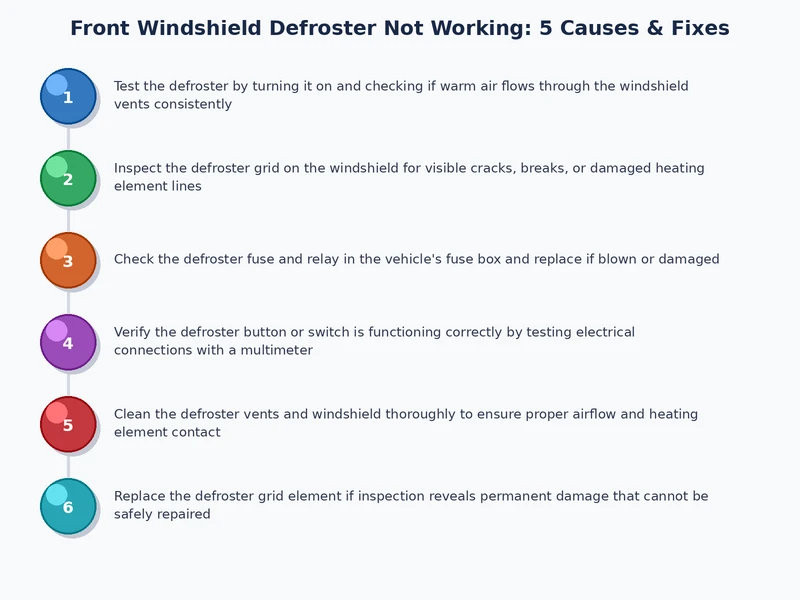
Fuse replacements, blower motor resistors, and cabin air filters sit at the easy end of the repair spectrum. Each requires basic tools, costs under $60 in parts, and produces clear results. Blend door actuators are mid-difficulty — accessible on most platforms without major disassembly. A factory service manual or a reputable online repair database makes the job straightforward.
Heater core replacement involves draining the entire cooling system, removing the dashboard assembly, and on many platforms, disconnecting the steering column. Labor alone runs 6–10 hours at shop rates. Climate control module replacements on modern vehicles require dealer-level programming equipment to initialize the replacement unit. Attempting either job without the right tools and experience creates far larger problems than the original failure.
A $1,000 heater core job on a vehicle worth $3,500 requires an honest calculation. Get a written estimate with parts and labor itemized. Compare that number against three months of car payments or the cost of a reliable used replacement. If your car also has developing issues — like a car that won't start after sitting or signs of other electrical problems — factor the full repair picture into the decision before authorizing major dashboard work.
The car care and maintenance category covers the full range of mechanical and electrical repairs every driver encounters across a vehicle's lifespan.
Cold air from the defroster on max heat setting points to one of three causes: a faulty blend door actuator stuck in the cold position, a clogged or low-flow heater core, or low coolant level reducing heat transfer. Check coolant level first. If it's full, listen for clicking from behind the dashboard — that sound confirms a failed blend door actuator.
Yes. A severely clogged cabin air filter reduces airflow through the HVAC system enough to noticeably weaken defroster performance. The defroster does not fail completely from a dirty filter, but output drops significantly. Replace the filter and retest before diagnosing more expensive components.
A properly functioning front defroster clears a heavily fogged windshield in 3–5 minutes on a cold day when the engine has reached operating temperature. If clearing takes longer than 10 minutes, reduced heat output from a restricted heater core or failing blower is the likely cause.
No. Driving with an obstructed windshield is both illegal in most jurisdictions and statistically dangerous. NHTSA data links reduced visibility directly to a significant share of weather-related collisions. Pull over if your windshield fogs beyond safe visibility and do not continue driving until the system is restored or the glass is fully clear.
 |
 |
 |
 |

About Sarah Whitfield
Sarah Whitfield is a diagnostics and troubleshooting specialist who spent ten years as an ASE-certified technician before joining the editorial team. She specializes in OBD-II analysis, electrical gremlins, and the kind of intermittent problems that make most owners give up.
Get some FREE car parts & gear.. Or check out the latest free automotive manuals and build guides here.
Disable your ad blocker to unlock all the hidden deals. Hit the button below 🚗
| | | |
