by Sarah Whitfield
Studies show roughly 40 percent of AWD and 4WD drivetrain failures trace back to differential problems left unaddressed after the first noise appeared. Front differential noise symptoms rank among the most misdiagnosed drivetrain complaints in independent shops, since grinding, whining, and clunking overlap convincingly with wheel bearings, CV axles, and suspension components. Our team has rebuilt differentials across hundreds of vehicles, and the trajectory is always the same: delayed diagnosis transforms a $400 bearing replacement into a $3,500 ring-and-pinion rebuild. The cost savings from early identification are substantial, and our broader car care and maintenance guides make this case consistently across every major drivetrain system.
Concurrent drivetrain faults frequently accompany differential wear; our breakdown of AWD System Fault explains how differential problems propagate fault codes through traction control modules and complicate the diagnostic picture considerably for any shop unfamiliar with the interaction.
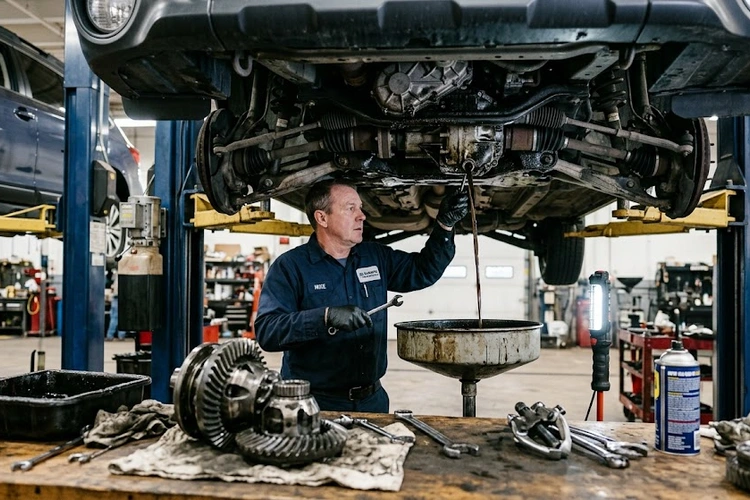
Contents
The front differential operates continuously in AWD vehicles and engages under load in part-time 4WD systems, which means when and how a noise appears carries genuine diagnostic weight. Our team classifies front differential noise symptoms into three primary patterns — speed-correlated whine, load-induced clunking, and turn-triggered grinding — each pointing to a distinct internal failure mode that requires a different repair strategy.
The most textbook front differential noise symptom is a whine that scales with vehicle speed rather than engine RPM, rising and falling with the speedometer regardless of which gear the transmission currently holds. When the tone tracks the speedometer and persists through a neutral coast, the ring-and-pinion mesh or pinion bearing is the first suspect our team reaches for. A whine that disappears on overrun but returns under light throttle typically indicates pinion preload loss, where the crush sleeve has relaxed and allowed excessive bearing end-play to develop. According to Wikipedia's explanation of automotive differential geometry, the hypoid gear mesh used in most front differentials produces a sliding contact pattern acutely sensitive to lubricant film thickness — which is why even modest fluid degradation accelerates wear disproportionately to any other variable.
A distinct clunk felt at initial throttle application, or a single bang when the driver lifts off after highway coasting, points to worn carrier bearings or excessive ring-and-pinion backlash beyond manufacturer specification. This symptom overlaps with driveshaft vibration caused by worn U-joints, but the key differentiator is that driveshaft clunks tend to repeat rhythmically at low speed, while differential backlash produces a single sharp event per throttle transition.
A grinding sensation felt specifically during tight-radius turns — most noticeable in parking lots at slow speed — is the signature of worn spider gears or side gears inside the differential case, which carry maximum load when the inner and outer axle shafts must rotate at different speeds. Our team consistently finds this symptom paired with a leaking pinion seal, since low fluid levels are the primary accelerant of spider gear wear. Anyone also experiencing symptoms that could originate in the transfer case should cross-reference our guide on Bad Transfer Case Symptoms before committing to a differential teardown, since the two units sit close together and share some noise characteristics at low speed.
Most differential failures that reach the full-rebuild stage do so because an earlier, cheaper repair was missed during diagnosis. Our team tracks the misdiagnosis patterns that appear most consistently in differential work, and three errors account for the vast majority of escalated repair costs we see.
The single most expensive diagnostic mistake is attributing differential whine to a failing wheel bearing without performing a lateral load-shift test at highway speed. Wheel bearing rumble shifts tone when the vehicle is steered left or right, because the load transfers on and off the bearing — front differential noise symptoms remain consistent regardless of steering input, maintaining steady pitch through lane changes and sweeping curves. Our team performs this test on every whining complaint before recommending any wheel-end work. Those investigating concurrent suspension noise should also review Bad Ball Joint Symptoms, since worn ball joints generate clunking over rough surfaces that layers on top of differential noise and creates a confusing composite signature.
Pro Tip: Differential whine stays constant through deliberate lane changes; wheel bearing rumble shifts pitch as lateral load transfers — that single distinction saves our team from incorrect part replacements on a weekly basis.
Draining a fluid sample and examining it against white paper with a strong magnet takes under ten minutes and delivers diagnostic information no road test can replicate. Black, burnt-smelling fluid with a visible shimmer of metallic fines confirms internal gear or bearing destruction is already underway, and our team treats heavy particle contamination as diagnostic confirmation equivalent to direct gear inspection — at that point, a teardown is not optional.
Those dealing with concurrent suspension complaints should also consult our notes on Sway Bar Link Symptoms and Bad Strut Symptoms to separate structural noise from drivetrain noise before committing to a differential disassembly.
A road test characterizes the noise; a lift inspection identifies the mechanical cause with precision. Our team never finalizes a differential diagnosis without rotating the front axle shafts by hand on the lift, feeling for rough bearing spots, and checking visual evidence of seal failure. Rough hand-rotation combined with contaminated fluid is a definitive diagnosis — no additional guesswork required before authorizing a teardown and cost estimate.
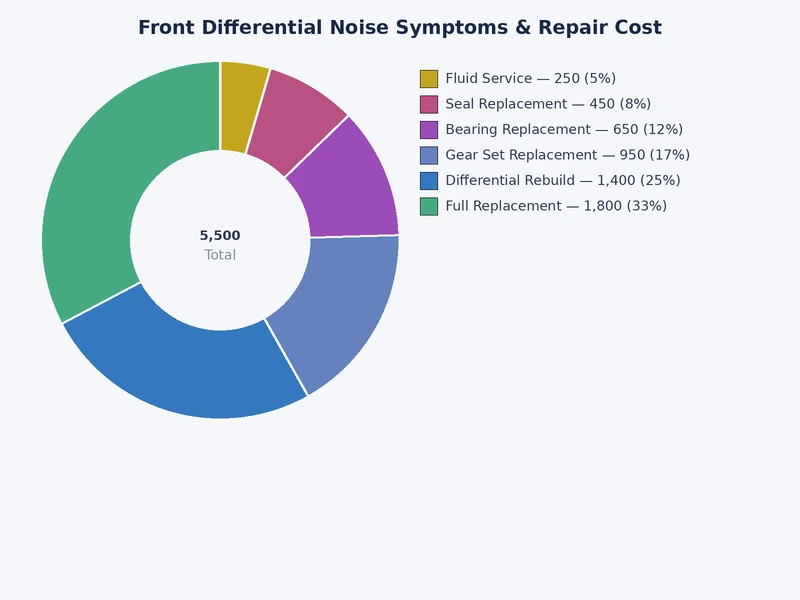
Differential repair pricing varies substantially depending on damage stage, vehicle type, and whether a rebuild or replacement unit is used. Our team's pricing data, drawn from hundreds of completed jobs, shows a sharp cost cliff between bearing-stage and ring-and-pinion-stage repairs — a cliff that early diagnosis avoids entirely.
A proper front differential rebuild requires a dial indicator with magnetic base for measuring ring-and-pinion backlash to OEM specification — typically 0.005 to 0.008 inches — a beam-style inch-pound torque wrench for setting pinion preload, and a hydraulic bearing press for installation without race damage. Our team also applies Prussian blue compound to the ring gear face to verify tooth contact geometry after setting lash, a step that is non-negotiable if the repair is expected to outlast a warranty period. Differential binding in AWD front axles can also generate steering resistance that mimics rack or pump failure; our analysis of Steering Feels Heavy covers how to trace that symptom back to its correct drivetrain source.
| Repair Type | Parts Cost | Labor Hours | Typical Total |
|---|---|---|---|
| Differential fluid service | $15–$40 | 0.5 hr | $80–$150 |
| Pinion seal replacement | $20–$60 | 1–2 hrs | $120–$280 |
| Carrier or pinion bearing swap | $100–$300 | 3–5 hrs | $450–$950 |
| Ring-and-pinion set replacement | $300–$800 | 5–8 hrs | $900–$2,200 |
| Full differential rebuild | $600–$1,500 | 6–10 hrs | $1,500–$4,000 |
Our consistent finding is that most people who address front differential noise symptoms during the whining phase pay under $500; those who wait until grinding or clunking begins routinely face invoices above $2,000, with the difference attributable almost entirely to how long the damaged bearing ran dry and contaminated the gear surfaces before arrival at the shop.
Several misconceptions about front differential behavior circulate widely in DIY forums and among less experienced shop technicians. Our team encounters these myths regularly, and each one results in delayed repairs and compounding damage that inflates the final invoice substantially.
Differential fluid services resolve noise caused purely by degraded lubrication with no internal mechanical damage — a scenario representing roughly 15 percent of cases where front differential noise symptoms are actively present. The remaining 85 percent involve bearing or gear wear that has already crossed the threshold where fresh fluid changes the outcome in any meaningful way. Our team fields this expectation constantly from drivers who have read forum threads claiming that a GL-5 upgrade or friction modifier additive will eliminate differential whine — neither will, and acting on that assumption delays a mechanical repair while damage continues to compound underneath.
A whine that only appears above 55 mph does not indicate early-stage damage — it indicates that the bearing or gear failure requires a specific load threshold to become audible, and the underlying wear can already be severe. Our most expensive differential rebuilds have come from vehicles where the sole reported symptom was a faint highway whine dismissed for a full season by the owner. Noise onset speed is a function of the resonant frequency of the damaged component, not a reliable proxy for damage severity, and our team treats any speed-correlated whine as urgent regardless of where in the speed range it first appears.
Wheel bearing rumble shifts tone or intensity when the vehicle is steered left or right at highway speed, because lateral load transfers across the bearing assembly. Front differential noise remains consistent regardless of steering input, maintaining a steady pitch through lane changes. Our team uses the lateral load-shift test as the primary differentiator between these two frequently confused conditions before recommending any parts replacement.
A complete service involves draining the old fluid, inspecting it visually and with a magnet for metallic contamination, cleaning the drain plug magnet, replacing the drain plug gasket where applicable, and refilling with the correct GL-5 or manufacturer-specified fluid. Our team considers a fluid-only service sufficient only when the drained fluid shows no metallic fines and the noise is mild and has not worsened over several hundred miles of monitoring.
Pinion seals, fluid changes, and cover gaskets can all be addressed in-vehicle with standard shop tools and no special rigging. Carrier bearings, pinion bearings, and ring-and-pinion sets require full removal and disassembly to service correctly, since accurate lash and preload settings cannot be measured or set without a clean bench environment and calibrated measuring tools.
Our team does not assign a safe operating window to a noisy differential, because the degradation rate depends on fluid condition, load frequency, and the specific failure mode. A whining differential with clean fluid and no metallic contamination may run for weeks; one operating on degraded fluid with active bearing wear can seize within days under heavy use. The only defensible recommendation is immediate inspection upon noticing any front differential noise symptoms.
In our experience, front differential noise symptoms do not self-resolve under any normal operating conditions, and the overwhelming trajectory is progressive worsening as gear and bearing surfaces continue to shed material and degrade the lubricant. The rare exception is noise caused purely by fluid breakdown, where a timely service eliminates the symptom completely — but this represents a small minority of cases, and assuming it applies without a fluid sample inspection is a mistake that consistently produces expensive outcomes.
 |
 |
 |
 |

About Sarah Whitfield
Sarah Whitfield is a diagnostics and troubleshooting specialist who spent ten years as an ASE-certified technician before joining the editorial team. She specializes in OBD-II analysis, electrical gremlins, and the kind of intermittent problems that make most owners give up.
Get some FREE car parts & gear.. Or check out the latest free automotive manuals and build guides here.
Disable your ad blocker to unlock all the hidden deals. Hit the button below 🚗
| | | |
