by Sarah Whitfield
If your fuel economy suddenly dropped, something specific caused it — and in almost every case, it's one of eight well-known mechanical or maintenance problems you can identify and fix. A 10–25% dip in MPG doesn't happen by accident. Worn spark plugs, a failing oxygen sensor, clogged injectors, low tire pressure — these are the usual suspects, and this guide walks you through all of them with real repair costs and a clear diagnostic path.
You don't need to be a seasoned mechanic to track this down. An OBD-II scan and a few visual checks will point you in the right direction most of the time. For more fuel efficiency resources, explore our fuel economy guide collection as you work through the diagnosis.

Contents
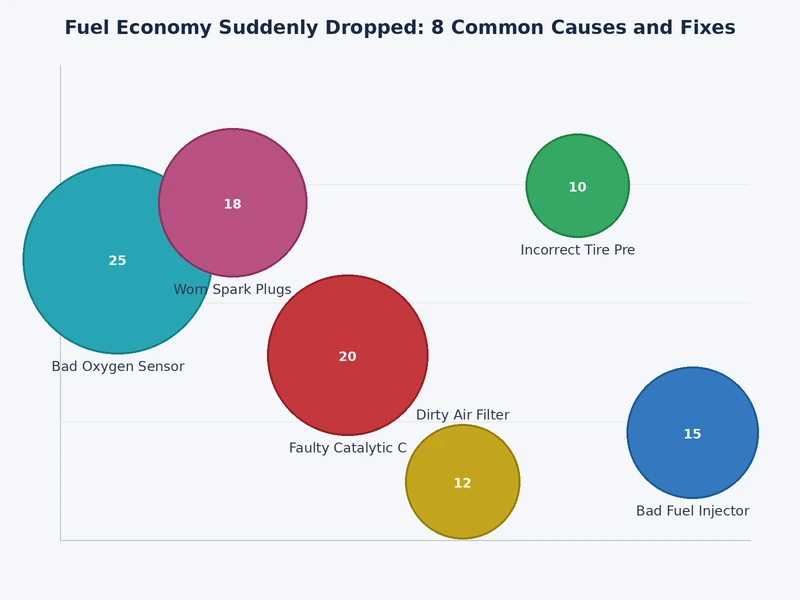
Each of these problems has a clear mechanism, a set of symptoms, and a defined fix. Work through them systematically rather than guessing — that saves both time and money.
The oxygen sensor monitors exhaust gases and feeds real-time data to your engine's ECU so it can dial in the correct air-fuel mixture. When a sensor fails or gets coated in carbon deposits, the ECU loses that feedback loop and defaults to running a rich mixture — burning more fuel than the engine actually needs. According to fueleconomy.gov, a faulty O2 sensor can cut fuel efficiency by up to 40%.
You'll typically see a check engine light with codes in the P0130–P0167 range. Most vehicles have two to four sensors and they generally last 60,000–100,000 miles before performance degrades enough to matter.
Fuel injectors spray a precisely metered mist of fuel into the combustion chamber. When deposits build up on the injector tips, that fine mist becomes an uneven dribble. The cylinder doesn't get the fuel charge it needs to combust efficiently, and unburned fuel exits through the exhaust. You'll notice rough idling, hesitation on acceleration, and a clear MPG penalty.
Spark plugs ignite the compressed air-fuel mixture inside each cylinder. A worn plug produces a weaker, less consistent spark — leading to incomplete combustion where some fuel passes through the cylinder without burning. That's wasted energy every power stroke, and it adds up fast across thousands of RPMs.
Most modern iridium and platinum plugs are rated for 60,000–100,000 miles, but combustion efficiency declines gradually well before they technically fail. If you're also seeing rough idle or sluggish throttle response alongside the MPG drop, plugs are a top suspect. An engine surging at idle often accompanies ignition-related issues and is worth investigating at the same time.
Your engine burns a precise mixture of air and fuel. A clogged air filter restricts airflow, forcing the engine to compensate by enriching the mixture — burning more fuel to maintain power output. This is the cheapest and fastest fix on this list. A replacement filter costs $15–$30 and takes about five minutes to swap in.
Pull the filter out and hold it up to light. If it's gray or black instead of white or light tan, it's overdue. Most manufacturers recommend replacement every 15,000–30,000 miles, but that interval shortens significantly if you drive on unpaved roads or in dusty conditions.
Under-inflated tires increase rolling resistance — your engine works harder just to push the car forward at the same speed. The impact is real and measurable: roughly 0.2% fuel economy loss per 1 PSI drop per tire. If all four tires are running 8 PSI low, that's a meaningful dent in your MPG before anything mechanical is even considered.
The coolant temperature sensor (CTS) tells the ECU how warm the engine is. If it sends a false signal — for example, constantly reporting that the engine is cold — the ECU holds a rich warm-up mixture indefinitely. You end up burning cold-start fuel volumes during normal driving, which is considerably more fuel than a warmed-up engine requires.
Watch for erratic temperature gauge behavior or a check engine light alongside the MPG drop. If your check gauges light comes on at the same time your fuel economy tanks, the CTS is a strong candidate to investigate. Replacement typically runs $100–$200 at an independent shop.
A brake caliper that doesn't fully release after braking keeps the pad in constant light contact with the rotor. Your engine fights that continuous friction drag across every mile you drive. You'll often notice the car pulling to one side, feel heat or smell a burning odor near a wheel, or observe uneven brake pad wear compared to the other side.
This problem compounds quickly. Beyond killing fuel economy, dragging brakes accelerate rotor and pad wear, turning a relatively simple caliper fix into a full brake job. If the car pulls alongside the MPG drop, don't wait on this one.
The MAF sensor measures incoming airflow volume so the ECU can inject the right amount of fuel. A dirty or failing MAF sensor sends inaccurate data — the ECU injects too much or too little fuel based on bad readings. Common symptoms include rough idle, black smoke from the exhaust, and check engine codes in the P0100–P0103 range.
Try cleaning the sensor first. A $10 can of dedicated MAF cleaner spray and 15 minutes of work resolves dirty-sensor cases surprisingly often. If that doesn't solve it, sensor replacement runs $150–$350 depending on the vehicle make and model.
Before touching anything under the hood, grab an OBD-II scanner and plug it into the diagnostic port under your dashboard — driver's side, below the steering column. Even a $25 Bluetooth unit paired with a free app gives you the fault codes you need. Here's how to read them:
If there are no stored codes, the problem is almost certainly mechanical rather than sensor-based. Low tire pressure and dragging brakes rarely trigger a check engine light. A reduced engine power warning alongside the MPG drop typically signals a more serious throttle body or sensor failure that warrants professional attention.
After the OBD scan, work through these physical checks before spending a dollar on parts:
Tackle the cheap fixes first. Air filter and tire pressure together take ten minutes and cost almost nothing. Eliminate them before diagnosing sensors.
Here's a realistic breakdown of DIY versus shop costs for each fix. Independent shop pricing is used below — dealer rates typically run 20–30% higher.
| Cause | DIY Cost | Shop Cost (Parts + Labor) | Potential MPG Gain |
|---|---|---|---|
| Oxygen sensor | $20–$100 | $150–$300 | Up to 40% |
| Fuel injector cleaning | $10–$15 (additive) | $150–$400 (professional) | 5–15% |
| Spark plugs | $20–$60 | $100–$250 | Up to 30% |
| Air filter | $15–$30 | $40–$80 | Up to 10% |
| Tire inflation | Free–$5 | N/A | Up to 3% |
| Coolant temperature sensor | $20–$50 | $100–$200 | 10–20% |
| Brake caliper rebuild/replace | $30–$80 per caliper | $200–$450 per axle | Varies by severity |
| MAF sensor | $10 (cleaning) | $150–$350 | 10–25% |
In the majority of cases, one or two of the cheaper fixes resolve the problem entirely. Work from the bottom of the cost column upward before committing to sensor replacement or brake work.
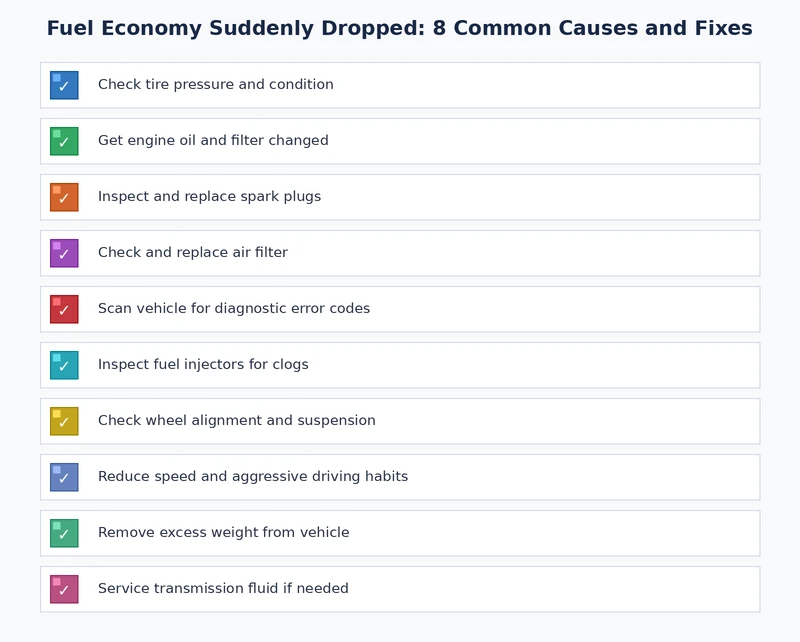
Most fuel economy problems are slow-developing maintenance failures that turn into sudden-feeling drops only after passing a tipping point. Staying on schedule prevents that cliff:
When you stay on top of these intervals, degradation is gradual rather than sudden. Gradual is far easier to catch and far cheaper to address.
Mechanical condition handles roughly half the fuel economy equation. How you drive handles the other half — and the impact is often larger than people expect.
A one-time repair is a good start. A system that catches the next problem early is better. The goal is to make fuel economy monitoring a low-effort background habit rather than something you notice only after a significant drop has already happened.
Track your MPG across fill-ups using your car's trip computer or a quick note on your phone: miles driven divided by gallons pumped. Once you have a two or three fill-up baseline, a 10% drop becomes immediately visible instead of getting masked by traffic pattern changes or seasonal shifts. Many modern vehicles display both real-time and average fuel economy in the instrument cluster — use that number proactively, not just when something feels off.
Set a monthly calendar reminder to check tire pressure. Pair it with an annual air filter inspection. Together those two tasks take about fifteen minutes per year and prevent two of the most common MPG killers before they develop into actual problems. If you drive predominantly in stop-and-go traffic or regularly make short trips that don't fully warm up the engine, add a fuel system cleaner additive every 10,000–15,000 miles. Injector deposits accumulate faster under those conditions, and prevention is consistently cheaper than treatment.
Finally, pay attention to how your car feels. Hesitation on acceleration, rough idle, and a subtle pull to one side are early warnings that appear before MPG craters. Catching issues at the symptom stage — before a fault code stores and a light turns on — keeps repair costs low and your fuel economy stable.
Most of the repairs on this list are genuinely accessible to a competent home mechanic with basic tools. A few require specialized equipment or carry enough risk to justify professional handling.
Confident DIY territory:
Worth paying a mechanic for:
The practical rule: if the component sits on the exterior of the engine or in the air intake path, it's fair game for DIY with a basic tool set. If it's inside the hydraulic brake system, under the intake, or involves pressurized fuel lines, hand it off.
Worn spark plugs can reduce fuel economy by up to 30% in severe cases. In practice, the drop is more gradual — you might lose 5–10% over many thousands of miles as the plugs degrade. A sudden, sharp MPG drop is more likely pointing to a sensor failure or clogged injectors, but plugs are inexpensive enough to replace as part of the diagnostic process.
Yes, cold weather is a legitimate cause. Engines run a richer fuel mixture during the extended warm-up phase in cold temperatures, and winter-blend gasoline has slightly less energy content than summer-blend fuel. Aerodynamic drag also increases in dense cold air. If your MPG drop coincides with a temperature drop and recovers in warmer weather, seasonal variation is likely the primary factor rather than a mechanical fault.
No — not unless your vehicle specifically requires premium fuel. Premium gasoline has a higher octane rating for knock resistance, not higher energy content. Using it in a car rated for regular won't improve combustion efficiency or MPG. If you're already using the correct fuel grade and your economy has dropped, the cause is mechanical or sensor-related, and no fuel grade change will address it.
When your fuel economy suddenly dropped, the fix is usually closer and cheaper than it feels in the moment. Start with the free and low-cost checks — tire pressure, air filter, an OBD-II scan — and work your way up from there. Most drivers solve the problem in an afternoon without touching anything more involved than spark plugs. If you've ruled out the basics and the MPG is still off, take the fault codes and your observations to a trusted mechanic and ask them to inspect the oxygen and MAF sensors alongside the brake calipers — that combination covers the overwhelming majority of cases that don't respond to simple maintenance.
 |
 |
 |
 |

About Sarah Whitfield
Sarah Whitfield is a diagnostics and troubleshooting specialist who spent ten years as an ASE-certified technician before joining the editorial team. She specializes in OBD-II analysis, electrical gremlins, and the kind of intermittent problems that make most owners give up.
Get some FREE car parts & gear.. Or check out the latest free automotive manuals and build guides here.
Disable your ad blocker to unlock all the hidden deals. Hit the button below 🚗
| | | |
