by Sarah Whitfield
Fuel pressure regulator symptoms are a direct signal that rail pressure has drifted out of spec. Our team puts hard starting, rough idle, black exhaust smoke, and fuel economy loss at the top of the failure list — these are the four signs most shops encounter first.
The FPR is a mechanical diaphragm valve. It holds fuel rail pressure at a fixed differential above intake manifold pressure. When the diaphragm cracks or the valve seat wears, pressure regulation collapses immediately. The engine management system tries to compensate, but the correction window is narrow.
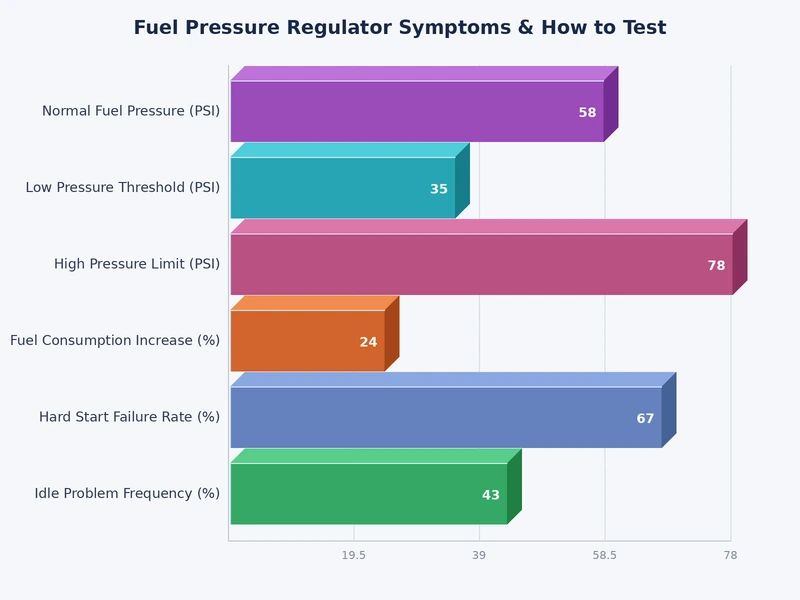
Most vehicles run best with rail pressure between 35 and 65 PSI depending on design. Even a 10 PSI deviation causes measurable drivability degradation. Our team has seen engine surging at idle appear as the first complaint before any fault codes set, making the FPR easy to overlook during initial diagnosis.

Contents
The fuel pressure regulator is the final authority on how much pressure the injectors see. It sits at the end of the fuel rail and bleeds excess pressure back to the tank through a return line. The fuel pump always delivers more pressure than the engine needs — the FPR trims that excess to a calibrated set point.
According to fuel injection system engineering fundamentals, rail pressure must remain constant relative to manifold pressure so that injector pulse width accurately meters fuel mass. The FPR enforces that relationship mechanically, without relying on the ECU for real-time correction at the rail.
Return-style systems route excess fuel back to the tank through an external line. The FPR lives in the engine bay at the end of the fuel rail, making it accessible. Returnless systems move the regulator inside the fuel module in the tank, which changes the diagnostic approach significantly. Our team always confirms the architecture before testing — the procedures differ enough that skipping this step wastes time and risks a missed diagnosis.
On return-style systems, a vacuum port on the FPR connects directly to intake manifold vacuum. At idle, high vacuum pulls the diaphragm open, lowering rail pressure by roughly 8–12 PSI. At wide-open throttle, vacuum drops to near zero, so the spring pushes pressure back up. This keeps injector differential pressure — and therefore fuel delivery per pulse — consistent across the entire engine load range. It is an elegant mechanical feedback loop that requires zero ECU involvement.
Classic fuel pressure regulator symptoms fall into two categories: over-pressure (rich condition) and under-pressure (lean condition). Both destroy fuel economy, foul oxygen sensors, and accelerate catalytic converter degradation. Our team sees rich failure far more often than lean failure because diaphragm rupture floods the intake with fuel rather than starving it.
A sudden drop in fuel economy is frequently the first measurable symptom before drivability complaints become obvious. Most drivers attribute it to traffic or driving habits — by the time rough idle and visible smoke appear, the FPR has often been failing for several weeks.
When the FPR sticks open or the diaphragm ruptures, excess fuel enters the intake under manifold vacuum. Black exhaust smoke appears at startup and under light throttle. Long-term fuel trims go strongly negative — LTFT readings below −10% are a reliable indicator. The spark plugs foul with carbon deposits quickly. Our team has pulled plugs on vehicles with failed FPRs and found heavy soot buildup in under 5,000 miles of driving after failure onset.
A stuck-closed FPR or a weak return-spring raises differential pressure artificially. A completely failed returnless regulator can drop rail pressure below the minimum operating threshold for the injectors. Lean symptoms include stumbling on acceleration, detonation under moderate load, and P0171 or P0174 lean fault codes. These overlap heavily with clogged injectors, vacuum leaks, and mass airflow sensor failures. Pressure testing at the rail separates the FPR from these other causes definitively and quickly.
This is the most definitive physical symptom of FPR diaphragm failure. Removing the vacuum line from the FPR and finding raw fuel or fuel vapor inside the hose confirms the diagnosis without any additional equipment. Our team makes this the first physical check on any vehicle presenting with a rich condition and an accessible return-style FPR. The check takes 30 seconds and removes all ambiguity from the diagnostic path.
Pro tip: Pull the FPR vacuum line before reaching for a scan tool — raw fuel in the hose is an immediate diagnosis, and no fault code provides that level of certainty that fast.
Accurate FPR diagnosis requires a fuel pressure gauge set, a hand vacuum pump, and a basic scan tool for live fuel trim data. Our team also keeps a digital multimeter on hand for electronically controlled pressure regulators found in certain GDI and diesel applications where solenoid resistance is part of the diagnostic spec.
A quality gauge set includes a Schrader valve adapter, a T-fitting for inline measurement, and a bleed valve for safe depressurization after testing. The gauge range needs to cover 0–100 PSI for the majority of port-injected applications, which run 35–65 PSI at the rail. GDI high-pressure circuits operate at 1,500–3,000 PSI — those require a dedicated high-pressure gauge and a separate diagnostic protocol entirely. Using a standard low-pressure gauge on a GDI system destroys the gauge and risks injury.
A hand-held vacuum pump applies measured vacuum directly to the FPR vacuum port during a bench test or with the engine off. A healthy FPR holds vacuum without decay for at least 60 seconds. Any measurable pressure drop in 30 seconds confirms diaphragm failure. The multimeter comes into play when testing electronically controlled pressure regulators — solenoid resistance measured against the OEM spec is the fastest diagnostic step before condemning the unit.
Our team follows a two-phase protocol: a static pressure test with the engine running, then a vacuum-hold and leak-down test with the engine off. Together, these two tests catch over 95% of FPR failures without disassembly or fuel system component removal.
Connect the fuel pressure gauge to the Schrader valve on the fuel rail. Start the engine and let it idle fully warm. Note the pressure reading. Disconnect the vacuum line from the FPR — pressure should rise by 8–12 PSI immediately. Reconnect the vacuum line and confirm pressure drops back to baseline. If pressure stays flat when the vacuum line is disconnected, the vacuum reference circuit is non-functional or the diaphragm has already ruptured. Next, blip the throttle to wide-open and confirm pressure tracks demand without hesitation — a slow response signals a restriction in the return circuit or a weak pump.
With the engine off and the key in the run position, cycle the fuel pump to prime the rail. Note peak rail pressure. Remove the key and watch the gauge over five minutes. Pressure should hold within 5 PSI of the peak reading. A rapid bleed-down exceeding 10 PSI per minute points to a leaking injector, a failing check valve in the pump, or a leaking FPR valve seat. Isolate the FPR by clamping the return line — if bleed-down stops, the FPR seat is confirmed as the source. If bleed-down continues with the return line clamped, the fault is upstream at the pump or injectors.
Most return-style FPRs are standalone units priced between $15 and $80 for OEM-equivalent parts. Returnless units integrated into the fuel pump module cost significantly more. Our team's standing recommendation is always replacement over rebuild — rebuilt diaphragms rarely maintain pressure spec reliably after repeated heat cycling in the engine bay.
| FPR Type | Location | Typical Part Cost | Labor (Hours) | DIY Difficulty |
|---|---|---|---|---|
| Return-style (rail-mounted) | Engine bay, fuel rail end | $15–$80 | 0.3–0.5 hr | Easy |
| Returnless (tank-mounted module) | Inside fuel pump assembly | $180–$420 (full module) | 1.5–3.0 hr | Moderate |
| GDI high-pressure (cam-driven) | Top of engine, camshaft-driven | $120–$350 | 1.0–2.0 hr | Moderate–Hard |
| Electronic solenoid-type | Fuel rail or pump assembly | $60–$200 | 0.5–1.0 hr | Moderate |
Many post-2000 vehicles package the FPR, fuel pump, sending unit, and strainer into a single drop-in module. Our team recommends replacing the complete assembly whenever the vehicle exceeds 100,000 miles and only the regulator tests bad. Separating the regulator from a worn pump assembly inside an aging module creates a high probability of a return visit within the same mileage window — a situation that erodes trust and adds unnecessary cost.
FPR failures produce rich and lean codes that look identical to injector faults, sensor failures, and vacuum leaks on a scan tool. Our team has seen FPRs misdiagnosed as full injector sets, downstream oxygen sensors, and catalytic converters — all expensive, incorrect repairs that a basic gauge test costing 20 minutes would have prevented.
P0172 (system rich, bank 1) with long-term fuel trims at −15% or worse is not a guaranteed injector condemnation. A ruptured FPR diaphragm delivers continuous fuel enrichment that mimics a stuck-open injector on every cylinder simultaneously. The diagnostic separator is straightforward: if all cylinders run identically rich and the vacuum line carries fuel vapor, the FPR is the source — not the injectors. Replacing a full set of injectors based on rich codes alone, without ruling out the FPR first, is a diagnostic failure.
Many technicians assume that if there is no rail-mounted FPR visible in the engine bay, pressure regulation is not a diagnostic concern. Returnless systems regulate at the pump module inside the tank — and those regulators fail at similar rates to rail-mounted units. Our team pressure-tests the full system regardless of architecture. Assuming component location communicates anything about condition is a shortcut that produces misdiagnoses.
A well-maintained fuel system routinely keeps FPRs functional well past 150,000 miles. The two biggest failure accelerators are contaminated fuel and infrequent filter maintenance. Our team consistently finds that premature FPR failures trace back to debris ingestion that scores the valve seat — not age or mileage alone. Clean fuel and a maintained filter are the most effective preventive measures available.
Top Tier certified fuel matters here. Detergent levels in Top Tier formulations measurably reduce deposit buildup on valve seats and injector tips over long intervals. External inline filters warrant replacement every 30,000 miles. Most modern vehicles use lifetime internal strainers that benefit from tank cleaning at high mileage. Our team includes a fuel system inspection as part of every standard car care service performed at 60,000-mile intervals — catching early pressure drift before it becomes a drivability problem.
A new FPR that fails within 20,000 miles is almost always a parts quality issue or an upstream contamination problem. Our team tests rail pressure immediately after installation and again at the first oil change interval. If pressure is already drifting out of spec, the root cause is inside the tank — not the regulator itself. Flushing the tank and replacing the in-tank strainer corrects the underlying condition. Installing another FPR without addressing tank contamination produces the same failure within the same mileage window.
The most common fuel pressure regulator symptoms are hard starting, rough idle, black exhaust smoke, poor fuel economy, and hesitation on acceleration. A ruptured diaphragm also forces raw fuel into the vacuum line — the most definitive physical symptom of internal FPR failure and the fastest one to confirm.
A failed FPR causes no-start in two distinct ways. If the regulator fails open, excess fuel floods the intake and fouls the spark plugs. If the return circuit fails completely, the pump over-pressurizes the rail and injector spray patterns collapse. Both scenarios prevent reliable combustion.
The standard procedure connects a fuel pressure gauge to the Schrader valve on the fuel rail, runs the engine to operating temperature, and measures how rail pressure responds when the vacuum line is disconnected. A healthy FPR raises pressure 8–12 PSI on disconnection. A vacuum-hold test with a hand pump confirms diaphragm integrity separately.
A ruptured diaphragm allows fuel to enter the intake manifold vacuum circuit directly. The engine runs severely rich, long-term fuel trims go deeply negative, and unburned fuel reaches the catalytic converter. Extended operation in this condition causes catalytic converter overheating and accelerated internal damage to the converter substrate.
They are separate components that share overlapping symptoms. Both cause low pressure and lean conditions. The diagnostic separator is the bleed-down test: clamping the return line and watching pressure — if bleed-down stops, the FPR valve seat is leaking. If pressure drops regardless of return line clamping, the fault is at the pump check valve or at an injector.
Most FPRs remain functional between 100,000 and 150,000 miles under normal operating conditions with clean fuel and maintained filters. Vehicles running E85 or high-ethanol blends see faster diaphragm degradation due to ethanol's effect on rubber compounds. Premature failures under 60,000 miles almost always trace to fuel contamination or a substandard aftermarket part.
A failing FPR commonly triggers lean codes (P0171, P0174) or rich codes (P0172, P0175) depending on the direction of pressure drift. Misfire codes (P0300–P0308) from fouled plugs or poor combustion quality are also common. A ruptured diaphragm frequently triggers multiple fault codes simultaneously, which can make the initial diagnosis appear more complex than it actually is.
 |
 |
 |
 |

About Sarah Whitfield
Sarah Whitfield is a diagnostics and troubleshooting specialist who spent ten years as an ASE-certified technician before joining the editorial team. She specializes in OBD-II analysis, electrical gremlins, and the kind of intermittent problems that make most owners give up.
Get some FREE car parts & gear.. Or check out the latest free automotive manuals and build guides here.
Disable your ad blocker to unlock all the hidden deals. Hit the button below 🚗
| | | |
