by Diego Ramirez
A friend of ours paid over $900 for a professional ceramic coating last spring. By summer, water spots and heat haze had him calling the shop back. That experience pushed our team to dig deep into the graphene coating vs ceramic coating debate. Both promise glossy, long-lasting paint protection. Both require serious prep work. The difference is in how they handle real-world conditions. For a broader comparison of surface protection options, see our guide on ceramic coating vs paint protection film.
Contents
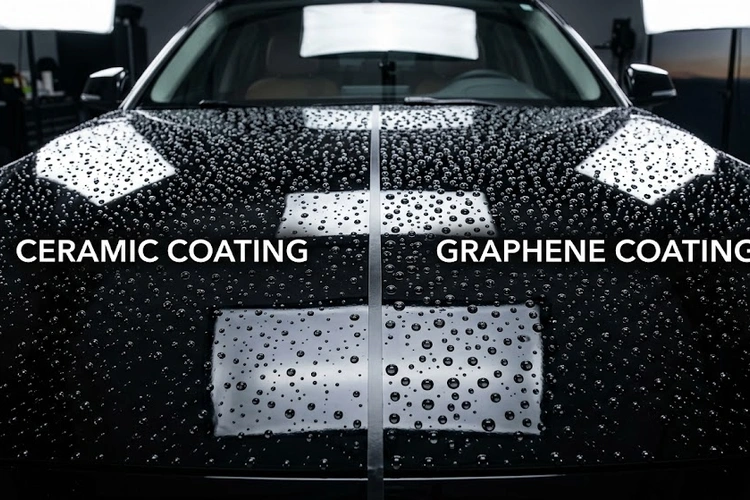
Both coatings bond to automotive paint at a molecular level. Ceramic coatings use silicon dioxide (SiO2) — a glass-like compound — to form a rigid protective shell. Graphene coatings add graphene — a single-layer carbon lattice known for extreme strength and flexibility — on top of a similar SiO2 base. The result is a coating that behaves differently under heat, impact, and water exposure.
Here's how the two stack up across the categories that matter most:
| Category | Ceramic Coating | Graphene Coating |
|---|---|---|
| Base material | Silicon dioxide (SiO2) | SiO2 + graphene particles |
| Hardness rating | 9H | 10H+ |
| Water behavior | Good hydrophobic performance | Excellent hydrophobic performance |
| Heat resistance | Up to ~250°C | Up to ~300°C+ |
| Water spot resistance | Moderate | High |
| Flexibility | Slightly brittle | More flexible under impact |
| Typical longevity | 2–5 years | 3–6 years (estimated) |
| Professional cost | $500–$1,500+ | $700–$2,000+ |
| Market maturity | Well-established | Newer, still evolving |
Ceramic coatings have been around for well over a decade. That means more real-world data, more certified installers, and more reliable third-party reviews. Here's what our team finds noteworthy:
Graphene coatings are newer. The technology is genuinely promising — but long-term field data is still thin. Here's what stands out from our experience:
Pro tip: When comparing graphene products, ask the manufacturer for the actual graphene concentration. Some "graphene coatings" on the market contain barely measurable amounts of the material.
Choosing the right coating depends on where a car lives and how it's used. There's no universal answer here.
Graphene tends to outperform ceramic in specific, demanding conditions:
Ceramic isn't outdated. It still makes solid sense in several common scenarios:
Warning: Applying either coating over uncorrected paint locks in swirl marks and scratches permanently. Paint correction before coating is not optional — it's essential.
Different ownership situations call for different strategies. Here's how our team maps coating choice to real-world scenarios.
Cars that commute daily, haul cargo, or rack up miles fast need durability above all. Graphene's flexibility gives it an edge against road debris impacts. Its superior water-beading means less time hand-drying after washes — that matters for busy owners who aren't professional detailers. Our team leans toward graphene for any vehicle spending significant time in traffic or weather exposure.
Protecting a car's exterior is part of a broader maintenance mindset. Just as understanding what causes windshield cracking helps prevent costly replacements, choosing the right coating early preserves resale value over the long haul.
Show vehicles and weekend drivers have a different set of priorities. These cars are often garaged, washed carefully, and kept in controlled environments. Ceramic coating is more than adequate here. A properly applied ceramic delivers incredible gloss depth. The money saved on the coating can go toward paint correction or professional detailing. For these vehicles, ceramic remains the smart, cost-effective choice.
The application process is nearly identical for both coating types. Graphene coatings often require more precise temperature and humidity control, but the core steps are the same.
Prep is the most critical phase. Rushing it leads to bonding failures and wasted money. Here's what proper prep involves:
Proper prep on a full-size sedan takes four to eight hours. Sealing any surface issue in before coating — similar to how headlight condensation trapped inside a sealed lens becomes permanent — creates problems that can't be fixed without starting over.
Once the surface is ready:
Lab ratings tell part of the story. Real-world performance across different climates tells the rest. Our team has tracked both coating types across a wide range of conditions.
In desert and sun-belt climates, ceramic coatings show their most obvious weakness: water spotting. Mineral-rich water combined with intense heat creates etched spots that need polishing to remove. Graphene coatings pull ahead noticeably here. The lower water contact angle means water sheets off faster, leaving fewer minerals behind. Several owners in our network switched from ceramic to graphene specifically for this reason and reported a significant drop in post-wash spotting. Graphene-coated hoods and roofs also show less micro-cracking after years of direct sun exposure.
In rainy, northern climates, the performance gap between the two narrows considerably. Both handle cold weather well. Road salt is managed comparably — the hydrophobic surface repels salt spray from both coating types. Ceramic holds up fine in these conditions. Graphene still edges ahead on water behavior, but the premium may not justify the extra cost in milder, wetter climates. Staying on top of broader maintenance — like monitoring engine oil color as part of a regular inspection routine — matters as much as coating choice for overall vehicle longevity.
Tip: In salt-belt regions, washing the undercarriage every two to three weeks during winter prevents corrosion that no coating can stop. No surface coating protects bare metal that isn't kept clean.
Choosing the right coating is only half the job. Long-term results depend on consistent maintenance afterward. A great coating treated poorly loses its advantage fast.
Here's what our team recommends for keeping either coating performing at its best:
These errors are easy to make and expensive to fix:
 |
 |
 |
 |

About Diego Ramirez
Diego Ramirez is a maintenance and care specialist who has been wrenching on cars since he was sixteen. He focuses on fluid changes, preventive care routines, paint protection, and the small habits that turn a five-year-old car into a fifteen-year-old car.
Get some FREE car parts & gear.. Or check out the latest free automotive manuals and build guides here.
Disable your ad blocker to unlock all the hidden deals. Hit the button below 🚗
| | | |
