by Sarah Whitfield
A grinding noise when reversing is your vehicle signaling a worn, damaged, or obstructed component in the brake system or drivetrain — and it will not resolve without attention. The sound indicates metal contacting surfaces that should be separated by friction material, fluid, or sealed bearings.
The cause determines both urgency and cost. A piece of road debris caught against a brake rotor presents a minor inconvenience. A deteriorating wheel bearing or low differential fluid represents a genuine safety risk. Knowing which scenario applies is the difference between a $30 fix and a $500 repair. Drivers who notice a burning smell from their brakes alongside the grinding frequently share the same root cause — metal contacting surfaces that should never touch. This guide covers all six causes, how to diagnose each at home, and what each repair realistically costs. For additional guidance on brake and drivetrain concerns, the CarCareTotal resource library covers hundreds of vehicle-specific topics.
Contents
Brake pads include a metal wear indicator — a thin steel tab designed to scrape audibly against the rotor once the friction lining thins below a safe threshold. According to the disc brake design standard, most pads begin with 10–12 mm of usable friction material; below 2–3 mm, metal-to-metal contact begins. In reverse, the brake caliper (the hydraulic clamp that squeezes the pad against the rotor) engages at a slightly different pressure angle, which frequently makes worn-pad grinding louder than during forward braking.
Small stones, road grit, or hardened mud occasionally lodge between the brake pad and the rotor face. This grinding typically disappears within ten minutes of normal driving as the debris wears down or dislodges. If the noise persists beyond that point, the material has likely scored (scratched) the rotor surface, and an inspection is necessary to assess whether resurfacing is required.
A wheel bearing is the ring of steel balls seated inside a housing that allows your wheel hub to spin freely. When the internal races (the grooved tracks the balls roll in) wear out or lose lubrication, a grinding or growling tone develops. The pitch often shifts during turns and becomes more pronounced in reverse as the axle load redistributes. For diagnostic overlaps with differential wear, the guide on front differential noise symptoms covers several shared indicators.
The CV (constant velocity) joint transfers power from the transmission to the wheels while accommodating suspension movement. When the rubber boot protecting the joint cracks and grease escapes, the internal components deteriorate rapidly. A grinding or clicking sound in reverse — especially while the steering wheel is turned — is a reliable indicator of CV joint failure. The guide on driveshaft vibration symptoms covers related axle wear patterns in detail.
The differential is the gear assembly that allows your left and right wheels to rotate at different speeds during turns. It operates in a bath of gear oil; when that oil drops below the minimum level or becomes saturated with metal particles, the internal ring gear and pinion gear grind against each other. Because reverse engages the differential at a different load angle than any forward gear, this noise often appears first — and sometimes exclusively — during backing maneuvers.
A frayed, corroded, or misadjusted parking brake cable can hold one rear brake partially engaged after the lever is released. The resulting drag creates a grinding sound that fades within a few feet of forward movement. You will typically also notice the vehicle pulling slightly to one side as you reverse, which confirms uneven brake application from the sticking cable.
Never continue driving if the grinding noise when reversing is paired with a soft brake pedal or a vehicle that pulls sharply to one side — these signs indicate a brake failure that is progressing rapidly toward a safety emergency.
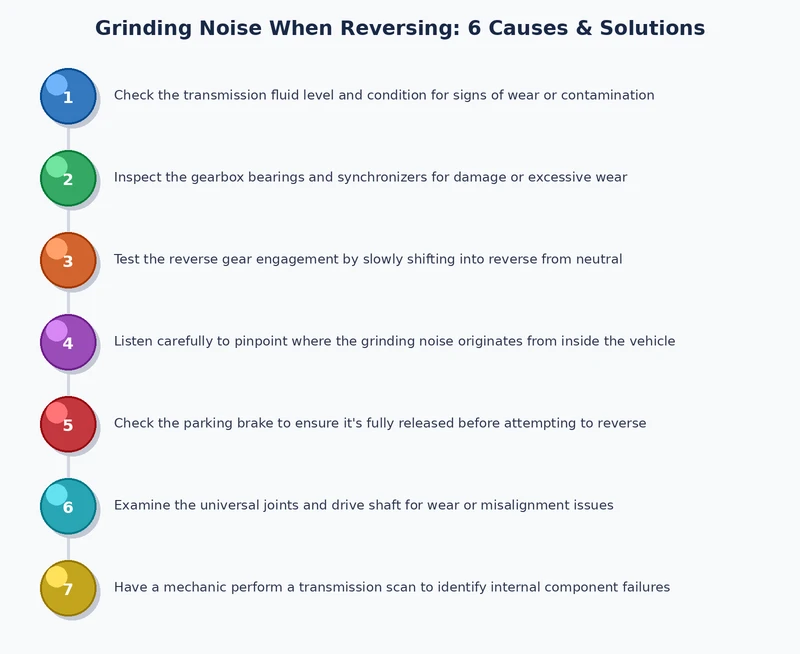
Have a trusted assistant slowly reverse the vehicle while you observe from a safe distance outside. Identify whether the sound originates from the front axle, the rear axle, or a specific corner — driver side or passenger side. A grinding noise isolated to one wheel points to a localized brake, bearing, or CV joint issue rather than a differential problem, which produces noise across all four wheels. If the vehicle also displays an AWD system fault warning, the differential or transfer case becomes the primary suspect.
With the vehicle on a level surface and the parking brake engaged, look through the wheel spokes at the rotor and pad assembly. Key warning signs include:
Locate the differential fill plug on the differential housing — your owner's manual will identify the exact position for your vehicle. Remove the plug and confirm that gear oil is level with the opening. If the cavity is dry, you have identified the problem. Dark, gritty, or burnt-smelling fluid requires an immediate service regardless of the current level reading.
Inspect brake pads every 12,000 miles and replace them before the wear indicator engages. Rotors should be resurfaced or replaced whenever their thickness drops below the manufacturer's minimum specification, which is stamped on the rotor edge. Maintaining your suspension in good condition also extends brake life indirectly, because worn struts allow excessive wheel oscillation that accelerates uneven rotor wear across the contact surface.
Change differential fluid every 30,000 to 60,000 miles under normal use, and every 15,000 miles under severe conditions such as towing, off-road driving, or heavy stop-and-go commuting. Use the exact viscosity grade specified in your owner's manual — substituting a heavier or lighter grade reduces the lubricating film between gear surfaces and accelerates wear. For four-wheel-drive vehicles, the guide on bad transfer case symptoms explains the full maintenance scope of a multi-differential drivetrain.
A differential fluid service costs $80 to $150 at a shop — postponing it risks ring and pinion gear damage that can exceed $1,500 to repair.
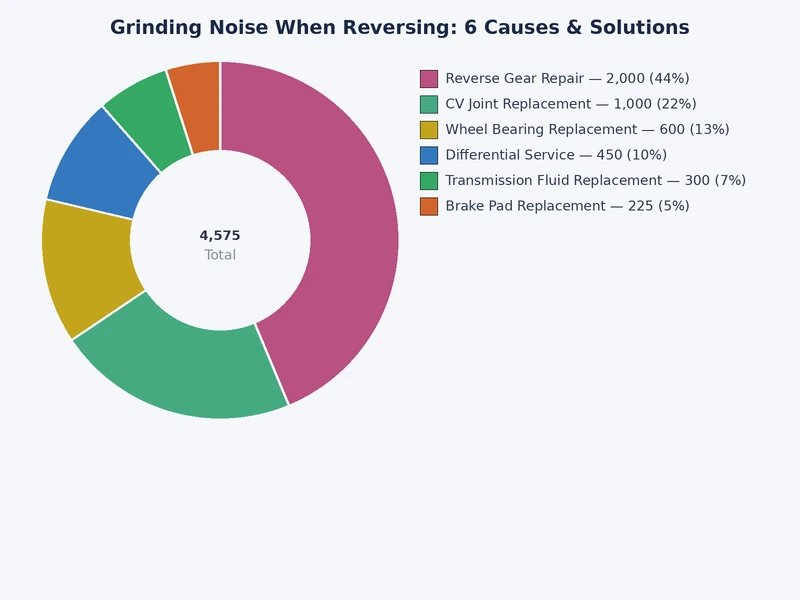
The table below presents realistic cost ranges for each of the six causes of a grinding noise when reversing. DIY figures cover parts only; professional figures include labor at standard shop rates.
| Cause | DIY Cost (Parts) | Professional Cost | Urgency Level |
|---|---|---|---|
| Worn brake pads | $30–$80 | $150–$300 per axle | High — repair within one week |
| Debris in rotor | $0 | $0–$50 inspection | Low — monitor for one to two days |
| Damaged wheel bearing | $80–$150 | $250–$550 per wheel | High — repair within three days |
| Worn CV joint or axle | $60–$150 | $250–$500 per axle | Medium-High — repair within two weeks |
| Low differential fluid | $15–$30 | $80–$150 fluid service | Medium — repair within one week |
| Faulty parking brake | $20–$60 | $100–$250 cable replacement | Medium — repair within two weeks |
Debris removal, parking brake adjustment, and differential fluid changes typically fall below $150 even at a professional shop. These are the most accessible DIY repairs on the list, requiring minimal disassembly and no specialized tooling beyond a hand pump for fluid service.
Wheel bearing replacement and CV axle jobs exceed $400 in most professional settings. Bearing work demands a hydraulic press to seat the race precisely inside the hub; CV axle replacement requires removing a hub nut torqued to 150–200 ft-lbs, which calls for an impact-rated tool beyond the capacity of a standard hand wrench.
Three of the six causes are practical DIY projects for anyone with basic mechanical confidence and a standard tool set:
The remaining three causes call for shop-level tools or structural disassembly that makes professional service the more reliable choice:
Suspension wear compounds brake noise over time. If handling concerns accompany the grinding, review the symptoms of bad ball joints before booking a repair appointment — worn joints amplify drivetrain noise and can mask the actual source of the problem.
Continuing to drive on worn pads after the wear indicator activates destroys the rotor face within days of metal contact. A rotor that could be resurfaced for $30–$50 becomes a full replacement at $150–$400. The grinding noise when reversing is a timed alert, not a standing warning — the low-cost window closes quickly once metal contacts metal.
Replacing brake pads on both axles while a failing wheel bearing continues to deteriorate is an expensive and preventable mistake. Always isolate the noise to a specific corner and rule out fluid-related causes before purchasing parts. A grinding that shifts pitch during turns almost exclusively indicates a bearing or CV joint problem, not a brake pad — and the two repairs carry very different cost and complexity levels.
Installing the incorrect differential fluid viscosity grade or mixing synthetic and conventional gear oils accelerates internal wear and, in some vehicles, voids the powertrain warranty. Brake fluid precision matters equally — installing DOT 3 fluid in a system requiring DOT 5.1 lowers the boiling point of the hydraulic fluid and introduces compressibility under heat load, reducing stopping effectiveness exactly when braking demands are highest.
Several components engage at different load angles or pressure profiles in reverse than in forward gears. Worn brake pads, a partially stuck parking brake cable, and differential gear contact all produce sounds that are more pronounced — or exclusive to — reverse. The directional shift redistributes axle loads in ways that expose worn components that remain quiet during normal forward driving.
It depends on the cause. Road debris in a rotor poses minimal short-term risk and often resolves on its own. Worn brake pads, a failing wheel bearing, or low differential fluid each carry genuine safety implications and require attention within days. Any grinding accompanied by a soft brake pedal or a vehicle that pulls to one side demands immediate professional inspection.
Costs range from $0 — for debris that dislodges on its own — to $550 or more for a professional wheel bearing replacement. Brake pad replacement runs $150–$300 at a shop. A differential fluid service runs $80–$150. The exact figure depends on which of the six causes applies and whether you perform the repair yourself or use a certified technician.
Yes. Reverse engages the differential's ring and pinion gears at a load angle that differs from every forward gear, so early-stage gear wear or insufficient lubrication often produces noise first — and sometimes exclusively — when backing up. Checking the differential fill plug is a low-cost first step that rules out one of the most common causes before you pursue more complex diagnostics.
Brake grinding is typically a steady scraping sound that occurs during brake application and worsens with increased pedal pressure. Wheel bearing grinding is a persistent growl or hum that changes pitch during turns and continues whether or not the brakes are applied. Isolate the noise to a specific corner and test both conditions — braking and coasting — to distinguish between the two sources reliably.
Only if road debris was the cause — in that scenario, the material wears down or dislodges within minutes of normal driving. Every other cause on this list will worsen without intervention. Worn pads progress to rotor destruction. Failing bearings eventually seize at highway speed. Low differential fluid leads to gear scoring and catastrophic drivetrain failure. Do not rely on the noise resolving without a confirmed diagnosis and repair.
A grinding noise when reversing is not a sound to monitor over time — it is a deadline, and every mile you add to the clock raises the final repair bill.
 |
 |
 |
 |

About Sarah Whitfield
Sarah Whitfield is a diagnostics and troubleshooting specialist who spent ten years as an ASE-certified technician before joining the editorial team. She specializes in OBD-II analysis, electrical gremlins, and the kind of intermittent problems that make most owners give up.
Get some FREE car parts & gear.. Or check out the latest free automotive manuals and build guides here.
Disable your ad blocker to unlock all the hidden deals. Hit the button below 🚗
| | | |
