by Sarah Whitfield
Ever sat down in a freezing car, pressed the seat heater button, and waited for warmth that never came? Heated seats not working is almost always an electrical problem — and electrical problems follow a logical chain. Trace the circuit from fuse to element, and the culprit shows up. Most failures are cheaper and easier to fix than drivers expect.
This guide walks through every common failure point in the heated seat circuit. It covers fast at-home checks, a component-by-component breakdown, realistic guidance on what's DIY-friendly versus what belongs on a lift, and how to prevent the problem from recurring. For other troubleshooting electrical gremlins, the same diagnostic mindset applies across most vehicle systems.
Contents
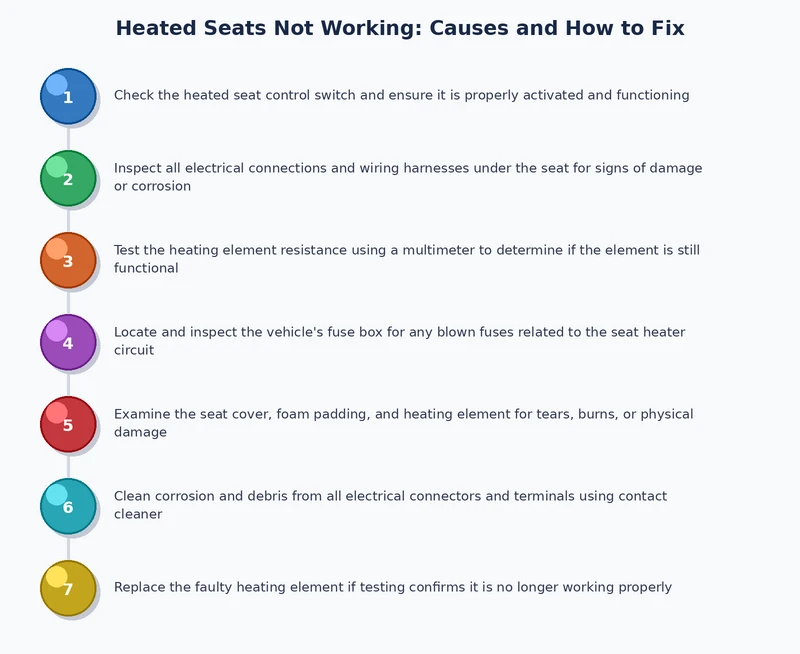
Fuses are the fastest and cheapest first stop on any electrical diagnosis. Heated seat circuits typically run on a dedicated 15A or 20A fuse — usually in the interior fuse box, though some vehicles route it through the engine bay power distribution center. Consult the fuse diagram on the box lid or in the owner's manual to pinpoint the correct fuse. Pull it, inspect visually for a broken filament or discoloration, and replace it if blown.
Knowing how to find and replace a car fuse is a foundational skill that applies to dozens of electrical issues. If the new fuse holds, the repair is done. If it blows again immediately, there's a short circuit downstream — the circuit needs further tracing before swapping another fuse, or the short will keep taking them out.
The seat heater switch takes more abuse than almost any other interior component. Drivers press it with gloves on, toggle it repeatedly in cold weather, and the switch endures thousands of thermal cycles over the vehicle's life. Contact points wear out, carbon deposits accumulate, and solder joints crack under the repeated flexion. Testing requires a multimeter in continuity mode. With the harness connector unplugged from the switch, actuate it through all heat level positions and check for consistent continuity at each position. Dead spots or complete open-circuit readings confirm a failed switch.
If the fuse and switch both test clean, the wiring harness is the next logical target. The harness runs from the switch, beneath the seat, to the heating element. It flexes every time the seat slides forward or back, reclines, or bears body weight. Over years of that repeated movement, insulation cracks and conductors break — often without any visible external damage. Inspect accessible harness sections for chafing, particularly where the harness crosses the seat track rails. Follow that with a multimeter continuity check across the full harness run, from the switch connector through to the element connector.
A heated seat circuit is more straightforward than most drivers assume. Power flows from the fuse, through the switch, into the control module on vehicles with multi-level heating, then out to the heating element embedded in the seat cushion and backrest pad. A thermistor monitors seat surface temperature and signals the module to cycle the element on and off. When any link in this chain fails, the seat either stops heating entirely or behaves erratically — shutting off early, cycling unexpectedly, or refusing to reach the selected heat level.
| Component | Typical Symptom | DIY Difficulty | Typical Repair Cost |
|---|---|---|---|
| Fuse | No heat, no indicator light | Easy | $1–$5 |
| Switch | Intermittent heat, stuck or dead indicator | Moderate | $20–$80 |
| Wiring Harness | Intermittent, position-dependent failure | Moderate | $0–$60 |
| Thermistor | Shuts off early, indicator light flashes | Moderate–Hard | $15–$60 |
| Heating Element | No heat, infinite resistance on multimeter | Hard | $50–$200 |
| Control Module | Multiple seats affected, no response at all | Hard | $100–$400 |
These two components produce similar surface symptoms but have distinct test profiles. A failed element shows infinite or very high resistance when measured with a multimeter between the element's two terminals — a healthy pad reads 2–5 ohms depending on the vehicle and pad size. A failed thermistor shows wildly incorrect resistance; at room temperature, a healthy thermistor typically measures around 10kΩ, though the exact spec varies by manufacturer and should be confirmed in the wiring diagram. Thermistor failures produce thermal cutout behavior: the seat heats briefly, then shuts off, often triggering a flashing indicator as the control module interprets the bad reading as an overtemperature condition and cuts power as a precaution.
Fuse replacement is trivially easy for anyone. Switch replacement is also well within reach — the switch panel typically pops out with a plastic trim tool, the harness connector unplugs, and the new switch clips in. Accessible wiring repairs, soldering a broken conductor and sealing the joint with adhesive-lined heat-shrink tubing, are manageable for anyone comfortable with basic electrical work. Measuring element and thermistor resistance requires a multimeter and the confidence to partially lift the seat cover, but no specialized equipment.
Testing the battery condition while diagnosing an electrical issue like this is a smart parallel step. A weak battery or faulty charging circuit can cause erratic behavior across multiple electrical systems simultaneously. The guide on how to test a car battery at home covers both multimeter voltage checks and load testing in straightforward detail.
Full element replacement requires disassembling the seat — removing it from the vehicle, stripping the cover, installing a new heating pad, and reassembling without damaging the foam or seat cover material. It's labor-intensive and easy to botch without experience. Vehicles with integrated occupant detection sensors or side-airbag wiring routed through the seat add genuine risk. Disturbing those circuits incorrectly can disable airbag deployment or set persistent DTCs requiring a scan tool to clear. Control module replacement on luxury vehicles with integrated climate management compounds complexity further. Those jobs belong to a technician with proper wiring diagrams and dealer-level scan tools.
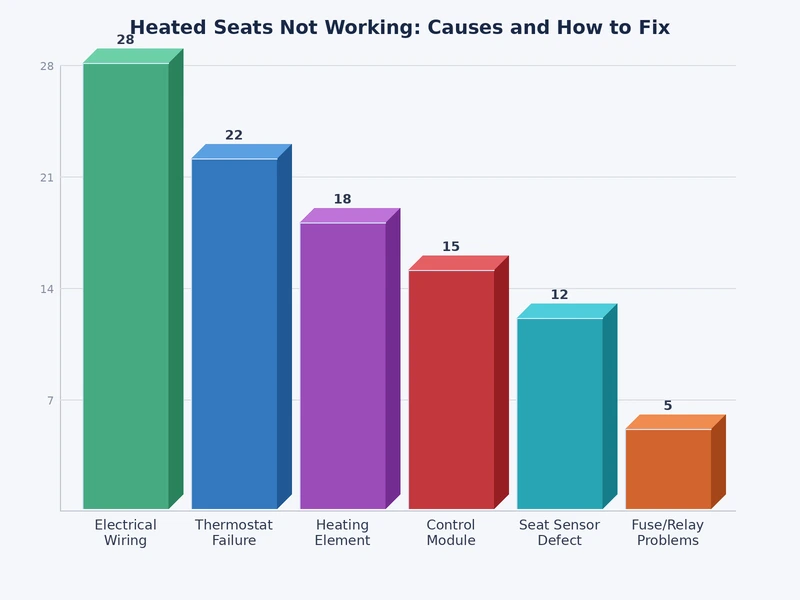
This is the most common misdiagnosis when heated seats stop working. Most people assume the element burned out. In reality, elements are among the most durable components in the circuit — sealed under the seat cover and protected from most mechanical stress. Switches and harness sections near the seat track fail far more frequently because they take daily mechanical abuse. Industry diagnostics consistently point to fuse, switch, and connector failures as the plurality of heated seat complaints. Test everything upstream of the element before pulling the seat apart. Element failure is real, but it's the last thing to suspect, not the first.
Heated seat elements draw 3–8 amps per seat at 12 volts — roughly 36–96 watts total. That's comparable to a pair of halogen fog lights. A healthy alternator handles that load without measurable strain during normal driving. The only scenario where seat heaters meaningfully drain a battery is running them for extended periods with the engine completely off — an unusual situation. On a properly functioning charging system, seat heaters are a minor electrical load. When drivers notice battery drain coinciding with seat heater use, it almost always reflects an underlying charging system weakness, not a problem with the heated seat circuit itself.
Heated seat elements are resistive pads — a grid of carbon fiber or nichrome wire laminated into the seat cushion foam. They're durable under normal occupant loads, but mechanical stress from sharp objects breaks the wire grid. The main culprit is concentrated point pressure: tools carried in back pockets, keys left directly on the seat, or hard-edged objects placed on the cushion. Consistent, even seating pressure over the full pad distributes thermal and mechanical stress uniformly. Thermal cycling within the designed temperature range rarely degrades elements on its own — it's mechanical puncture and abrasion that cut lifespan short.
Annual inspection of the seat heater switch connector for corrosion takes about two minutes. Connector oxidation is common in humid climates and in vehicles exposed to road salt. A small amount of dielectric grease applied to the connector pins during reassembly prevents oxidation from degrading contact resistance over time. The harness under the seat is worth a visual inspection every few years — look for chafing where the harness routes over seat track edges. A frayed insulation section caught early is a five-dollar solder repair. The same section discovered after it arcs, blows the fuse, and damages the control module becomes a four-hundred-dollar repair.
Single-side failure almost always points to a component specific to that seat's circuit — a blown fuse on a split circuit, a failed switch, or a broken harness section. If both seats share a single fuse and both stop working simultaneously, suspect the common fuse or power feed first. If only one seat fails while the other works normally, trace that seat's dedicated circuit from the fuse box through the switch connector to the element terminals.
On vehicles where the seat heater control module is integrated into the climate control system — common on newer luxury models — a software calibration issue can cause erratic cycling or premature thermal cutoff. A dealer scan and software update has resolved this on certain model-year technical service bulletins. However, the majority of heated seat failures are hardware problems: blown fuses, failed switches, broken wiring, or dead elements. Software is rarely the root cause.
A well-maintained heating element under normal occupant use and without mechanical abuse should last the life of the vehicle — often well beyond 150,000 miles. Elements fail prematurely due to puncture from sharp objects, repeated compression from extremely heavy loads, or water intrusion through a cracked or torn seat cover. In most cases, the circuit components surrounding the element — switches, connectors, and harness sections — fail first.
A torn cover over the heating element creates direct contact risk with the element surface and exposes the wiring to moisture and debris ingress. It also removes the thermal distribution layer that spreads heat evenly across the pad, which can create localized hot spots capable of causing discomfort or, in extreme cases, burns. Operating a heated seat with significant cover damage is not recommended — repair the cover before using the seat heater again.
 |
 |
 |
 |

About Sarah Whitfield
Sarah Whitfield is a diagnostics and troubleshooting specialist who spent ten years as an ASE-certified technician before joining the editorial team. She specializes in OBD-II analysis, electrical gremlins, and the kind of intermittent problems that make most owners give up.
Get some FREE car parts & gear.. Or check out the latest free automotive manuals and build guides here.
Disable your ad blocker to unlock all the hidden deals. Hit the button below 🚗
| | | |
