by Sarah Whitfield
A driver parks after a long commute and notices an unmistakable sweet smell drifting from the dashboard vents, even though the coolant reservoir appeared full just days ago. The next morning, the inside of the windshield carries a thin, greasy film that the defroster cannot clear no matter how long it runs. These are textbook heater core failure symptoms, and recognizing them early prevents both significant interior damage and the dangerous coolant loss that leads to engine overheating.
Heater core failure symptoms develop gradually, which makes early identification especially important for avoiding a repair bill that is dominated by labor rather than parts. The heater core — a compact, radiator-like heat exchanger mounted inside the dashboard that circulates hot engine coolant through the cabin heating system — is a sealed component, so internal leaks often go unnoticed until damage is already significant. Drivers who suspect a cooling system issue should also consult the guide on diagnosing strange car smells, because coolant odors are among the most distinctive and diagnostically useful warning signs a vehicle produces. Unusual gurgling or ticking sounds during warm-up should be noted as well, since these may indicate air pockets in the coolant system rather than the timing chain or valve train noise that can produce similarly rhythmic sounds at idle.
Contents
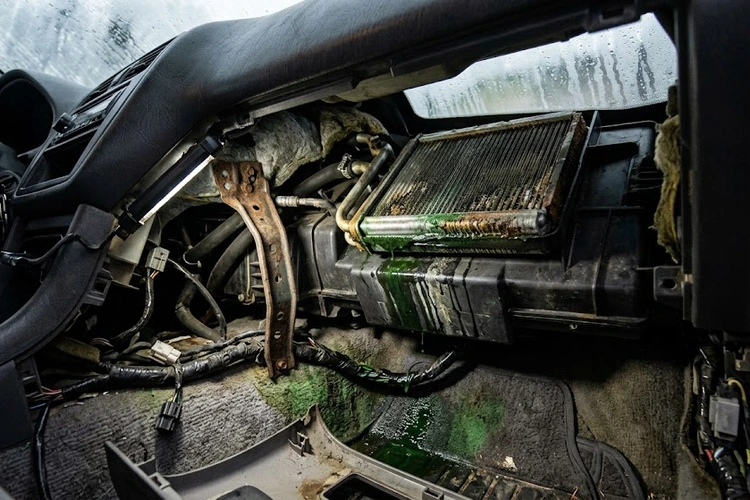
The heater core sits inside the HVAC (Heating, Ventilation, and Air Conditioning) housing behind the dashboard, positioned between the blower motor and the cabin air outlets. Hot engine coolant flows continuously through the core's copper or aluminum tubes while the blower fan pushes cabin air across those tubes, transferring heat into the passenger compartment. According to Wikipedia's overview of the heater core, the component routinely operates at coolant temperatures approaching 200°F (93°C), which places significant thermal and pressure stress on its solder joints and thin-walled tubing across years of continuous use.
A blend door — a small internal flap — directs airflow either through the core or around it, depending on the cabin temperature setting. When this door or the heater control valve fails alongside the core itself, symptoms overlap considerably and complicate an accurate diagnosis.
Issues with the blower motor are frequently misidentified as heater core problems because both produce the symptom of reduced cabin heat. A failing blower motor resistor eliminates airflow across a perfectly functional heater core and produces cold air at the vents without any coolant leak, odor, or pressure loss. Distinguishing between these two failure modes early avoids unnecessary and expensive heater core replacement.
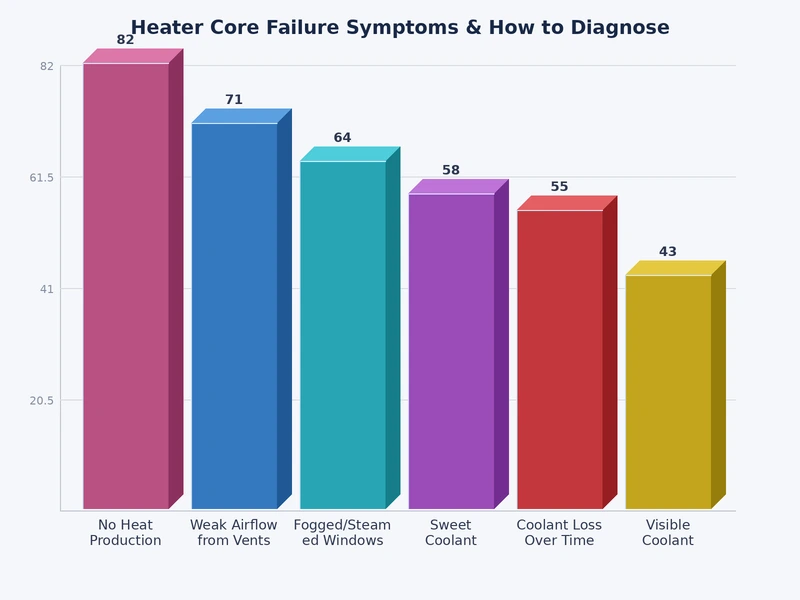
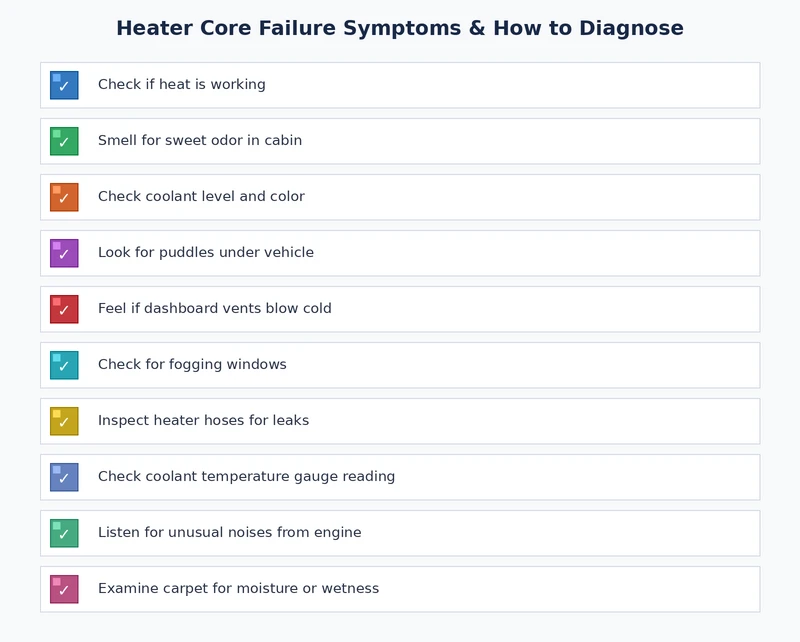
The most reliable heater core failure symptoms appear inside the passenger cabin, where leaking coolant leaves physical evidence that clearly distinguishes it from other HVAC problems. These signs warrant prompt investigation rather than extended monitoring.
Warning: Never dismiss a sweet smell from the dashboard vents — coolant vapor is toxic when inhaled over extended periods, and the odor confirms an active internal leak that will only worsen with continued driving.
Drivers who notice unusual burning or chemical odors alongside cooling system issues should review the resource on car smells and their causes, which covers the critical distinction between coolant odors, burning plastic, and exhaust-related smells that can arise simultaneously. A worn serpentine belt that drives the water pump can also reduce coolant circulation and mimic a heater core clog; the article on fixing a squeaky belt covers belt and tensioner inspection steps that apply directly to water pump assessment.
Vehicles parked for extended periods without adequate antifreeze protection are at elevated risk of heater core cracking from freeze damage. The guide on maintaining a car that sits unused for months explains the coolant concentration checks that protect against this specific and preventable failure mode.
Scheduled coolant flushes are the single most effective preventive measure against heater core failure. Fresh coolant maintains the correct pH balance and corrosion inhibitor concentration that protects the core's internal surfaces, while neglected coolant becomes acidic and attacks soft metal tubing silently from within.
| Coolant Type | Recommended Flush Interval | Common Application |
|---|---|---|
| IAT — Green (Inorganic Additive Technology) | Every 30,000 miles or 2 years | Older domestic vehicles; fastest additive depletion rate |
| OAT — Orange/Red (Organic Acid Technology) | Every 50,000 miles or 5 years | GM Dex-Cool, Toyota Red; extended service life |
| HOAT — Yellow/Gold (Hybrid OAT) | Every 50,000 miles or 5 years | BMW, Mercedes, Ford; dual inhibitor chemistry |
| NOAT — Purple (Nitrite OAT) | Every 600,000 miles or 6 years | Heavy-duty diesel engines; not for passenger cars |
Pro tip: Always use distilled water — never tap water — when diluting antifreeze concentrate, because tap water's mineral content accelerates internal deposits and measurably shortens heater core service life.
Simultaneously failing AC and heating performance often points to shared HVAC housing damage rather than two independent component failures. The article on car AC freezing up covers the HVAC system overlap between the evaporator core and heater core that produces confusing mixed symptoms in colder operating conditions.
The heater core part itself is moderately priced, but the total repair bill is driven almost entirely by labor — because accessing the core requires partial or complete dashboard removal on most modern vehicles, a process that consumes six to twelve hours of shop time depending on the specific platform and model year.
| Cost Component | Typical Range | Notes |
|---|---|---|
| Heater core (aftermarket part) | $40 – $150 | OEM units cost $100 – $300; application-specific fitment required |
| Labor — standard passenger car | $400 – $900 | 6–10 hours at $65–$120/hr; dashboard removal is the primary cost driver |
| Labor — difficult access (trucks, luxury SUVs) | $900 – $1,500+ | Some platforms require steering column and full HVAC box removal |
| Coolant refill and system flush | $50 – $120 | Always required after replacement; old coolant must never be reused |
| Total — average passenger car | $500 – $1,100 | Independent shops typically charge 20–35% less than franchise dealerships |
A heater core bypass — routing the inlet and outlet hoses directly to each other so coolant never enters the core — eliminates both the internal leak and the coolant vapor entering the cabin. This procedure costs very little in parts and can be completed in under an hour at any shop. However, it permanently removes all cabin heating capability, which is acceptable only as a short-term measure in warm climates or while scheduling a full repair appointment.
 |
 |
 |
 |

About Sarah Whitfield
Sarah Whitfield is a diagnostics and troubleshooting specialist who spent ten years as an ASE-certified technician before joining the editorial team. She specializes in OBD-II analysis, electrical gremlins, and the kind of intermittent problems that make most owners give up.
Get some FREE car parts & gear.. Or check out the latest free automotive manuals and build guides here.
Disable your ad blocker to unlock all the hidden deals. Hit the button below 🚗
| | | |
