by Marcus Chen
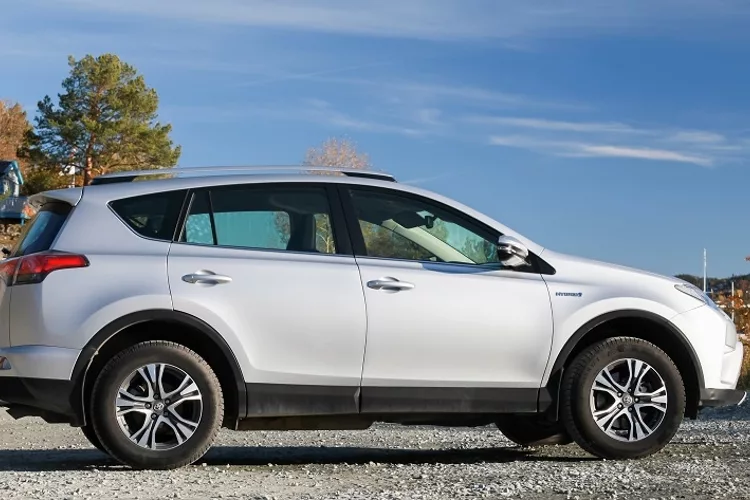
A service technician at a suburban Toyota dealership once documented a RAV4 arriving for routine brake service with 287,000 miles on the odometer — no engine overhaul, no transmission swap, just worn pads and a cabin filter. That vehicle had cycled through three brake jobs, two sets of tires, and one timing chain without a single catastrophic failure. For owners weighing a long-term purchase decision, the question of how long do Toyota RAV4 last draws a consistent answer from the data: well past 250,000 miles under disciplined maintenance, and routinely past 300,000 miles in documented fleet cases.
Contents
The Toyota RAV4 entered the compact SUV market built on a unibody platform derived directly from passenger car architecture, inheriting car-grade NVH damping, corrosion resistance, and thermal management systems. That foundation — rather than a truck-based body-on-frame design — gives the RAV4 a structural baseline more favorable to long service life than many competitors in the class.
Third-party reliability surveys from J.D. Power and Consumer Reports consistently place the RAV4 in the top quartile of compact SUVs for long-term dependability scores. iSeeCars data on vehicles reaching 200,000 miles lists the RAV4 among the five most over-represented compact SUVs in high-mileage populations. Comparing RAV4 longevity projections against platforms like the Jeep Grand Cherokee reveals a meaningful gap in drivetrain repair frequency after 100,000 miles, particularly in transmission and transfer case expenditures.
Owner forums, fleet operator maintenance logs, and long-term automotive press evaluations collectively document a reliable ceiling for the RAV4: 250,000 to 300,000 miles under disciplined maintenance, with outliers exceeding 350,000 miles. These are not statistical anomalies but predictable outcomes when prescribed service intervals are followed without deviation.
Pro Insight: Fleet operators who service RAV4s at strict 5,000-mile oil change intervals — rather than the maximum 10,000-mile OEM recommendation — report measurably lower sludge accumulation in long-term teardown inspections, particularly in VVT-i actuator passages.
For context on where the RAV4 sits relative to other mass-market platforms, comparing its longevity data against vehicles like the Nissan Altima or the Jeep Wrangler reveals that the RAV4 competes favorably in total cost of ownership projections when normalized for equivalent mileage accumulation rates. The RAV4's advantage is most pronounced between 150,000 and 250,000 miles, where competing platforms typically require major drivetrain intervention.
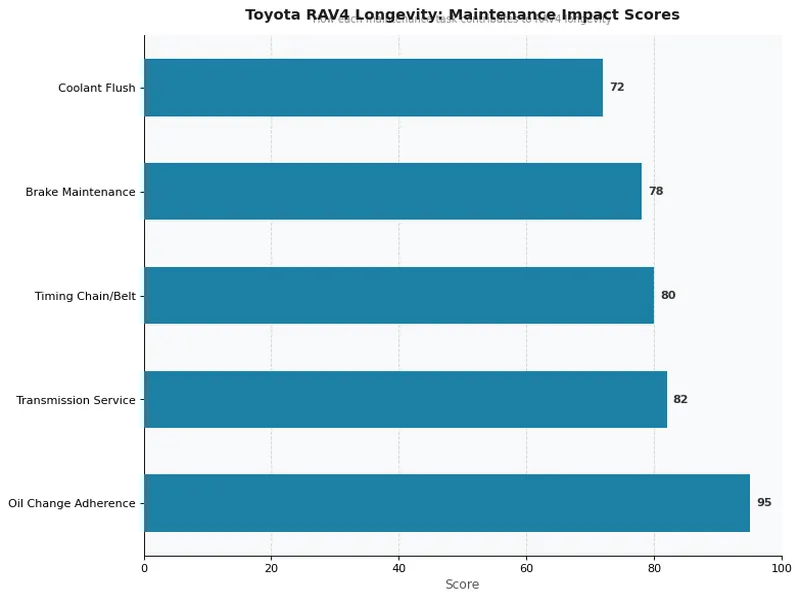
The answer to how long do Toyota RAV4 last differs meaningfully depending on whether the vehicle operates in urban stop-and-go cycles, sustained highway cruising, or mixed off-road terrain. Each profile imposes distinct wear patterns on the powertrain, braking system, and chassis components, and the maintenance response must be calibrated accordingly.
Persistent misconceptions about compact SUV longevity cause owners to make premature trade-in decisions or to under-invest in preventive maintenance during the high-mileage phases when proper care delivers its highest return on investment.
A widely circulated belief holds that vehicles become financially untenable at 100,000 miles, requiring powertrain expenditures that exceed depreciated market value. This framing does not apply to properly maintained RAV4s. The 2AR-FE and 2.5L Dynamic Force engines show no statistically elevated internal failure rates at 100,000 miles in well-maintained units. According to the Toyota RAV4 overview on Wikipedia, the platform's engineering evolution across five generations reflects deliberate durability investment — not cosmetic annual updates. Total repair costs between 100,000 and 200,000 miles on a maintained RAV4 average $1,200–$1,800, far below the depreciation cost of trading into a comparable new vehicle over the same period.
Warning: Owners who repeatedly discharge hybrid battery packs to near-zero — through extended accessory use with the ICE off, or aggressive thermal cycling in extreme cold — accelerate battery degradation significantly beyond documented population averages.
Sustaining a high-mileage RAV4 requires a baseline diagnostic toolkit that enables owners and independent shops to monitor system health between scheduled dealer intervals. Clearing a check engine light without reading the underlying fault code is among the most counterproductive habits in DIY maintenance; an OBD-II scanner eliminates that knowledge gap entirely and costs less than a single dealership diagnostic fee.
Identifying component degradation before catastrophic failure is the single highest-return maintenance strategy in high-mileage RAV4 ownership. Engine misfire symptoms in the RAV4 — rough cold-start idle, elevated fuel trim variance, and P0300-series fault codes — most commonly reflect ignition system wear rather than internal engine damage, making early intervention straightforward and inexpensive compared to delayed diagnosis.
The gap between a RAV4 that reaches 150,000 miles and one that reaches 300,000 miles is almost entirely explained by owner maintenance behavior rather than production variance. The core principles of vehicle maintenance apply to the RAV4 with particular urgency given the platform's documented sensitivity to oil quality degradation and coolant system neglect.
| Maintenance Error | Component at Risk | Repair Cost if Neglected |
|---|---|---|
| Extending oil changes beyond 7,500 miles with conventional oil | VVT-i actuator, camshaft journals | $2,500–$6,000 (cylinder head) |
| Skipping coolant flush at 60,000-mile intervals | Radiator, water pump seal, heater core | $800–$1,500 |
| Ignoring transmission fluid beyond 60,000 miles | CVT solenoids, clutch pack friction material | $3,500–$5,500 (CVT replacement) |
| Delaying brake fluid replacement (2-year interval) | ABS modulator, caliper bore seals | $600–$1,200 |
| Using non-Toyota SLLC coolant in hybrid cooling circuit | Hybrid inverter coolant pump seals | $1,200–$2,800 |
The RAV4's 2.5-liter engine specifies 0W-20 full-synthetic oil, and substituting 5W-30 conventional oil increases internal friction coefficients during cold-start operation, accelerating piston ring seating wear and VVT-i actuator erosion over accumulated mileage. Short-trip city driving compounds this by preventing full oil temperature stabilization, leaving moisture and combustion byproducts suspended in the oil film between change intervals.
Owners who document RAV4 longevity above 250,000 miles share a consistent set of maintenance behaviors that extend well beyond the minimum OEM recommendations. Selecting premium all-season tires from established manufacturers — see the analysis of Michelin tire value for one benchmark — also reduces irregular wear patterns that transfer vibration stress to wheel bearings and strut mounts over sustained high-mileage service. For deeper coverage of performance-oriented maintenance strategies, CarCareTotal's performance section outlines component-level approaches relevant to long-term ownership goals.
High-mileage RAV4 owners who avoid reactive repair costs replace the following components at known wear thresholds rather than waiting for failure symptoms to appear:
The strategic calculus of high-mileage RAV4 ownership shifts meaningfully after the 200,000-mile threshold, where the primary financial risk transitions from routine maintenance cost to major powertrain repair probability. Owners who have maintained the vehicle properly to this point operate in a favorable cost-per-mile position, well past the depreciation curve's steepest descent.
The repair-versus-replace calculation for a high-mileage RAV4 centers on whether the repair cost exceeds 12 months of equivalent replacement financing. A RAV4 with 220,000 miles requiring a $3,500 transmission rebuild is statistically preferable to initiating a $600/month new-vehicle payment — provided the engine and chassis are confirmed structurally sound via borescope inspection and undercarriage assessment.
A Toyota RAV4 maintained on the prescribed service schedule — oil changes every 5,000–7,500 miles with full-synthetic 0W-20, coolant flushes at 60,000-mile intervals, and transmission fluid exchanges at 30,000–60,000 miles depending on use — reliably reaches 250,000 to 300,000 miles. Documented fleet and owner data shows outliers exceeding 350,000 miles in highway-primary, low-idle-cycle use cases with consistent fluid discipline throughout the vehicle's service life.
Hybrid RAV4 variants demonstrate comparable or superior longevity to non-hybrid counterparts, particularly in urban use cycles where regenerative braking substantially reduces mechanical brake wear and extends rotor and caliper service life. Toyota hybrid battery replacement rates remain below 2% at 150,000 miles across documented fleet populations, and the federal warranty coverage — 8 years/100,000 miles federally, 10 years/150,000 in CARB states — provides a meaningful ownership safety net during the critical mid-mileage phase.
Extended oil change intervals that allow sludge accumulation in the VVT-i oil passages are the most frequently documented cause of premature engine failure on the RAV4 platform. Owners using conventional oil who push change intervals beyond 7,500 miles — particularly in short-trip city driving where oil never fully thermally stabilizes — account for the majority of camshaft lobe wear and head gasket failures reported before the 150,000-mile mark in owner and independent shop surveys.
 |
 |
 |
 |

About Marcus Chen
Marcus Chen is a performance and tuning specialist with 12+ years of hands-on experience modifying everything from daily drivers to track cars. He specializes in suspension setup, wheel-and-tire fitment, and squeezing every drop of performance from stock platforms without sacrificing reliability.
Get some FREE car parts & gear.. Or check out the latest free automotive manuals and build guides here.
Disable your ad blocker to unlock all the hidden deals. Hit the button below 🚗
| | | |
