by Joshua Thomas
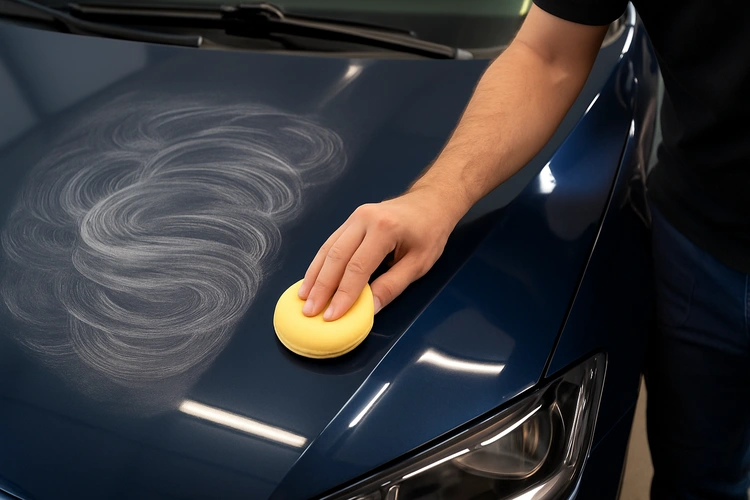
Knowing how to buff a car by hand is one of the most practical detailing skills any car owner can develop. Hand buffing removes light oxidation, minor scratches, water spots, and dullness from your paint — restoring gloss without a machine polisher. It takes a little elbow grease, the right products, and a proper technique. This guide walks you through every step so you get professional-looking results at home.
Before you start, it helps to decontaminate your car paint before polishing — removing embedded iron particles and tar ensures your compound works on the paint defects, not surface contamination.
Contents
Hand buffing requires minimal equipment. You do not need a machine polisher — in fact, for light defects and smaller areas, working by hand gives you excellent control. Gather these items before you begin:
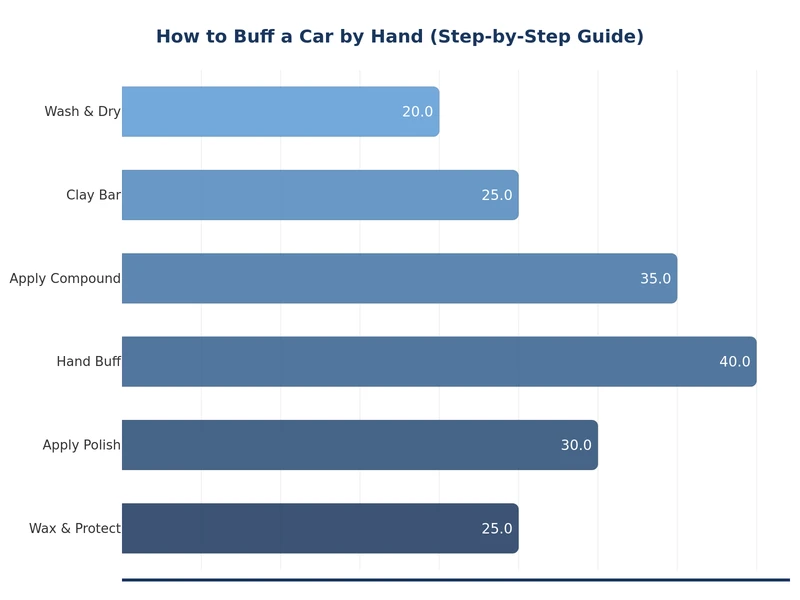
Never buff a dirty car. Grit trapped between your pad and the paint will cause deep scratches that are far harder to correct. Use a proper car wash soap rather than dish soap — dish soap strips protective wax and can dry out rubber seals. Rinse, wash in straight lines (not circles), and dry with a clean microfiber drying towel.
Work in bright lighting — a single LED work light or direct sunlight helps. Look for:
Run your fingernail lightly over a scratch. If it catches, the scratch is likely deep and may need professional attention. If your nail glides over it, hand buffing can fix it. Apply masking tape along all plastic trim, rubber seals, and emblems before you start — compound is very difficult to remove from porous surfaces.
Apply a pea-sized amount of compound or polish to your foam applicator pad. Do not over-apply — too much product creates smearing and waste. Spread it thinly over a small area (roughly 18 × 18 inches / 45 × 45 cm) before you begin working.
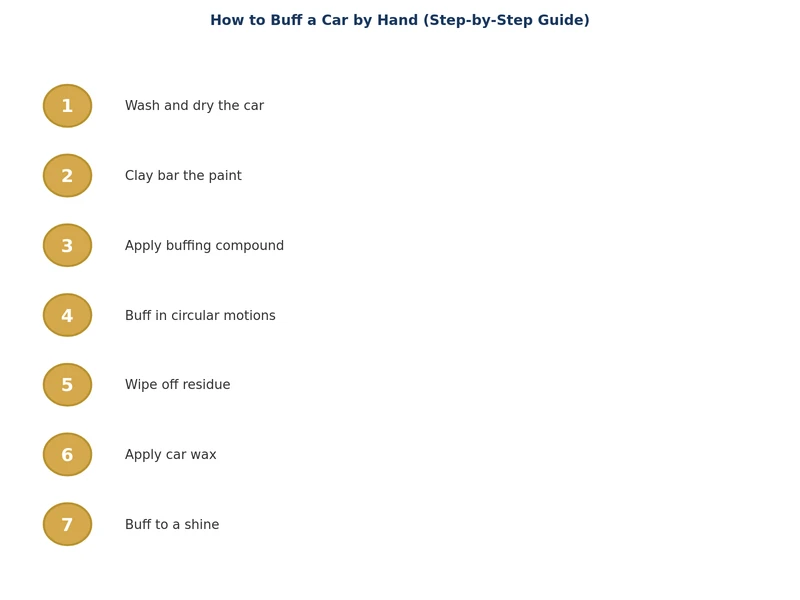
This is the most important technique tip. Divide the car into manageable panels — hood, roof, each door, trunk. Work one section completely before moving on. Use firm, overlapping passes:
Work the product until it becomes nearly clear and the area looks hazier (that haze buffs off easily). Avoid circular motions — they introduce new swirl marks, which is exactly what you are trying to eliminate. If you already have swirl marks to address afterward, visit our guide on how to remove swirl marks by hand.
Using a clean, dry microfiber towel, wipe off the dried residue with light pressure. Flip the towel frequently to a clean side — a residue-loaded towel will smear the product and dull the finish. Inspect under your light. If scratches or oxidation remain, do a second pass with fresh product on a clean pad.
Choosing the right product is critical. Using a cutting compound on perfect paint is unnecessary and removes more clear coat than needed. Using a finishing polish on deep scratches will not fix them. Use this table as a guide:
| Product Type | Abrasiveness | Best For | Clear Coat Removal |
|---|---|---|---|
| Cutting Compound | High | Deep oxidation, heavy scratches, paint transfer | Most — use sparingly |
| Car Polish | Medium | Light scratches, mild oxidation, swirl marks | Moderate |
| Finishing Polish | Low | Fine swirls, water spots, pre-wax prep | Minimal |
| All-in-One Polish | Low–Medium | Light defects + some protection in one step | Low |
According to Wikipedia's overview of automotive paint, modern vehicles use a basecoat/clearcoat system where the clear coat is typically 40–60 microns thick. Each polish or compound pass removes a small amount of this layer, so it is important to use the least abrasive product that gets the job done.
Direct sunlight heats the paint surface and causes compound to dry too quickly, making it harder to work and leaving streaks. An overcast day or a shaded garage is ideal. If you must work in sun, do very small sections at a time and keep the surface cool.
Dried compound caked into your foam pad becomes an uneven abrasive that can cause marring. Rinse foam pads with clean water during breaks, squeeze dry, and replace them if they tear or harden. Use a separate pad for each product — never use a compound pad for wax.
Buffing removes existing wax protection along with paint defects. A freshly polished surface is exposed and vulnerable to UV, moisture, and contaminants. Always follow buffing with a quality wax or sealant. If you are unsure about frequency, read our guide on how often you should wax your car.
Press firmly enough to slightly compress the foam pad — roughly 10–15 lbs of pressure. Too light and the abrasives do not engage the paint. Too heavy and you risk burning through the clear coat on edges, corners, and body lines. Be especially careful on raised panel edges.
Once you have finished polishing, follow these final steps to protect your work:
Hand buffing is effective for light to moderate defects. For heavy scratches, paint chips, or large areas of severe oxidation, a dual-action machine polisher will produce faster and more consistent results with less fatigue — but the technique principles remain the same.
Yes. Hand buffing is effective for light scratches, mild oxidation, water spots, and swirl marks. It requires more effort than a machine polisher but gives you excellent control, especially on small areas or delicate paint. Use a quality foam applicator pad and work in straight overlapping passes.
The terms are often used interchangeably, but polishing typically refers to using a fine abrasive to refine the paint surface, while buffing refers to the physical action of working a product into the paint and removing residue. In practice, buffing a car by hand usually involves both polishing and finishing steps.
For most vehicles, once or twice a year is sufficient for maintenance polishing. Buffing more frequently than needed removes clear coat unnecessarily. If you maintain good washing habits and apply wax regularly, you will need to polish less often.
Hand buffing can only remove scratches that sit within the clear coat layer. If a scratch has cut through to the base coat or primer, polishing will not fix it — you will need touch-up paint or professional repair. Test by running your fingernail across the scratch: if it catches, the scratch is likely too deep for hand buffing alone.
Straight-line, back-and-forth motion is better. Circular buffing motions introduce swirl marks into the paint surface — the same circular scratches visible in sunlight on poorly maintained cars. Work in straight, overlapping passes for a swirl-free finish.
Yes, always. Polishing and compounding remove the existing wax or sealant along with paint defects. Leaving freshly polished paint unprotected exposes it to UV damage, oxidation, and environmental contaminants. Apply a coat of carnauba wax or synthetic paint sealant immediately after polishing.
 |
 |
 |
 |

About Joshua Thomas
Joshua Thomas just simply loves cars and willing to work on them whenever there's chance... sometimes for free.
He started CarCareTotal back in 2017 from the advices of total strangers who witnessed his amazing skills in car repairs here and there.
His goal with this creation is to help car owners better learn how to maintain and repair their cars; as such, the site would cover alot of areas: troubleshooting, product recommendations, tips & tricks.
Joshua received Bachelor of Science in Mechanical Engineering at San Diego State University.


Get some FREE car parts & gear.. Or check out the latest free automotive manuals and build guides here.
Disable your ad blocker to unlock all the hidden deals. Hit the button below 🚗
| | | |
