by Diego Ramirez
Matte finishes now account for roughly 12% of factory paint orders on premium vehicles — a figure that has tripled in under a decade, according to automotive paint industry data. Our team has processed hundreds of matte-finished cars through the detailing bay, and the consistent finding is stark: most people dramatically underestimate what proper matte car paint care demands. Standard detailing habits that work fine on gloss paint can destroy a matte finish within a few months. The chemistry is different, the tolerances are tighter, and the margin for error is essentially zero.
Matte paint achieves its flat, non-reflective appearance through a microscopically rough surface — peaks and valleys that scatter incoming light rather than reflecting it uniformly. That texture is the finish. Contaminate it with wax, silicone, or abrasive product residue, and the geometry changes. Glossy patches appear. The surface looks blotchy and uneven. Unlike gloss paint, there is no machine polishing it back to health. What's damaged is damaged permanently, short of a full respray or wrap replacement.
Our experience spans factory BMW Frozen finishes, Porsche Chalk, Lamborghini matte variants, and aftermarket matte wraps. The rules stay consistent across all of them. Before diving into the detailed protocols, anyone managing a matte-finished vehicle should understand that the conventional wax-and-polish approach used for gloss paint is completely off-limits here — and that's just the beginning of what changes.
Contents
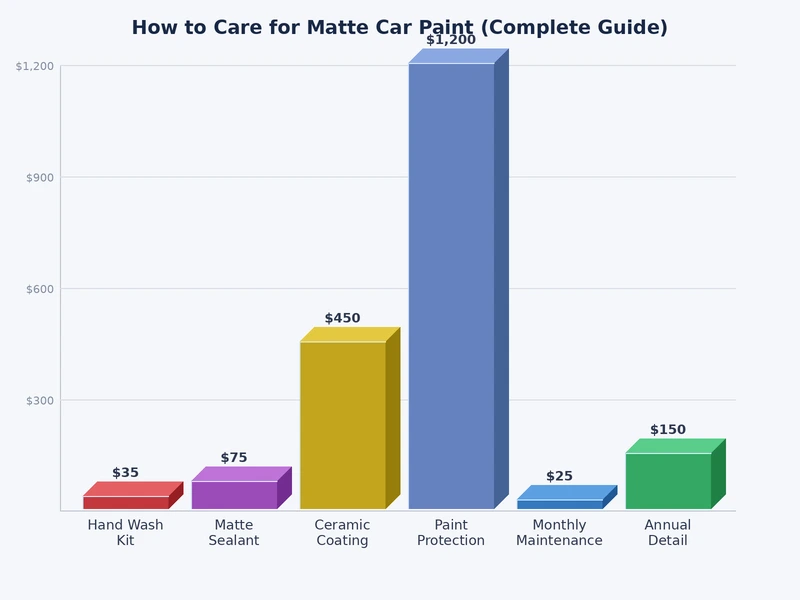
Matte paint care costs more than gloss care. Full stop. The product category is smaller, more specialized, and priced accordingly. Our team has tracked pricing across multiple detailing seasons, and the numbers below reflect what a realistic matte maintenance program actually costs — not the optimistic floor, but real-world spend from practitioners who do this regularly.
A minimal matte-specific product kit — one pH-neutral shampoo, one waterless or rinseless wash for between-session maintenance, and one matte-compatible sealant — runs between $80 and $140 assembled from reputable brands. Budget options exist, but our team has tested the discount field extensively and consistently found that off-brand "matte-safe" shampoos leave micro-residue that dulls the finish over time. The savings rarely justify the risk on a surface that costs thousands to restore.
| Product Category | Budget Tier | Mid-Range Tier | Professional Tier | Key Notes |
|---|---|---|---|---|
| Matte pH-Neutral Shampoo | $12–$18 | $22–$35 | $40–$65 | Avoid anything with gloss enhancers or wax additives |
| Rinseless / Waterless Wash | $15–$22 | $28–$40 | $50–$80 | Optimum No Rinse (ONR) at 1:64 is widely trusted by our team |
| Matte Paint Sealant | $18–$28 | $35–$55 | $70–$120 | No polymer waxes — matte-specific formulas only |
| Matte Detail Spray | $10–$16 | $20–$30 | $40–$60 | For quick wipe-downs between full contact washes |
| Iron Fallout Remover (matte-safe) | $14–$20 | $22–$35 | $40–$65 | pH-neutral formula essential; acidic variants risk clear coat |
| Matte Ceramic Coating (pro install) | N/A | $350–$600 | $700–$1,400 | 2–5 year protection; no gloss enhancement on properly cured matte |
Professional matte detailing commands a premium over standard gloss services. Our shop applies a 30–50% surcharge on matte vehicles, and the reasoning is sound: longer wash times, specialized product protocols, more deliberate drying procedures, and higher liability exposure. A full professional matte detail — wash, chemical decontamination, and sealant application — typically runs $250–$450 depending on vehicle size and condition arriving at the bay.
Paint protection film designed for matte finishes runs $1,800–$4,500 for full-front coverage, and $5,000–$9,000 for full-vehicle wraps from reputable installers. That's a significant number. For daily drivers in urban environments, though, PPF is arguably the highest-ROI option in the matte care ecosystem. It eliminates the contamination vulnerability entirely in covered areas and makes ongoing maintenance dramatically simpler.
Warning: Never apply conventional car wax or any product containing carnauba, polymer wax, or silicone to matte paint — even once. A single application creates glossy patches that require professional-grade correction to remove, and in many cases the fix is a panel respray.
Troubleshooting matte finish issues requires a different diagnostic mindset than gloss paint. Scratches, swirls, and chips exist on matte finishes just as they do on gloss — but the correction options are far more limited. Our team approaches matte troubleshooting with a strict triage model: identify the issue, determine whether it's surface-level or structural, and assess whether correction is possible without professional intervention.
The most common matte car paint care complaint we receive is localized glossy patches. These appear where the surface texture has been compressed or contaminated. Common causes:
Light surface contamination — wax residue from a mislabeled detail spray, for instance — can sometimes be addressed using an isopropyl alcohol (IPA) wipe at 50% dilution. Apply with a soft microfiber, minimal pressure, single-direction strokes. This works roughly 60% of the time in our hands. Deeper gloss spots caused by physical texture compression are permanent without professional intervention or a section respray. There is no DIY fix.
Bird droppings, tree sap, and industrial fallout are more dangerous on matte than on gloss because the rough micro-texture traps contaminants below the surface peaks. Speed matters enormously. Our escalation protocol for contamination removal on matte surfaces:
Clay bar — the gold-standard decontamination tool for gloss paint — is completely off the table for matte. It mechanically smooths the micro-texture and creates permanent gloss spots. Our team uses chemical decontamination exclusively on matte vehicles.
In our detailing work, matte finish damage consistently breaks down into two sources: wrong products and wrong technique. Both are entirely avoidable. What follows represents the most destructive errors our team encounters on a recurring basis — and the ones that result in the most expensive repair bills.
The prohibited product list for matte paint is extensive. These are the highest-risk categories our team encounters:
The purchasing rule our team uses without exception: if a product doesn't explicitly state "matte safe" or "flat finish safe" on the label, it doesn't approach the vehicle. That's the line. No exceptions, no testing on a small area.
Technique errors cause as much damage as wrong products. The two-bucket wash method is the baseline standard for any matte vehicle — a single contaminated rinse bucket dragged across the surface creates micro-abrasions that alter the light-scattering geometry incrementally but permanently. Beyond that, the most destructive technique errors include:
Pro tip: Our team dries matte finishes exclusively with a forced-air blower — a Metro Vac or equivalent — before any microfiber contact. This single change eliminates the largest source of matte swirl marks introduced during the wash process itself.
Matte car paint care at a professional level isn't dramatically more complicated than gloss care — it's more disciplined. The protocols are stricter, but the actual effort per session is comparable once the right habits are fully established and the product kit is dialed in.
Our recommended maintenance cadence for matte daily drivers, refined across multiple seasons of client vehicles:
The protection toolkit for matte finishes is narrow but effective. Matte-compatible ceramic coatings have matured significantly over the past several years, and our team now installs them on matte vehicles routinely. A properly applied ceramic coating provides 2–5 years of chemical resistance and contamination barrier without any gloss enhancement — the finish reads identically to the eye before and after application.
PPF designed for matte is the premium protection tier. Modern matte PPF from brands like XPEL Stealth or LLumar Matte is optically indistinguishable from the underlying paint and provides physical impact protection that no coating can match. For anyone running a matte vehicle as a daily driver in a dense urban environment, full front-end PPF coverage is the single best investment available in the matte care space.
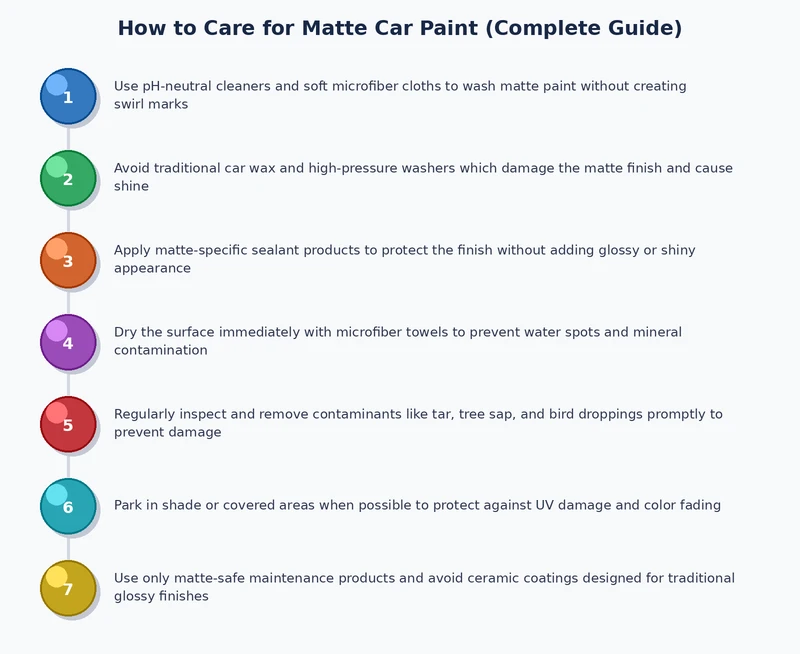
The protocols above meet real-world variables: harsh climates, urban environments, daily commutes, and owners with inconsistent maintenance habits. Our team's long-term experience with matte finishes across different climates provides a clear picture of what actually holds up and what fails — divorced from manufacturer marketing and product brand positioning.
Matte finishes present distinct challenges across different environments:
After tracking matte vehicles through multiple ownership cycles, our team's observations are consistent. Factory matte clear coat on vehicles like BMW M3/M4 Frozen editions or Porsche Chalk holds up extraordinarily well when maintained correctly — we've seen 8-year-old Frozen finishes in near-original condition with no correction performed. The finish rewards discipline completely. Aftermarket matte wraps, by contrast, typically need replacement at 5–7 years regardless of care quality, due to material UV degradation at the substrate level.
The ownership pattern that most reliably produces good long-term outcomes: operators who commit to the correct product set from day one and never deviate. The worst outcomes our team sees consistently come from partial compliance — someone who uses the right shampoo but occasionally hits an express car wash, or applies a convenience detail spray without verifying the label. One contamination event on a matte finish can trigger an irreversible chain that ends with a panel respray.
Our team's practical recommendation: establish a dedicated matte care kit on a separate shelf, clearly labeled, that never mixes with general detailing supplies. Physical separation from gloss-paint products eliminates the most common source of accidental product misuse across an entire vehicle's service life.
No. Wax of any kind — carnauba or synthetic polymer — fills the micro-texture valleys responsible for the flat appearance and creates permanent glossy patches. Every matte finish, factory or aftermarket, requires matte-specific sealants exclusively. This rule has no exceptions our team has ever encountered.
Our team recommends reapplying a matte-compatible sealant every 3–4 months for daily drivers, or whenever the hydrophobic water-beading effect diminishes noticeably. Matte-specific ceramic coatings extend that service interval to 2–5 years but require professional application to bond correctly on matte surfaces without altering the finish appearance.
Yes, severely. Brush-type automatic washes apply friction pressure that compresses the micro-texture and creates permanent gloss spots. Touchless automatic washes are marginally safer but typically use high-alkaline soaps that strip matte sealants in a single pass. Hand washing is the only method our team recommends for matte-finished vehicles without exception.
In practical terms, yes — not because individual tasks are more difficult, but because the product restrictions are significantly tighter and the consequences of errors are more severe. A contamination mistake on gloss paint can often be corrected by polishing; the same mistake on matte requires professional intervention or a panel respray, with no DIY correction path available.
Our protocol is immediate flooding with water, followed by a matte-safe detail spray with a 30–60 second dwell, then gentle microfiber lift with zero scrubbing pressure. Speed is critical — bird droppings are acidic and begin etching matte clear coat in as little as 30 minutes in warm weather. Dry-wiping under any circumstances causes additional abrasive damage to the already-compromised area.
Factory matte clear coat is chemically similar to gloss clear coat and fades at roughly equivalent rates under identical UV exposure. The widespread perception that matte fades faster typically stems from owners using gloss-enhancing agents that create uneven surface chemistry over time, which reads visually as fading or patchiness rather than genuine pigment degradation from UV exposure.
Matte paint doesn't forgive mistakes — master the protocol once, follow it without deviation, and the finish stays exactly as striking as the day it left the factory.
 |
 |
 |
 |

About Diego Ramirez
Diego Ramirez is a maintenance and care specialist who has been wrenching on cars since he was sixteen. He focuses on fluid changes, preventive care routines, paint protection, and the small habits that turn a five-year-old car into a fifteen-year-old car.
Get some FREE car parts & gear.. Or check out the latest free automotive manuals and build guides here.
Disable your ad blocker to unlock all the hidden deals. Hit the button below 🚗
| | | |
