by Joshua Thomas
Knowing how to check tire pressure is one of the simplest yet most impactful maintenance tasks you can perform. Properly inflated tires improve fuel economy, extend tire life, and keep your vehicle handling safely. Yet studies from the National Highway Traffic Safety Administration (NHTSA) show that a large percentage of vehicles on the road have at least one significantly under-inflated tire. This guide walks you through the entire process — from reading your door placard to adding air at a gas station pump — so you can keep your tires in peak condition year-round. For a broader look at keeping your car in top shape, see our vehicle maintenance guide.
Contents
Tires are the only part of your vehicle that contacts the road. When pressure is off — even by a few PSI — the contact patch changes, handling suffers, and wear accelerates unevenly.
Under-inflated tires flex excessively, generating heat that can lead to blowouts at highway speed. Over-inflated tires reduce the contact patch, making it harder to brake and corner on wet roads. Either condition increases stopping distance and reduces steering response.
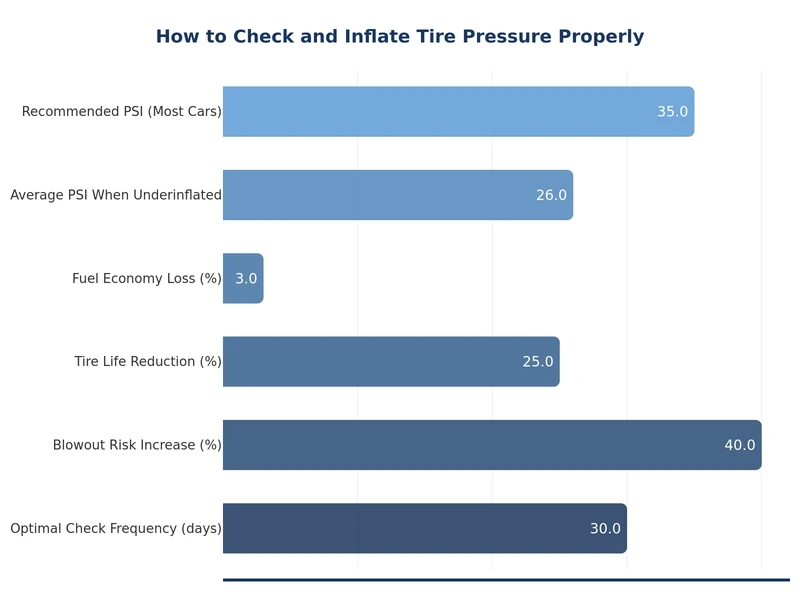
Running tires just 10 PSI below the recommended level can reduce fuel economy by 1–2%. Under-inflation also causes the tire shoulders to wear faster, shortening tire life significantly. Maintaining correct pressure is one of the easiest ways to save money on both fuel and replacements.
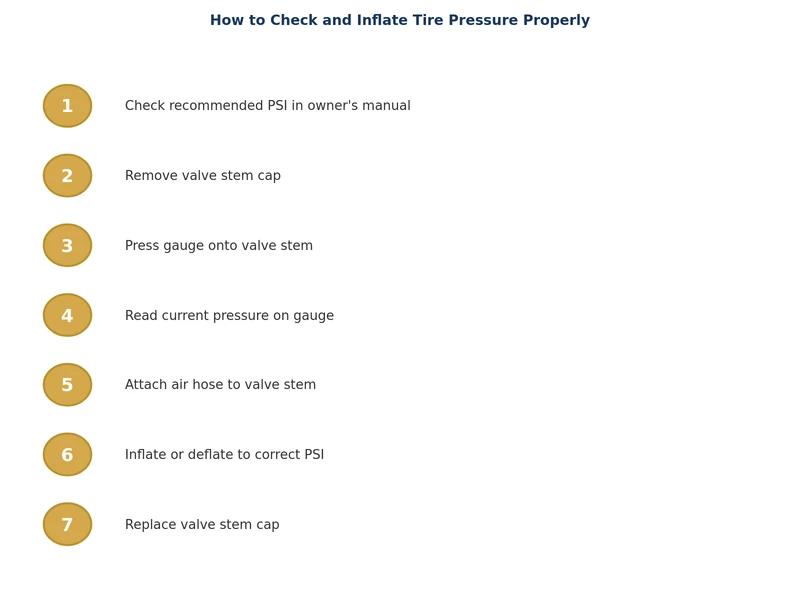
Learning how to check tire pressure correctly takes about five minutes once you have the right tool. The process is the same whether you use a pencil-style, dial, or digital gauge.
The correct tire pressure is set by the vehicle manufacturer, not the tire maker. Always follow the specification for your car, not the maximum PSI printed on the tire sidewall — that number is the tire's maximum safe limit, not the recommended operating pressure.
| Vehicle Type | Typical Front PSI | Typical Rear PSI | Notes |
|---|---|---|---|
| Compact / sedan | 32–36 PSI | 30–35 PSI | Front and rear often differ by 2–4 PSI |
| SUV / crossover | 33–40 PSI | 33–40 PSI | Heavier vehicles tend toward higher PSI |
| Pickup truck | 35–45 PSI | 50–80 PSI (loaded) | Rear PSI increases significantly under load |
| Sports car | 36–42 PSI | 38–44 PSI | Performance tires may need higher pressure |
| Compact spare ("donut") | 60 PSI | Always check — spares lose pressure in storage | |
Always defer to your door jamb sticker over this table. If you've recently replaced your tires with a different size, consult a tire shop for the correct specification.
If a tire is over-inflated, use the small pin in the center of the valve stem to release air. Most tire gauges have a bleed valve on the back for this purpose. Press briefly and re-check until you reach target PSI.
A 12V tire inflator plugs into your car's power outlet and can inflate a standard passenger tire in 3–5 minutes. These are invaluable for emergencies and for topping off pressure without driving to a gas station. Look for models with an auto-shutoff feature that stops inflation at a preset PSI to prevent over-inflation.
Most manufacturers recommend checking tire pressure at least once a month and before any long road trip. Tires naturally lose 1–2 PSI per month even without a slow leak, so monthly checks catch gradual deflation before it becomes a safety issue.
Temperature has a direct effect on tire pressure. For every 10°F drop in temperature, tires lose approximately 1 PSI. This means a tire inflated correctly in summer may be 4–6 PSI low by midwinter without a single leak. Check pressure every time the outside temperature drops significantly, especially when the cold season begins. If you store a car for winter, inflate the tires to the door-jamb specification before parking it long-term.
Most vehicles made after 2008 are equipped with a Tire Pressure Monitoring System (TPMS) that illuminates a warning light when a tire drops roughly 25% below recommended pressure. That threshold is significant enough to damage the tire — don't wait for the light. Manual monthly checks catch pressure drops well before the TPMS triggers.
Tire condition goes hand in hand with pressure. Once you've confirmed your pressures are correct, take a minute to check your tire tread depth — worn tires don't perform safely even when properly inflated. And if it has been a while since your last service, consider whether it's time to rotate your tires at home to even out wear patterns.
After highway driving, tire pressure rises 4–8 PSI above the cold reading. If you top off a hot tire to the door-jamb specification, it will be significantly under-inflated once it cools. Either check before driving or wait at least three hours after stopping.
The "Max Press" number on the tire sidewall is an engineering limit, not a recommendation. Running tires at maximum sidewall pressure creates a harsh ride, accelerates center-tread wear, and reduces grip on uneven surfaces.
A compact spare sitting in your trunk for years loses pressure silently. Check it every time you check your main tires. Most compact spares require 60 PSI — far higher than regular tires — so keep a gauge handy before you need it in an emergency.
Valve cores are tiny metal pins sealed with a rubber gasket. Dirt and moisture compromise that seal over time, causing slow leaks. Always replace caps after checking pressure, and replace damaged or missing caps promptly.
The correct PSI is listed on a sticker inside your driver's door jamb and in your owner's manual. It is set by the vehicle manufacturer and varies by model — most passenger cars fall between 32 and 36 PSI front and rear, but always confirm with your specific door-jamb sticker rather than using a generic number.
It is best to check tire pressure when tires are cold — meaning you have driven less than one mile. Heat from driving raises pressure by 4–8 PSI and gives a falsely high reading. If you must check hot tires, add 4 PSI to the recommended cold PSI as a rough target, then recheck once the tires cool fully.
Over-inflated tires have a smaller contact patch with the road, which reduces traction and braking performance. The center tread wears faster than the edges, shortening tire life. The ride also becomes noticeably harsher because the tire cannot absorb road imperfections as effectively.
Under-inflated tires flex excessively, building up heat that can cause a blowout at speed. Fuel economy drops, handling becomes sluggish, and the outer edges of the tread wear prematurely. Driving on significantly under-inflated tires even for short distances can cause internal structural damage that is not visible from the outside.
Yes — for every 10°F drop in ambient temperature, tire pressure falls approximately 1 PSI. A tire correctly inflated in summer can easily be 4–6 PSI low by the first cold snap of winter without any leak. Check and adjust pressure at the start of cold weather and whenever temperatures drop significantly.
Yes, gas station air compressors work well. Bring your own tire pressure gauge rather than relying on the station's gauge, which is often inaccurate from heavy use. Add air in short bursts and check pressure with your gauge between bursts to avoid over-inflation. Many modern stations offer digital preset pumps that stop automatically at a chosen PSI.
 |
 |
 |
 |

About Joshua Thomas
Joshua Thomas just simply loves cars and willing to work on them whenever there's chance... sometimes for free.
He started CarCareTotal back in 2017 from the advices of total strangers who witnessed his amazing skills in car repairs here and there.
His goal with this creation is to help car owners better learn how to maintain and repair their cars; as such, the site would cover alot of areas: troubleshooting, product recommendations, tips & tricks.
Joshua received Bachelor of Science in Mechanical Engineering at San Diego State University.


Get some FREE car parts & gear.. Or check out the latest free automotive manuals and build guides here.
Disable your ad blocker to unlock all the hidden deals. Hit the button below 🚗
| | | |
