by Joshua Thomas
Knowing how to check tire tread depth is one of the simplest, most important safety checks any driver can perform. Worn tires lose grip on wet roads, extend stopping distances, and raise the risk of sudden blowouts. The best part? Checking your tread takes under two minutes and requires nothing more than a coin. Make it part of your regular vehicle maintenance routine and you'll always know where your tires stand.
According to the National Highway Traffic Safety Administration (NHTSA), tire failure contributes to thousands of crashes every year — most of them preventable with routine inspection. This guide covers every reliable method for measuring tread depth, explains what the readings mean, and tells you exactly when replacement can't wait.
Contents
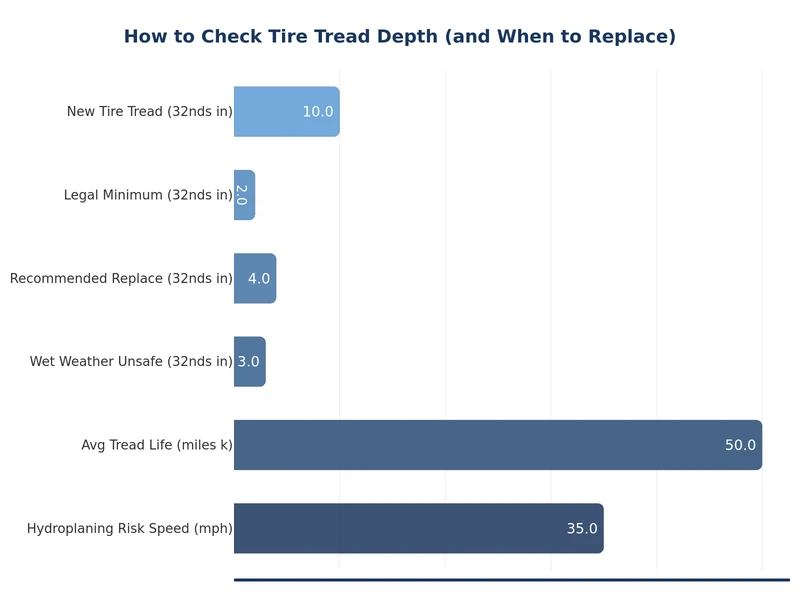
Tread grooves do one critical job: they channel water away from the contact patch so the rubber maintains grip on wet pavement. When those grooves are shallow, water builds up between the tire and the road — a phenomenon called hydroplaning. At highway speeds, even a brief loss of contact can mean loss of steering control.
The deeper your tread, the shorter your stopping distance on wet roads. Tests consistently show that a tire worn to 2/32 inch — the legal minimum in most states — takes roughly 100 feet longer to stop from 70 mph on wet pavement compared to a new tire at 10/32 inch. That extra distance is often the difference between a near-miss and a crash.
Most U.S. states set the legal minimum tread depth at 2/32 inch (1.6 mm). Driving on tires below this threshold can result in a fine and may void your insurance coverage in the event of an accident. Some states and many European countries set the bar higher for winter conditions. Always check local regulations if you're unsure.
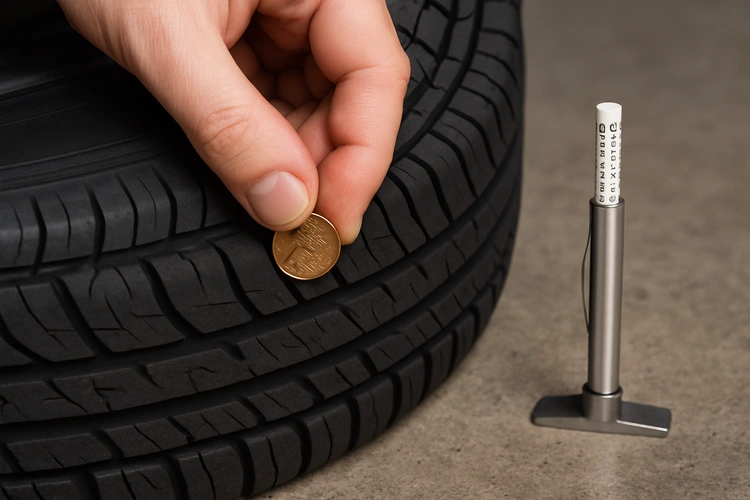
You don't need specialized equipment to learn how to check tire tread depth. Three methods range from quick visual checks to precise measurement, and each takes just a moment per tire.
The penny test is the most widely known method:
Result: If you can see the top of Lincoln's head (the space above his hairline), your tread is at or below 2/32 inch — replacement is urgent. If part of his head is hidden by the tread, you still have some life left, but move to the quarter test for a more nuanced reading.
Test multiple grooves across the tire width and in several spots around the circumference. Uneven wear can hide a problem if you only check one spot.
The quarter test gives you an earlier warning:
At 4/32 inch you're not yet at the legal limit, but wet-road performance is already noticeably compromised. Plan for replacement soon rather than waiting until the penny test fails. This is a smarter threshold to act on, especially if you drive in rain or use the same tires year-round.
For the most accurate reading, a tread depth gauge costs a few dollars and fits in a glove box. Digital versions are the easiest to read:
Record your readings. Comparing measurements over several months tells you how fast your tires are wearing, which helps you plan the replacement before you're caught off guard.
Tread depth is measured in 32nds of an inch in the U.S. and in millimeters elsewhere. The table below shows what each range means for safety and what action to take.
| Tread Depth (32nds) | Tread Depth (mm) | Condition | Recommended Action |
|---|---|---|---|
| 10/32" or more | 7.9 mm+ | New / Excellent | No action needed — check every 3 months |
| 7–9/32" | 5.6–7.1 mm | Good | Monitor regularly, rotate on schedule |
| 5–6/32" | 4.0–4.8 mm | Adequate | Watch closely; budget for replacement |
| 4/32" | 3.2 mm | Marginal | Plan replacement — wet grip is reduced |
| 2–3/32" | 1.6–2.4 mm | Worn | Replace immediately — legal limit or near it |
| Below 2/32" | Below 1.6 mm | Unsafe / Illegal | Do not drive — replace without delay |
New passenger tires typically start between 9/32 and 11/32 inch. Performance and summer tires sometimes start shallower — always check the manufacturer's specification for your specific tire model.
Tread depth is the primary metric, but it isn't the only reason to replace a tire. Look for these additional warning signs during any inspection.
Every modern tire has molded wear indicator bars sitting at 2/32 inch inside the main grooves. When tread wears down to those bars, they become flush with the surrounding rubber — a clear visual signal that the tire has reached its legal limit. No tools required; just look into the groove.
Center wear suggests chronic over-inflation. Edge wear points to under-inflation. One-sided shoulder wear usually means a wheel alignment problem. Cupping or scalloping across the tread often indicates worn shocks or struts. Uneven wear accelerates the retirement of a tire regardless of average depth, and the underlying cause should be corrected before fitting new tires.
Rubber degrades over time even without use. Sidewall cracking, blistering, or visible bulges are structural warning signs that demand immediate replacement — a bulge especially, as it indicates internal belt separation and the tire can fail without warning. Most manufacturers recommend replacing tires older than six years regardless of tread depth, and no tire should remain in service past ten years from its manufacture date (found as a four-digit DOT code on the sidewall).
Just as you'd check your brake fluid level during a routine safety inspection, tire condition should be on the same checklist — both directly affect your ability to stop in an emergency.
Replacing tires early is expensive. A few simple habits can add thousands of miles to a set.
Pressure is the single biggest factor in tread wear. Under-inflated tires flex excessively, generate heat, and wear the outer edges rapidly. Over-inflated tires ride on the center strip and wear it faster. Check pressure monthly when tires are cold, and always match the specification on the driver's door jamb — not the maximum pressure printed on the tire sidewall.
Front tires wear faster than rears on front-wheel-drive vehicles because they handle both steering and power delivery. Rotating all four tires every 5,000 to 7,500 miles (or at every oil change) equalizes wear and extends the life of the full set.
A wheel alignment ensures all four tires point in the correct direction. Even a slight misalignment causes rapid, uneven shoulder wear. Wheel balancing prevents vibrations that create cupping patterns. Both should be checked annually or after any significant pothole impact.
If you're storing a vehicle for winter, park on a flat surface and inflate tires to the recommended pressure before storage. Avoid leaving a car stationary for months without moving it, as flat spots can develop. Keeping tires out of direct UV light and away from ozone sources such as electric motors also slows rubber degradation.
Tires are just one piece of overall vehicle safety. Check your windshield wiper blades at the same time — worn blades reduce visibility in rain, compounding the grip problems that worn tires create.
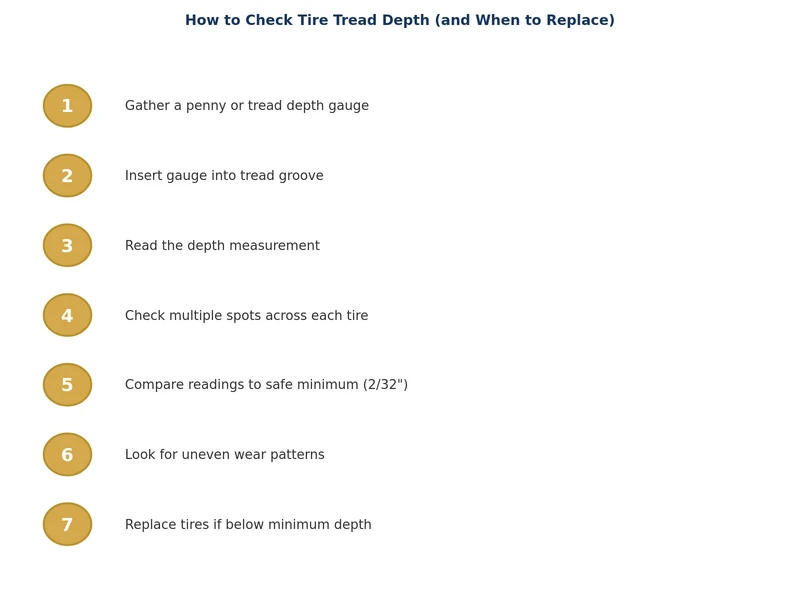
The legal minimum in most U.S. states is 2/32 inch (1.6 mm), but safety organizations recommend replacing tires at 4/32 inch (3.2 mm) because wet-road braking performance degrades significantly before the legal limit is reached.
Check tread depth at least once every three months, before long road trips, and at every oil change. Monthly checks take less than two minutes and let you spot rapid wear caused by alignment or inflation problems early.
Yes. A penny or quarter is enough to check all four tires. Insert it into the deepest groove on each tire in multiple spots around the circumference to account for uneven wear. For precise numbers, a tread depth gauge is more reliable and inexpensive.
No. Most new passenger tires start between 9/32 and 11/32 inch, but performance tires and some summer tires may start as shallow as 7/32 inch. Check the specification sheet for your specific tire model to know the starting depth.
Not always immediately, but uneven wear means you should investigate the cause — usually improper inflation, misalignment, or worn suspension components — and plan replacement sooner. The underlying issue must be fixed before fitting new tires, or the new set will wear unevenly too.
Look for the DOT code on the tire sidewall. The last four digits indicate the manufacture date: the first two digits are the week of the year and the last two are the year. For example, "2319" means the 23rd week of 2019. Tires older than six years should be inspected by a professional, and tires over ten years old should always be replaced regardless of tread depth.
 |
 |
 |
 |

About Joshua Thomas
Joshua Thomas just simply loves cars and willing to work on them whenever there's chance... sometimes for free.
He started CarCareTotal back in 2017 from the advices of total strangers who witnessed his amazing skills in car repairs here and there.
His goal with this creation is to help car owners better learn how to maintain and repair their cars; as such, the site would cover alot of areas: troubleshooting, product recommendations, tips & tricks.
Joshua received Bachelor of Science in Mechanical Engineering at San Diego State University.


Get some FREE car parts & gear.. Or check out the latest free automotive manuals and build guides here.
Disable your ad blocker to unlock all the hidden deals. Hit the button below 🚗
| | | |
