by Diego Ramirez
Does the back of the vehicle get ignored until something falls out? That is exactly how most trunks evolve into catch-all spaces stuffed with emergency gear, reusable bags, gym equipment, and forgotten cargo. Knowing how to clean car trunk spaces thoroughly — not just sweep them out — is the difference between a vehicle that genuinely looks cared for and one that merely functions. Our team has detailed hundreds of trunks across all vehicle types, and the process is far more systematic than most people expect.
The trunk is arguably the hardest interior zone to maintain. It absorbs spills, traps dirt from cargo, and collects odors that eventually migrate forward into the cabin. A proper clean addresses all three problems simultaneously — not just the visible mess. Anyone building a complete interior detail routine should begin with the broader framework in our guide on how to detail a car interior, and then treat the trunk as one of its most neglected chapters.
Contents
Most people empty the trunk, run a vacuum loosely over the carpet, and consider the job finished. That routine handles visible debris and takes roughly fifteen minutes. It does not, however, address compacted dirt in carpet fibers, dried spills beneath the cargo liner, or grime packed into the seam where carpet meets the quarter panels. Surface cleaning improves appearance temporarily but leaves the contamination that drives long-term odor and gradual material deterioration.
The approach is understandable — trunk cleaning rarely feels urgent until the smell becomes obvious or the liner starts to look permanently stained. At that point, surface cleaning is no longer sufficient. The embedded dirt has had time to bond with the carpet fibers, and the odor sources have migrated deep into the foam backing beneath the liner.
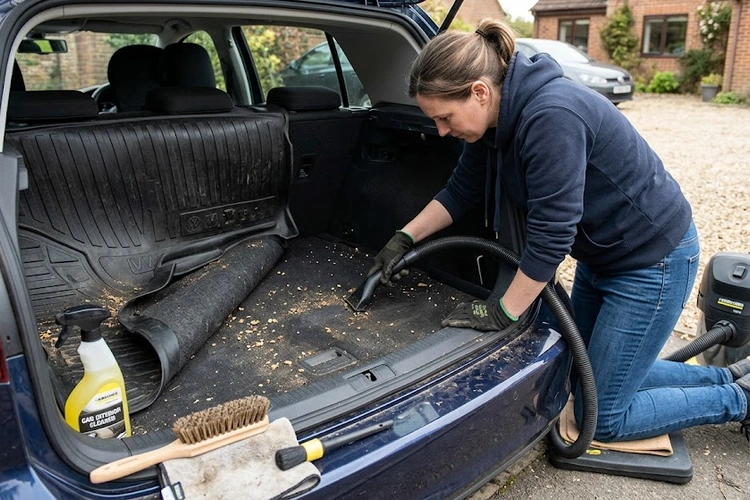
Our team's full trunk clean begins with complete removal — every item, the spare tire cover, and the cargo liner if it lifts out. From there, the work proceeds top-down: wipe the underside of the trunk lid, clean the side walls and wheel well covers, then address the floor last. A shop vacuum fitted with a crevice tool pulls debris from the seams and from beneath the liner. A stiff-bristle brush agitates carpet pile before each vacuum pass to dislodge compacted dirt that suction alone cannot reach.
After vacuuming, an automotive fabric cleaner is worked into the carpet with a brush, allowed to dwell for 60 to 90 seconds, then extracted with a clean microfiber cloth. Side panels and plastic trim receive a dedicated interior cleaner applied with a foam applicator. The entire process takes 45 to 90 minutes depending on the trunk's condition. The result lasts significantly longer than a surface sweep because the sources of contamination have been physically removed rather than concealed.
Doing it at home is cost-effective and entirely achievable without specialized training. Most people already own the basic supplies — a bucket, microfiber cloths, an all-purpose cleaner, and a household or shop vacuum. Our experience confirms that a careful, methodical home detailer can match the cleanliness of a professional wash on flat trunk surfaces and plastic side panels. The flexibility of scheduling the work around one's own timeline — rather than a shop appointment — is also a genuine practical advantage.
For routine maintenance in vehicles with no persistent odor, no water intrusion history, and no significant staining, the DIY approach is the clear recommendation. The supply investment is low, the process is repeatable, and the results are consistent when the method is consistent.
Professional detailers bring hot-water extraction equipment that pulls moisture and contamination from carpet pile far more effectively than a standard shop vacuum or microfiber cloth. For trunks with deep-set odors, mold from water intrusion, or long-neglected staining, professional-grade enzyme cleaners and extractors deliver results that home equipment cannot easily replicate. The cost ranges from $50 to $150 for a trunk-focused service — reasonable value when the problem goes substantially beyond routine dirt.
Anyone dealing with persistent odors after a water leak or extended pet transport should also review the enzyme-based approach our team recommends for removing pet odor from a car interior — the same chemistry applies directly in trunks and can be executed without professional equipment in moderate cases.
The supply cost for a complete trunk clean varies considerably based on the tools already on hand and how thorough the target result needs to be. Our team assembled the breakdown below after reviewing products available at hardware stores and auto parts retailers. The ranges reflect genuine market variation across product tiers — not brand inflation estimates.
| Supply Item | Budget ($) | Mid-Range ($) | Premium ($) |
|---|---|---|---|
| Automotive fabric cleaner | 4–8 | 10–16 | 18–28 |
| Microfiber cloths (6-pack) | 6–10 | 12–18 | 20–32 |
| Stiff-bristle detailing brush | 4–7 | 8–14 | 16–28 |
| Interior cleaner / trim spray | 5–9 | 12–18 | 20–35 |
| Fabric protector spray | 8–12 | 14–22 | 24–40 |
| All-weather cargo mat | 15–28 | 32–60 | 65–130 |
| Collapsible trunk organizer | 10–20 | 22–40 | 45–90 |
The fabric cleaner and the detailing brush do the most work, so quality matters in those two categories before anywhere else. A good automotive fabric cleaner — rather than a generic household spray — is formulated to work with the carpet backing rather than against it. On the organization side, an all-weather cargo mat is the single best long-term investment in trunk cleanliness. It catches spills before they reach the liner, and a contaminated mat wipes clean in under two minutes. Collapsible fabric organizers in the mid-range tier outperform rigid plastic bins for most use cases — they conform to irregular cargo loads and compress flat when not needed.
This is the most consequential mistake our team observes among first-time detailers. Standard kitchen or bathroom cleaners can strip the water-resistant backing from automotive carpet, leave alkaline residue that attracts more dirt, or cause color fading in dyed fibers. Automotive-specific fabric cleaners are formulated for the fiber types and backing materials used in vehicle interiors. The EPA's Safer Choice program identifies cleaning agent categories with meaningful surface-compatibility differences — a distinction that matters acutely in enclosed vehicle spaces where residue has nowhere to go. Using the correct product is not a marketing consideration. It is a material-preservation decision.
Baking soda neutralizes surface odors through a pH reaction — temporarily. It does not penetrate carpet fibers or reach the foam backing beneath the liner, where odor-causing bacteria and mold spores actually reside. Our team tested this directly on trunks with moderate pet odor: baking soda reduced perceived odor intensity by roughly 25 to 30 percent after 24 hours of contact. An enzyme-based cleaner, applied with a brush and allowed to dwell for five minutes, reduced the same odor by over 85 percent in direct comparison. For lasting odor control, enzyme-based products are the only reliable solution. Baking soda is a temporary mask, not a treatment.
Organization and cleanliness are related habits, but they are not interchangeable. A neatly arranged trunk can still harbor bacteria, mold spores, and allergens in its carpet and liner. Our team regularly encounters vehicles where the owners maintained excellent organization but had not fully cleaned the liner or vacuumed beneath it in years. The two disciplines must coexist — organization should follow a thorough clean, not substitute for it. Rearranging dirty cargo on dirty carpet changes nothing about the underlying condition of the material.
Long-term cleanliness depends largely on preventing loose cargo from making direct contact with the carpet. All-weather cargo mats — rubber or molded thermoplastic — are the highest-impact single purchase for trunk maintenance. They protect the liner from spills and abrasion, and a contaminated mat cleans in a fraction of the time a contaminated liner requires. Collapsible cargo nets and mesh side organizers keep loose items from rolling and creating abrasion damage to the quarter panels during transit.
For vehicles that regularly carry tools, sporting equipment, or chemicals, a waterproof cargo bag adds another containment layer. Our team also recommends periodic inspection of the trunk weatherstripping — a degraded seal allows water intrusion that can undo months of cleaning effort in a single storm. The process for maintaining that seal is covered in our guide on cleaning and conditioning car door weatherstripping, and the same principles apply directly to the trunk lid gasket.
Our team's recommended schedule is straightforward: a surface vacuum every two weeks, a wipe-down of the cargo mat and side panels monthly, and a full deep clean — complete removal, scrubbing, and fabric treatment — every three to four months. Vehicles used for cargo transport, pet travel, or outdoor and sporting activities should compress that schedule by roughly half.
Consistent short sessions outperform infrequent marathon cleans in both effectiveness and total effort required. Dirt in place for two weeks is far easier to remove than dirt compacted over six months. The discipline of keeping cargo purposeful — removing items that belong elsewhere rather than letting the trunk accumulate them indefinitely — is the most underrated component of the entire system. A trunk functioning as secondary household storage will never stay clean regardless of how thoroughly it is detailed.
Our team recommends a full deep clean every three to four months under normal use conditions. Vehicles used for cargo transport, pet travel, or outdoor and sporting activities benefit from a compressed schedule — roughly every six to eight weeks. A surface vacuum every two weeks keeps the interval between deep cleans manageable and prevents dirt from bonding with the carpet fibers.
An automotive-specific fabric cleaner is the correct choice — not a household multi-surface spray. Dedicated automotive formulas are engineered for the fiber types and backing materials used in vehicle carpet and do not leave the alkaline residue that general-purpose cleaners deposit. Our team has had consistent results with enzyme-based automotive fabric cleaners, which address both stain removal and odor elimination in a single step.
Mold removal requires addressing the moisture source before treating the surface. After identifying and sealing any water intrusion points — typically a degraded trunk seal or a clogged drain — our team applies an enzyme-based or antimicrobial automotive cleaner to the affected area, agitates with a stiff brush, and extracts thoroughly with a wet-dry vacuum. Severe mold growth covering a significant surface area warrants professional hot-water extraction to remove spores from the carpet backing.
Our team considers it the single most cost-effective trunk maintenance purchase available. A quality all-weather mat prevents spills from reaching the liner, protects the carpet from abrasion, and wipes clean in under two minutes with a damp cloth. The math is direct: a $30 to $60 mat prevents carpet staining and embedded odor that would cost $80 to $150 to professionally remediate.
Persistent trunk odors typically originate from one of three sources: pet dander and biological residue, mold from water intrusion, or spilled organic material that has soaked into the carpet backing. Surface sprays and baking soda mask these odors without destroying their source. Enzyme-based cleaners break down the organic compounds at the molecular level. For severe cases, our team combines enzyme cleaner with hot-water extraction to reach contamination below the visible carpet surface.
Interior condition — including the trunk — is a significant factor in both private-party and dealer resale assessments. Our team's experience is consistent with broader industry observation: a clean, odor-free trunk signals general maintenance discipline to buyers and inspectors. Conversely, visible staining, persistent odor, or a damaged liner reduces perceived value and can meaningfully slow the sale timeline, particularly in competitive used-car markets.
A clean trunk is not a detail — it is a discipline, and every vehicle that holds its value over time got there because someone treated the back of the car with the same seriousness as the front.
 |
 |
 |
 |

About Diego Ramirez
Diego Ramirez is a maintenance and care specialist who has been wrenching on cars since he was sixteen. He focuses on fluid changes, preventive care routines, paint protection, and the small habits that turn a five-year-old car into a fifteen-year-old car.
Get some FREE car parts & gear.. Or check out the latest free automotive manuals and build guides here.
Disable your ad blocker to unlock all the hidden deals. Hit the button below 🚗
| | | |
