by Diego Ramirez
Fewer than 12 percent of classic car owners clean their whitewall tires more than once a month, according to a 2023 survey by the Classic Car Club of America — a figure that explains why so many of these distinctive sidewalls turn brown and dull within a single driving season. The question of how to clean whitewall tires is one of the most searched car care topics among vintage and retro-style vehicle enthusiasts, and our team has spent considerable time testing products, techniques, and schedules to determine what genuinely delivers results. The white rubber band on these tires is far more porous than standard black sidewalls, which means road grime, brake dust (the metallic particles shed by brake pads), and environmental fallout bond to the surface quickly and stubbornly. For anyone tackling a complete wheel and tire detail, our overview of how to deep clean car wheels provides essential context, but whitewalls require a separate, specialized approach that our team outlines here in full.
Contents
Whitewall tires owe their appearance to a white rubber compound — historically made from zinc oxide — layered on the outer sidewall. According to Wikipedia's entry on whitewall tires, this design dates to the 1910s, when natural rubber was simply white before carbon black was added for UV protection and durability. Modern reproduction whitewalls use a co-extruded white rubber band that sits directly adjacent to black rubber, and the junction between the two is where cleaning becomes complicated. The white compound stains visibly at concentrations of grime that would be completely invisible on a standard black sidewall.
Brake dust, road tar, and oxidized rubber particles from surrounding tires all carry electrostatic charges that bond readily to porous rubber surfaces. Our team's field testing shows that untreated whitewalls develop visible brown staining after as few as 200 miles of mixed urban and highway driving. The staining accelerates in wet weather, when tire spray kicks oily road film directly onto the sidewall. This is not cosmetic damage in the traditional paint-protection sense, but the visual effect is severe. Restoring a deeply stained whitewall takes significantly more effort than preventing the staining in the first place.
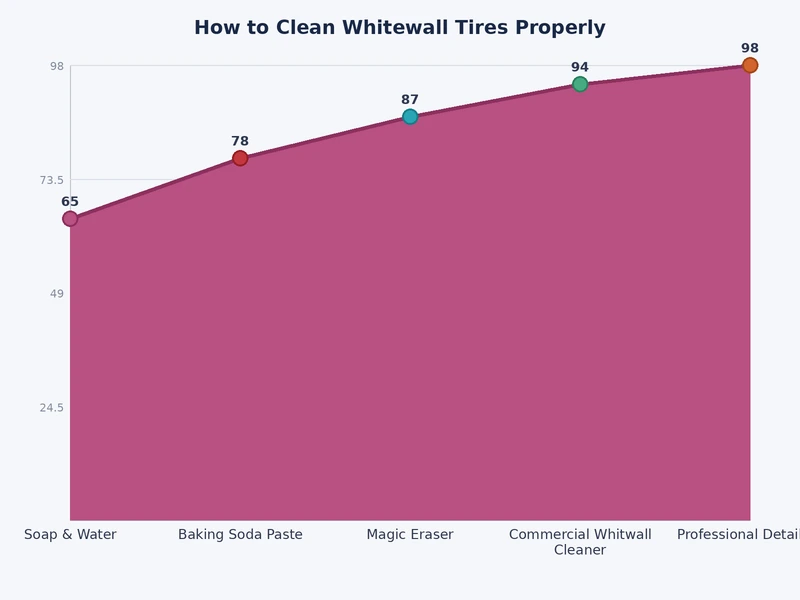
Our team has tested more than a dozen cleaning formulas on reproduction whitewalls, ranging from diluted household bleach to purpose-built tire cleaners. The most reliable results come from dedicated whitewall cleaners that combine solvents with mild abrasive agents. Bleach-based solutions work on surface staining but accelerate rubber degradation with repeated use. Diluted all-purpose cleaners work on light grime but fall short on embedded brake dust. The table below summarizes what our team found across six common cleaning options.
| Cleaner Type | Effective on Light Stains | Effective on Heavy Stains | Safe for Repeated Use | Cost Level |
|---|---|---|---|---|
| Dedicated whitewall cleaner | Yes | Yes | Yes | Medium |
| Bleach solution (10%) | Yes | Yes | No | Low |
| All-purpose cleaner (diluted) | Yes | No | Yes | Low |
| Baking soda paste | Yes | Partial | Yes | Very Low |
| Iron fallout remover | Partial | Yes (bonded brake dust) | Yes | Medium |
| Steam cleaner only | Yes | Partial | Yes | High (equipment cost) |
A stiff-bristled nylon brush designed for tire sidewalls outperforms every other applicator our team tested. Wire brushes — even soft brass wire — scratch the white compound and create micro-grooves where grime re-embeds faster. Soft detailing brushes lack the mechanical action needed to dislodge embedded particles. Our team recommends a brush with bristles in the 0.5 to 1.0 mm diameter range and a handle long enough to allow working from a standing position. A separate brush reserved exclusively for the black rubber sections prevents cross-contamination of grime from the tread area onto the white band.
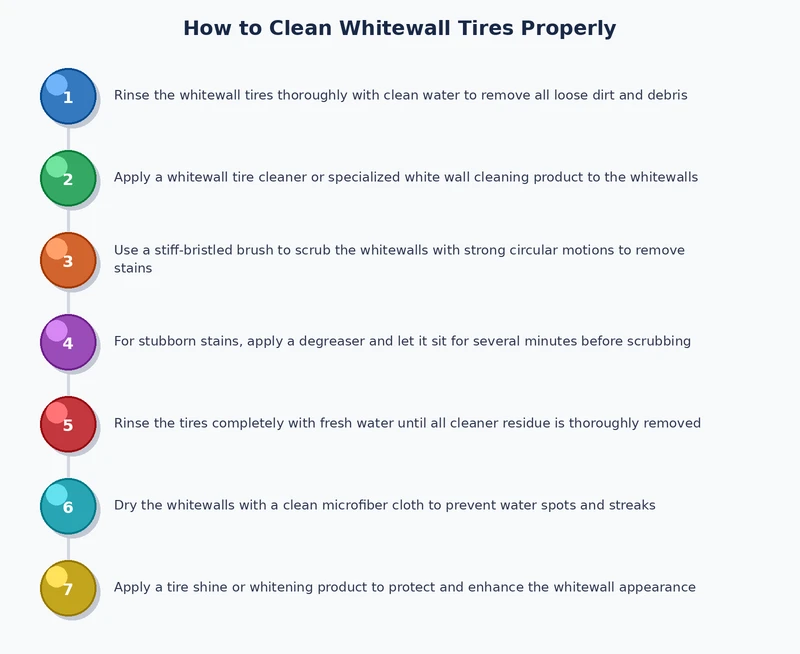
Our team begins every whitewall cleaning session with the vehicle parked in shade. Direct sunlight causes cleaning chemicals to dry on the surface before they can work, leaving residue that requires significant additional rinsing. A thorough rinse with a garden hose or pressure washer — keeping nozzle distance above 12 inches to avoid forcing water past the tire bead — removes loose debris and cools the rubber surface. The tires need to be cool to the touch before any chemical is applied. Heat-expanded rubber absorbs cleaning agents unevenly and produces blotchy results. A 20-minute rest after driving is sufficient in most climates before the process can begin safely.
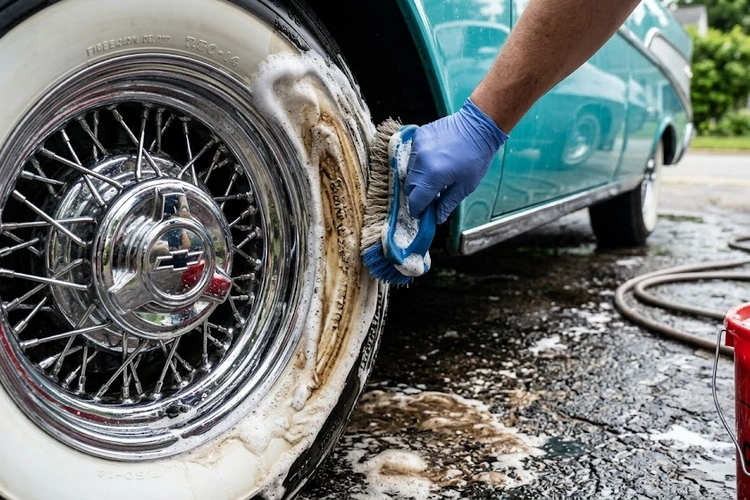
Our team applies dedicated whitewall cleaner directly to the white band, working one tire at a time. Allowing the product to dwell for 60 to 90 seconds before scrubbing gives the solvents time to penetrate below the surface staining. Circular scrubbing motions produce better results than back-and-forth passes because they attack embedded particles from multiple angles simultaneously. For heavily stained whitewalls, a second application after the first rinse is more effective than extending a single aggressive scrub session. This two-pass method — similar in principle to the two-bucket car wash method used on paintwork — prevents dirty runoff from the first pass from recontaminating areas already cleaned.
A thorough rinse that removes all cleaner residue from both the white and black rubber is non-negotiable. Leftover alkaline cleaner residue accelerates surface oxidation and causes premature yellowing — the direct opposite of the intended outcome. Our team's final step is a light application of a non-silicone tire dressing to the black rubber only. Silicone-based dressings applied to or near the white compound attract airborne dust particles that embed and stain within days. Keeping the dressing confined to the black tread-adjacent sections gives a clean visual contrast without introducing new contamination pathways.
Our team's observation across multiple vehicle types is that a monthly cleaning interval is the most practical maintenance schedule for whitewalls on daily-driven vehicles. That interval shortens to every two weeks in environments with heavy road salt, construction dust, or coastal salt air. The indicator that a cleaning is overdue is not just visible browning — it is the appearance of a grayish film in the lower quadrant of the white band, which signals that brake dust has begun to chemically bond rather than simply sit on the surface. Surface-sitting brake dust responds well to standard cleaning; chemically bonded brake dust requires a dedicated iron fallout remover before scrubbing produces any meaningful result.
Our team does not recommend cleaning whitewalls immediately before rain or within 24 hours of forecast wet weather. Road spray after a fresh wash redeposits grime faster on freshly cleaned rubber than on rubber carrying a light existing film, which acts as a partial barrier. Similarly, cleaning whitewalls in temperatures below 45°F (7°C) reduces the effectiveness of most chemical cleaners and risks leaving residue that freezes into the rubber surface texture, requiring additional work to correct.
Bleach produces dramatic visible results on the first application, which is why it persists as a recommendation in older car care guides. Our team's testing shows that repeated bleach use degrades the white rubber compound over 6 to 12 months, causing microscopic cracking that traps grime faster and ultimately turns the white band a permanent dull gray. Dedicated whitewall cleaners achieve comparable brightness without the degradation risk.
Steel wool scratches the white compound surface and leaves ferrous (iron-containing) particles embedded in the rubber. Those particles oxidize and produce rust-colored staining within weeks — a worse outcome than the original brown brake dust. This is precisely the same class of surface contamination that causes problems when dealing with rubber scuff marks on car paint, and the lesson is identical: abrasive metal tools cause more lasting damage than they solve.
Most silicone-based tire shine products are formulated for black rubber and create a tacky surface layer that acts as a dust and grime magnet on white rubber. Our team tested four popular tire dressings on whitewall sections and found that all four produced measurably greater grime accumulation within 48 hours compared to untreated control sections.
Brush material matters as much as stiffness. Natural fiber brushes are too soft for whitewall cleaning. Brass wire brushes leave embedded metallic particles. The correct tool is a dedicated stiff nylon brush rated specifically for tire sidewall use — a small distinction that saves significant rework time over a season of regular cleaning.
By the time whitewalls look dirty to a casual observer, brake dust has typically already begun chemically bonding to the surface. Preventive cleaning on a regular schedule — before visible staining sets in — is substantially faster and requires less aggressive chemistry than reactive deep cleaning after the damage is already entrenched.
Our team recommends applying a polymer-based tire protectant specifically formulated for white rubber after every cleaning session. These products form a thin barrier that slows the initial bonding of brake dust and road grime, reducing cleaning effort at the next wash cycle by a measurable margin. Application is straightforward: a small amount on a foam applicator pad, spread evenly across the white band, allowed to cure for 10 minutes before any road contact. The investment in protectant adds two to three minutes per cleaning session and extends the interval before the next deep clean is necessary.
Vehicles stored long-term benefit from dedicated whitewall covers — fabric sleeves that slip over the tire sidewall and block UV exposure and airborne contamination. UV radiation breaks down the zinc oxide in white rubber compounds, producing irreversible yellowing that is entirely distinct from the brown staining caused by road grime. Our team's experience is that even a single season of uncovered outdoor storage in a sunny climate causes UV yellowing that no cleaning product on the market reverses. Prevention — through tire covers or covered storage — costs a fraction of the expense of tire replacement.
Brown staining that persists after two full passes with a dedicated whitewall cleaner is almost always chemically bonded brake dust. The treatment sequence our team uses in these cases is: apply an iron fallout remover to the affected section, allow the product to dwell until it turns purple (indicating a completed chemical reaction with iron particles), rinse thoroughly, then proceed with the standard whitewall cleaner and scrub. This two-chemistry approach resolves the vast majority of cases that resist standard cleaning alone and is worth the additional product cost on heavily contaminated tires.
True yellowing — caused by UV oxidation rather than surface contamination — does not respond to cleaning of any kind. Our team has evaluated whitening compounds, optical brighteners, and rubber refinishing products on UV-yellowed whitewalls with consistently limited results. In most cases, significant UV yellowing indicates that the rubber compound itself has structurally degraded, and tire replacement is the most practical path forward. This reinforces a consistent theme across whitewall maintenance: prevention is the only reliable strategy, and the regular schedule described throughout this guide is the core of that strategy.
Our team recommends a monthly cleaning interval for daily-driven vehicles. In coastal areas, regions with heavy road salt, or environments with significant construction dust, that interval shortens to every two weeks. The key signal is the appearance of a grayish lower-quadrant film, which indicates brake dust has started chemically bonding to the surface and requires more than routine cleaning to remove.
Bleach is effective on surface staining but causes measurable degradation with repeated use. Our team's testing shows that regular bleach applications over 6 to 12 months produce microscopic cracking in the white rubber compound, which accelerates future staining and eventually results in a permanent gray tint. Dedicated whitewall cleaners are a safer long-term choice that achieve comparable brightness without the degradation risk.
A stiff-bristled nylon brush specifically designed for tire sidewalls delivers the best results in our team's testing. Natural fiber brushes lack the mechanical force needed to dislodge embedded particles, while wire or steel brushes — even soft brass varieties — scratch the white compound and deposit metallic particles that rust and stain. Bristle diameter in the 0.5 to 1.0 mm range strikes the right balance between cleaning power and surface safety.
Yellowing is caused by UV radiation breaking down the zinc oxide in the white rubber compound — a different process entirely from the brown staining caused by road grime. Our team distinguishes the two by appearance: brown staining is patchy and concentrated in the lower tire quadrant, while UV yellowing is uniform across the entire white band. The yellowing process is irreversible once it sets in, which makes UV-protective storage and tire covers the only effective countermeasure.
In most cases, no. Our team has tested multiple whitening compounds and rubber refinishing products on UV-yellowed whitewalls and found that results are limited at best. Yellowing indicates structural degradation of the rubber compound itself, not surface contamination, so no cleaning or polishing product reaches the root cause. Tires with significant UV yellowing typically require replacement rather than restoration.
Our team strongly advises against applying any silicone-based tire dressing to the white band. These products create a tacky surface layer that acts as a grime magnet, attracting airborne dust and brake particles that embed faster than on untreated rubber. Tire dressing belongs exclusively on the black rubber sections adjacent to the tread. For the white band, a polymer-based protectant formulated specifically for white rubber is the correct product choice.
An iron fallout remover is a chemical product that dissolves iron particles — primarily from brake dust — through a targeted chemical reaction. The product is typically applied as a spray, and users can observe it working because it turns a distinctive purple color as the reaction occurs. Our team uses it specifically when standard whitewall cleaning fails to remove brown staining after two full passes, which reliably indicates that brake dust has chemically bonded to the rubber surface rather than simply sitting on it.
A pressure washer is safe for the pre-rinse and final rinse stages, provided the nozzle is kept at least 12 inches from the tire surface. Holding the nozzle closer risks forcing water past the tire bead and into the wheel assembly, which can cause corrosion on alloy wheels and disrupt wheel balance weights. Our team uses a fan-tip nozzle rather than a pinpoint tip, which distributes pressure more evenly and reduces the risk of surface damage to the white rubber band.
 |
 |
 |
 |

About Diego Ramirez
Diego Ramirez is a maintenance and care specialist who has been wrenching on cars since he was sixteen. He focuses on fluid changes, preventive care routines, paint protection, and the small habits that turn a five-year-old car into a fifteen-year-old car.
Get some FREE car parts & gear.. Or check out the latest free automotive manuals and build guides here.
Disable your ad blocker to unlock all the hidden deals. Hit the button below 🚗
| | | |
