by Joshua Thomas
A lingering odor can make every drive miserable. Whether it's stale food, cigarette smoke, pet smell, or mildew, knowing how to deodorize car interior surfaces properly is the difference between a fresh cabin and one that never quite smells right. Most people grab an air freshener and call it done — but that only masks the problem. This guide walks you through every step to find the source, eliminate it, and keep your car smelling clean long-term. If you've also been dealing with damp smells after rain, our guide on how to remove mildew smell from car covers that specific issue in depth.
Contents
Before you reach for any product, you need to identify what's causing the smell. Spraying an air freshener without finding the root cause is like painting over rust — it won't hold. Park your car somewhere well-lit and do a thorough investigation.
The most frequent culprits are food spills soaked into carpet fibers, wet floor mats that never dried properly, pet dander and oils embedded in seat fabric, smoke residue coating every surface, and mold growing under the seats or in the trunk. Each requires a different approach, so identification saves you time and money.
Check underneath the seats and in the seams where the seat cushion meets the backrest — crumbs and liquid collect there. Lift the floor mats and smell the carpet underneath. Open the trunk and press your nose near the spare tire well, which traps moisture. Smell the AC vents with the blower running — a musty output means the evaporator coil has mold. Also check the headliner by pressing gently; if it smells sour, smoke or moisture has soaked in.
No deodorizer will be effective on a dirty surface. You have to physically remove the odor-causing material before neutralizing what remains. Start by removing everything from the cabin — floor mats, seat covers, any loose items.
Vacuum thoroughly, getting into every crevice with a narrow attachment. For fabric seats and carpet, mix one part white vinegar with two parts warm water in a spray bottle. Lightly mist the area — do not saturate — then blot with a clean microfiber cloth. For tougher stains and embedded pet odor, an enzymatic cleaner (covered below) is far more effective. After cleaning, leave the doors open and allow everything to air dry completely. Damp fabric is the fastest path back to a smelly cabin. For a related job that often goes hand-in-hand, see our guide on how to clean carpet car floor mats.
Wipe down the dashboard, door panels, center console, and steering wheel with an interior cleaner or diluted all-purpose cleaner. Smoke residue and food grease coat plastic surfaces and off-gas continuously. Use a soft brush or cotton swab to get into vent louvers and small gaps. For leather seats, use a leather-specific cleaner — harsh chemicals will dry and crack the material. Once clean, condition the leather to restore its barrier. Our article on how to condition and protect leather car seats explains the full process.
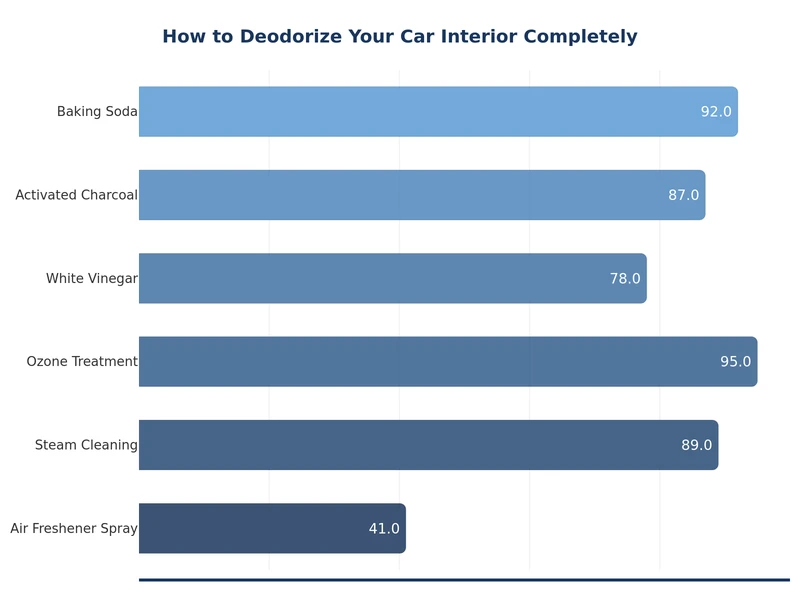
Once the surface is clean, you need to neutralize residual odor molecules rather than covering them up. The products below are proven to work through chemistry, not fragrance.
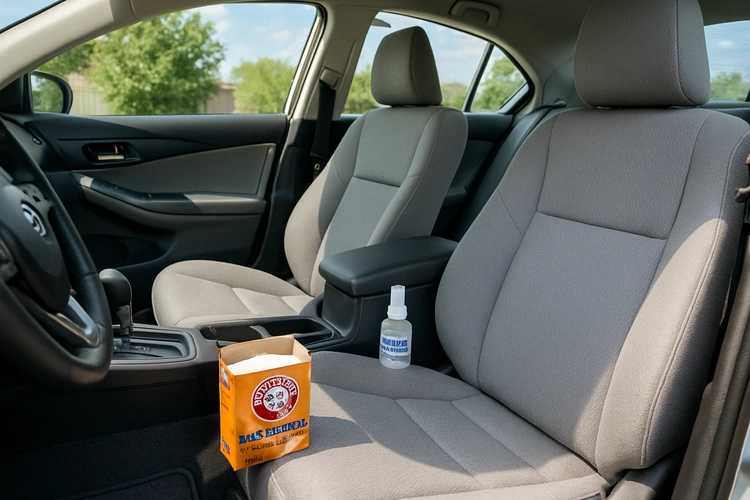
Baking soda (sodium bicarbonate) is a mild base that neutralizes acidic odor compounds. Sprinkle a generous layer over carpet and fabric seats, let it sit for several hours or overnight, then vacuum it up completely. Repeat if needed. Activated charcoal bags are ideal for ongoing absorption — place two or three under the seats and in the trunk. They last several months and can be recharged by setting them in sunlight for a few hours. According to the EPA's indoor air quality guidance, source removal combined with absorbent materials is the most effective strategy for persistent odors.
Enzymatic cleaners contain biological enzymes that break down organic odor sources — urine, vomit, pet waste, blood, and food — at the molecular level. Apply to the affected area, allow the dwell time specified on the label (usually 10–15 minutes), then blot clean. Do not rinse immediately; the enzymes need time to work. These are the only products that truly eliminate biological odors rather than temporarily suppressing them. Brands like Rocco & Roxie, Nature's Miracle, and Biokleen are widely available and effective.
If the smell returns every time you run the air conditioning, the problem is inside the HVAC system itself. The evaporator coil sits behind the dashboard and stays moist during operation — a perfect environment for mold and bacteria. There are two approaches:
Vent spray method: With the AC running on recirculation mode and fan on high, spray an antimicrobial HVAC treatment (such as Lysol or a dedicated product like Chemical Guys Odor Eliminator) directly into the fresh air intake, usually located at the base of the windshield under the hood. Let the system run for 10 minutes to distribute the treatment through the ducts.
Cabin air filter replacement: A clogged, moldy cabin air filter is often the primary culprit. Replacing it takes about 10 minutes for most vehicles and makes an immediate difference. Check your owner's manual for location — it's typically behind the glove box or under the dashboard. For a detailed walkthrough of cleaning the vent outlets themselves, see our guide on how to clean car AC vents and remove musty smell.
Not every product suits every odor type. Use the table below to match your problem to the correct solution before spending money on the wrong thing.
| Odor Type | Best Product Type | Application Method | Expected Result |
|---|---|---|---|
| Pet smell | Enzymatic cleaner | Spray, dwell, blot | Permanent elimination |
| Cigarette smoke | Ozone treatment + surface wipe | Professional or rental unit | Near-complete removal |
| Mildew / mustiness | Antimicrobial spray + charcoal bags | Spray surfaces, place bags | Elimination + ongoing control |
| Food / general stale | Baking soda + all-purpose cleaner | Sprinkle, vacuum, wipe | Full removal |
| Fuel / chemical | Activated charcoal + ventilation | Place bags, air out 24–48 hrs | Gradual absorption |
| AC mustiness | HVAC antimicrobial + filter change | Vent spray + filter swap | Immediate improvement |
For ongoing freshness after deodorizing, check out our roundup of the best air fresheners — covering vent clips, under-seat canisters, and natural options that won't overwhelm with fragrance.
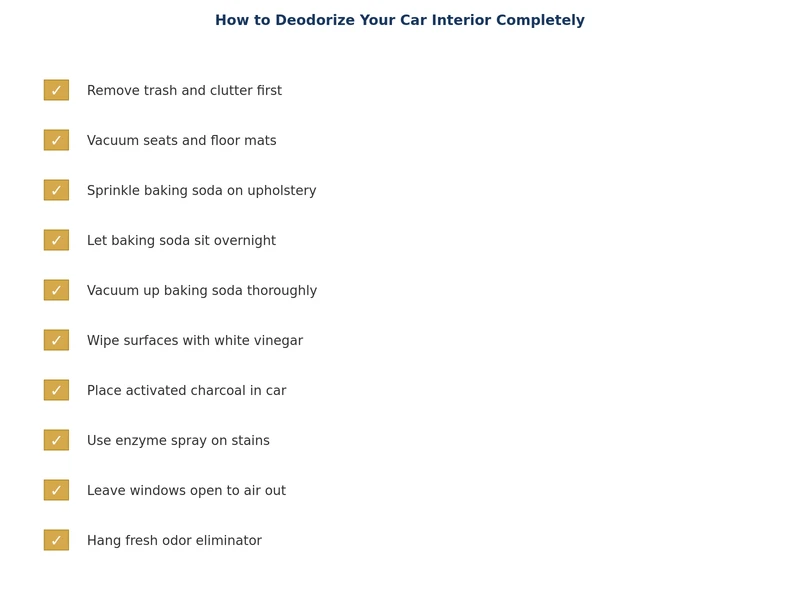
Eliminating an odor is satisfying. Keeping it gone takes a few simple habits:
Staying consistent with these habits means you'll rarely need a full deodorizing session again. Think of it as the same philosophy that keeps exterior paint from deteriorating — regular, light maintenance beats intensive correction every time.
For mild odors, a single deep clean with baking soda or enzymatic cleaner takes 2–4 hours including drying time. Heavy smoke or pet odors may require multiple treatments over 2–3 days. Ozone treatments for severe smoke take 4–6 hours and require the car to air out afterward.
Yes, baking soda effectively neutralizes acidic odor compounds found in food, sweat, and mild pet smells. It works best on dry fabric — sprinkle generously, leave overnight, then vacuum thoroughly. It won't eliminate biological odors like urine or vomit on its own; use an enzymatic cleaner for those.
You need to physically remove the mold first using an antimicrobial cleaner, then treat the affected area and the AC system. Replace the cabin air filter and use an HVAC spray to kill mold in the ducts. Activated charcoal bags help absorb remaining musty odor over the following days.
Ozone generators are highly effective for severe odors like cigarette smoke, but require caution. Run the unit in the empty, closed vehicle for 30–60 minutes, then air the car out for at least 2 hours before anyone enters. High ozone concentrations are harmful to breathe and can damage rubber seals with prolonged exposure.
The odor source is likely still present. Check underneath the seats and carpet padding, inside the AC system, and in the trunk. Odor molecules can soak into padding and foam beneath the visible surface. An enzymatic cleaner applied with adequate dwell time will reach deeper than surface wipes.
Cigarette smoke requires a multi-step approach: wipe all hard surfaces with a vinegar-water solution or dedicated smoke odor remover, clean all fabric and carpet with an odor-eliminating upholstery cleaner, replace the cabin air filter, and follow up with an ozone treatment for complete removal. A single method rarely eliminates smoke smell entirely.
 |
 |
 |
 |

About Joshua Thomas
Joshua Thomas just simply loves cars and willing to work on them whenever there's chance... sometimes for free.
He started CarCareTotal back in 2017 from the advices of total strangers who witnessed his amazing skills in car repairs here and there.
His goal with this creation is to help car owners better learn how to maintain and repair their cars; as such, the site would cover alot of areas: troubleshooting, product recommendations, tips & tricks.
Joshua received Bachelor of Science in Mechanical Engineering at San Diego State University.


Get some FREE car parts & gear.. Or check out the latest free automotive manuals and build guides here.
Disable your ad blocker to unlock all the hidden deals. Hit the button below 🚗
| | | |
